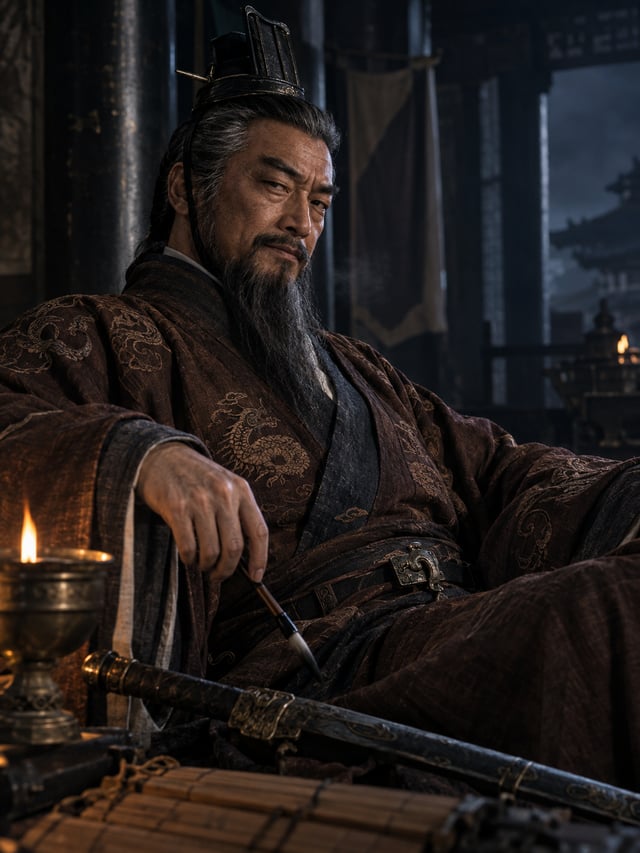
The life of Cao Cao
「They call you a treacherous hero. At those turning points, in his place, what would you choose?」
Cao Cao, late Han powerbroker and Wei founder, was famed for facing Yuan Shao before Guandu; Romance depicts him as cunning and ruthless.
Cao Cao's profile →One scene per chapter, and you are him. Underlined lines come from the books (green: Records of the Three Kingdoms, gold: the Romance); tap one to see the source. Lines without an underline connect the scenes or imagine them. At each fork you choose first, then see what he did.
Better I Wrong Others
In your youth, you delight in falconry and hunting dogs, roaming without restraint, and the world thinks little of you. You go to ask Xu Shao: “What sort of man am I?” He does not answer. You press him again and again before he says: “In peaceful times, you would be an able minister; in troubled times, a treacherous hero.” You laugh aloud.
Back then, all you wanted was to win merit and be enfeoffed as a marquis, become General Who Attacks the West, and have a line inscribed on your tomb passage after your death: “Tomb of the Marquis Cao, late General Who Attacks the West of the Han”.
Emperor Ling dies. Grand General He Jin summons Dong Zhuo to the capital, intending to use him to coerce the Empress Dowager. You hear this and can only laugh: “If you mean to punish them, then execute the chief culprit. One prison officer is enough. Why summon generals from outside in such confusion?” Before Dong Zhuo arrives, He Jin has already been killed. Dong Zhuo arrives, deposes the Young Emperor and makes him Prince of Hongnong, then enthrones Emperor Xian. The capital falls into chaos.
He recommends you as Cavalry Commandant and wants to confer with you. You can see that this man is bound to meet his downfall, and refuse the appointment, changing your name and taking a back road east.
At Zhongmou, the soldiers guarding the pass seize you and take you before the county magistrate. At midnight, the magistrate summons you to the rear courtyard and asks why, when the Chancellor has treated you well, you bring disaster upon yourself. You say: “How can sparrows know the aspirations of a swan?” You add that you mean to return to your home region, issue a forged imperial edict, and summon the lords throughout the realm to raise troops and join in killing Dong Zhuo.
He personally unties you, abandons his office, and flees with you. His name is Chen Gong, courtesy name Gongtai.
After three days on the road, you reach Chenggao as evening falls. You point your riding crop into the depths of the woods: here lives Lü Boshe, your father’s sworn brother; you will ask to stay the night with him.
When the old man sees you, his first words are: “I hear that the court has sent notices everywhere, urgently seeking your capture. Your father has already taken refuge in Chenliu.” He thanks Chen Gong, then goes inside. A long while passes before he comes out and says there is no good wine in the house; he will go to the western village to buy a jug. He hurriedly mounts his donkey and rides away.
You sit for a long time. Night has fully fallen. You have defied Dong Zhuo’s orders, and on this road everyone looks as if they have come to seize you.
Suddenly, from behind the manor comes the sound of a knife being sharpened. You whisper: “Lü Boshe is no close kinsman of mine. His departure is suspicious; we should listen in secret.” You creep on tiptoe to the rear of the thatched hall and hear someone say: “Shall we bind and kill? How about it?”
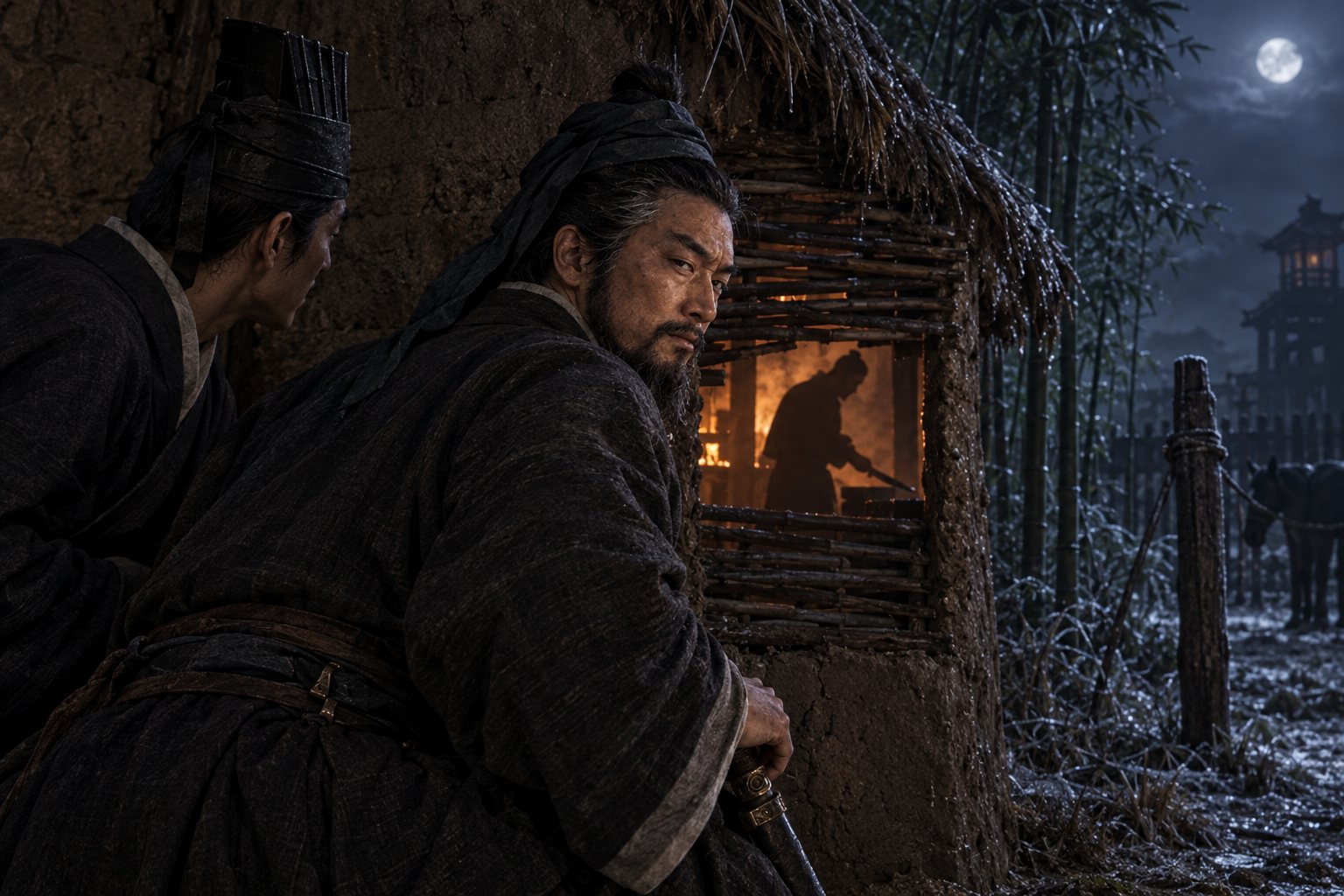
The sound of sharpening stops. Chen Gong is watching you. What do you do?
You and Chen Gong draw your swords and rush straight in, killing eight people, women and men alike.
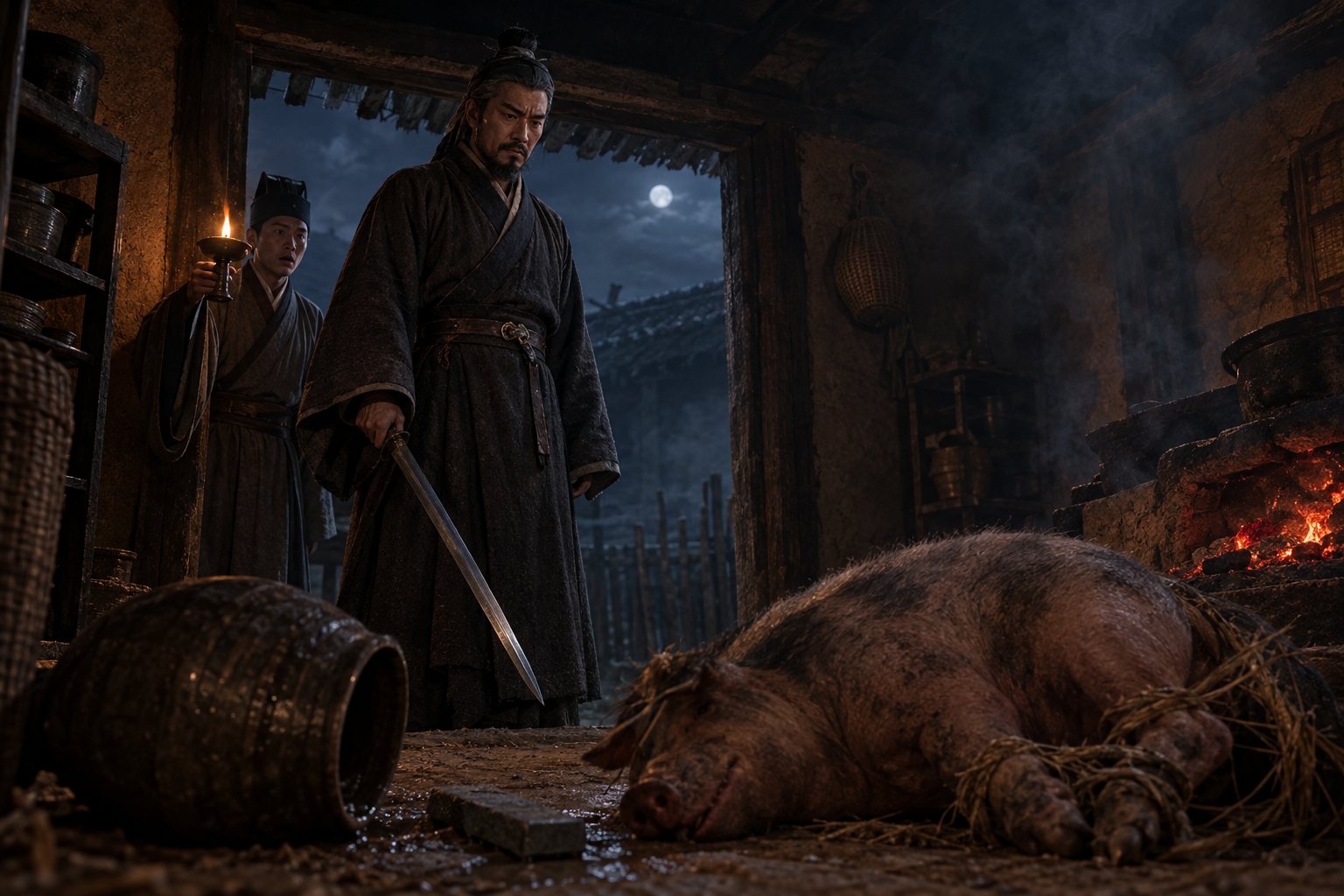
Searching the kitchen, you find a pig bound and ready for slaughter.
Chen Gong says: “Mengde is so suspicious that he has mistakenly killed good people!”
You leave the manor, mount your horses, and ride off. Before you have gone two li, Lü Boshe returns, two jugs of wine hanging from the front of his donkey’s saddle and fruit and vegetables in his hand. He says: “I have already told my family to slaughter a pig to welcome you. Nephew, my lord, why begrudge us one night? Please turn back at once.”
You ignore him and ride on. After a few steps, you suddenly draw your sword, turn back, and call to him, “Who is that coming?” He turns to look, and you cut him down from his donkey with one stroke.
Chen Gong is appalled: “That just now was a mistake. What is this?” You say: “When Boshe gets home and finds so many dead, how could he let it rest? If he leads his men after us, we will surely come to grief!” He says: “To kill a man knowing he is innocent is a great injustice!”
You say: “I would rather wrong the world than let the world wrong me.”
Chen Gong falls silent. That night at the inn, you fall asleep first. Moonlight spills in. Chen Gong thinks of drawing his sword to kill you. But then he thinks again: to kill you would be unjust, so he sheathes his sword, mounts his horse, and leaves for Dong Commandery before dawn. When daylight comes, you wake to find no one beside you.
Through the Flames
You reach Chenliu, distribute your family’s wealth, and gather a righteous army, and in winter, in the twelfth month, you raise your army at Jiwu. In a battle at the Bian River, you are struck by a stray arrow and your horse is wounded. Your younger cousin Cao Hong gives you his horse, and only then do you escape under cover of night.
Liu Dai, Inspector of Yanzhou, ignores advice and fights the Yellow Turbans of Qing Province. He is killed. The Records of the Three Kingdoms has no account of that night at Chenggao: Chen Gong only began following Taizu when the realm fell into chaos. After Liu Dai’s death, he goes to speak for you to the people of the province: “Cao of Dong Commandery is a talent destined for this age. If we welcome him to govern the province, he will surely bring peace to the people.” Bao Xin and the others come to Dong Commandery to welcome you as Governor of Yanzhou. You accept the Yellow Turbans’ surrender, select their best troops, and call them the Qing Province Army.
Your father Cao Song returns to Qiao after resigning his post; during Dong Zhuo’s coup, he flees to Langya for refuge, later living in Hua County, Taishan. You ask Ying Shao, Administrator of Taishan, to bring your family to Yanzhou.
The one who brings the news is a soldier under Ying Shao, fleeing for his life. Before Ying Shao’s troops arrive, Tao Qian has secretly sent several thousand cavalry to ambush and capture them. Your family thinks Ying Shao has come to escort them, and takes no precautions. Your younger brother Cao De is killed inside the gate. Your father breaks through the rear wall and sends his concubine out first; she is fat and cannot get through in time. He hides in the latrine. He and the concubine are killed, and your whole family dies.
When you hear, you fall to the ground weeping. Those around you help you up, and you grit your teeth and say: “Tao Qian let his troops kill my father. I will not live under the same sky as him! I now raise my entire army to lay waste to Xu Province, and only then will my hatred be avenged!”
Before you set out, you tell your family: “If I do not return, go and rely on Mengzhuo.” Mengzhuo is Zhang Miao. You and Yuan Shao are both his friends; when Yuan Shao asks you to kill him, you refuse. In autumn, you campaign against Tao Qian and take more than ten cities in succession. In a great battle at Pengcheng, Tao Qian’s army is defeated; tens of thousands die, and the Si River stops flowing. You return and meet Zhang Miao. The two of you face each other in tears.
The following summer, you leave Xun Yu and Cheng Yu to defend Juancheng, then campaign against Tao Qian again, taking five cities and fighting all the way to Donghai. Everywhere you pass, many are slaughtered.
After you leave, Zhang Miao’s younger brother Zhang Chao and your subordinate Chen Gong, among others, secretly plot to rebel against you. Chen Gong says to Zhang Miao: “Now the provincial army is campaigning east, and the region is empty. Lü Bu is a stalwart warrior, unmatched in battle. If we invite him for the time being and jointly govern Yanzhou, we can observe the situation under Heaven and wait for events to change. This, too, is a chance to make our mark in the world.” Zhang Miao listens to him.
You had originally ordered Chen Gong to stay behind with troops in Dong Commandery. He takes those troops and goes east to welcome Lü Bu as Governor of Yanzhou, occupying Puyang. The commanderies and counties all respond; only Juancheng, Dong'e, and Fan remain to hold out for you. You lead your army back.
You launch a night attack on Lü Bu’s separate camp west of Puyang and take it by dawn. Before you can withdraw, Lü Bu’s reinforcements arrive. You call for volunteers to break the enemy line; a man named Dian Wei is the first to step forward. Arrows rain down, but he does not even look; he only says to the men beside him: “When the enemy comes within ten paces, tell me.” Holding a dozen or more halberds, he cries out and charges; everyone he reaches falls at his hand.
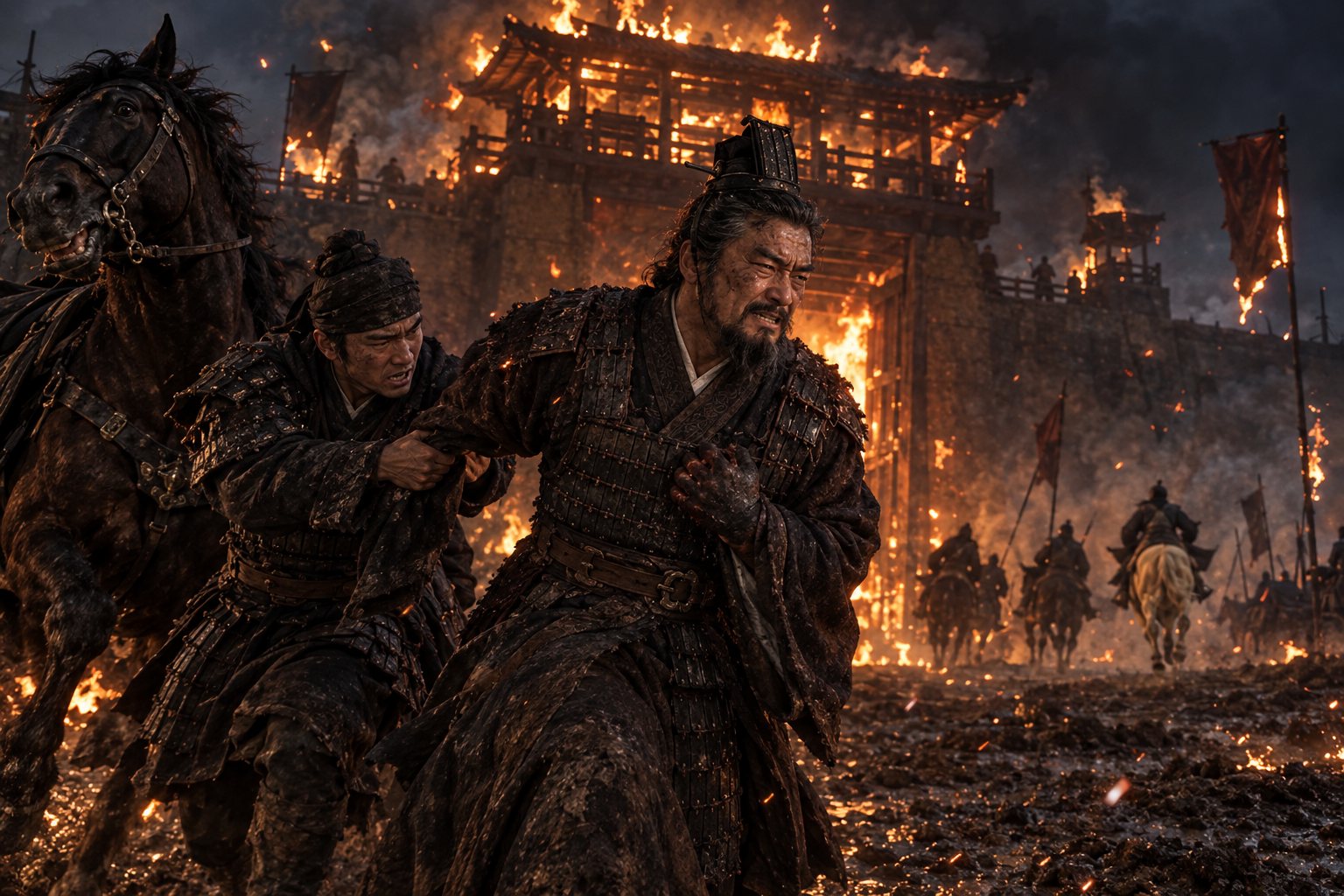
The Tian clan, a great family of Puyang, act as your inside men, and you enter the city. You burn the East Gate, declaring that you will retreat no farther. As soon as battle is joined, you are defeated.
Flames curl out through the gate opening. Lü Bu’s cavalry seize you, but do not recognize you, and ask, “Where is Cao Cao?” You say, “The one riding away on the yellow horse is he.” They let you go and pursue the man on the yellow horse. The fire on the gate is still fierce; you charge through the flames, fall from your horse, and burn the palm of your left hand. Major Lou Yi helps you onto a horse.
Back at camp, the officers have not yet seen you, and are terrified. You force yourself to comfort the soldiers and order the army to hastily build siege engines. You and Lü Bu face each other for more than a hundred days. Locusts rise, the people are starving, and both sides withdraw.
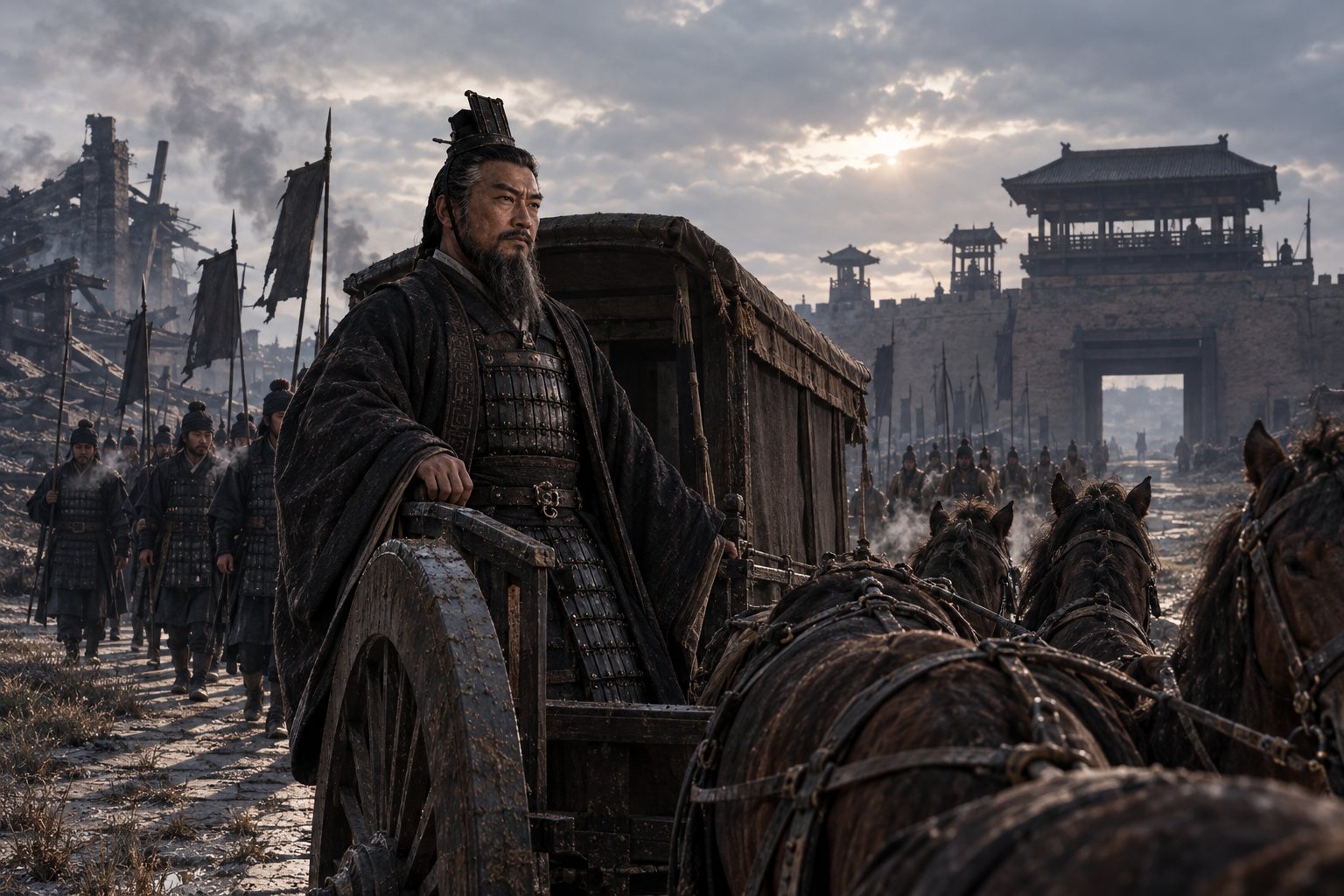
Upholding the Son of Heaven
The next year, Lü Bu and Chen Gong come to fight with more than ten thousand men. Your forces are few, so you lay an ambush, send out a surprise force, and defeat them utterly. Lü Bu flees through the night, heading east to join Liu Bei. In the twelfth month, Yongqiu falls, and Zhang Chao kills himself; you exterminate the three branches of Zhang Miao’s family. Zhang Miao goes to Yuan Shu for help, but his own subordinates kill him, and Yanzhou is pacified.
You want to welcome the Son of Heaven, but your generals have doubts. Some say the lands east of the mountains are not yet pacified; Han Xian and Yang Feng have only just brought the Son of Heaven to Luoyang, and are linked northward with Zhang Yang. They cannot be brought under control at once.
Xun Yu says: “In the past, Duke Wen of Jin received King Xiang of Zhou, and the feudal lords followed him like shadows. When Emperor Gaozu campaigned east for the Righteous Emperor, dressed in mourning, the realm gave him its allegiance.” He adds: “To seize this moment, uphold the sovereign and answer the people’s hopes: this is great accord. To uphold the utmost fairness and win over the powerful: this is great strategy. To support the highest righteousness and draw in the finest men: this is great virtue.” Cheng Yu also urges you.
You first send Cao Hong west with troops to welcome the emperor, but Dong Cheng and Yuan Shu’s officers hold the passes against him. Cao Hong cannot get through.
In autumn, in the seventh month, Yang Feng and Han Xian escort the Son of Heaven back to Luoyang. You too arrive in Luoyang to guard the capital; Han Xian flees. The emperor grants you the insignia of authority and the axe, and appoints you to oversee the affairs of the Secretariat.
In your youth, you served here as Commandant of the Northern District of Luoyang. Luoyang is now in ruins; the palaces are rubble, and wild grass grows up the steps. When the Son of Heaven first arrives, he lives in the residence of Zhao Zhong, the former Regular Palace Attendant, in the city’s west. When you were young, it was a name everyone in Luoyang knew.
You pay your respects to the emperor, draw Dong Zhao to sit beside you, and ask him: “Now that I have come here, what plan should I pursue?”
He says: “General, you raise a righteous army to punish violence and disorder, enter court to attend the Son of Heaven, and support the royal house; this is the achievement of the Five Hegemons. The generals here each have different intentions and opinions, and may not necessarily obey. To stay here and assist the court is not expedient; the only course is to move the emperor to Xu.”
He adds: “The court has been driven from place to place and has only just returned to the old capital. People near and far look on, hoping for peace at last. If the emperor moves again now, the people’s hearts will not be won. Yet extraordinary deeds bring extraordinary achievements. I ask you to weigh the greater good.”
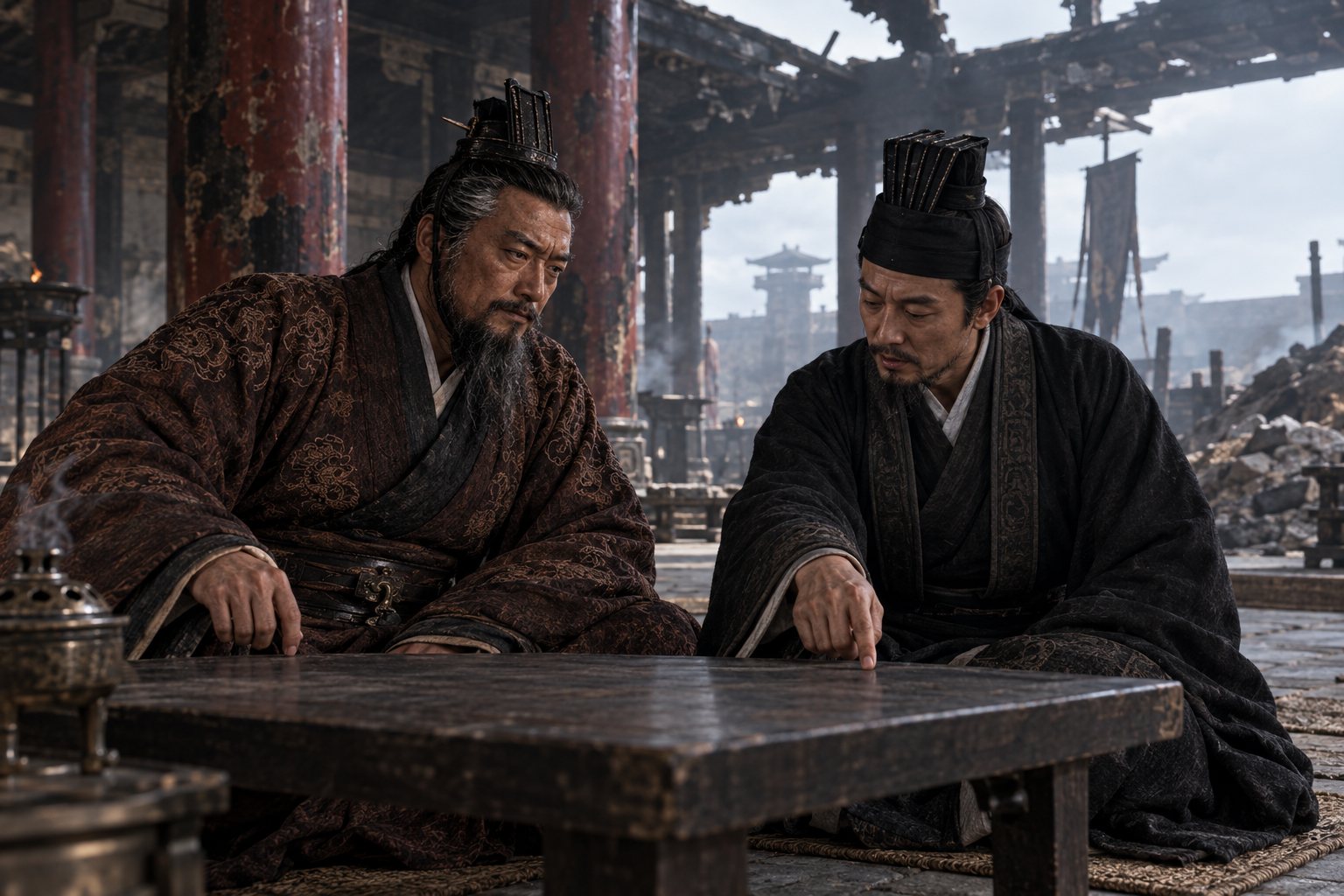
The Son of Heaven is here among these ruins. What do you do?
You ask again: “Yang Feng is nearby at Liang. I hear his troops are strong. Could he become a burden to me?” Dong Zhao says you should promptly send an envoy with a generous gift in reply, to set his mind at ease, and say only that the capital has no grain, and you wish to take the imperial carriage temporarily to Luyang, which is near Xu and easier to supply. “Feng is brave by nature but not much given to forethought; he will surely not suspect you.”
You say, “Good,” and at once send a man to meet Yang Feng.
In the ninth month, the imperial carriage passes through Huanyuan and turns east. You ride beside it. The emperor appoints you Grand General and enfeoffs you as Marquis of Wuping. Since the emperor moved west, the court has been in daily disorder. Only now are the rites of the ancestral temples and the institutions of the state put in place.
The Grand Astrologer Wang Li once said to the emperor: “Earth succeeds Fire; Wei succeeds Han. The Cao clan can bring peace to the realm.” You hear of it and send someone to tell him: “I know you are loyal to the court, but the Way of Heaven is profound and distant. I hope you will say no more.”
That year, you recruit people to farm at Xu and harvest a million hu of grain. Yuan Shao regrets his decision and wants you to move the emperor to Juancheng, closer to him. You refuse.
Jueying
Zhang Ji comes from Guanzhong to Nanyang and dies; his nephew Zhang Xiu takes command of his troops, garrisons Wan and allies himself with Liu Biao.
In the first month, you arrive at Wan. You campaign south and encamp by the Yu River; Zhang Xiu leads his men in surrender. You are delighted and invite Zhang Xiu and his commanders to drink.
You rise to pour the wine, while Dian Wei stands behind you holding a great axe with a blade a foot wide; whoever you approach, he raises the axe and stares at them. The banquet ends, and not one of Zhang Xiu’s commanders dares raise his head.
After Puyang, he keeps several hundred personal guards circling your great tent, standing by your side all day and sleeping beside your tent at night.
Zhang Xiu has a trusted follower named Hu Che'er, the bravest in his army. You admire his strength and courage and reward him with gold from your own hand.
You stay for several days, and Zhang Xiu hosts a banquet for you each day. One day you get drunk and return to your quarters, then privately ask those around you: “Are there any women in this city?”
Your nephew Cao Anmin sees what you have in mind and whispers: “Last night I caught sight of a woman beside the guest quarters, a great beauty. I asked about her: she is the wife of Zhang Ji, Zhang Xiu’s uncle.”
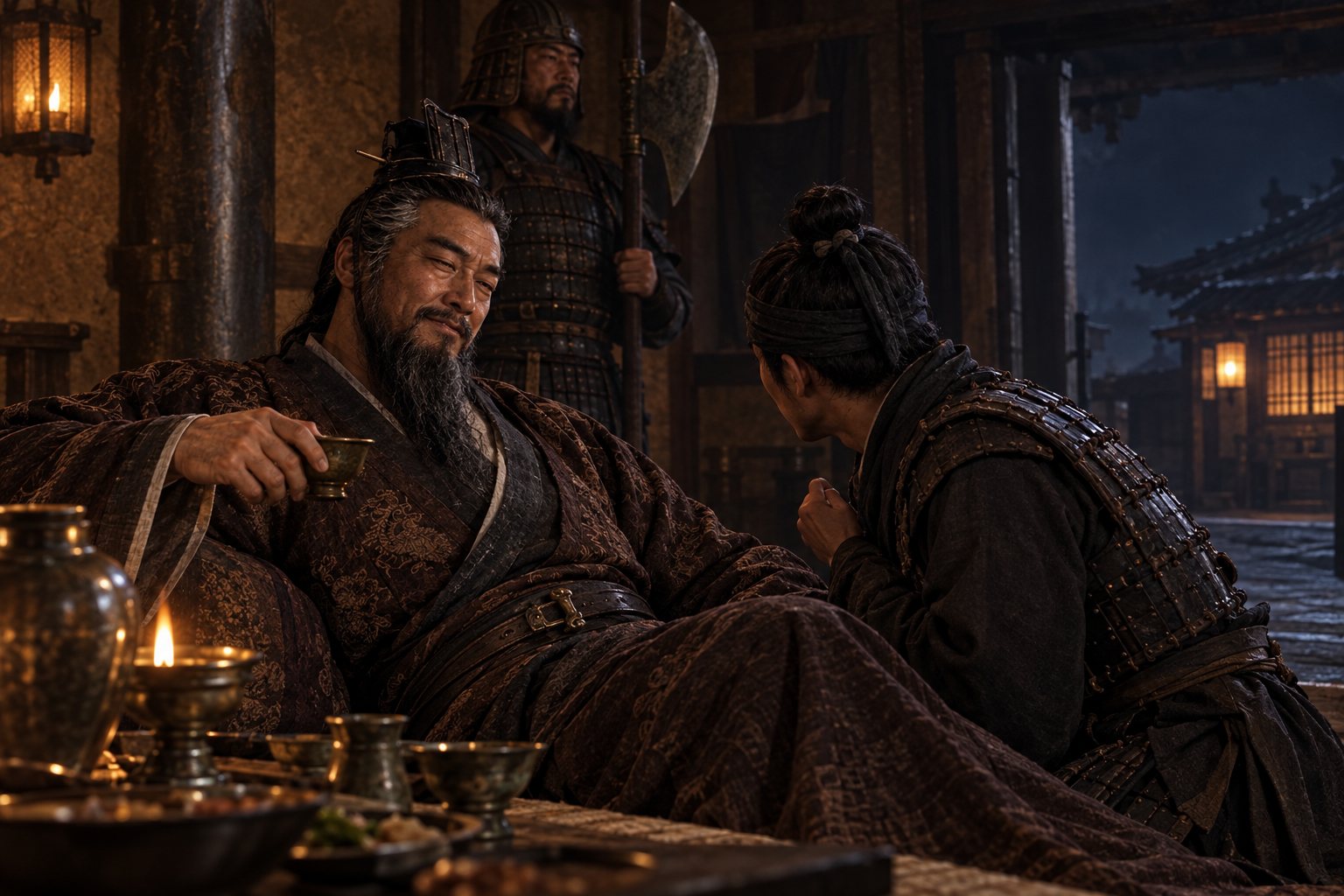
Zhang Ji has been dead only a short while, and Zhang Xiu’s troops are in the city. What do you do?
You take Zhang Ji’s wife. Zhang Xiu hates you; in the Romance, he says: “Cao, you rogue, you have humiliated me beyond all measure!” You hear that he is displeased and secretly plot to kill him. The plot is exposed.
Zhang Xiu asks to move his troops, saying their route must pass through your camp, and adds: “The carts are few but heavily loaded; I beg leave for my soldiers to wear their armor.” You believe him and agree to everything. He then arms his troops and storms your camp. You fare badly in battle and retreat with light cavalry.
Dian Wei holds the camp gate, keeping the enemy out. Only a dozen or so of his men remain, and every one fights to the death. He swings his long halberd from side to side; one thrust snaps more than a dozen spears. Though wounded dozens of times, he seizes two men and kills them. At last his wounds burst open; glaring and cursing, he dies. Only after a long while do the enemy dare approach.
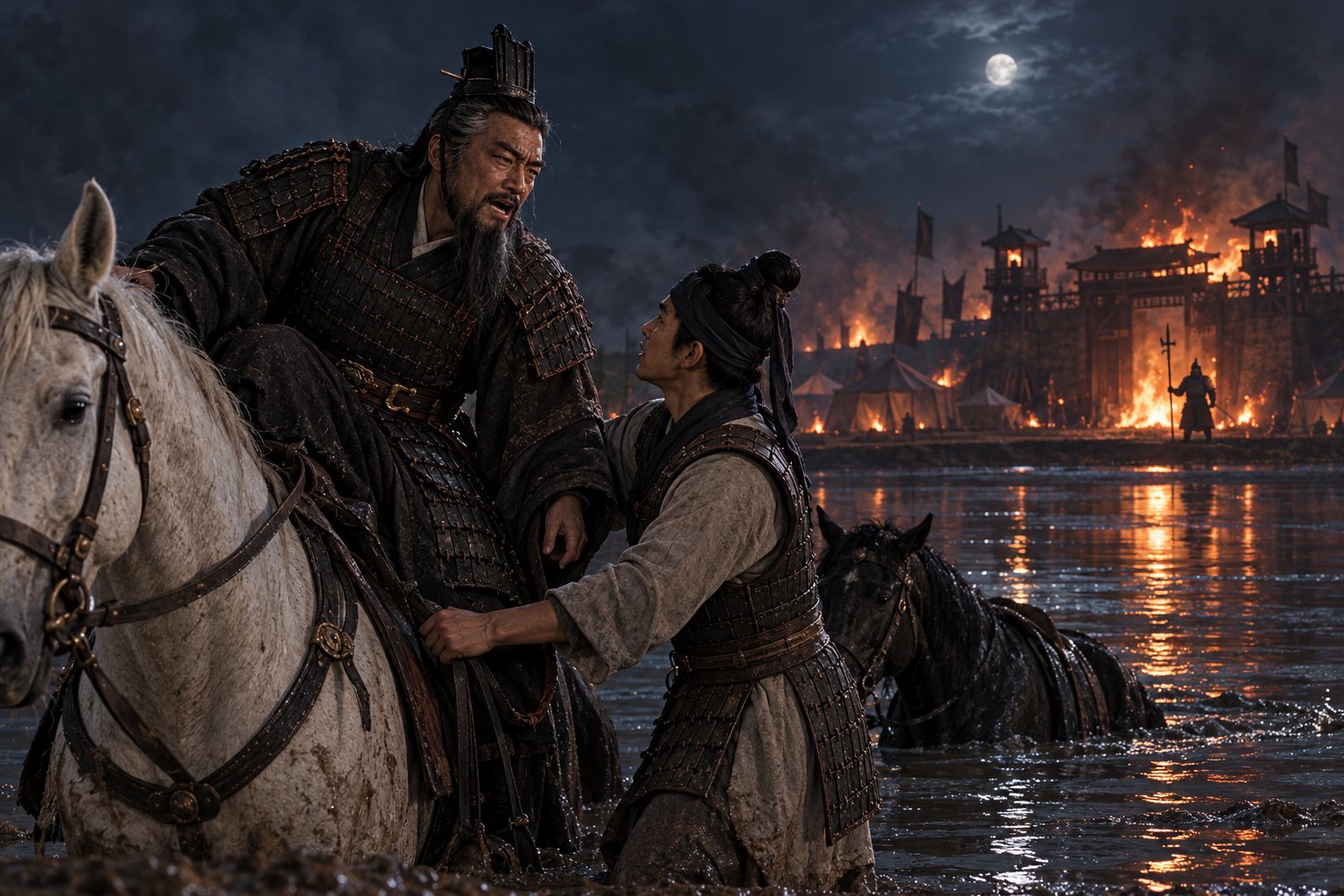
The horse you ride is named Jueying. A stray arrow strikes it, wounding its cheek and leg; your right arm is hit by an arrow too. Your eldest son Cao Ang gives you his horse, saving you, while he dies. Cao Anmin dies as well.
You retreat to Wuyin. Hearing that Dian Wei is dead, you weep. You recruit men to steal back and retrieve his body, and mourn him yourself. In the Romance, you tell the generals: “I feel no deep grief for the loss of my eldest son and beloved nephew; I weep for Dian Wei alone.”
You say to the generals again: “I accepted Zhang Xiu’s surrender and failed to take hostages at once; this is what brought us to this pass. I know why we were defeated. My lords, watch: from this day on, I will never be defeated again.”
Zixiu is Cao Ang’s courtesy name. His birth mother, Lady Liu, dies young, and Lady Ding raises him. She often says, “You got my son killed, and you never even think of him!” and weeps without restraint. You grow angry and send her back to her family.
Later, you go to see her. She is weaving; when someone outside calls, “The lord has arrived,” she remains seated at her loom. You walk over and stroke her back: “Will you come back with me in the same carriage?” She does not turn around or answer. You step outside, then say: “Is there still a chance?” She still does not answer. You say: “It is truly over.”
Binding the Tiger
After Puyang, Chen Gong remains at Lü Bu’s side, giving Lü Bu plans, which Lü Bu often does not follow.
In the third year of Jian'an, Lü Bu again sends Gao Shun to attack Liu Bei on Yuan Shu’s behalf. You send Xiahou Dun to his aid, but he cannot save him. In the ninth month, you march east in person.
You advance to Xiapi, where Lü Bu personally leads cavalry to meet you and you rout him utterly. You pursue him to the city walls and write to him, setting out the consequences, for good and ill. Beneath the walls, you see him climb the White Gate Tower and call to your soldiers: “You men need not press me; I will give myself up to the Illustrious Lord.” Then comes Chen Gong’s voice: “Cao Cao is a rebel. What ‘Illustrious Lord’!”
He does not surrender. Chen Gong and the others urge him to seek help from Yuan Shu and to ride out and fight; he is defeated again, retreats into the city, and holds it fast, while you cannot take it. You fight for many days. Your soldiers are exhausted, and you want to withdraw. Following Xun You and Guo Jia’s plan, you divert the Si and Yi rivers to flood the city. The winter water runs yellow up to the foot of the walls, rising higher each day.
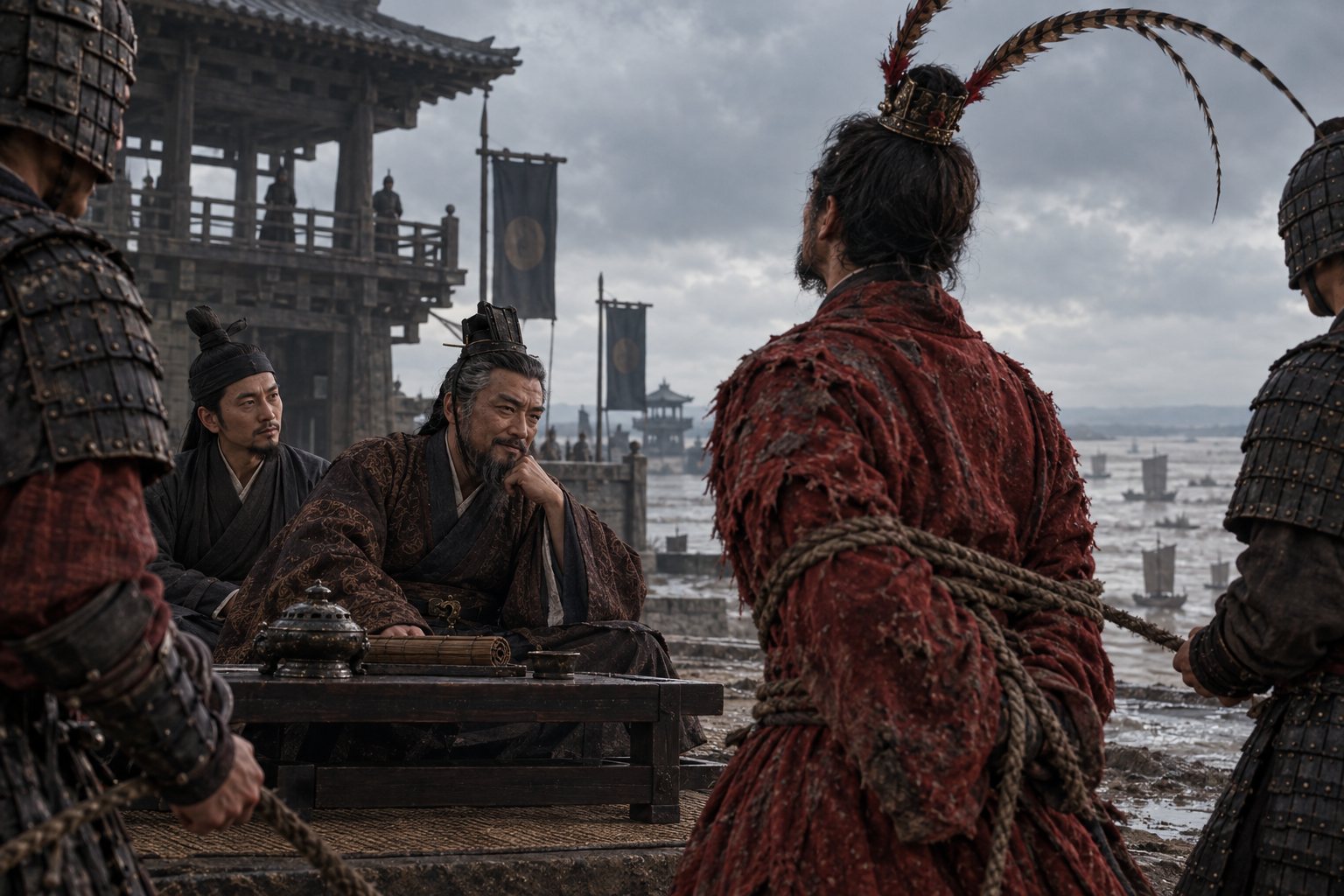
You dig trenches around the city and divert water into it. More than a month later, Lü Bu’s officers Hou Cheng, Song Xian, and Wei Xu bind Chen Gong and lead their troops out to surrender. Lü Bu climbs the White Gate Tower with his attendants; as the siege tightens, he finally comes down and surrenders.
You sit atop the White Gate Tower, with Liu Bei beside you. They bring Lü Bu up, bound. He says, “The bonds are too tight. Loosen them a little.” You say, “One must bind a tiger tightly.” He looks up at you: “Why have you grown so thin, my lord?” You ask, “How do you know me?” He says, “Long ago in Luoyang, we met in the garden of the Wen family.” You say, “Yes. I had forgotten. I am thin because I regret that we did not meet sooner.”
He says, “The only one you feared, my lord, was me. Now I have submitted, and the realm is nothing to worry about. If you command the infantry and let me command the cavalry, the realm will easily be brought to order.”
Chen Gong is brought up, bound, as well. You ask him, “Gongtai, you have always claimed to be rich in wisdom and stratagems. How has it come to this?” He turns and points at Lü Bu: “It is only because this man would not heed my words that things have come to this. Had he listened, he might not have been captured.” You ask what will become of his aged mother. He says, “I have heard that those who rule the realm through filial piety do not harm another man’s parents. Whether my aged mother lives or dies rests with you, my lord.” You ask about his wife. “Whether my wife and children live or die also rests with you, my lord.” You say nothing more.
He says, “Allow me to go out and be executed, to uphold military law.” He walks out on his own; no one can stop him. You see him off in tears, and he does not look back. Ten years ago, on that road at Chenggao, he was just as silent.
You return to the tower. Lü Bu is still there. The ropes bite tight; he turns to Liu Bei: “Xuande, you are a guest here, while I am a captive. Can you not say a word to make this easier for me?” You laugh: “Why not speak to me, instead of pleading with Lord Liu?” You mean to spare his life and tell them to loosen the ropes. Your Registrar, Wang Bi, steps forward briskly: “Lü Bu is a formidable captive. His men are close by outside; we must not loosen his bonds.” You spread your hands: “I meant to ease them, but the Registrar will not allow it. What can I do?” The ropes stay tight.
The finest cavalry general in the realm stands before you. Doubt shows on your face. Liu Bei speaks: “My lord, have you not seen how Lü Bu served Ding Jianyang and Grand Preceptor Dong?”
Ding Yuan. Dong Zhuo. Both once entrusted their lives to him.
You nod. Lü Bu points at Liu Bei: “That fellow is the least trustworthy of all.” And so Lü Bu is strangled to death.
After Chen Gong’s death, you provide for his aged mother until she dies of old age, and marry off his daughter.
The people below the tower → Read Lü Bu's story →
Only You and I
Three years ago, Lü Bu attacked Liu Bei, seized Xiapi, and Liu Bei came to seek refuge with you. Cheng Yu urges you: “Liu Bei has great talent and wins the hearts of many. He will never remain beneath another. Better to move against him early.” You say: “Now is the time to gather heroes. To kill one man and lose the hearts of all under Heaven is unthinkable.”
After the White Gate Tower, he returns to Xu with you. You recommend him for the post of General of the Left, and treat him with ever greater warmth: you share a carriage when you go out and sit together at table.
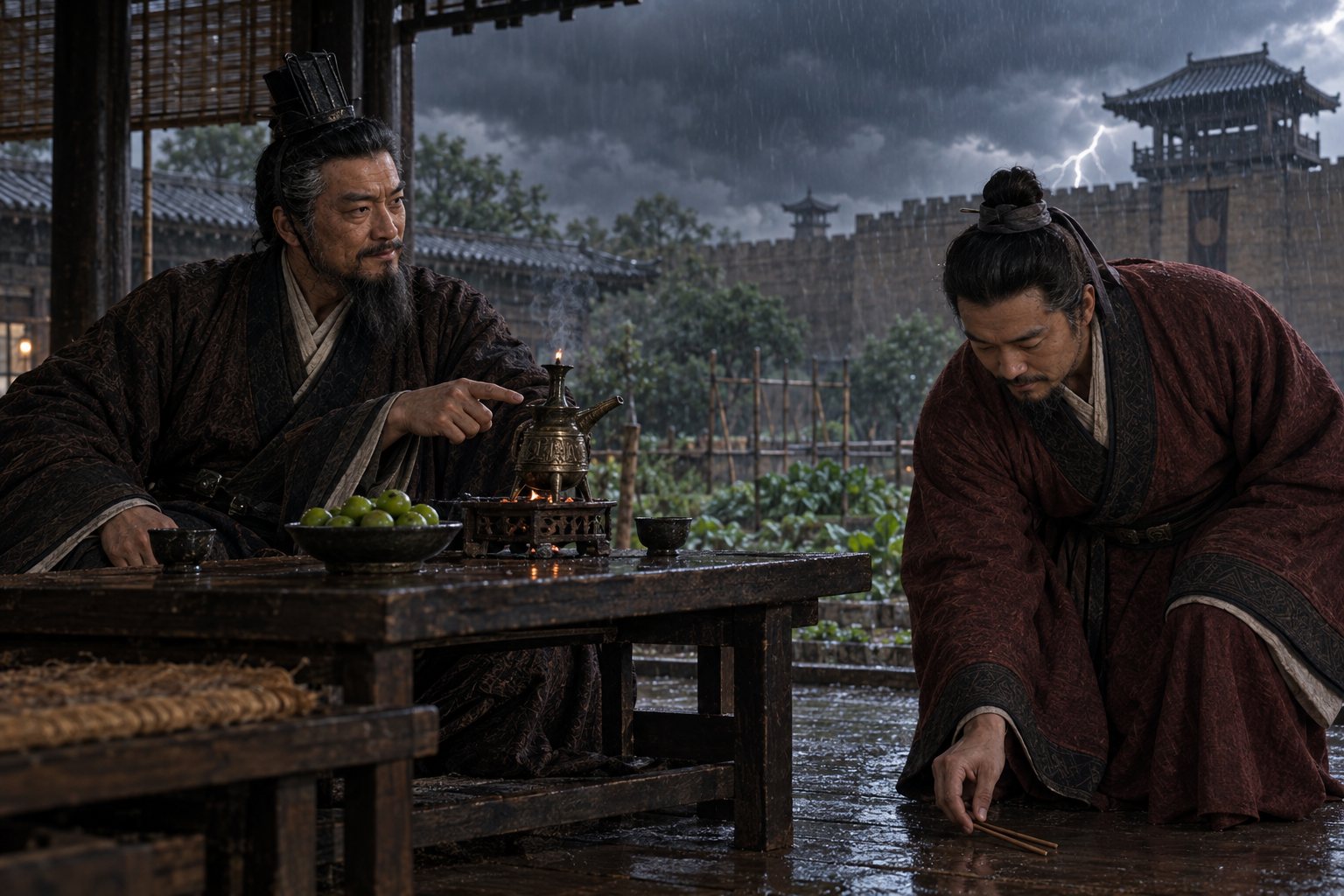
He grows vegetables in the garden behind his residence, watering them himself. One day, Xu Chu and Zhang Liao lead dozens of men into the garden and summon him at once. He has no choice but to follow them to your residence.
You laugh and say: “What great things you do at home!” He is so frightened that his face turns ashen. You take his hand and lead him all the way to the rear garden: “Xuande, it is not easy to tend a garden.”
The plums on the branches are green. You remember last year, on the campaign against Zhang Xiu, there was no water along the road, and the soldiers were all thirsty. You point your whip toward the distance, though there is nothing there: “There’s a plum grove up ahead.” At the sound of this, the soldiers’ mouths fill with saliva. Green plums sit on a plate, a jug of warmed wine beside them, and the two of you sit facing each other.
You are both half drunk; dark clouds gather, and a sudden shower threatens. A man in your retinue points toward a dragon-shaped waterspout in the far sky. You say a dragon can grow large or small, rise or hide, and may be compared with the heroes of the age, then ask him to name the heroes of the present age.
He names Yuan Shu. You laugh: “A dry bone in its grave. I’ll capture him sooner or later!” He names Yuan Shao. You say Yuan Shao is fierce in appearance but timid at heart, fond of plans but incapable of decision; he risks his life over small gains, yet clings to it when great deeds are at stake—not a hero. He goes on to name Liu Biao, Sun Ce, and Liu Zhang, then Zhang Xiu, Zhang Lu, and Han Sui. You clap your hands and laugh: “Such mediocre little men—why even mention them?”
He says: “Beyond these, I truly know no one.”
You look at him and say: “The heroes of the age are only you, my lord, and I. Men like Yuan Shao are not worth counting.”
He is eating when the knife and chopsticks fall from his hands. At that very moment, thunder cracks. He says: “The sage says, ‘When sudden thunder and fierce winds come, one must change one’s countenance.’ There is good reason for this. The might of a single peal can bring one to such a state!”
You laugh and say: “Can a grown man be afraid of thunder?” You no longer suspect him.
As soon as the rain stops, two men come charging into the rear garden with swords in hand; no one can hold them back. They are Guan Yu and Zhang Fei. You laugh and say: “This is no Feast at Hong Gate. Why would we need Xiang Zhuang and Xiang Bo?”
What you do not know is that the imperial in-law Dong Cheng says he has received a secret edict hidden in the Son of Heaven’s belt, ordering your death. After the thunder, he conspires with Dong Cheng and the others, but you happen to send him away, and he has no chance to act.
Yuan Shu is heading north from Xiapi, and you send Liu Bei and Zhu Ling to intercept him. Yuan Shu dies of illness. Cheng Yu and Guo Jia hear the news and come to tell you, “Liu Bei must not be allowed to go free.” You regret it and send men after him, but they cannot catch up. When he reaches Xiapi, he kills Che Zhou, the Inspector of Xu Province, and raises troops at Pei.
the man drinking across from you → Read Liu Bei's story →
Barefoot
Yuan Shao commands the lands of four provinces, with more than 100,000 men, and comes to attack Xu. The generals think he cannot be defeated. You say: “I know Yuan Shao’s character: he has great ambition but little wisdom; he looks fierce but is timid; he is envious and intolerant, and commands little authority. His troops are many, but his plans are unclear; his generals are arrogant, and his orders inconsistent. His territory is vast and his provisions plentiful, but it will only end up as my provisions.”
In winter, in the eleventh month, Zhang Xiu leads his men to surrender. Jia Xu is the one who persuades the man who killed your eldest son at Wancheng to come over: “It would be better to follow Lord Cao.” You meet Jia Xu, greatly pleased, and take his hand, saying: “You are the one who makes me trusted and respected throughout the realm.”
In spring, in the first month of the fifth year, the conspiracy of Dong Cheng and the others is exposed, and they are all killed. You mean to lead an eastern campaign against Liu Bei yourself. The generals say Yuan Shao is about to attack; if you abandon him and head east, he will strike you from behind. You say: “Liu Bei is a hero among men. If we do not attack him now, he will surely become a danger later.” You defeat him, and he flees to take refuge with Yuan Shao; Guan Yu surrenders to you.
At the Battle of Baima, Zhang Liao and Guan Yu lead the charge and behead Yan Liang. Then you withdraw to Guandu.
In the eighth month, Yuan Shao advances with his camps stretching dozens of li from east to west. He builds earthen mounds and digs tunnels, shooting arrows into your camp until they fall like rain; even those walking must hold shields over their heads.
Your provisions are running low. You write to Xun Yu to discuss withdrawing to Xu. He replies: “At your weakest, you face him at his strongest. If you cannot hold them back, they will seize their chance. This is the great turning point for all under Heaven.” You listen to him.
You tell the men hauling provisions: “Give me fifteen days, and I will defeat Yuan Shao for you. You will have no more toil.” Even as you say it, you have no idea where those fifteen days will come from.
You and Yuan Shao have faced each other for months. Though you have repeatedly fought and slain his generals, your troops are few, your provisions are gone, and your soldiers are exhausted.
One night in winter, in the tenth month, you are taking off your clothes to rest when someone reports: Xu You has deserted and come to your camp.
Xu You is one of Yuan Shao’s advisers, and also an old friend of yours. He is greedy, and Yuan Shao cannot satisfy him. You run out barefoot to greet him, clapping your hands and laughing: “You have come from afar, sir. My cause will succeed!”
Once you are seated, he asks: “Yuan Shao’s army is strong. How will you face it? How much grain do you have now?” You say: “Enough for a year.” He says: “No, that’s not it. Tell me again!” You say: “Enough for half a year.” He says: “Don’t you want to defeat Yuan Shao? Why aren’t you telling me the truth?”
You say: “I was only joking just now. In truth, we have enough for a month. What should we do?”
He says: “You are alone with your army, holding the line without help from outside, and your grain is gone. This is a moment of danger. Yuan Shao has more than ten thousand carts of supplies at Gushi and Wuchao, where his camp is poorly guarded. Take light troops and strike there. Arrive unexpectedly and burn his stores. In no more than three days, Yuan Shao will be defeated of himself.”
Those around you all doubt him. Xun You and Jia Xu urge you to go.
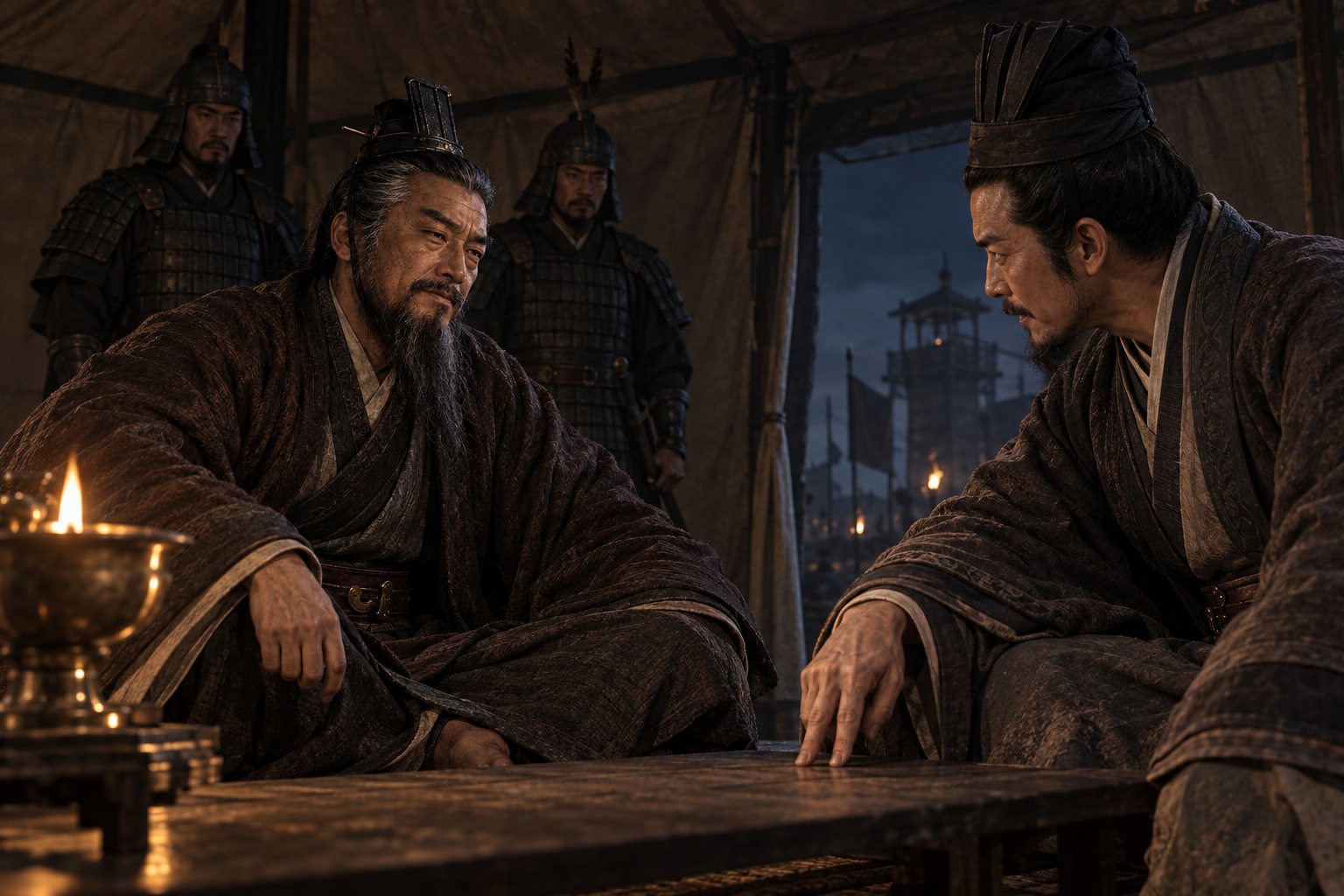
It is cold outside the tent. Xu You is waiting for your answer. What do you do?
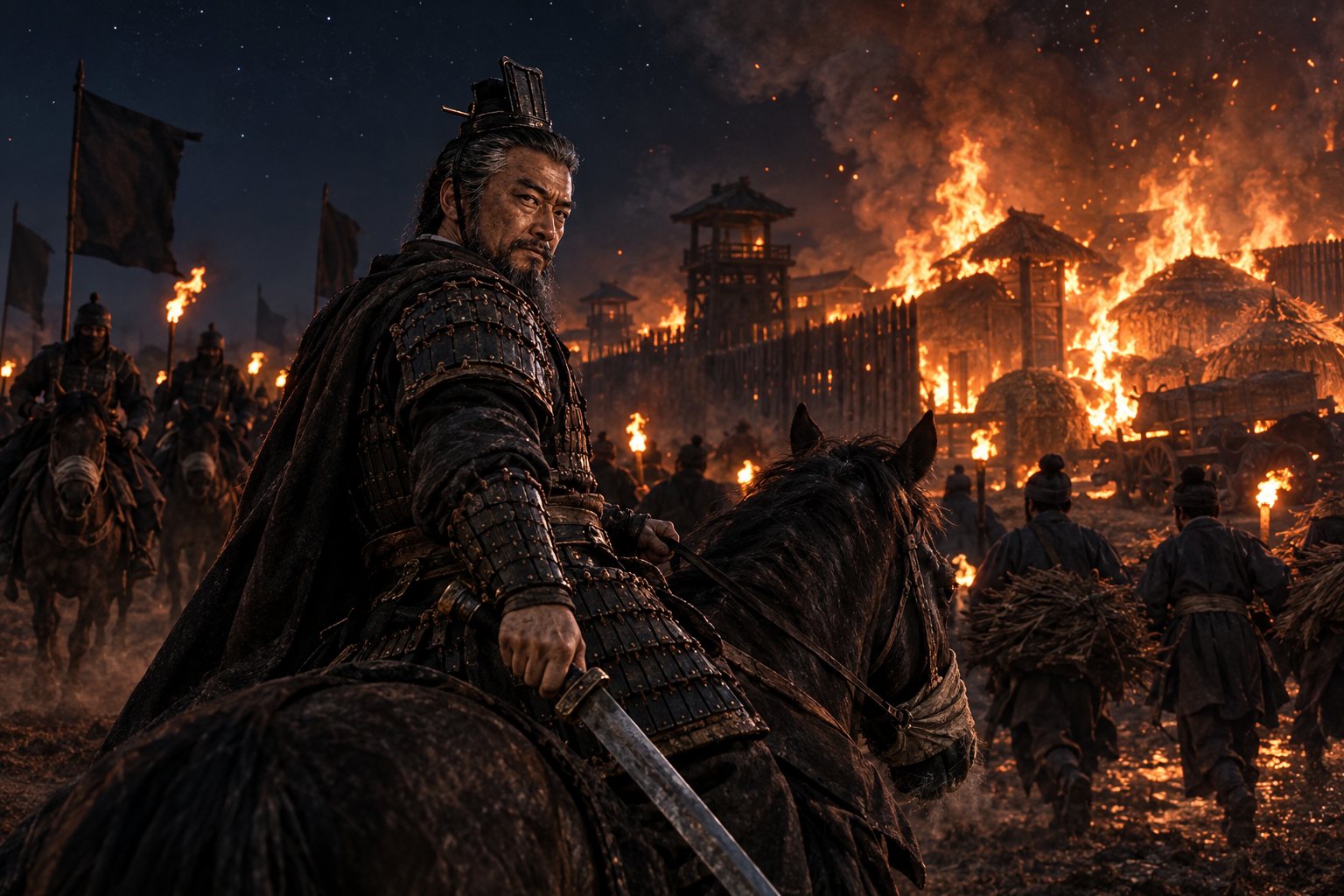
You leave Cao Hong to defend the camp and lead 5,000 infantry and cavalry out by night. The men and horses all bear Yuan Shao’s banners. The men hold gags in their mouths, bind the horses’ muzzles, take a narrow path, and each man carries a bundle of firewood. When someone asks along the way, they answer: “Lord Yuan fears Cao Cao will raid the rear guard, so he has sent troops to reinforce it.” Everyone who hears them believes it.
At daybreak, you arrive. Chunyu Qiong sees that your force is small and comes out of camp to form ranks. You attack fiercely, and he retreats into camp. You surround the camp and set it ablaze.
Yuan Shao’s cavalry comes to the rescue. Those around you say: “The enemy cavalry is drawing near. Please divide your forces to repel them.” You shout angrily: “Report to me when the enemy is at our backs!”
The soldiers all fight with desperate resolve and rout Chunyu Qiong utterly, burning all his grain, provisions, and treasure.
Chunyu Qiong is brought before you, bound. You ask: “Why did it come to this?” He says: “Victory and defeat are decided by Heaven. What use is there in asking?” You mean to spare him. Xu You says: “Tomorrow, when he looks in a mirror, he will remember this all the more.” So you have him killed.
Zhang He and Gao Lan hear that Wuchao has fallen and come to surrender. Yuan Shao’s great army collapses; he and Yuan Tan abandon it, cross the river, and flee.
Among the captured papers, you find letters written to Yuan Shao by men in Xu and in your own army. You do not look at the names. “When Shao was strong, I could barely keep myself safe; how much less could the others?” You burn them all.
In the firelight, you remember what you said that night at Chenggao.
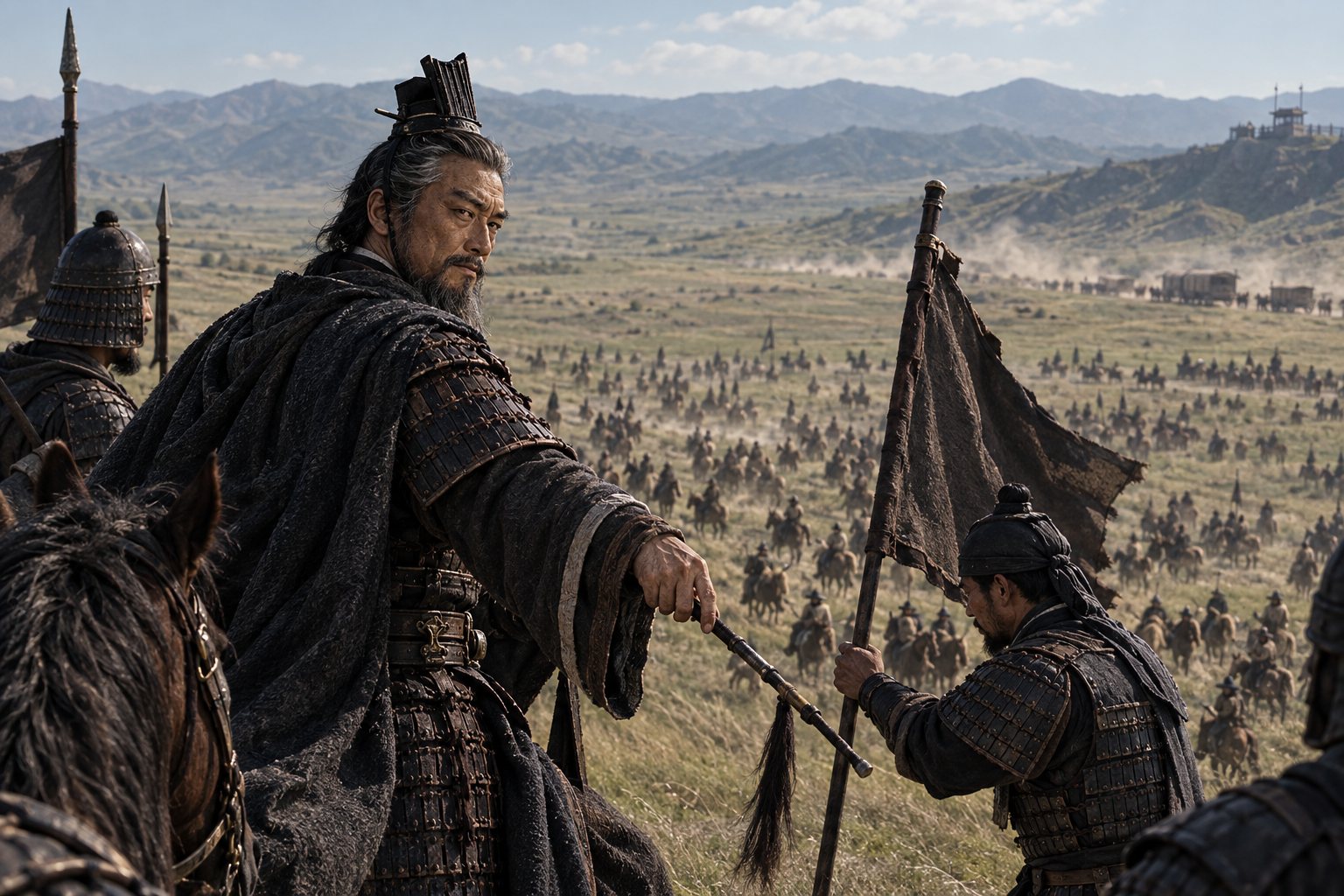
Seizing Fortune in Peril
After Guandu, Yuan Shao falls ill, vomits blood, and dies. In the first month of the tenth year, you behead Yuan Tan, and Jizhou is pacified.
Taking advantage of the chaos across the realm, the Wuhuan of the three commanderies break into You Province and carry off more than a hundred thousand Han households. Tadun, chanyu of Liaoxi, is the strongest. Yuan Shao treated him generously, so the brothers Yuan Shang and Yuan Xi have gone to take refuge with him, and they repeatedly raid across the passes, doing harm.
You are about to campaign north against the Wuhuan of the three commanderies. The generals all say: “Yuan Shang is merely a fugitive. The barbarians are greedy and have no loyalty; how could they serve Shang? If we now march deep into their lands to attack them, Liu Bei will surely persuade Liu Biao to strike Xu. Should anything change, it will be too late to regret it.”
Guo Jia says: “Though your might shakes the realm, the Hu rely on their distance and will surely make no preparations. Take them unprepared and strike suddenly, and they can be destroyed.”
He adds: “The people of the four provinces have submitted only out of fear; your benevolence has not yet reached them. If you leave them and campaign south, Yuan Shang will use the Wuhuan’s strength to rally men who would die for their old master. If the Hu rise up, the people and the barbarians will answer together. This will stir Tadun’s ambitions and set him plotting to seize what he covets. I fear Qing and Ji provinces will no longer be ours.”
Of Liu Biao, he says only this: “Biao is a mere talker who sits and debates. He knows he lacks the talent to control Liu Bei. If he entrusts him with great responsibility, he fears he cannot control him; if he gives him little, Bei will not serve him. Even if you empty the state and campaign far away, my lord, you need not worry.”
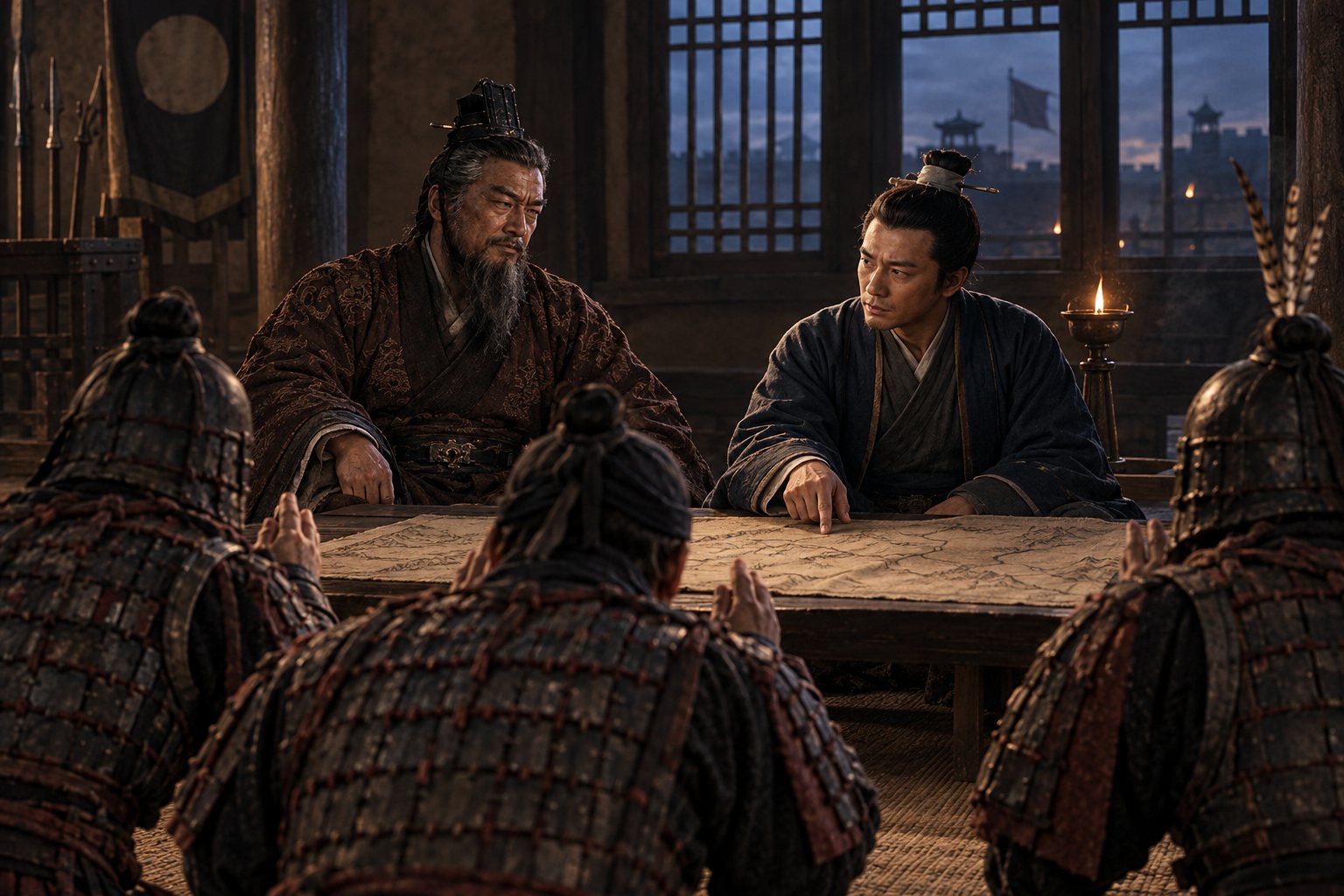
Liu Biao and Liu Bei are to the south; Yuan Shang and Tadun are to the north. What do you do?
When you reach Yi, Guo Jia says again: “Speed is what matters in war. We are now marching a thousand li to strike the enemy. With so much baggage, it will be hard to move swiftly and seize an advantage; and once they hear of us, they will surely prepare. Better to leave the baggage behind, take a light force, and press on by forced marches, catching them unawares.”
In summer, in the fifth month, you reach Wuzhong. In autumn, in the seventh month, the waters rise, and the coastal road becomes impassable. Tian Chou offers to guide you, and you heed him.
You lead the army through Lulong Pass. Beyond the pass, the road has long been lost; you cut through mountains and fill valleys for more than five hundred li, passing Baitan, crossing Pinggang, traversing the Xianbei court, and heading east straight for Liucheng. You are less than two hundred li from Liucheng when the enemy finally discovers you.
In the eighth month, you climb White Wolf Mountain and suddenly encounter the enemy, whose numbers are overwhelming. Your baggage train is behind you, and few of your men wear armor; everyone around you is afraid. From the heights you look out: the enemy formation is disordered, so you send your troops into the attack and appoint Zhang Liao as the vanguard. The enemy is utterly routed. You behead Tadun and the other kings, and more than two hundred thousand Hu and Han surrender.
Yuan Shang and Yuan Xi flee to Liaodong. Someone urges you to seize the moment and attack Liaodong. You say: “I am about to have Kang behead Shang and Xi and send their heads here. There is no need to trouble the army.”
In the ninth month, you turn your army back from Liucheng. The weather is cold and dry. For two hundred li there is no water, and the army is short of provisions. You kill several thousand horses for food and dig more than thirty zhang before finding water.
After you return, you summon those who had urged you not to go, and they are all afraid. Instead, you reward them all handsomely: “I went forward, courting fortune in peril. Though I prevailed, Heaven was helping me; I cannot make this a rule. Your remonstrances were plans for our safety, so I reward you. Do not hesitate to speak up in the future.”
As expected, Gongsun Kang beheads Yuan Shang and Yuan Xi and sends their heads to you. The generals ask why. You say: “They have always feared Shang and the others. If I press them, they will join forces; if I give them time, they will turn on one another. That is how things stand.”
Guo Jia falls gravely ill as soon as he returns from Liucheng; you send messenger after messenger to ask after him. He is thirty-eight when he dies. You attend his funeral, stricken with grief, and say to Xun You and the others: “You are all of my generation in age; and Fengxiao was the youngest. When the affairs of the realm are settled, I mean to entrust what comes after to him. But he has died in his prime. Such is fate!”
You write to Xun Yu: “Guo Fengxiao was not yet forty. We were together for eleven years, sharing every peril and hardship.” You write again: “Fengxiao was the one who truly understood me. Few in the world understand me, and this makes his loss all the more bitter. What can I do? What can I do?”
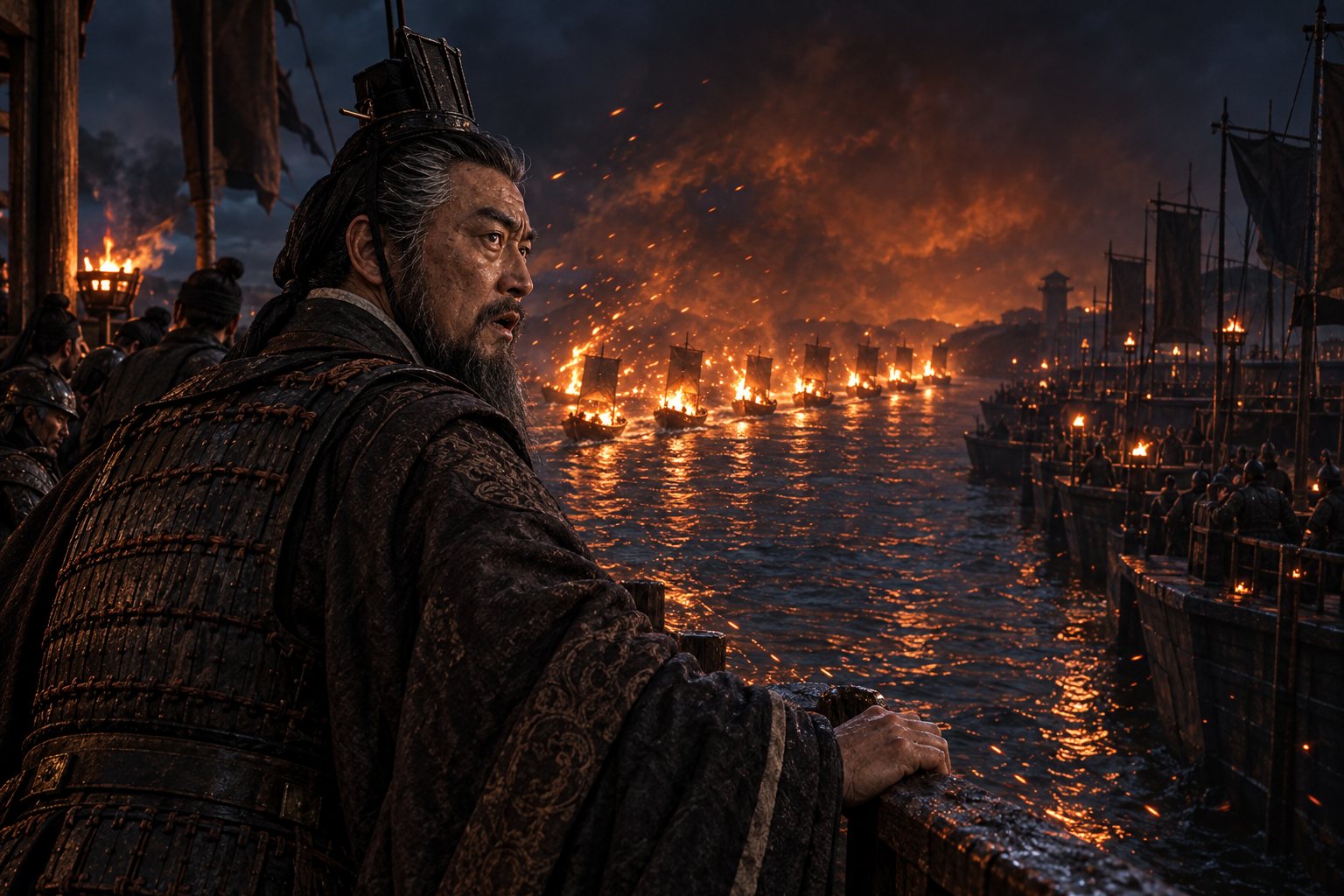
I Burned My Own Ships and Withdrew
In the spring of the 13th year, you return to Ye and drill the navy at Xuanwu Pond. In summer, in the sixth month, you become Chancellor.
In autumn, in the seventh month, you campaign south against Liu Biao. In the eighth month, Liu Biao dies. In the ninth month, you reach Xinye; Liu Cong surrenders, and Liu Bei flees to Xiakou. You advance on Jiangling and order the officials and people of Jing Province to begin anew with you. In a month, Jing Province’s navy, ships, and grain are all yours.
You write Sun Quan a letter: “Recently, I received the imperial command to punish the guilty. My banners point south, and Liu Cong has surrendered. I now command 800,000 naval troops, and am about to meet the general in a hunt at Wu.”
Jia Xu urges you to wait: “My lord, you once defeated the Yuan clan, and now you have taken the lands south of the Han River. Your fame and authority reach far, and your army is mighty. If you draw on the abundance of old Chu to feed your officers and soldiers, comfort the people and let them settle and enjoy their work, then the lands east of the Yangtze may submit without your exhausting your troops.”
You do not listen. You set out from Jiangling to attack Liu Bei, heading downriver.
Illness has already broken out in the camp. The men from the north cannot stomach the southern water. At the first clash, your army is beaten and falls back to the north bank. Zhou Yu and his men are on the south bank.
Your ships lie packed together along the north bank. Across the river, Zhou Yu’s subordinate Huang Gai watches them for a long time and says they are joined bow to stern: they could be set ablaze and the enemy put to flight.
Huang Gai sends a letter, saying he will surrender. In it he writes: “To pit the people of the six commanderies of Jiangdong, including the Shanyue, against a million men of the Central Plains is to face an enemy too numerous to overcome, as all under Heaven can see.” He adds: “On the day of battle, I will lead the vanguard and act as events allow; the day I serve you is close.” You summon the messenger alone and say to him yourself: “I fear you are deceiving me. If Gai is sincere, I will grant him rank and rewards beyond those given before or after.”
When the day comes, a strong southeast wind is blowing. Ten ships lead the way; when they reach midstream, they raise their sails all at once. The men aboard shout together, “We surrender!” All your soldiers come out of camp to watch, craning their necks and pointing, saying that Huang Gai is coming to surrender.
When they are just over two li from your ships, they all catch fire at once. The flames blaze, the wind roars, and the ships race like arrows, burning up the northern fleet and spreading all the way to the camps on shore. Many men and horses burn or drown.
You retreat on foot along Huarong Road. The way is blocked by mud, and then a strong wind rises. You order the weak soldiers to carry grass and fill the road so the cavalry can pass. The weak soldiers are trampled by men and horses, sink into the mud, and die in great numbers. Once you emerge, you are overjoyed. Your generals ask why. You say: “Liu Bei is my equal. He only devised his plan a little too late. Had he set the fires earlier, none of us would have escaped.”
When you reach Baqiu, plague breaks out in the army again, and you burn the ships that remain, sighing: “If Guo Fengxiao were here, he would not have let me come to this.”
Later, you write to Sun Quan: “At the battle of Chibi, there was an outbreak of disease. I burned my ships and retreated of my own accord, letting Zhou Yu win this undeserved fame.”
the man across the river → Read Zhuge Liang's story →
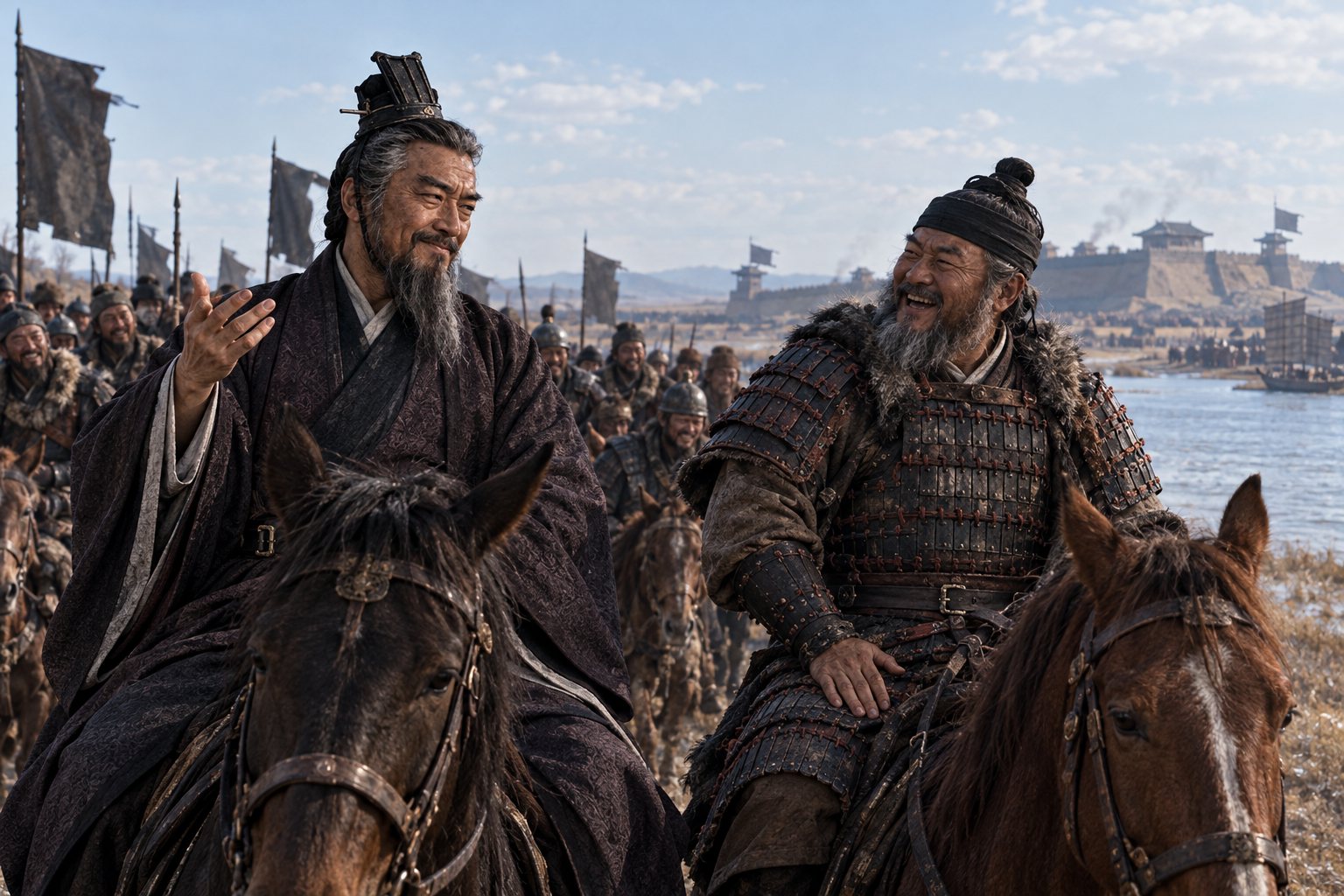
Just More Wits
After Chibi, you issue an order: The realm is not yet settled; this is precisely the urgent moment to seek worthy men, and you appoint men solely for their ability. That winter, you build the Bronze Sparrow Terrace at Ye.
In the 16th year, Ma Chao rebels in Guanzhong with Han Sui, Yang Qiu, Li Kan, Cheng Yi, and others, and encamps at Tong Pass. In autumn, in the seventh month, you march west.
Some say the troops west of the Pass are strong and skilled with long spears; only a handpicked vanguard can withstand them. You say: “The battle lies with me, not with the enemy. Though the enemy is skilled with long spears, I will make them unable to thrust. Just watch.”
You and Ma Chao face each other with armies at the Pass, while you secretly send Xu Huang and Zhu Ling to cross the Puban Ford by night and make camp west of the river.
Then you cross north yourself. Just as the vanguard reaches the far bank, Ma Chao and the others suddenly attack. You remain seated on your folding stool, not rising. Xu Chu says, “The enemy is numerous. Our troops have all crossed; we should leave.” He helps you onto a boat.
Ma Chao’s cavalry pursues, shooting arrows that fall like rain. Xu Chu cuts down the men climbing aboard and raises a saddle with his left hand to shield you. The boatman is hit by an arrow and dies; Xu Chu poles the boat with his right hand, and you barely make it across. The commandant Ding Fei releases cattle and horses to lure the enemy; they break ranks to seize them.
The generals see the army defeated and, not knowing where you are, are terrified; when they find you, grief and joy mingle, and some weep. You laugh: “Today I was nearly trapped by these little bandits!”
Each time you cross the Wei, Ma Chao’s cavalry scatters your men; you cannot establish a camp, and the ground is too sandy for ramparts. A man named Lou Gui comes to offer a plan: “The weather is cold. We can pile up sand for a wall, pour water over it, and it will be ready in a night.” You have many silk bags made to carry water and build through the night; by dawn, the wall stands.
Earlier, they sent envoys asking you to cede the land west of the river and make peace, but you refused. They challenge you again and again, but you still refuse. Now they again press you to cede territory, offering to send hostage sons.
Jia Xu says you can pretend to agree. You ask him for a plan. He says: “Only divide them.”
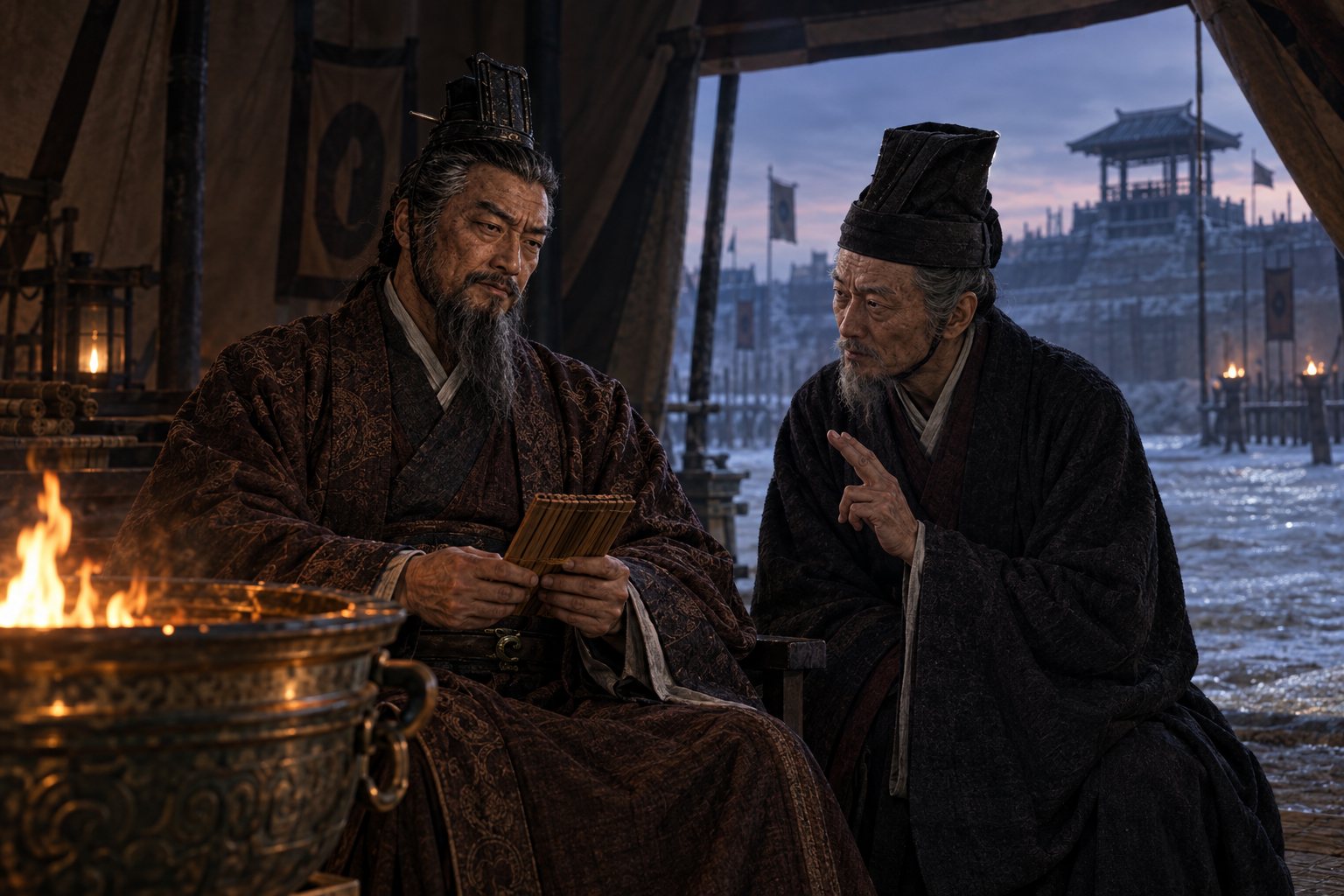
The envoys are still waiting outside the camp. What is your answer?
You use Jia Xu’s plan and pretend to agree.
Han Sui asks to meet you. You and his father were nominated Filial and Incorrupt in the same year, and you and Han Sui are of the same generation. You ride side by side and talk for a long time, saying nothing of military affairs, only recalling old times in the capital and clapping your hands as you laugh.
Afterward, Ma Chao and the others ask Han Sui, “What did you talk about?” Han Sui says, “Nothing.” They grow suspicious.
At another meeting later, the enemy generals see you and bow from their saddles; Qin people and Hu people crowd around to watch, packed several layers deep. You smile and tell them: “You want to see Cao Cao? I’m just like anyone else. I don’t have four eyes or two mouths—I’m only a little wiser!”
A few days later, you write Han Sui another letter, with alterations and deletions that make it look as if Han Sui himself has revised it. Ma Chao and the others become even more suspicious of him.
You set a date to meet them in battle, first sending light troops to challenge them; after a long fight, you bring out the Tiger Cavalry to strike from both sides and rout them completely. Han Sui and Ma Chao flee to Liang Province, and Guanzhong is pacified.
The generals ask you why, whenever a contingent of enemy troops arrived, you wore a look of delight. You say: “Now they have all gathered here. Though their numbers are great, they do not submit to one another. Their army has no settled commander. A single attack can destroy them, and victory will be all the easier. That is why I am glad.”
I Shall Be King Wen of Zhou
In the 18th year, the Son of Heaven invested you as Duke of Wei; in the fifth month of the 21st year, he raised your title again, to King of Wei.
In the 24th year, you come through Xie Valley to Yangping, where Liu Bei holds the heights and refuses to yield. You give an order: “Chicken ribs.” In the fifth month, you lead your army back to Chang'an.
In the eighth month that year, the Han River floods; Guan Yu captures Yu Jin and surrounds Cao Ren.
In winter, in the tenth month, you return to Luoyang. You rebuild the office where you served as Commandant of the Northern District of Luoyang, making it finer than before.
Sun Quan sends an envoy with a memorial, saying he is willing to attack Guan Yu and prove his loyalty. You march south against Guan Yu, but before you arrive, Xu Huang has already defeated him and lifted the siege of Fancheng. You garrison your troops at Mopi.
Sun Quan sends another memorial, declaring himself your subject and saying Heaven’s mandate is yours. You hold the letter up for those outside to see: “Does that boy mean to perch me over a furnace?”
Palace Attendant Chen Qun and Minister of the Secretariat Huan Jie submit a memorial: “Since the reign of Emperor An of Han, power has left the imperial house, and the succession of the state has been broken several times. Today, only the title remains; not a foot of land or a single person belongs to Han.” They add: “Your Highness has answered the call of the age. You possess nine-tenths of the realm, yet serve Han.”
Xiahou Dun comes to speak as well: “All under Heaven know that Han’s mandate is spent and a new dynasty is rising.” “Your Highness has been in command of the armies for more than thirty years. Your achievements and virtue are renowned among the people, and all under Heaven look to you. You answer Heaven and follow the people—what is there left to doubt?”
More than thirty years. You recall the order you gave ten years ago, which contains these words: “If I were not here, I know not how many would call themselves emperors, how many would call themselves kings.”
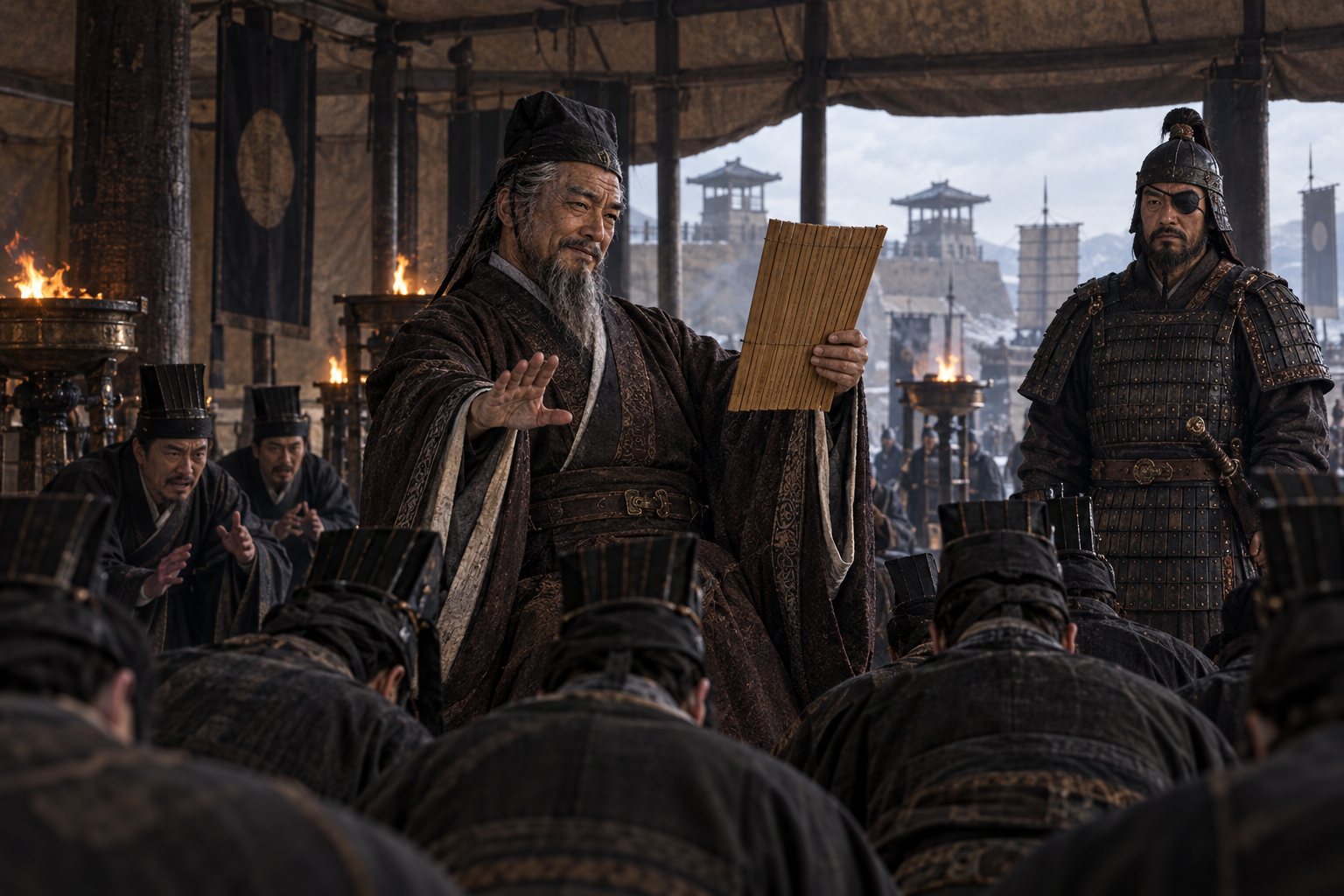
Everyone in the hall waits for your answer. What do you say?
In spring, in the first month of the 25th year, you arrive in Luoyang. Sun Quan kills Guan Yu and sends his head to you.
You order the craftsman Su Yue to transplant a fine pear tree; when he digs it up, blood flows from its wounded roots. You go to see it yourself, feel repelled, and take it as an ill omen. You return and fall ill.
When Lady Ding dies, Lady Bian asks you to arrange her burial. You agree, and she is buried south of Xu City. Now gravely ill, you think you will not rise again, and sigh: “In all my conduct, before and after, I have never felt I did wrong in my heart. If the dead have spirits, and Zixiu asks, ‘Where is my mother?’ what answer can I give him?”
In the Romance, you say to those at your bedside: “For more than thirty years I have ranged across the realm. All the other lords are gone. Only Sun Quan in Jiangdong and Liu Bei in western Shu remain, and I have yet to destroy them.”
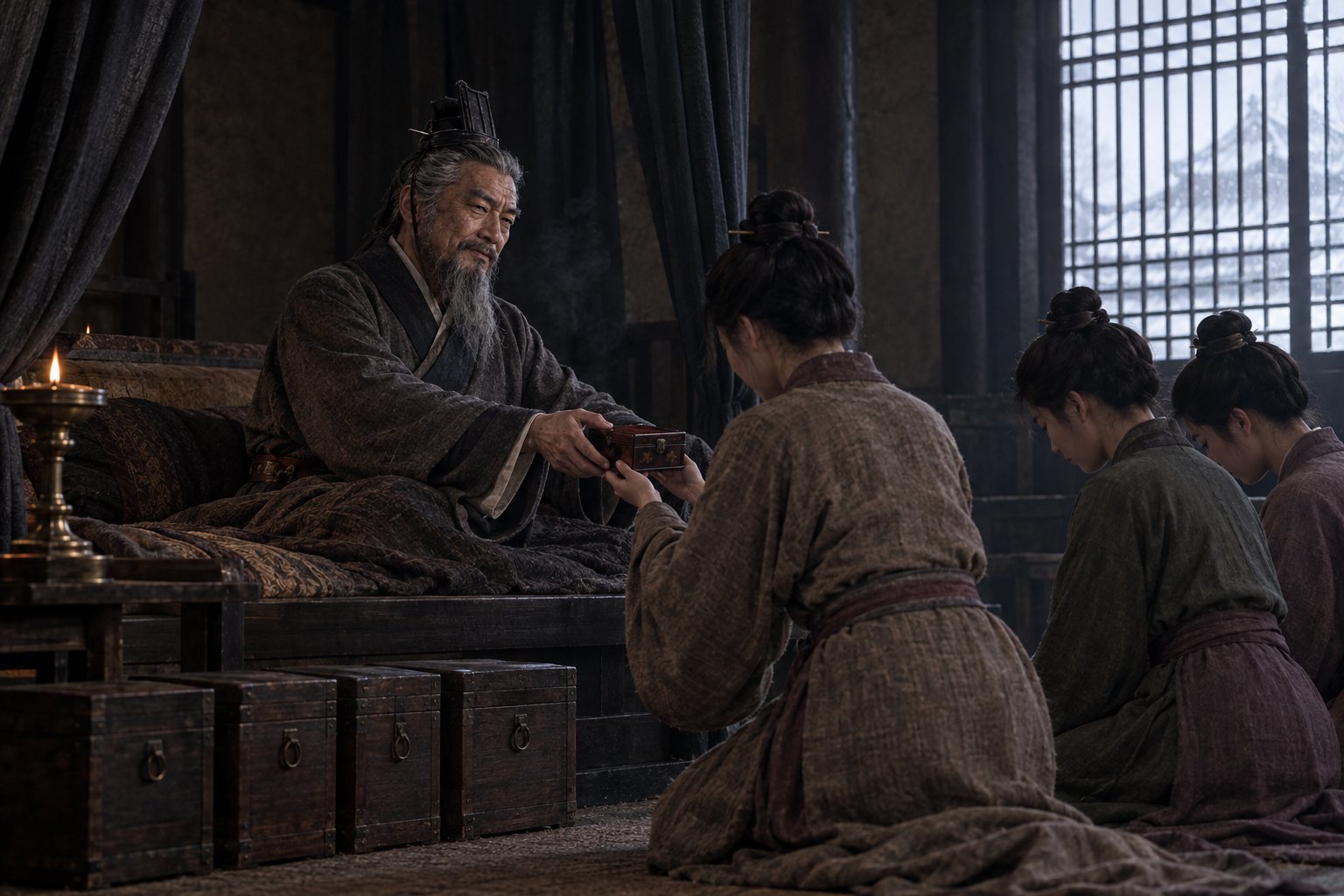
You have your attendants bring out the fine incense you have kept over the years and divide it among your concubines, instructing them: “After I die, you must diligently practice women’s work and make many silk shoes. You can sell them to support yourselves.”
Your final instructions are: “The realm is not yet at peace, so we cannot follow the ancient ways. Once the burial is over, all must remove mourning clothes. Those commanding troops and serving in garrisons must not leave their posts. Each official must attend to his duties. Bury me in the clothes I wear in life; do not store gold, jade, or precious treasures with me.”
You have long since prepared your own burial clothes: only four chests’ worth.
On the day gengzi, you die in Luoyang, aged 66. On the day dingmao in the second month, you are buried at Gaoling.
What you wanted in your youth was only that one line on your tomb passage: “Tomb of the Marquis Cao, late General Who Attacks the West of the Han”.
How Cao Cao's story ends
Taizu laid his plans and devised his strategies, and whipped the realm into submission… That in the end he could take the reins of imperial power and complete his great enterprise was due above all to his brilliant strategy. He may truly be called an extraordinary man, a hero who surpassed his age.
The chief in merit and the chief in crime are not two men;<br>the stink that lingers and the fame that endures belong to one man.