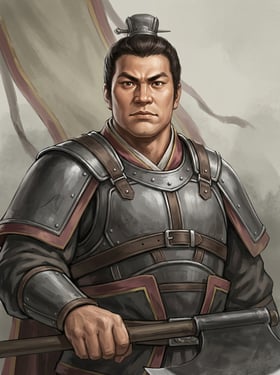
Historical Record
Xu Chu, courtesy name Zhongkang, was a man of Qiao county in the state of Qiao. When Cao Cao campaigned in the Huai and Ru regions, Xu Chu led his followers and submitted to him; seeing his powerful build, Cao Cao praised him, saying, "This is my Fan Kuai," and at once appointed him Commandant and brought him into the palace guard. Xu Chu's knight-errant followers were likewise appointed "tiger warriors" by Cao Cao. He once followed Cao Cao in the campaign against Zhang Xiu, taking the lead in person and beheading countless foes, and was thereby promoted to Colonel. In the Battle of Guandu, Xu Chu also went on campaign. At that time, the attendant guard Xu Ta and others secretly plotted to revolt, but dared not act for fear of Xu Chu always being at Cao Cao's side. When Xu Chu was on leave, Xu Ta and the others came in with knives hidden. Xu Chu, in his quarters, felt a foreboding in his heart and immediately returned to attend his post. Not knowing this, Xu Ta and the others entered the tent and, on seeing Xu Chu, were greatly startled. Xu Chu, perceiving the strangeness of their looks, at once struck down Xu Ta and the others. Cao Cao thereby grew all the closer and more trusting toward Xu Chu, keeping him at his side coming and going, never a step apart c:3372.
Xu Chu fought valiantly in the siege of Ye and rendered merit, for which he was granted the rank of Marquis Within the Passes. In the Battle of Tong Pass, he followed Cao Cao against Han Sui and Ma Chao. Cao Cao was about to cross the Wei River northward; he first sent the main body across the river, while he himself, with Xu Chu and over a hundred tiger warriors, stayed on the south bank as rear guard. Ma Chao led more than ten thousand foot and horse in a sudden assault on Cao Cao's force, with arrows falling like rain. Xu Chu advised Cao Cao that the enemy were many and that, the army having finished crossing, they should withdraw at once, and so helped Cao Cao onto a boat. The enemy attacked fiercely, and the soldiers scrambled to board, so that the boat, overloaded, was about to capsize. Xu Chu cut down those clinging to the boat and, raising a saddle in his left hand, shielded Cao Cao from the arrows. After the boatman was struck dead by an arrow, Xu Chu, paddling hard with his right hand, managed to cross. Had it not been for Xu Chu that day, Cao Cao would scarcely have kept his life. Thereafter Cao Cao met alone with Han Sui, Ma Chao, and the others to parley for peace; none of the attendants was allowed near, only Xu Chu went along. Ma Chao, presuming on his own valor, secretly wished to rush forward and strike at Cao Cao, but, having long heard of Xu Chu's fierceness, suspected that the attendant was Xu Chu, and so asked Cao Cao: "Where is the tiger marquis you have?" Cao Cao pointed to Xu Chu, and Xu Chu glared furiously at Ma Chao, so that Ma Chao dared not act rashly, and the two sides parted. Some days later they gave battle, and Cao Cao greatly crushed Ma Chao and the others; Xu Chu personally took the heads of enemy generals and was promoted to General of Martial Guard of the Household. The title "Martial Guard" began from this. In the army, because Xu Chu was as strong as a tiger and somewhat simple-witted, they called him "Tiger Fool"; and because Ma Chao asked after the "tiger marquis," to this day the realm still calls Xu Chu by this name, all referring to his very name c:3372.
Xu Chu was cautious and law-abiding in character, steady and of few words. When Cao Ren came from Jing Province to court, and Cao Cao had not yet come out to receive him, Cao Ren met Xu Chu outside the hall. Cao Ren called Xu Chu over to sit and talk, but Xu Chu said, "The King is about to come out," and returned within the hall. Cao Ren was thereby displeased. Someone reproached Xu Chu, saying: "The General Who Conquers the South is a weighty minister of the royal house; he humbled himself to ask you to sit — why did you refuse?" Xu Chu replied: "Though he is a close and weighty minister, he is a marquis of the outer regions. I am an inner minister; that we converse in company is enough — why must we whisper apart in a private room?" Hearing of this, Cao Cao loved and esteemed Xu Chu all the more, and promoted him to General of the Central Firmness. When Cao Cao died, Xu Chu wailed and cried out, even to vomiting blood. After Cao Pi succeeded to the throne, he advanced Xu Chu to Marquis of Wansui Pavilion, transferred him to General of Martial Guard, and put him in command of the central army's palace guard troops, with deep favor c:3374.
In the Novel
In the Romance of the Three Kingdoms, Xu Chu's image is further deified and magnified, his valor and loyalty endowed with more legendary color. He first appears when Cao Cao campaigns against the Yellow Turban remnants He Yi and Huang Shao. Xu Chu captured several hundred Yellow Turban bandits in Gebei Fort, and fought Dian Wei for two days without a decisive outcome, until at last he was captured by a trap set by Cao Cao. Cao Cao personally untied his bonds, and on asking his name, Xu Chu recounted how he had once driven off bandits by hurling stones, and had once gripped the tails of two oxen with both hands and dragged them backward over a hundred paces, displaying extraordinary strength. Hearing of his great fame, Cao Cao then induced the surrender of Xu Chu and several hundred of his clansmen c:6263.
In the novel, Xu Chu repeatedly served as vanguard, slaying generals and seizing banners. For instance, when Cao Cao attacked Yanzhou, he volunteered, slew Li Feng in a single bout, and helped Cao Cao recover Yanzhou c:3376. In the Battle of Puyang, he fought Lü Bu for some twenty bouts without a decisive outcome, after which it took the combined strength of six generals — Dian Wei, Xiahou Dun, Xiahou Yuan, Li Dian, and Yue Jin — to drive Lü Bu off c:3377. When Cao Cao welcomed Emperor Xian of Han, Xu Chu, with Dian Wei, Cao Ren, and three hundred iron horsemen, charged three times through the battle line of Li Jue's army, and slew Li Jue's nephews Li Xian and Li Bie, and was praised by Cao Cao as "my Fan Kuai" c:3379.
The novel also stresses Xu Chu's "foolishness" and "loyalty." After the Battle of Guandu, Xu Chu cut down Xu You for his rudeness to Cao Cao; though Cao Cao rebuked him, he still gave Xu You a lavish burial c:3383 (unattested in history). At the Battle of Changban, when Cao Cao was frightened into retreat by a furious roar from Zhang Fei, Xu Chu and Zhang Liao caught up to console him, and were ordered to scout out the truth of Zhang Fei's strength c:3384. In the Battle of the Wei River, at Cao Cao's moment of peril, Xu Chu dragged Cao Cao onto a boat, then carried Cao Cao on his back leaping onto another boat, and on the boat used a saddle to shield Cao Cao from the arrows, paddling hard to bring Cao Cao to safety c:3385. These episodes all greatly enrich Xu Chu's image as the "Tiger Fool."
When Cao Cao was drunk, Xu Chu stood with sword in hand at the hall door, barring Cao Ren, who wished to enter, saying that though Cao Ren was of the royal house, he was a marquis of the outer regions, while he himself was an inner minister and dared not let him disturb his lord; hearing of this, Cao Cao sighed that he was a "loyal minister" c:3388 (unattested in history). These details all bring out the "weighty and reticent" and "utterly loyal" side of Xu Chu's character.
Key Relationships
* Cao Cao (serves): Xu Chu was Cao Cao's loyal guard and trusted chief general. The histories record that Cao Cao called him "This is my Fan Kuai" c:3372 and trusted him deeply, keeping him at his side coming and going. In the novel, Xu Chu repeatedly saves Cao Cao from peril at critical moments, as when he carried Cao Cao to safety in the Battle of the Wei River c:3385 and dutifully guarded him when Cao Cao was drunk c:3388 (novel only).
* Cao Wei (serves): After Cao Cao died, Xu Chu continued to serve Cao Pi and Cao Rui, rising to General of Martial Guard and commander of the central army's palace guard troops c:3374, an important military pillar of the Cao Wei regime.
* Xu Ta (enemy_of): The histories record that Xu Ta and others plotted revolt but dared not act for fear of Xu Chu always being in attendance, and were later detected and struck down by Xu Chu c:3372.
* Ma Chao (fights_in): In the Battle of Tong Pass, Xu Chu had several clashes with Ma Chao. The histories record that Ma Chao once asked Cao Cao, "Where is the tiger marquis you have?", and Xu Chu glared at him, so that Ma Chao dared not act rashly c:3372. In the novel, Xu Chu in the Battle of the Wei River fought directly with Ma Chao's pursuers to protect Cao Cao c:3385.
* Dian Wei (comrade): In the novel, Xu Chu and Dian Wei are often named together, both being Cao Cao's close guards and surpassingly valiant. The two once fought for two days at Gebei Fort without a decisive outcome c:13674 (novel only), and in the Battle of Puyang also jointly opposed Lü Bu c:3377 (novel only).
* Yellow Turban Army (enemy_of): In the novel, on his first appearance Xu Chu captured the Yellow Turban bandits He Yi, Huang Shao, and others at Gebei Fort c:3375 (novel only).
* Zhang Xiu (fights_in): The histories record that Xu Chu followed Cao Cao in the campaign against Zhang Xiu, taking the lead and beheading foes by the tens of thousands c:3372. In the novel, Xu Chu slew Zhang Xian in three bouts beneath the walls of Nanyang and greatly crushed Zhang Xiu's army c:6265 (novel only).
* Lü Bu (fights_in): In the novel, Xu Chu once fought Lü Bu for some twenty bouts without a decisive outcome, after which he and six generals including Dian Wei attacked Lü Bu together c:3377 (novel only).
* Liu Bei (fights_in): In the novel, Xu Chu was once ordered by Cao Cao to bring Liu Bei back, but because Liu Bei's words were fitting, Xu Chu could not force his return c:13682 (novel only).
* Zhang Fei (fights_in): In the novel, at the Battle of Changban, when Cao Cao was frightened into retreat by a furious roar from Zhang Fei, Xu Chu and Zhang Liao caught up to console him c:3384 (novel only).
* Xu You (enemy_of): In the novel, Xu Chu cut down Xu You for his rudeness to Cao Cao c:3383 (novel only).
Signature Scene
* Submitting to Cao Cao, praised as "Fan Kuai": Xu Chu led his followers and submitted to Cao Cao, who, for his valor, praised him as "my Fan Kuai" and appointed him Commandant, beginning his soldier's career in Cao Cao's following c:3372.
* Striking down Xu Ta, guarding Cao Cao: During the Battle of Guandu, Xu Chu perceived the revolt plotted by Xu Ta and others, struck them down decisively, and spared Cao Cao from danger, after which Cao Cao trusted him all the more and kept him at his side coming and going c:3372.
* Saving his lord at Tong Pass, turning the tide: In the Battle of Tong Pass, when Cao Cao met Ma Chao's pursuit while crossing the Wei River northward, Xu Chu, at the critical moment, helped Cao Cao onto a boat, cut down those clinging to it, shielded Cao Cao from the arrows with a saddle raised in his left hand, and paddled with his right, bringing Cao Cao to safety c:3385.
* Glaring at Ma Chao, awing the enemy's nerve: When Cao Cao met Ma Chao in a single-horse parley, Ma Chao wished to strike at Cao Cao, but having long heard of Xu Chu's fierceness, asked "Where is the tiger marquis?"; Xu Chu glared furiously, so that Ma Chao dared not act rashly c:3372.
* Refusing Cao Ren entry, faithful to his duty: When Cao Ren came to court to see Cao Cao and, since Cao Cao had not come out, wished to enter the hall to speak privately with Xu Chu, he was refused by Xu Chu on the grounds that "the King is about to come out," and with the words, "Though he is a close and weighty minister, he is a marquis of the outer regions. I serve as an inner minister; that we converse in company is enough — why whisper apart in a private room?", displaying his cautious, law-abiding character and devotion to duty c:3374.
* Capturing bandits at Gebei Fort, battling Dian Wei: On his first appearance, Xu Chu captured the Yellow Turban bandits He Yi and Huang Shao at Gebei Fort, and fought Dian Wei for two days without a decisive outcome, displaying his extraordinary martial strength c:13674 (novel only).
* Slaying Li Feng, awe-inspiring on the field: When Cao Cao attacked Yanzhou, Xu Chu volunteered, slew Li Feng in a single bout, and won the first merit in recovering Yanzhou for Cao Cao c:3376 (novel only).
* Battling Lü Bu at Puyang, six generals surrounding him: Xu Chu fought Lü Bu for some twenty bouts without a decisive outcome, after which it took the combined strength of six generals including Dian Wei and Xiahou Dun to drive Lü Bu off, highlighting his valor c:3377 (novel only).
* Cutting down Xu You, loyally guarding his lord: After the Battle of Guandu, Xu Chu cut down Xu You for his rudeness to Cao Cao; though rebuked, he thereby showed his absolute loyalty to Cao Cao c:3383 (novel only).
* Guarding his drunken lord, Cao Cao praising a loyal minister: When Cao Cao lay drunk in the hall, Xu Chu stood with sword in hand within the door, barring Cao Ren who wished to enter, and Cao Cao, hearing of it, praised him: "Xu Chu is truly a loyal minister" c:3388 (novel only).
Portrait file
Character profile
- Appearance
- Xu Chu stood over eight chi tall, with a waist ten spans around, a fierce and majestic countenance, and strength beyond that of ordinary men. At times he wore heavy armor with arrows lodged in the plates, his round eyes glaring wide and his gaze flashing with a divine light.
- Character
- Xu Chu was cautious and law-abiding by nature, solid and sparing of words, and utterly loyal. His strength surpassed all others and earned him the nickname 'the Tiger Fool'; at times fierce and unyielding, he could also err by growing careless of the enemy when emboldened by drink.
- Manner of speech
- Xu Chu's speech was terse and weighted with a sense of duty. He once said, 'Though he is a close and trusted kinsman, he is still an external lord; I serve as an inner minister, and the counsel of the assembly is enough—why should I confer with him in private?', thus showing his sense of the proper bounds between inner and outer.
- Life
- Xu Chu stood over eight chi tall with a waist ten spans around. At the end of the Han he gathered several thousand households of young men and clansmen to fortify a stronghold against marauders, and with hurled stones and by dragging an ox backward by its tail he made the tens of thousands of Ge Bei bandits of Runan fear him. After submitting to the Grand Progenitor he was that very day appointed Commandant and drawn into the bodyguard; following the campaign against Zhang Xiu he was first to scale the walls and beheaded foes by the myriad; in the campaign against Yuan Shao at Guandu he slew the traitor Xu Ta and others who plotted rebellion; and at the siege of Ye he fought hard and was granted the rank of Marquis Within the Passes. At the Battle of Tong Pass he helped the Grand Progenitor onto the boat, cut down those who clutched at it, sculled the vessel with his right hand while raising a saddle with his left to shield the Grand Progenitor, and glared at Ma Chao until he dared not stir. Afterward, having routed Ma Chao and the others, he was promoted to General of the Martial Guard of the Household; when Cao Ren came to court, Xu Chu declined his request to sit at ease. When the Grand Progenitor died, Xu Chu wept aloud until he vomited blood. Emperor Wen advanced him to Marquis of Wansui Pavilion, Emperor Ming to Marquis of Mou District, and at his death he was given the posthumous title Zhuang (the Valiant).
- Weapons
- Xu Chu wielded a great axe, a great blade, twin halberds, weapons for meeting the foe head-on, a sword, and a steel saber.
- Anecdotes
- Xu Chu, styled Zhongkang, once struck down bandits with hurled stones and dragged two oxen backward by their tails with his bare hands. Cao Cao likened him to Fan Kuai and praised, 'Xu Chu is truly a loyal minister!' He was the father of Xu Yi, and his son Yi succeeded him; his elder brother Ding served as General Who Rouses Valor and commanded the Tiger Guards patrolling the roads, and in the Taihe era two of his sons and grandsons were again granted the rank of Marquis Within the Passes.
Relationships
23 relationships
Quotes
23 recorded lines · 3 featured
「我乃譙國譙縣人也:姓許,名褚,字仲康。向遭寇亂,聚宗族數百人,築堅於塢中以禦之。一日寇至,吾令眾人多取石子準備,吾親自飛石擊之,無不中者,寇乃退去。又一日寇至,塢中無糧,遂與賊和,約以耕牛換米。米已送到,賊驅牛至塢外,牛皆奔走回還,被我雙手掣二牛尾,倒行百餘步。賊大驚,不敢取牛而走:因此保守此處無事。」
This self-account displays Xu Chu's early martial prowess, establishing his image as the 'Tiger Fool.'
「吾等千生萬死,身冒血戰,奪得城池,汝安敢誇口!」
Angrily rebuking Xu You reveals Xu Chu's loyal courage and blunt honesty, unafraid of the powerful.
「將軍雖親,乃外藩鎮守之官;許褚雖疏,現充內侍。主公醉臥堂上,不敢放入。」
These words highlight Xu Chu's loyalty and sense of duty as Cao Cao's close attendant.
Chapters25 回 ▸
- 史ch.18
- 演ch.12ch.14ch.17ch.19ch.21ch.25ch.27ch.30ch.32ch.33ch.40ch.41ch.42ch.48ch.56ch.57ch.58ch.59ch.61ch.66ch.67ch.72ch.79ch.116
Relationship timeline20 条 ▸
史 ch.18
演 ch.12
演 ch.14
演 ch.21
- Liu Bei§18
奉命追还玄德(强制召回)
演 ch.30
- Gao Lan§5
fights_in
阵前挺槍接住,捉对兒厮杀
演 ch.33
- Xu You§5
enemy_of
怒攸夸功,拔剑斩之,提头来见曹操
演 ch.42
- Cao Cao§13
witnesses
与张辽追上扯住曹操辔环
演 ch.58
- Cao Cao§22
commands_in
渭水拖操下船、以鞍遮箭、独撑舟舵;为操亲随护卫
演 ch.59
- Ma Chao§5
fights_in
阵前裸衣大战二百余合
演 ch.61
- Cao Cao§44
commands_in
纵马舞刀敌住韩、周二将,曹操得脱归寨;後引虎卫军救出
演 ch.66
- Cao Ren§37
rival_of
段37仗剑立堂门,拒曹仁入;曹操叹「許褚真忠臣也」
演 ch.67
- Zhang Wei§17
fights_in
交锋斩张卫于马下
演 ch.79
- Cao Pi§7
serves
奉命领虎卫军擒曹植
演 ch.116
- Xu Yi§2
parent_of
父子
Inner monologues · AI-generated3 段 ▸
- Throughout my life, I spoke little and acted with caution, guarding no more than the honor and integrity my position dem
- I am Xu Chu, courtesy name Zhongkang. I remember returning from the Huai and Ru regions to join the Grand Ancestor. When
- I was born in Qiao County, Qiao State, and my courtesy name was Zhongkang. I remember when banditry and chaos erupted on
Life events10 ▸
- 0195-01-01 · DingtaoDefeat of Lu Bu at Dingtao· Warrior
- 0201-01-01 · CangtingBattle of Cangting· Warrior
- 0201-01-01 · RangshanBattle of Rangshan· Warrior
- 0207-01-01 · YeCao Cao Pacifies Hebei· Warrior
- 0207-01-01 · White Wolf MountainCao Cao's Campaign Against the Wuhuan· Warrior
- 0208-01-01 · Jing ProvinceCao Cao's Southern Campaign Against Jing Province· Warrior
- 0210-01-01 · YeBronze Bird Terrace Inauguration Ceremony· Warrior
- 0211-01-01 · Tong PassCao Cao Cuts His Beard and Discards His Robe· Warrior
- 0211-01-01 · Tong PassXu Chu Fights Ma Chao Bare-Chested· Warrior
- 0215-01-01 · NanzhengZhang Lu Surrenders to Cao Cao· Warrior