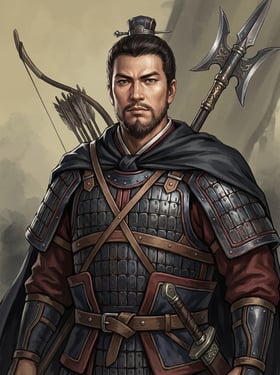
Historical Record
Zhang Liao, courtesy name Wenyuan, was a native of Mayi in Yanmen. His original surname was Nie, which he changed to avoid an enmity. In his youth he served as a commandery clerk. At the end of the Han, Ding Yuan, Inspector of Bing Province, prizing Zhang Liao's exceptional martial prowess, recruited him as an attendant officer and sent him at the head of troops to the capital. He Jin then dispatched Zhang Liao to Hebei to recruit troops, where he successfully enrolled more than a thousand men. After He Jin's downfall, Zhang Liao's troops came under Dong Zhuo. After Dong Zhuo's downfall, Zhang Liao came under Lü Bu and was appointed Cavalry Commandant. After Lü Bu was defeated by Li Jue, Zhang Liao followed Lü Bu east to Xu Province, then twenty-eight years old, holding the post of Chancellor of Lu. In the third year of Jian'an (198 CE), Cao Cao defeated Lü Bu at Xiapi, and Zhang Liao led his troops in surrender, was appointed General of the Household, and granted the rank of Marquis Within the Passes. Thereafter Zhang Liao repeatedly won merit and was promoted to Assistant General. After Cao Cao defeated Yuan Shao, Zhang Liao was ordered to pacify the counties of the state of Lu. He once joined Xiahou Yuan in besieging Chang Xi at Donghai; after several months their provisions ran out, and the generals discussed withdrawing. Zhang Liao, however, keenly observed Chang Xi's hesitation and judged that he could be persuaded to surrender. He went alone to speak with Chang Xi and, by Cao Cao's prestige and benevolent governance, induced him to surrender, and Chang Xi at last submitted.
Zhang Liao also followed Cao Cao in campaigning against Yuan Tan and Yuan Shang at Liyang, and for his merit was made Acting General of the Central Firmness. In the attack on Ye, Yuan Shang held firm and could not be taken, and Cao Cao for a time returned to Xu; Zhang Liao, with Yue Jin, took Yin'an and moved its people to south of the Yellow River. After Ye was taken, Zhang Liao separately overran Zhao state and Changshan, inducing the surrender of the various mountain bandits and Sun Qing of the Black Mountain and others. After defeating Yuan Tan, Zhang Liao again led a separate force overrunning the seacoast, defeating the Liaodong bandit Liu Yi and others. When he returned to Ye, Cao Cao personally came out of the city to welcome him, rode in the same carriage with him, and appointed him General Who Routs Bandits. Thereafter Zhang Liao was ordered to attack Jing Province, pacifying the counties of Jiangxia, and then garrisoned Linying and was enfeoffed Marquis of Duting. In the campaign against Yuan Shang at Liucheng, Zhang Liao encountered the enemy and strongly urged Cao Cao to give battle; morale was high, and for this Cao Cao bestowed his own battle standard on Zhang Liao, who in the end greatly defeated the enemy and slew the Chanyu Tadun.
In the thirteenth year of Jian'an (208 CE), with Jing Province not yet settled, Zhang Liao was sent to garrison Changshe. As he was about to set out, a mutiny broke out in the army, with panic and fire arising in the night. Zhang Liao responded calmly, ordering those who had not mutinied to sit still, while he personally led several dozen of his guards to stand in the midst of the formation, and soon quelled the mutiny and seized the ringleader. Later, Chen Lan and Mei Cheng rebelled in the six counties of Di, and Zhang Liao supervised Zhang He, Niu Gai, and others in campaigning against Chen Lan. Facing the steep Mount Tianzhu, the generals held that with few troops and a perilous road it was hard to penetrate, but Zhang Liao said: "This is what is called 'one against one'—only the brave can advance." He resolutely advanced, stormed the mountain stronghold, slew Chen Lan and Mei Cheng, and captured all their host. When Cao Cao rewarded merit, he praised Zhang Liao—"ascending Mount Tian, treading sheer perils, to take Lan and Cheng—this is the merit of routing bandits"—and increased his fief and granted him the Staff of Authority.
In the twentieth year of Jian'an (215 CE), Cao Cao campaigned against Zhang Lu, leaving Zhang Liao with Yue Jin, Li Dian, and others, more than seven thousand troops in all, to garrison Hefei. Sun Quan led a host of a hundred thousand to besiege Hefei. The sealed instructions Cao Cao left with the Protector of the Army Xue Ti read: "If Sun Quan arrives, Generals Zhang and Li are to give battle; General Yue is to guard the Protector of the Army and must not join battle." The generals were puzzled by this instruction, but Zhang Liao overruled all objections, holding that they should strike while the enemy was not yet firmly established, repelling them to blunt their edge and steady the army's morale. Overnight he enrolled eight hundred dauntless men; the next dawn, Zhang Liao, donning armor and grasping his halberd, charged at the head of his men into the enemy ranks, slaying several dozen men and two generals, and pressing right up to Sun Quan's own banner. Sun Quan was greatly alarmed, and Zhang Liao broke through the encirclement several more times before successfully withdrawing, and the Wu army's morale was badly shaken. Sun Quan besieged the city for more than ten days without taking it, and in the end led his troops away. Zhang Liao pursued and nearly captured Sun Quan. Cao Cao therefore greatly esteemed Zhang Liao and appointed him General Who Conquers the East.
In the twenty-fourth year of Jian'an (219 CE), Guan Yu besieged Cao Ren at Fancheng, Sun Quan declared himself a vassal, and Cao Cao summoned Zhang Liao and others back to the rescue. Before Zhang Liao arrived, Xu Huang had already defeated Guan Yu, and the siege of Cao Ren was lifted. Zhang Liao met Cao Cao at Mopi; Cao Cao rode out in a carriage to welcome and comfort him, then transferred him back to garrison Chen Commandery. After Cao Pi proclaimed himself King of Wei, Zhang Liao was transferred to General of the Front, and his elder brother Zhang Fan and one of his sons were enfeoffed as marquises. When Sun Quan rebelled again, Zhang Liao was ordered back to garrison Hefei and advanced in rank to Marquis of Duxiang. Cao Pi specially bestowed a carriage on Zhang Liao's mother and sent troops to escort his family to the garrison, ordering that when Zhang Liao's mother arrived, Zhang Liao lead the officers of all the troops under his command to line up in rows beside the road to receive her—an honor that onlookers thought glorious. After Cao Pi ascended the throne as emperor, he enfeoffed Zhang Liao as Marquis of Jinyang, increasing his fief by a thousand households, for a total of two thousand six hundred households in all. In the second year of Huangchu (221 CE), Zhang Liao came to court at Luoyang, and Emperor Wen personally asked him in the Jianshi Hall about how he had defeated Wu, sighing, "This too is the Zhao Hu of old," specially building him a mansion and erecting a hall for his mother, and enfeoffing as Tiger Guards all the conscript foot soldiers Zhang Liao had led to defeat Wu.
After Sun Quan again declared himself a vassal, Zhang Liao returned to garrison Yongqiu, where he unfortunately fell ill. Emperor Wen sent the Palace Attendant Liu Ye with imperial physicians to visit him, and sent Tiger Guards to inquire after him, the comings and goings on the road unbroken. With his illness not yet healed, Emperor Wen had Zhang Liao brought to his traveling residence, personally visited him, took his hand, bestowed imperial robes on him, and had the imperial kitchen send him food daily. When his illness improved slightly, Zhang Liao returned to his garrison. When Sun Quan rebelled again, Emperor Wen sent Zhang Liao by ship with Cao Xiu to Hailing, overlooking the river. Sun Quan greatly feared Zhang Liao and warned his generals: "Though Zhang Liao is ill, he cannot be withstood—be careful!" That same year, Zhang Liao and the other generals defeated Sun Quan's general Lü Fan. Zhang Liao's illness then worsened, and he finally died at Jiangdu. Emperor Wen wept for him and granted him the posthumous title Marquis Gang. His son Zhang Hu inherited his rank.
In the Novel
In Romance of the Three Kingdoms, Zhang Liao's image is further literary-ized, his valor and loyalty depicted in vivid detail. He first appears in Chapter 11 as one of Lü Bu's Eight Valiant Generals, sallying forth together with Zang Ba to cut off Xiahou Dun and displaying exceptional martial prowess. When Cao Cao attacked Puyang, Zhang Liao and Zang Ba attacked Cao Cao from the east and west lanes, forcing Cao Cao to retreat in defeat.
While under Lü Bu, Zhang Liao took part in many engagements. For example, in the affair of Lü Bu's marriage alliance with Yuan Shu, Lü Bu, on Chen Gong's advice, sent Zhang Liao to pursue Yuan Shu's envoy, snatch back his daughter, and imprison Han Yin. Later, when Lü Bu divided his forces into five columns, Zhang Liao and Zang Ba together set out for Langya to oppose Lei Bao. When Lü Bu and Liu Bei contested Xu Province, Gao Shun led Zhang Liao to attack Guan Yu while Lü Bu himself attacked Zhang Fei; both Guan's and Zhang's armies collapsed, and Liu Bei was forced to abandon his wife and children and flee.
One of Zhang Liao's most dramatic episodes is his conduct after the fall of Xiapi, when he was captured by Cao Cao. After Lü Bu was taken, Zhang Liao too was brought up by the executioners. Cao Cao pointed at Zhang Liao and said, "This man looks very familiar," and Zhang Liao replied, "We once met in the city of Puyang—how could you have forgotten?" When Cao Cao asked, "What do you regret?" Zhang Liao boldly answered, "I regret that the fire that day was not great enough, and did not burn you to death, you traitor to the state!" Cao Cao, in a great rage, was about to kill him, but was dissuaded by Liu Bei and Guan Yu. Cao Cao finally released Zhang Liao, appointed him General of the Household, and granted him the rank of Marquis Within the Passes. This episode has no clear basis in the histories and is an artistic creation by the novel to highlight Zhang Liao's loyal valor and Cao Cao's love of talent.
In the episode of Guan Yu's surrender to Cao Cao, Zhang Liao played a key role. He volunteered to Cao Cao to persuade Guan Yu to surrender. Using the argument of the "three faults"—that if Liu Bei reappeared and Guan Yu were dead he could not aid him; that the two sisters-in-law would have no one to rely on; and that failing to think of upholding the house of Han, he would merely become a man of mere brute valor—he successfully persuaded Guan Yu to propose his "three conditions" and surrender. After Guan Yu slew Yan Liang and killed Wen Chou, Zhang Liao was sent by Cao Cao to sound out Guan Yu's intention to leave. Guan Yu stated plainly, "I will not stay here in the end. I must first render some service to repay Lord Cao, and only then leave," adding that if Liu Bei had departed the world, he would "follow him below the earth". These dialogues further portray Guan Yu's loyalty and righteousness and Zhang Liao's discernment of men.
During Guan Yu's solitary thousand-li ride, Zhang Liao was also sent by Cao Cao, together with Xiahou Dun, to pursue Guan Yu. Zhang Liao explained to Xiahou Dun Cao Cao's intention in letting Guan Yu pass and conveyed Cao Cao's august command, so that Guan Yu was able to continue on his way.
At the Battle of Guandu, Zhang Liao followed Cao Cao in raiding Wuchao. When Xu You offered the plan to raid the granaries, Zhang Liao once questioned its truthfulness, but Cao Cao held firm. Zhang Liao and Xu Chu were in front, Xu Huang and Yu Jin behind, and Cao Cao in the center, and in the end they successfully raided and burned Wuchao. On the return Zhang Liao and Xu Chu also slew Jiang Qi.
At the Battle of Changban, Zhang Liao and Xu Chu together pursued Cao Cao; when Cao Cao fled, stunned by Zhang Fei's roar, Zhang Liao and Xu Chu caught up and seized the bridle reins, comforting Cao Cao and advising him to bring his army back and fight again. These episodes all underscore Zhang Liao's bravery and resourcefulness and his important standing in Cao Cao's camp.
Key Relationships
* He Kui: In the histories, He Kui once joined Zhang Liao in campaigning against the remnant Yellow Turban bandits and pacifying the rebellion in Guangchang county.
* Ding Yuan: In his early years Zhang Liao, for his exceptional martial prowess, was summoned by Ding Yuan as an attendant officer and put in command of troops.
* Dong Zhuo's Faction: After He Jin's downfall, Zhang Liao's troops came under Dong Zhuo.
* Lü Bu's faction: After Dong Zhuo's downfall, Zhang Liao came under Lü Bu and was promoted to Cavalry Commandant. He once followed Lü Bu east to Xu Province, holding the post of Chancellor of Lu. In the novel, Zhang Liao was one of Lü Bu's Eight Valiant Generals, repeatedly sallying forth with Lü Bu.
* Cao Wei: After Lü Bu's downfall, Zhang Liao led his host in surrender to Cao Cao and became an important general of Cao Wei. He repeatedly won merit, was deeply esteemed by Cao Cao and Cao Pi, rose to General Who Conquers the East, was enfeoffed Marquis of Jinyang, and given the posthumous title Marquis Gang.
* Chang Xi: Zhang Liao once joined Xiahou Yuan in besieging Chang Xi and, by his words, successfully induced Chang Xi to surrender.
* Guan Yu: In the novel, Zhang Liao had a deep friendship with Guan Yu, once persuading him to surrender and pleading for him during his solitary thousand-li ride (novel only).
* Sun Quan: At the Battle of Hefei, Zhang Liao greatly defeated Sun Quan, making Sun Quan greatly fear him and say, "Though Zhang Liao is ill, he cannot be withstood".
* Wu Zhou: In the histories, Zhang Liao once had a rift with the Protector of the Army Wu Zhou, but was later reconciled through another's mediation.
Iconic Scenes
* Persuading Chang Xi to surrender: While besieging Chang Xi, Zhang Liao keenly perceived the enemy's situation and entered the camp alone to persuade him to surrender, finally succeeding in inducing Chang Xi to submit to Cao Cao, displaying his combination of wisdom and valor.
* Quelling the mutiny at Changshe: When Zhang Liao was garrisoning Changshe, a mutiny broke out in the army; he kept his composure in the crisis, commanded calmly, swiftly quelled the mutiny, and displayed his steadiness and decisive leadership.
* The Battle of Mount Tianzhu: Facing the steep Mount Tianzhu, Zhang Liao overruled all objections, resolutely advanced, stormed the stronghold of Chen Lan and Mei Cheng, and won a great victory, with Cao Cao praising him, "ascending Mount Tian, treading sheer perils, to take Lan and Cheng".
* The Battle of Hefei (overawing Xiaoyao Ford): Zhang Liao led eight hundred dauntless men in a surprise assault on Sun Quan's great host at the Battle of Hefei, slaying enemy generals and charging right up to Sun Quan's banner, badly shaking the Wu army's morale, so that Sun Quan still held lingering dread of him. This battle became Zhang Liao's most celebrated iconic campaign.
* The Battle of Liucheng: In the campaign against Yuan Shang at Liucheng, Zhang Liao strongly urged Cao Cao to give battle and received Cao Cao's standard, finally greatly defeating the enemy and slaying the Chanyu Tadun, displaying his boldness and valor.
* Reviling Cao Cao at Xiapi: In the novel, after being captured, Zhang Liao, facing Cao Cao's interrogation, showed no fear but instead reviled Cao Cao as a "traitor to the state," displaying his loyal, valiant, and unbending character (novel only).
* Persuading Guan Yu to surrender: In the novel, Zhang Liao, by the argument of the "three faults," successfully persuaded Guan Yu to surrender to Cao Cao and brought about Guan Yu's "three conditions," reflecting his outstanding eloquence and insight into the human heart (novel only).
Portrait file
Character profile
- Character
- Zhang Liao's martial prowess surpassed others; he threw himself into battle with valor, stayed composed amid crisis, served his lord with loyalty and diligence, and understood the bond of ruler and minister. He once faced death without fear, stretching out his neck to await execution, and to Cao Cao's face cursed him as a 'traitor to the state.'
- Manner of speech
- Zhang Liao spoke plainly and to the point, addressing his lord as 'my lord' or 'my enlightened lord,' and in discussing warfare often closed with decisive phrases such as 'the crux of victory or defeat lies in this one battle.'
- Life
- Zhang Liao was a native of Mayi in Yanmen, originally a descendant of Nie Yi who changed his surname to escape a feud, and in his youth a commandery clerk. He served in turn under Ding Yuan, He Jin, Dong Zhuo, and Lü Bu, then submitted to Cao Cao, who appointed him Gentleman of the Household and granted him the rank of Marquis Within the Passes. He repeatedly garrisoned Hefei, crushed Sun Quan, and beheaded the Chanyu Tadun, dying at last of illness at Jiangdu.
- Weapons
- Zhang Liao chiefly used the halberd, and also the bow and the saber.
- Anecdotes
- Chen Shou ranked Zhang Liao 'foremost of the Five Elite Generals,' and together with Zhang He and Xu Huang praised him as 'thoroughly accomplished.' Lord Guan knew he had a spirit of loyalty and duty, and once drew him into the tale through the memory of their old battle at Puyang.
Relationships
45 relationships
Family2
Lord & vassal2
Friends9
Enemies10
Teacher & student2
Other18
Quotes
54 recorded lines · 3 featured
「當初劉使君與兄結義之時,誓同生死;今使君方敗,而兄即戰死,倘使君復出,欲求兄相助,而不可復得,豈不負當年之盟誓乎?其罪一也。劉使君以家眷付託於兄,兄今戰死,二夫人無所倚賴,負卻使君依託之重。其罪二也。兄武藝超群,兼通經史,不思共使君匡扶漢室,徒欲赴湯蹈火,以成匹夫之勇,安得為義?其罪三也。兄有此三罪,弟不得不告。」
This speech persuading Guan Yu to surrender reflects Zhang Liao's blend of wisdom and courage, a classic passage in Romance of the Three Kingdoms.
「主公遠征在外,吳兵以為破我必矣。今可發兵出迎,奮力與戰,折其鋒銳,以安眾心,然後可守也。」
This speech displays Zhang Liao's boldness and strategic vision at the Battle of Hefei, cementing his standing as a renowned general.
「公遠征在外,比救至,彼破我必矣。是以教指及其未合逆擊之,折其盛勢,以安衆心,然後可守也。成敗之機,在此一戰,諸君何疑?」
This is recorded as historical fact: Zhang Liao rallied the troops' morale before the Battle of Hefei, reflecting his military talent.
Chapters32 回 ▸
- 史ch.12ch.17ch.18ch.27ch.36
- 演ch.11ch.12ch.16ch.17ch.18ch.19ch.20ch.23ch.24ch.25ch.26ch.27ch.28ch.30ch.32ch.33ch.42ch.46ch.48ch.49ch.50ch.53ch.58ch.67ch.68ch.86ch.98
Relationship timeline24 条 ▸
史 ch.12
- He Kui§40
fights_in
与何夔共讨矦平、从钱等贼
史 ch.17
史 ch.18
- Chen Lan§19
fights_in
张辽讨陈兰,臧霸为之断孙权援
史 ch.27
- Hu Zhi§11
friend_of
见刺史温恢求请质委意于己,质辞以疾;后辽感言复与周平
演 ch.12
- Cao Cao§4
fights_in
自东巷转出夹攻
演 ch.24
- Guan Yu§27
friend_of
与关公有一面之交,愿往说降
演 ch.25
- Guan Yu§4
friend_of
张辽以故人之情上土山说关公,劝以"三便"易"三罪",往复传约不绝
演 ch.26
- Wen Chou§6
enemy_of
飞马追文丑,被一箭射中头盔簪缨,再被射中坐马面颊落地
演 ch.27
- Guan Yu§1
friend_of
与关公交厚;奉命单骑先往请住
演 ch.28
- Cao Cao§4
serves
奉丞相钧旨持谕传放行
演 ch.30
- Jiang Qi§30
fights_in
大喝并斩蒋奇于马下
演 ch.33
- Tadun§28
fights_in
拍马斩冒顿于马下
演 ch.42
- Cao Cao§13
advises_in
与许褚追上扯住辔环,劝丞相休惊
演 ch.49
演 ch.50
- Guan Yu§23
friend_of
驟馬而至引動雲長故舊之情,並皆放去
演 ch.67
- Li Dian§31
rival_of
素与张辽不睦;终慨然听其指挥
Inner monologues · AI-generated3 段 ▸
- I have reached Jiangdu, and my illness grows worse by the day. The river wind blows against my clothes, yet it still bri
- I have often thought that, when facing the enemy, the hardest thing is not wielding a halberd, but discerning the hearts
- I am Zhang Liao, courtesy name Wenyuan, from Mayi in Yanmen. I recall that in my youth, my family was descended from Nie
Life events19 ▸
- 0194-01-01 · PuyangFire Attack at Puyang· Warrior
- 0198-01-01 · XiapiBattle of Xiapi· Warrior
- 0198-01-01 · XuMi Heng Beats the Drum and Reviles Cao Cao· Witness
- 0199-01-01 · XiapiTrial at White Gate Tower· Warrior
- 0200-01-01 · XiapiGuan Yu Surrenders to Cao Cao· Advisor
- 0200-01-01 · XiapiGuan Yu's Three Conditions at Tushan· Advisor
- 0200-01-01 · XuchangGuan Yu Hangs Up His Seal and Returns the Gold· Witness
- 0201-01-01 · CangtingBattle of Cangting· Warrior
- 0207-01-01 · YeCao Cao Pacifies Hebei· Warrior
- 0207-01-01 · White Wolf MountainCao Cao's Campaign Against the Wuhuan· Warrior
- 0207-01-01 · White Wolf MountainBattle of White Wolf Mountain· Warrior
- 0208-01-01 · Jing ProvinceCao Cao's Southern Campaign Against Jing Province· Warrior
- 0208-01-01 · ChibiBattle of Red Cliffs· Warrior
- 0210-01-01 · Mount TianzhuBattle of Tianzhushan· Commander
- 0214-01-01 · WanBattle of Wan· Witness
- 0215-01-01 · Xiaoyao FordBattle of Xiaoyao Ford· Commander
- 0215-01-01 · Xiaoyao FordAmbush North of Xiaoyao Ford· Commander
- 0217-01-01 · RuxukouBattle of Ruxu (217)· Warrior
- 0222-01-01 · GuanglingCao Pi's Guangling Campaign· Killed in action