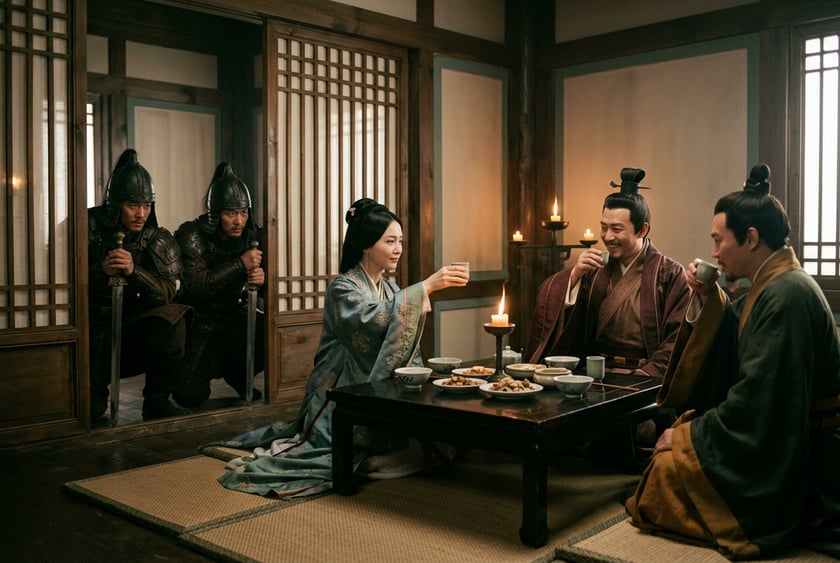
Strategic Background
In the third year of Jian'an, Cao Cao was operating under an acutely narrow window of pressure on the Central Plains: to the north, Yuan Shao was nearly finished consolidating Hebei; to the south, Yuan Shu was in decline but still held the Huai River plain; to the east, Lv Bu occupied Xuzhou with characteristic unpredictability. Xuzhou controlled the Yellow River-Huai River corridor — it was both a breadbasket and the pivot linking the Jiang-Huai region with the Qing and Xu circuits. If Cao Cao could not absorb Xuzhou before Yuan Shao moved south, there would always be a gap open in the belly of his Central Plains position. In the ninth month, Lv Bu sent Gao Shun and Zhang Liao to break through Liu Bei's base at Xiaopei, completely disrupting Cao Cao's buffer arrangement in Xuzhou. Cao Cao now had to end the Xuzhou problem as rapidly as possible so as to free his forces to face Yuan Shao — this was the fundamental background against which Jueyisiguanxiapi (diverting the Yi and Si rivers to flood Xiapi) came to be executed.
Disposition of Forces
Xiapi was situated at the confluence of the Yi and Si rivers: its walls were thick and solid, and three sides were surrounded by water — one of the rare "water cities" of the Central Plains. Lv Bu still had the strategic counsel of Chen Gong, the battle-hardened Xianjin Camp of Gao Shun, and the elite Bingzhou cavalry of Zhang Liao; relying on the city walls in a defensive posture made it extremely unfavorable for the attacker. In the initial investment, Cao Cao employed the conventional approach of encircling the walls with trenches and suppressing the defenders with arrow towers, intending to exhaust Lv Bu into surrender through prolonged attrition. Cao Cao's army had already been in continuous operation for several months; morale and provisions were both showing signs of decline. Lv Bu, for his part, relied on food stocks inside the city and the loyalty of his personal retinue and clansmen to hold out, while placing his hopes on Chen Gong soliciting relief from Yuan Shu and Zhang Yang.
Key Decision Points
After more than a month of siege with no breakthrough, calls for "withdrawing the troops" arose within Cao Cao's army, and even Cao Cao himself began to waver. The turning point came with the combined remonstrance of Xun You and Guo Jia: they pointed out that Lv Bu was physically brave but strategically shallow, and that after a string of defeats his morale was low; Chen Gong was resourceful but slow to decide; this was precisely the window of "given time he will certainly fall, but a sudden assault can take him now." At the same time they recommended changing the method of attack — diverting the Yi and Si rivers to flood the city. The engineering difficulty of this decision was extreme: it required completing a large-scale redirection of waterways in the face of the enemy, a rare "flood attack plus encirclement" combination for a cold-weapons era. Cao Cao's approval of the plan was a double victory — for his own personal resolution and for his trust in his advisory corps — and stands as the sharpest possible contrast with Yuan Shao's characteristic indecisiveness.
Results and Reverberations
After the flooding of Xiapi, standing water turned the interior into silt; grain stores rotted and the garrison suffered epidemic illness, and celebrated commanders who might otherwise have maneuvered freely — Zhang Liao, Gao Shun — were pinned down in a cold, damp, isolated city with no room to operate. Defection sentiment within Lv Bu's circle grew day by day; officers Hou Cheng, Song Xian, and Wei Xu turned coat in succession, ultimately seizing and binding Chen Gong and surrendering the east gate. Lv Bu climbed a tower to request surrender, but Cao Cao had Lv Bu, Chen Gong, and Gao Shun publicly executed at the Baimen Tower. Xuzhou, Pengcheng, and the Xiapi corridor in its entirety passed into the Cao family's domain. The military significance of this campaign was threefold: it eliminated the last high-mobility cavalry force in the Central Plains; it freed Cao Cao's eastern flank for the confrontation with Yuan Shao; and it institutionalized the three-step operational pattern of flood assault, encirclement, and enemy dissolution within the Caowei military system, a pattern that recurred in later sieges such as those of Yecheng and Xiangping.
Counterfactual Analysis
If Cao Cao had listened to the "withdraw" faction when the siege failed to break through after one month, the Xuzhou problem would have been pushed forward to around the time of Guandu. Had Yuan Shao then marched south, Cao Cao would have faced the passive situation of "resisting Yuan Shao to the north, watching Lv Bu to the east." Given Lv Bu's mobility combined with Chen Gong's strategic mind, and taking into account the external diplomatic pressure from Yuan Shu's remnant forces and Sun Ce of Jiangdong, this would have been sufficient to overturn the entire Central Plains balance of power. Conversely, if the remonstrance from Xun You and Guo Jia had come one month earlier, after the flooding Cao Cao's forces might have retained enough strength to intervene more directly in the early phases of the maneuvering against Yuan Shao, and the crises at Yanchuan and Baima might never have arisen at all. The precision of this single decision point demonstrates that the "commander–advisory group" bandwidth of mutual trust within the Caowei camp was the decisive variable in determining who would ultimately hold the Central Plains.