Historical Record
Dong Zhuo, styled Zhongying, was a native of Lintao in Longxi, Liang Province. In the first year of Chuping (190 CE), with fierce military strength and political maneuvering, he rose swiftly amid the chaos of the late Eastern Han. After Emperor Ling died, the Grand General He Jin and Yuan Shao plotted to execute the eunuchs, and He Jin summoned Dong Zhuo into the capital to coerce the Empress Dowager. However, before Dong Zhuo arrived, He Jin had already been killed c:3125. After Dong Zhuo reached Luoyang, he swiftly took control of the situation. He deposed the Young Emperor to King of Hongnong and installed the Prince of Chenliu as emperor, that is, Emperor Xian of Han. This act threw the capital into great turmoil and laid the groundwork for his later atrocities c:3125.
Dong Zhuo's lust for power and his cruel nature were soon fully exposed. He moved up to Chancellor of State, was enfeoffed as Marquis of Mei, and enjoyed the privileges of being addressed without his name at audience and of ascending the hall wearing sword and shoes; he even enfeoffed his mother as Lady of Chiyang, and his relatives within and without all held high positions c:3130. Cruel and pitiless by nature, he repaid even the slightest grudge, and constantly cowed the masses with harsh laws and punishments. For example, he once, at a banquet, before the assembly cut out the tongues, severed the hands and feet, gouged out the eyes, or boiled alive several hundred surrendered men from Beidi, while he himself ate and drank as if nothing were amiss c:3132. He also once sent an army to Yangcheng, where they slaughtered the men, plundered the women and their goods, and burned the corpses—the depth of his savage rebelliousness was appalling c:3130.
In his early period Dong Zhuo trusted the Master of Writing Zhou Bi, the Colonel of the City Gates Wu Qiong, and others, and adopted their advice, appointing Han Fu, Liu Dai, Kong Zhou, Zhang Zi, Zhang Miao, and others to important provincial and commandery posts. However, after taking office, these appointees joined forces to campaign against Dong Zhuo. On learning of this, Dong Zhuo believed that Zhou Bi and Wu Qiong had colluded with the enemy and betrayed him, and so executed them c:3131. Faced with the campaign of the eastern heroes, Dong Zhuo grew fearful and uneasy. In the second month of the first year of Chuping, he forcibly moved the capital to Chang'an, burned the palaces of Luoyang, dug up the tombs, and plundered the treasures c:3132. In the course of the relocation, he drove out the people of Luoyang, causing great loss of life, and loosed his soldiers to burn, kill, and plunder, so that for a hundred li within and around Luoyang all became scorched earth c:3132.
In Chang'an, Dong Zhuo styled himself Grand Tutor, called himself "Esteemed Father," and built the fortress of Mei, as high as the walls of Chang'an, stockpiling thirty years' worth of grain, intending thereby to dominate the realm or to make it his refuge in old age c:3132. He also cast small coins, causing the currency to depreciate, prices to soar, and the people to suffer hardship c:3132. His atrocities and his usurping affronts to the House of Han ultimately stirred the public outrage of all under heaven, and laid the groundwork for his own destruction.
In the Novel
The image of Dong Zhuo in Romance of the Three Kingdoms is, on the basis of historical fact, given a more dramatic artistic treatment, making his cruel, treacherous, and lustful side more prominent, turning him into a typical warlord of a chaotic age. The novel opens by depicting Dong Zhuo escaping punishment by bribing the Ten Attendants, and later befriending court notables, commanding the great army of the Western Liang, and constantly harboring disloyal designs c:3134.
After Dong Zhuo entered the capital, he encountered the Young Emperor and the Prince of Chenliu below Mount Beimang. The Prince of Chenliu's (the later Emperor Xian's) composed responses secretly stirred in Dong Zhuo the intent to depose and install; this is also recorded in the histories, but the novel, through details of dialogue, more vividly displays Dong Zhuo's sinister nature c:3128, c:3136. At the court assembly to depose and install the emperor, the novel emphasizes Dong Zhuo's overbearing manner and the fear of the assembled ministers. Ding Yuan stepped forth and angrily rebuked Dong Zhuo, but was checked by Lü Bu c:3137. Lu Zhi also frankly remonstrated, pointing out that Dong Zhuo lacked the talent of Yi Yin or Huo Guang and that to depose and install was an act of usurpation, and was nearly killed by Dong Zhuo c:13245. These episodes all reinforce Dong Zhuo's tyranny and the helplessness of the ministers.
In the novel, Dong Zhuo's winning over of Lü Bu is one of its important episodes. Li Su, with the Red Hare horse and gold and pearls, persuaded Lü Bu to kill Ding Yuan and join Dong Zhuo, and Lü Bu honored Dong Zhuo as his adoptive father c:3138. Although the histories record Lü Bu killing Ding Yuan and absorbing his troops, the specific details and Li Su's scheming are a brilliant invention of the novel c:3128. After Dong Zhuo deposed the Young Emperor and installed Emperor Xian, he styled himself Chancellor of State, was addressed without his name at audience, ascended the hall wearing sword and shoes, and his power and prestige were beyond compare c:13257. He even sent Li Ru to poison the King of Hongnong and Empress Dowager He, and forced Consort Tang to kill herself—the depth of his cruelty was appalling c:13258.
The episode of Cao Cao's attempt to assassinate Dong Zhuo is another climax in the novel's shaping of Dong Zhuo's image. Cao Cao entered the Chancellor's residence bearing a seven-jeweled sword, intending to strike while Dong Zhuo slept, but because Dong Zhuo grew alert he did not succeed, and finally escaped under the pretext of presenting the sword c:13260, c:13263. This episode has no clear historical record and is invented by the novel to highlight Cao Cao's daring and Dong Zhuo's cunning. In addition, when Dong Zhuo moved the capital to Chang'an, he loosed his soldiers to burn, kill, and plunder, reducing Luoyang to ruins and digging up the imperial tombs; these atrocities are depicted even more shockingly in the novel c:3144.
The novel also adds the episode of Diao Chan's "interlocking stratagem" sowing discord between Dong Zhuo and Lü Bu, so that Dong Zhuo, through his lust, turned against Lü Bu and was finally killed by him. Dong Zhuo's infatuation with Diao Chan, and the suspicion he harbored toward Lü Bu because of her, ultimately led to his destruction c:3147, c:13269. Before being killed, Dong Zhuo was even still immersed in fantasies of receiving the abdication and becoming emperor, and was finally stabbed to death with a single halberd thrust by Lü Bu at the North Side Gate, with Li Su cutting off his head c:13287. These episodes greatly enrich Dong Zhuo's literary image, making him a complex figure combining scheming, cruelty, and lust.
Key Relationships
* Liu Bian (the Young Emperor): After entering the capital, Dong Zhuo deposed the Young Emperor Liu Bian and installed the Prince of Chenliu, Liu Xie, as emperor. In the novel, Dong Zhuo even sent Li Ru to poison the King of Hongnong, Liu Bian, and his mother Empress Dowager He c:13258.
* Liu Xie (Emperor Xian): After deposing the Young Emperor, Dong Zhuo installed the Prince of Chenliu, Liu Xie, as emperor, that is, Emperor Xian of Han. However, under Dong Zhuo's control, Liu Xie was no more than a puppet c:3130.
* Zhang Huan: The histories record that Dong Zhuo was once recommended by Zhang Huan and was once his subordinate. In Dong Zhuo's early years, Zhang Huan showed him the kindness of recognizing his talent.
* Han Sui: There was military conflict between Dong Zhuo and Han Sui. The histories record that Bian Zhang and Han Sui of Jincheng killed the inspectors and commandery administrators in revolt, and Dong Zhuo took part in suppressing them c:3125.
* Lü Bu: Dong Zhuo's most important general. The histories record that Dong Zhuo had Lü Bu kill the Bearer of the Gilded Mace Ding Yuan and absorb his troops, so that the military power of the capital all fell to Dong Zhuo c:3128. In the novel, Li Su, with the Red Hare horse and gold and pearls, persuaded Lü Bu to kill Ding Yuan and honor Dong Zhuo as his adoptive father, but later they turned against each other over Diao Chan, and Lü Bu finally assassinated Dong Zhuo c:3138, c:13287.
* Li Ru: Dong Zhuo's trusted strategist. In the novel, Li Ru repeatedly devised plans for Dong Zhuo, including deposing and installing the emperor, winning over Lü Bu, and moving the capital to Chang'an, and even, by command, poisoned the King of Hongnong c:3137, c:13258.
* Wang Yun: The Minister over the Masses Wang Yun was Dong Zhuo's political adversary. In the novel, Wang Yun used Diao Chan to carry out the "interlocking stratagem," sowing discord between Dong Zhuo and Lü Bu, finally bringing about Dong Zhuo's death c:13269.
* Yuan Shao: Leader of the Eastern allied army, irreconcilably opposed to Dong Zhuo. The histories record that Yuan Shao once plotted with He Jin to execute the eunuchs, and later became the leader of the alliance campaigning against Dong Zhuo c:3125. In the novel, Yuan Shao drew his sword against Dong Zhuo at the court assembly to depose and install the emperor, then fled to Jizhou and became leader of the anti-Dong alliance c:3140, c:13265.
* Cao Cao: An important figure in the campaign against Dong Zhuo. In the novel, Cao Cao once secretly plotted to assassinate Dong Zhuo, fled after failing, and later dispersed his family wealth at Chenliu, gathered righteous troops, and rose up to campaign against Dong Zhuo c:13260, c:3125.
* Sun Jian: An important general in the campaign against Dong Zhuo. In the novel, Sun Jian fought bravely against Dong Zhuo's forces at the front lines of Sishui Pass and Hulao Pass c:13265. Dong Zhuo once wished to make a marriage alliance with Sun Jian, but was refused by Sun Jian c:3143.
Iconic Scenes
* Deposing and installing the emperor: After entering the capital, Dong Zhuo, disregarding the objections of Lu Zhi and others, forcibly deposed the Young Emperor Liu Bian and installed the Prince of Chenliu, Liu Xie, as emperor. This act was the iconic event of Dong Zhuo's seizing control of the court and acting with arbitrary autocracy c:3130, c:13256.
* Winning over Lü Bu: Through Li Su's scheming, Dong Zhuo bribed Lü Bu with the Red Hare horse and gold and pearls, so that he killed Ding Yuan and came over to him, greatly strengthening Dong Zhuo's military power. This event is depicted in detail in the novel and was a key step in the expansion of Dong Zhuo's power c:3138.
* Moving the capital to Chang'an and burning Luoyang: Faced with the campaign of the Eastern alliance, Dong Zhuo forcibly moved the capital to Chang'an, set fire to the palaces and dwellings of Luoyang, dug up the imperial tombs, and plundered the treasures. This atrocity not only caused enormous destruction but also thoroughly exposed Dong Zhuo's cruel nature c:3132, c:3144.
* The banquet at Mei fortress and slaughter of surrendered men: At a banquet in his Mei fortress, Dong Zhuo before the assembly cruelly executed several hundred surrendered soldiers from Beidi, severing hands and feet, gouging out eyes, or boiling them alive, while he himself ate and drank as if nothing were amiss. This scene is recorded in both the histories and the novel, and is a typical embodiment of Dong Zhuo's pitiless cruelty and bloodthirst c:3132, c:3146.
* Cao Cao's attempt to assassinate Dong Zhuo: In the novel, Cao Cao entered the Chancellor's residence bearing a seven-jeweled sword, intending to strike while Dong Zhuo slept, and finally escaped under the pretext of presenting the sword. Although this episode is a fiction of the novel, it vividly displays Dong Zhuo's wariness and Cao Cao's daring, and has become a classic passage of Romance of the Three Kingdoms c:13260.
* Diao Chan's stratagem of discord: In the novel, the Minister over the Masses Wang Yun used the singing-girl Diao Chan to sow discord between Dong Zhuo and Lü Bu, father and son, so that the two turned into enemies. Diao Chan met with Lü Bu at the Fengyi Pavilion, and then wept before Dong Zhuo over being bullied by Lü Bu, finally prompting Lü Bu to harbor the intent to kill Dong Zhuo c:3147, c:13269.
* The killing of Dong Zhuo: On his way to the Weiyang Hall to receive the abdication, Dong Zhuo was stabbed to death with a single halberd thrust by Lü Bu, and Li Su cut off his head. This scene marks the end of Dong Zhuo's tyrannical rule and the conclusion of his wicked life c:13287.
Portrait file
Character profile
- Character
- Dong Zhuo was cruel and merciless, with a taste for killing; he avenged the smallest grudge, was arrogant, extravagant, and unrestrained, and presumed upon his great power, given to declaring himself 'noble above all.' Arrogant by nature, he slighted Xuande, was disloyal, greedy for gain, and quick to rage, yet he recognized the sharp wit of the Prince of Chenliu. He was brutal and domineering, suspicious and haughty, relying on military force, and the first to take fright at any alarm.
- Manner of speech
- Dong Zhuo spoke with arrogant condescension and snobbery, looking down on others according to their rank.
- Life
- Dong Zhuo, styled Zhongying, was a native of Lintao in Longxi. In his youth he was fond of chivalric feats, roamed among the Qiang, and formed ties with their chieftains. He held such posts as Gentleman of the Feathered Forest, Gentleman-of-the-Household, Prefect of Guangwu, Commandant of the Northern Section of Shu Commandery, and Wu-Ji Colonel of the Western Regions; later he was appointed Inspector of Bing Province and Grand Administrator of Hedong, and promoted to General of the Household. He commanded a great western army of two hundred thousand and long harbored disloyal ambitions. When he failed to gain merit against the Yellow Turbans and was about to be punished, he bribed the Ten Attendants to escape it, and further attached himself to court notables to obtain high office.
- Weapons
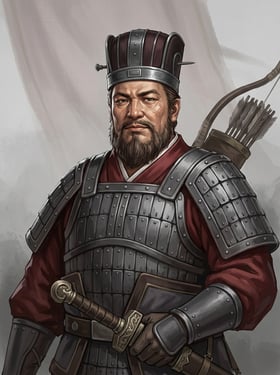
- Dong Zhuo was skilled at mounted archery, carrying two bow-cases so that he could gallop and shoot to both left and right.
- Anecdotes
- Acting on a secret edict, Dong Zhuo raised troops and marched toward Luoyang, submitting a memorial requesting the execution of the Ten Attendants to set matters right. After entering Luoyang he stationed his troops outside the city, and each day led his armored cavalry into the city to run rampant through the streets. At the Wenming Garden he summoned the officials to debate deposing the emperor, berated Ding Yuan, and used gold, pearls, and Red Hare to buy over Lü Bu before killing Ding Yuan. He entered the court without hastening his steps, ascended the hall wearing sword and shoes, and was announced without his name being called; he styled himself 'Imperial Preceptor,' built the fortress of Meiwu stocked with twenty years' provisions, and often boiled or hacked surrendered soldiers to amuse his banquets.
Relationships
51 relationships
Family9
Lord & vassal6
Enemies20
Other14
Quotes
55 recorded lines · 3 featured
「順我者生,逆我者死!」
A classic portrayal of Dong Zhuo's tyranny, revealing his domineering and overbearing character.
「今上闇弱,不可以奉宗廟;吾將依伊尹、霍光故事,廢帝為弘農王,立陳留王為帝。有不從者斬!」
Dong Zhuo's declaration of deposing and installing emperors, a key manifestation of his ambition to usurp the Han.
「天下事在我!我今為之,誰敢不從?汝視我之劍不利否?」
Dong Zhuo's arrogant words as his power dominated the entire court, displaying his overweening posture.
Chapters13 回 ▸
- 史ch.1ch.6ch.7ch.15ch.38ch.46
- 演ch.3ch.4ch.5ch.6ch.7ch.8ch.9
Relationship timeline24 条 ▸
Inner monologues · AI-generated3 段 ▸
- I still remember the debate in the hall at Luoyang. The emperor was young and unformed; in my view, the King of Chenliu
- I am Dong Zhuo, courtesy name Zhongying. The power I wield today is beyond comparison with what I once had as a mere fro
- I remember that when I was young, I was born in Lintao, Longxi. The frontier was a hardy, fierce place, where Qiang and
Life events3 ▸
- 0189-01-01 · LuoyangDong Zhuo's Coup· Instigator
- 0190-01-01 · YangrenBattle of Yangren· Commander
- 0192-01-01 · Chang'anWang Yun's Interlocking Stratagem· Victim