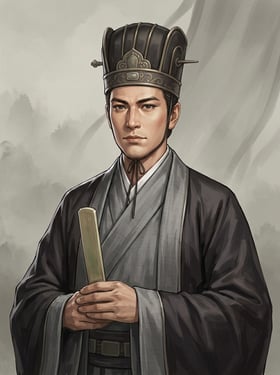
Historical Record
Xun Yu, styled Wenruo, was a native of Yingyin in Yingchuan, born into an eminent and prominent family of the late Eastern Han. His grandfather Xun Shu was famous for his "Eight Dragons" (his eight sons), his father Xun Gun once served as Chancellor of Jinan, and his uncle Xun Shuang rose to the office of Excellency of Works. As a youth, Xun Yu already displayed extraordinary qualities, and He Yong of Nanyang appraised him as "a talent fit to assist a king". In the first year of Yonghan under Emperor Xian of Han (189 CE), Xun Yu was nominated as Filial and Incorrupt and appointed Prefect of the Palace Secretariat. After Dong Zhuo's Coup, he foresaw that Yingchuan would become a battleground fought over on all sides, and urged his fellow townsmen to leave quickly, but most hesitated indecisively. In the end, Xun Yu alone led his clan to Jizhou, taking refuge with Han Fu, who was from the same commandery. However, Han Fu, the Governor of Jizhou, was soon supplanted by Yuan Shao. While in Yuan Shao's service, Xun Yu keenly perceived that Yuan Shao "would never be able to accomplish great things," and so in the second year of Chuping (191 CE) he abandoned Yuan Shao and joined Cao Cao, who was then in Dong Commandery. Upon meeting Xun Yu, Cao Cao was overjoyed, calling him "my own Zifang," and appointed him Major.
In the early stages of Cao Cao's enterprise, Xun Yu played a crucial role. In the first year of Xingping (194 CE), when Cao Cao campaigned eastward against Tao Qian, he left Xun Yu to guard Juancheng. At this time, Zhang Miao and Chen Gong revolted and welcomed Lü Bu into Yanzhou. With the various cities of Yanzhou responding to Lü Bu one after another, Xun Yu responded calmly, swiftly summoning Xiahou Dun, Administrator of Dong Commandery, and executing those who intended to rebel, thereby stabilizing the army's morale. When Guo Gong, Inspector of Yu Province, arrived at the city walls with tens of thousands of troops, all the generals were afraid, but Xun Yu went in person to persuade him, causing Guo Gong to withdraw his troops. He also conspired with Cheng Yu to preserve the three cities of Juancheng, Fan, and Dong'e, safeguarding Cao Cao's base.
In the first year of Jian'an (196 CE), when Emperor Xian of Han returned from Hedong to Luoyang, Cao Cao wished to receive the Son of Heaven and establish the capital at Xu. Facing the doubts of many, Xun Yu overruled the objections, pointing out that receiving the Son of Heaven was an act of "great compliance, great strategy, and great virtue" that would help Cao Cao rescue and uphold the realm. Cao Cao adopted his advice, received the Son of Heaven at Xu, and was thereby appointed Grand General. Xun Yu was appointed Palace Attendant of Han and Prefect of the Masters of Writing, often residing at the center holding weighty responsibility, planning the great affairs of state and war for Cao Cao. He not only devised strategy for Cao Cao, but also contributed outstandingly in recommending talent, successively recommending Xun You, Zhong Yao, Xi Zhicai, Guo Jia, and many other worthy men. In the eighth year of Jian'an (203 CE), Cao Cao memorialized Xun Yu's merits, enfeoffing him as Marquis of Wansui Precinct, and later increased his fief to two thousand households.
However, the relationship between Xun Yu and Cao Cao as lord and subject developed a rift in the later period. In the seventeenth year of Jian'an (212 CE), Dong Zhao and others proposed that Cao Cao be advanced to the rank of Duke of State and granted the Nine Bestowments. Xun Yu held that Cao Cao had raised righteous armies in order to rescue and uphold the House of Han, and should uphold the substance of loyalty and yielding, and that this was not fitting. Cao Cao thereupon grew displeased with Xun Yu. That same year, when Cao Cao campaigned against Sun Quan, he memorialized to request that Xun Yu reward the troops at Qiao, but then kept him at Shouchun. Xun Yu finally died of melancholy, at the age of fifty. The following year, Cao Cao was enfeoffed as Duke of Wei.
In the Novel
In Romance of the Three Kingdoms, Xun Yu's image is further shaped into Cao Cao's chief strategist and a loyal and faithful subject, with his trait as "a talent fit to assist a king" repeatedly emphasized. He first appears in chapter 10, joining Cao Cao together with his nephew Xun You; Cao Cao calls him "my own Zifang" and appoints him Marching Major. In the novel, Xun Yu not only possesses foresight himself but is also adept at recommending talent: Cheng Yu, Guo Jia, Liu Ye, Man Chong, Lu Qian, Mao Jie, and others were all recommended to Cao Cao by him or by those he had recommended, laying a solid foundation of talent for Cao Cao's camp.
The Romance places emphasis on Xun Yu's crucial role when Cao Cao faced difficulties. For example, when Lü Bu seized Yanzhou and Cao Cao was left homeless, Xun Yu and Cheng Yu devised a plan to hold fast to the three cities of Juancheng, Dong'e, and Fan, preserving a foothold for Cao Cao. When Cao Cao wished to attack Xu Province because of Tao Qian's death, Xun Yu strongly remonstrated, pointing out, "If Xu Province is not won, where will Your Excellency return to?" He urged Cao Cao first to stabilize Yanzhou, and suggested campaigning eastward to take the lands of Chen, using the grain of the Yellow Turban remnants to feed the army—a move that both solved the army's provisioning problem and accorded with the will of the people.
In the matter of receiving the Son of Heaven, the Xun Yu of the Romance likewise played a key role. He urged Cao Cao that "to receive the Son of Heaven and thereby comply with the people's hopes is an unrivaled strategy," prompting Cao Cao to receive Emperor Xian of Han at Xu, so that "from this point all great power fell to Cao Cao". The novel also invents a discussion between Xun Yu and Wang Li, Liu Ai, and others concerning the prophecy that "he who replaces Han is of the earth," further reinforcing the rationale for Cao Cao's relocation of the capital to Xu, as well as Xun Yu's profound understanding of Cao Cao's hegemonic enterprise.
In the Romance, Xun Yu's strategy is also reflected in dividing and undermining enemies. He once offered Cao Cao the "Stratagem of Two Tigers Fighting over Food" and the "Stratagem of Driving the Tiger to Devour the Wolf," attempting to use Liu Bei's hand to eliminate Lü Bu, or Yuan Shu's hand to weaken Liu Bei, displaying his deep and far-reaching calculation. Before the Battle of Guandu, when Kong Rong worried about the strength of Yuan Shao's power, Xun Yu refuted him with the "ten victories and ten defeats" argument (which in historical fact was spoken by Guo Jia, but in the Romance is put into Xun Yu's mouth, perhaps a conflation), pointing out the internal contradictions within Yuan Shao's faction and the weaknesses of his generals, thereby firming Cao Cao's confidence.
Regarding Xun Yu's end, the Romance differs from historical fact, but both emphasize his loyalist stance toward Han. In the novel, when Cao Cao wished to advance to the rank of Duke of Wei, Xun Yu dissuaded him with the words "we originally raised righteous armies to set the court right and bring peace to the state," angering Cao Cao. In the end, Cao Cao sent Xun Yu an empty food box; Xun Yu understood its meaning and thereupon took poison and killed himself. Although this episode has no clear historical record, it greatly reinforces Xun Yu's character of "loyal and yielding faithfulness," making him a tragic figure of the loyal minister.
Key Relationships
* Cao Cao (lord and subject): Xun Yu was one of Cao Cao's most important strategists, praised by Cao Cao as "my own Zifang". He devised strategy for Cao Cao, recommended talent, and stabilized the rear, contributing immensely to the establishment of Cao Cao's hegemony. However, when Cao Cao later intended to usurp the Han, Xun Yu developed a rift with him by insisting on his stance as a loyal subject of the House of Han, ultimately dying of melancholy (in history) or taking poison to kill himself (in the novel).
* Xun You (kin/colleague): Xun Yu's nephew, likewise an important strategist of Cao Cao. Xun Yu once recommended Xun You to Cao Cao, saying he could take his place in devising plans for Cao Cao. The two assisted Cao Cao together and were close.
* Yuan Shao (former lord/rival): Xun Yu once briefly served Yuan Shao, but soon saw that Yuan Shao "would never be able to accomplish great things" and switched to Cao Cao. During the standoff between Cao Cao and Yuan Shao, Xun Yu's analysis of Yuan Shao and his steadfast support for Cao Cao were among the key factors in Cao Cao's eventual victory.
* Cheng Yu (colleague/comrade-in-arms): During Cao Cao's eastern campaign against Tao Qian and the Yanzhou revolt, Xun Yu cooperated fully with Cheng Yu to preserve the three cities of Juancheng, Fan, and Dong'e, holding Cao Cao's base.
* Guo Jia (colleague/recommended): After Xi Zhicai died, Xun Yu recommended Guo Jia to Cao Cao, and Cao Cao thereupon praised Xun Yu as a "judge of men". Guo Jia also became an important strategist of Cao Cao, devising plans for Cao Cao alongside Xun Yu.
* Emperor Xian of Han (object of loyalty): Throughout his life, Xun Yu upheld the conviction of loyalty to Han, strongly advocating receiving Emperor Xian, and taking the rescue of the House of Han as his own duty. His opposition to Cao Cao's advancement to Duke of State and grant of the Nine Bestowments arose precisely from his loyalty to the House of Han.
* He Yong (one who knew him): As a youth, He Yong appraised Xun Yu as "a talent fit to assist a king," showing his discernment of men.
* Mi Heng (one who appraised him): Mi Heng once gave Xun Yu the contemptuous appraisal that "Wenruo could be lent out as a face to mourn at funerals," holding that Xun Yu had only appearance and no real talent. However, this reflects more Mi Heng's arrogance than Xun Yu's true abilities.
Iconic Scenes
* Abandoning Yuan for Cao, called "Zifang": While in Yuan Shao's service, Xun Yu saw that Yuan Shao "would never be able to accomplish great things" and resolutely abandoned him to join Cao Cao. Upon meeting Xun Yu, Cao Cao was overjoyed and called him "my own Zifang"—a scene that established Xun Yu's important position in Cao Cao's camp.
* Holding the three cities to preserve Yanzhou: At the critical moment when Cao Cao was campaigning eastward against Tao Qian, Lü Bu took advantage of the gap, and most of Yanzhou rebelled, Xun Yu conspired with Cheng Yu to hold fast to the three cities of Juancheng, Fan, and Dong'e, preserving Cao Cao's base so that he still had a place to return to even after his defeat in Xu Province.
* Overruling objections to receive the Son of Heaven: When Cao Cao hesitated over whether to receive Emperor Xian of Han, Xun Yu forcefully laid out the advantages and risks, pointing out that the move was one of "great compliance, great strategy, and great virtue," prompting Cao Cao to receive the Son of Heaven and establish the capital at Xu, thereby "holding the Son of Heaven to command the lords" and laying the political foundation for Cao Cao's hegemony.
* Recommending worthies, knowing men and using them well: Xun Yu was not only outstandingly talented himself but, with his discernment of men, successively recommended Xun You, Zhong Yao, Xi Zhicai, Guo Jia, and many other first-rate talents, providing a steady stream of fresh blood for the growth of Cao Cao's camp. Cao Cao once praised Xun Yu as a "judge of men," saying, "The two Xun prefects' appraisals of men become more trustworthy with time; I shall never forget them to the end of my days".
* Analysis of Yuan Shao's faction before the Battle of Guandu: Before the Battle of Guandu, when Cao Cao and Yuan Shao were vastly unequal in strength, Xun Yu (in the Romance; in history it was Guo Jia) made a precise analysis of the internal contradictions in Yuan Shao's faction and the characteristics of his generals, pointing out that his troops were "many but disorderly" and "bound to give rise to internal upheaval," firming Cao Cao's confidence to overcome the strong with the weak.
* Death by the empty box (unique to the novel): When Cao Cao wished to advance to the rank of Duke of Wei, Xun Yu dissuaded him by insisting on his stance as a loyal subject of the House of Han, angering Cao Cao. Cao Cao sent Xun Yu an empty food box; Xun Yu understood its meaning and thereupon took poison and killed himself. Although this episode has no clear historical record, it became the iconic scene of Xun Yu's unyielding loyalty and willingness to prove his resolve through death in the Romance.
* Dissuading Cao Cao from attacking Xu Province, turning instead to take the lands of Chen: In the Romance, when Cao Cao wished to attack Xu Province because of Tao Qian's death, Xun Yu strongly remonstrated, pointing out that attacking Xu Province would leave Yanzhou empty, and that the hearts of Xu Province's people had already turned to Liu Bei. He suggested that Cao Cao instead campaign eastward to take the lands of Chen, using the grain of the Yellow Turban remnants to feed the army—a plan that both solved the army's provisioning problem and avoided premature conflict with Liu Bei.
* The "Two Tigers Fighting over Food" and "Driving the Tiger to Devour the Wolf" stratagems (unique to the novel): Xun Yu offered Cao Cao plans to exploit the conflict between Liu Bei and Lü Bu, or that between Yuan Shu and Liu Bei, in order to weaken or eliminate Liu Bei, displaying his superb political strategy.
* "Walking among coffins of the dead, how could I not weep?": Mi Heng was arrogant and unrestrained before Cao Cao, publicly humiliating Cao Cao and his strategists. When Xun Yu and others saw Mi Heng off, they deliberately remained seated and did not rise; Mi Heng then wept aloud, saying, "Walking among coffins of the dead, how could I not weep?"—mocking Cao Cao and his subordinates as "corpses." Although this episode is Mi Heng's arrogant raving, it also indirectly reflects the standing of Xun Yu and others in Cao Cao's camp and their loyalty to Cao Cao.
Portrait file
Character profile
- Character
- Xun Yu possessed the talent of a royal counselor, loyal and steadfast yet deferential, deep in thought and far-sighted in strategy. He humbled himself to court men of ability, never bent to private interests, and held his heart fair and upright. His deliberations were thorough and comprehensive; he excelled at dissecting matters in terms of advantage and harm, weighty and measured in his planning.
- Manner of speech
- In discussing affairs, Xun Yu analyzed gains and losses point by point, often drawing on the successes and failures of ancient and modern times as illustration, and set great store by his 'four points of superiority.' He judged matters through incisive appraisals of men, terse yet decisive in speech, and was also skilled at long-form strategic memorials and weighty, measured remonstrance.
- Life
- Xun Yu's grandfather was Xun Shu, his father Xun Gun, and his uncle Xun Shuang. In his early years he was nominated as filial and incorrupt (xiaolian); later he went over to Cao Cao, who called him 'my own Zifang.' He once urged Cao Cao to receive and escort the Son of Heaven and establish the capital at Xu, and strenuously advocated holding fast at Guandu. He opposed the proposal of Dong Zhao and others to advance Cao Cao to Duke of the State with the Nine Bestowals, and in the end died of illness at Shouchun.
- Anecdotes
- Xun Yu was Cao Cao's chief strategist, and repeatedly stayed behind to guard Juancheng and Xu. He was enfeoffed as Palace Attendant and Master of Writing (Shangshu Ling), and once firmly declined the memorialized enfeoffment offered for his labors in the field.
Relationships
26 relationships
Family6
Lord & vassal1
Friends9
Enemies1
Teacher & student1
Other6
Quotes
46 recorded lines · 3 featured
「昔晉文公納周襄王,而諸侯服從;漢高祖為義帝發喪,而天下歸心;今天子蒙塵,將軍誠因此時首倡義兵,奉天子以從眾望,不世之略也。若不早圖,人將先我而為之矣。」
This stratagem laid the strategic foundation for Cao Cao to hold the emperor in hand and thereby command the feudal lords, with far-reaching influence.
「將軍勇則勇矣,不知用謀。今許都新定,未可造次用兵。彧有一計,名曰:『二虎競食之計』。今劉備雖領徐州,未得詔命。明公可奏請詔命實授備為徐州牧,因密與一書,教殺呂布。事成則備無猛士為輔,亦漸可圖;事不成,則呂布必殺備矣;此乃『二虎競食之計』也。」
The 'two tigers competing for food' stratagem demonstrates Xun Yu's masterful political scheming.
「不可。丞相本興義兵,匡扶漢室,當秉忠貞之志,守謙退之節。君子愛人以德,不宜如此。」
Xun Yu's political allegiance to the House of Han foreshadows the tragedy of his life.
Chapters31 回 ▸
- 史ch.10ch.11ch.13ch.14ch.16ch.23ch.26ch.29
- 演ch.10ch.11ch.12ch.14ch.16ch.17ch.18ch.19ch.20ch.21ch.22ch.23ch.24ch.25ch.26ch.30ch.31ch.34ch.37ch.39ch.40ch.60ch.61
Relationship timeline35 条 ▸
史 ch.10
kin_of
叔侄(爽为彧叔父,司空)
- Xun Gun§3
kin_of
父子
- He Yong§5
friend_of
何颙异荀彧,称"王佐才也"
- Cao Cao§5
advises_in
太祖曰"吾之子房也",以彧为腹心谋主
- Xun Chen§5
sibling_of
兄弟
- Cheng Yu§5
friend_of
兴平元年同谋全鄄、范、东阿三城
friend_of
兖州反时驰召夏侯惇;惇夜诛谋叛者数十人
friend_of
荀彧荐钟繇于太祖
- Guo Jia§7
friend_of
志才卒,又进郭嘉
friend_of
荀彧所荐为扬州,后败亡
- Wei Kang§7
friend_of
荀彧所荐为凉州,后为马超所杀
- Xun Yun§27
parent_of
父子
- Cao Cao§29
rival_of
反对董昭等进太祖国公九锡之议,太祖心不能平
- Xun You§45
kin_of
从父叔侄(攸为彧从子)
史 ch.11
史 ch.14
- Guo Jia§21
mentor_of
荀彧荐嘉于曹操
史 ch.29
- Hua Tuo§19
friend_of
请太祖宽宥华佗
演 ch.10
演 ch.12
- Cao Cao§13
advises_in
谏阻舍兖州取徐州,献东略陈地之计
演 ch.14
- Cao Cao§10
advises_in
进「奉天子以从众望」之策;後又献二虎竞食、驱虎吞狼之计
演 ch.18
演 ch.19
- Guo Jia§30
friend_of
笑问「莫非決沂、泗之水乎?」
演 ch.20
- Cao Cao§6
advises_in
入见劝议——「天子認劉備為叔,恐無益於明公」
演 ch.21
- Cao Cao§33
建议密令车胄就内图之
演 ch.22
- Cao Cao§21
advises_in
反对议和,逐评袁绍麾下之短
演 ch.24
- Cao Cao§19
advises_in
荀彧据牙旗折断之象判断今夜刘备必来劫寨
演 ch.25
- Cao Cao§10
advises_in
谏勿轻退兵恐有诈
演 ch.26
- Cao Cao§11
advises_in
密谏不可频令关公出征,恐其知玄德消息必去
演 ch.31
- Cao Cao§16
advises_in
自许都驰书报刘备袭许之事
演 ch.40
- Zhi Xi§5
advises_in
为脂习求情称其义人,操遂止杀
演 ch.60
- Cao Cao§14
advises_in
谏免张松死,乱棒打出
演 ch.61
- Cao Cao§37
betrayed_by
阻尊操为魏公加九锡;操深恨之,遣空盒赐死
Inner monologues · AI-generated3 段 ▸
- By this point, what I was guarding was no longer the security of a single city or commandery, but whether the Han house
- Throughout my life, I held to one conviction: so long as the Han court still stood, its proper order and rites must not
- I was styled Wenruo and was from Yingyin, Yingchuan. My grandfather, Xun Shu, styled Jihe, once served as Magistrate of
Life events22 ▸
- 0189-01-01 · ChenliuCao Cao Raises an Army· Advisor
- 0193-01-01 · Xu ProvinceCao Cao's Campaign Against Xu Province· Advisor
- 0194-01-01 · YanzhouLü Bu's Seizure of Yanzhou· Advisor
- 0194-01-01 · Xu ProvinceCao Cao's Campaign Against Tao Qian· Advisor
- 0194-01-01 · JuanchengCheng Yu Holds Three Cities Against Chen Gong· Advisor
- 0195-01-01 · YanzhouBattle of Yanzhou· Advisor
- 0196-01-01 · XuchangStratagem of Two Tigers Fighting over Food· Advisor
- 0196-01-01 · XuchangCao Cao Escorts the Emperor and Moves the Capital to Xu· Advisor
- 0196-01-01 · JuanchengXun Yu's Counsel to Escort the Emperor· Advisor
- 0196-01-01 · YeGuo Jia Leaves Yuan Shao and Joins Cao Cao· Advisor
- 0198-01-01 · XiapiFlooding of Xiapi via the Yi and Si Rivers· Advisor
- 0198-01-01 · XuMi Heng Beats the Drum and Reviles Cao Cao· Witness
- 0198-01-01 · XuchangGuo Jia's Ten Advantages and Ten Disadvantages· Advisor
- 0200-01-01 · XiapiGuan Yu Surrenders to Cao Cao· Advisor
- 0200-01-01 · XuchangThe Ten Victories and Ten Defeats Theory· Advisor
- 0201-01-01 · Chang'anWei Ji's Salt Office Policy· Advisor
- 0207-01-01 · XuchangCheng Yu's Forged Letter Lures Xu Shu· Witness
- 0208-01-01 · XuchangExecution of Kong Rong· Advisor
- 0208-01-01 · XuchangCao Cao Has Hua Tuo Executed· Advisor
- 0211-01-01 · ChengduZhang Song Presents the Map and Plots to Cede Shu· Witness
- 0212-01-01 · ShouchunDeath of Xun Yu· Victim
- 0213-01-01 · XuchangCao Cao Elevated to Duke of Wei· Advisor