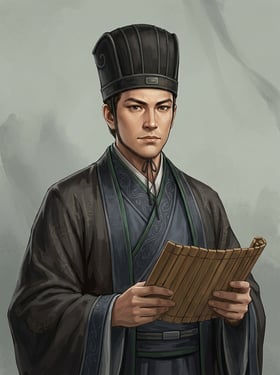
Historical Record
Guo Jia, styled Fengxiao, was a native of Yangzhai in Yingchuan. Even in his youth he possessed far-reaching vision and insight. Amid the great upheaval at the end of the Han, he secretly cultivated ties with men of distinction and refused to mingle with the common crowd, so that few of his contemporaries understood him—only a small number of discerning men recognized that he was extraordinary. At the age of just twenty-seven, he was summoned by the office of the Minister over the Masses. c:3886
Guo Jia once traveled north to call upon Yuan Shao, and spoke bluntly to Yuan Shao's advisers Xin Ping and Guo Tu: "A wise man carefully chooses his lord, and only thus can his every undertaking succeed and his fame be achieved. Lord Yuan merely imitates the Duke of Zhou's courtesy to worthy men, yet does not grasp the art of employing them. He ponders much but cannot seize the essentials, is fond of scheming yet indecisive—to seek with him to relieve the great troubles of the realm and accomplish a hegemon's enterprise would surely be most difficult!" And so Guo Jia left Yuan Shao. c:3886
After Xi Zhicai died, Cao Cao asked Xun Yu who might fill his place. Xun Yu recommended Guo Jia. Cao Cao summoned Guo Jia, and after discussing the great affairs of the realm with him was overjoyed, praising him: "The one who will enable me to accomplish my great enterprise must be this man!" When Guo Jia withdrew, he too said with delight: "This truly is my real lord." Guo Jia was then appointed Libationer of the Excellency of Works' Army. c:6505
When Cao Cao and Yuan Shao stood opposed, Guo Jia put forward his famous theory of the "Ten Victories and Ten Defeats." He likened Cao Cao to the wise Han Gaozu, and Yuan Shao to Xiang Yu, who though mighty was in the end captured. Guo Jia analyzed that Yuan Shao had ten grounds for defeat: excessive ceremony and ritual; acting against righteousness; meeting leniency with further leniency; outward generosity but inward suspicion; much scheming but little decision; obsession with reputation; caring for those near while neglecting those far; ministers contending for power; an inability to tell right from wrong; and a love of empty displays of strength. Cao Cao, by contrast, had ten grounds for victory: conducting himself naturally; leading the realm in obedience to what is right; correcting men with firmness; outwardly plain and simple yet inwardly sharp and astute; carrying out a plan as soon as it was decided; treating men with utmost sincerity; bestowing favor that always exceeded expectation; governing his subordinates by principle; advancing what was right with propriety and correcting what was wrong with law; and wielding troops like a god. Guo Jia declared that though Yuan Shao's troops were strong, he could accomplish nothing. c:3887
In the campaign against Lü Bu, Cao Cao's army won three battles in three engagements, and Lü Bu withdrew to defend his position. At that point the soldiers were weary, and Cao Cao once thought to withdraw, but Guo Jia urged him to press the attack hard, and in the end Lü Bu was captured. c:3888 When Sun Ce rose swiftly in the Jiangdong region and intended to strike north against Xu, all the generals were afraid. But Guo Jia foresaw: "Sun Ce has only just annexed Jiangdong, and those he has put to death were heroes able to command men to fight to the death for them. Yet Sun Ce is rash and unguarded; though he have a host of a million, it is as if he walks alone through the Central Plains. Should an assassin lie in wait, he is no more than a match for a single man. As I see it, he is bound to die at the hands of a common fellow." And indeed, before crossing the river Sun Ce was killed by retainers of Xu Gong. c:3889
After Cao Cao defeated Yuan Shao, he wished to press his victory and pursue Yuan Tan and Yuan Shang. But Guo Jia advised: "Yuan Shao cherished these two sons and never clearly designated an heir. With advisers such as Guo Tu and Feng Ji among them, the brothers are bound to contend with one another. Press them hard and they will unite; ease the pressure and a spirit of strife will arise. It would be better to turn south toward Jing Province, feigning a campaign against Liu Biao, and to wait for the brothers to turn on each other; once they do, we may attack them and settle the matter at a single stroke." Cao Cao adopted the plan, marched south against Liu Biao, and Yuan Tan and Yuan Shang did indeed contend for Jizhou, whereupon Cao Cao seized the chance to pacify the region north of the Yellow River. c:3890
In the campaign against the Wuhuan, the generals, fearing that Liu Biao and Liu Bei would take advantage of the empty rear, urged Cao Cao to withdraw. But Guo Jia overruled them all, pointing out: "Though your might shakes the realm, the barbarians, relying on their remoteness, are sure to be unprepared. Striking them suddenly while they are off guard, we can destroy them. Moreover, Yuan Shao showed favor to the people and the Yi, and the brothers Yuan Shang still survive. The people of the four provinces have now submitted merely out of fear of our power, while our virtuous governance has not yet been extended; if we abandon them and march south, Yuan Shang, relying on the support of the Wuhuan, will gather his old followers, and once the barbarians stir, the people and the Yi will respond, rousing Tadun's ambitions—then I fear that Qing and Ji provinces would no longer be ours. As for Liu Biao, he is no more than a man of idle talk; he knows his own ability is insufficient to control Liu Bei, so if he employs him greatly he fears he cannot restrain him, and if he employs him lightly Liu Bei will not be used by him. Even if we empty the state for a distant campaign, you, my lord, need not worry." Cao Cao adopted Guo Jia's advice. When the army reached Yixian, Guo Jia further proposed that "speed is precious in war," advising a march by light troops along a double route to catch the enemy unawares; in the end the Wuhuan were crushed and Tadun was slain. c:14951
In the Novel
In Romance of the Three Kingdoms, Guo Jia's entrance is closely linked with the advisers Xun Yu, Cheng Yu, and others. Xun Yu recommended Cheng Yu to Cao Cao, and Cheng Yu in turn recommended Guo Jia to Xun Yu, calling him "a worthy man of the present age." c:6507 This differs slightly from the historical record, in which Xun Yu recommends Guo Jia directly, but both highlight that Guo Jia's talent was recognized by Cao Cao's camp.
The novel's portrayal of Guo Jia stresses his almost supernatural foresight and deep, far-sighted planning. For example, when Cao Cao attacked Xu Province and Liu Bei came to its relief, Guo Jia advised Cao Cao to "answer him with fair words to ease Bei's wariness," and then to continue the siege. c:11 In the campaign against Lü Bu, Guo Jia offered counsel many times. When Cao Cao fell into Lü Bu's trap at Puyang and was attacked with fire, Guo Jia offered the stratagem of "turning the enemy's plan against him," spreading the false report that Cao Cao was dead to lure Lü Bu to attack, and laid an ambush at Maling Mountain that dealt Lü Bu a great defeat. c:3893
In the novel, Guo Jia also played an important role in Cao Cao's attitude toward Liu Bei. When Xun Yu advised killing Liu Bei, Guo Jia, from the standpoint of attracting worthy men of the realm, urged Cao Cao not to kill him, arguing: "If you kill him, this is to harm a worthy man. The men of wisdom and strategy throughout the realm, hearing of it, will grow suspicious and hold back their steps—with whom then, my lord, will you settle the realm?" c:6509 Although Liu Bei later led troops out to Xu Province, and Guo Jia and Cheng Yu urgently remonstrated with Cao Cao, pointing out, "This is to loose a dragon into the sea, to let a tiger return to the mountains," Cao Cao was unable to recall him in time. c:3896 This differs from the records of the Fuzi and the Book of Wei concerning Liu Bei's coming and going; the novel leans more toward highlighting Guo Jia's foresight regarding the latent threat of Liu Bei.
Before Cao Cao's campaign against Yuan Shao, Guo Jia once more used his "Ten Victories and Ten Defeats" argument to firm Cao Cao's resolve. His exposition is largely consistent with the historical record, but the novel adds Xun Yu's agreement, as well as Guo Jia's further proposal of the strategy to first take Lü Bu and only then deal with Yuan Shao. c:14935 In the Wuhuan campaign, Guo Jia's analysis likewise resembles the historical record, stressing that "speed is precious in war" and that Liu Biao was not worth worrying about. c:3900 The novel also depicts Guo Jia falling gravely ill on the march against the Wuhuan, with Cao Cao caring for him with the utmost solicitude, adding further to the character's tragic coloring. c:14945
Key Relationships
* Cao Cao (advises_in): Guo Jia was one of the advisers Cao Cao relied on most, regarded by Cao Cao as "my own Zifang." c:6507 (novel only) He provided many crucial pieces of advice for Cao Cao's military operations and strategic decisions, including the "Ten Victories and Ten Defeats" theory c:3887, the strategy for attacking Lü Bu c:3888, the prediction about Sun Ce c:3889, and the strategy toward the Yuan brothers after pacifying the north c:3890 and the advice to campaign against the Wuhuan c:3900. Cao Cao's trust in and esteem for Guo Jia were unmistakable; he called him "the one who will enable me to accomplish my great enterprise—it must be this man." c:6505
* Yuan Shao (rival_of): Guo Jia once traveled north to see Yuan Shao, but left out of dissatisfaction with his character of "much scheming but little grasp of essentials, fond of plans but lacking decision." c:3886 Later he became a key figure in Cao Cao's camp in the struggle against Yuan Shao; his "Ten Victories and Ten Defeats" theory laid bare Yuan Shao's weaknesses and provided the theoretical foundation for Cao Cao's victory over him. c:3887
* Cao Wei (serves): As Cao Cao's Army Libationer, Guo Jia rendered great service to the establishment and consolidation of the Cao Wei regime. His strategy ran through many of the important campaigns by which Cao Cao unified the north, and he was an indispensable strategist of the Cao Wei group. c:6508 (novel only)
* Lü Bu (enemy_of): In Cao Cao's campaign against Lü Bu, Guo Jia strongly advocated pressing the attack, in the end leading Cao Cao to capture Lü Bu. c:3888 In the novel, Guo Jia further offered the stratagem of flooding Xiapi, hastening Lü Bu's downfall. c:3895 (novel only)
* Liu Bei (advises_in / enemy_of): Guo Jia's view of Liu Bei was complex and penetrating. He once urged Cao Cao not to kill Liu Bei, who had come to take refuge in his destitution, lest he "harm a worthy man." c:6509 (novel only) Yet at the same time he keenly perceived Liu Bei's heroic ability and latent threat, saying "to loose an enemy for a single day is a calamity for ten thousand generations," and urging Cao Cao not to let Liu Bei depart. c:3896 (novel only)
Iconic Scenes
* The "Ten Victories and Ten Defeats" theory: This is the most celebrated display of Guo Jia's strategic insight. At the crucial moment when Cao Cao and Yuan Shao stood opposed, Guo Jia analyzed in detail Cao Cao's ten advantages and Yuan Shao's ten disadvantages, greatly strengthening Cao Cao's confidence and resolve to defeat Yuan Shao. c:3887 This scene is fully presented in both history and the novel, and is the concentrated embodiment of Guo Jia's wisdom.
* Urging Cao Cao to press the attack on Lü Bu: During the campaign against Lü Bu, Cao Cao's army was exhausted and Cao Cao once thought to retreat. Guo Jia overruled the others, pointing out that Lü Bu was already a spent force and that pressing the victory would surely capture him. Cao Cao adopted his advice and in the end captured and killed Lü Bu, avoiding the danger of nurturing a tiger. c:3888 In the novel, Guo Jia further offered the stratagem of flooding Xiapi, hastening Lü Bu's destruction. c:3895 (novel only)
* Predicting the death of Sun Ce: When Sun Ce rose to great power in Jiangdong and intended to strike north against Xu, all were afraid. But Guo Jia, analyzing coolly, predicted that Sun Ce, being "rash and unguarded, is bound to die at the hands of a common fellow." c:3889 The accuracy of this prediction fully displays Guo Jia's extraordinary ability to discern human nature and the course of events.
* A clever plan to pacify the north: After defeating Yuan Shao, Guo Jia advised Cao Cao to ease the pressure on Yuan Tan and Yuan Shang and instead campaign south against Liu Biao, waiting for the Yuan brothers to fall into internal strife. This strategy of "easing off so that a spirit of contention arises" in the end brought the Yuan brothers to slaughter one another, allowing Cao Cao to pacify the north without the slightest effort. c:3890
* Strongly advocating the Wuhuan campaign: Facing the generals' misgivings about the Wuhuan campaign, Guo Jia, with his singular insight, analyzed the true situation of the Wuhuan and how Liu Biao and Liu Bei were not worth worrying about, firming Cao Cao's resolve to campaign against the Wuhuan. On the march he further proposed that "speed is precious in war," laying the foundation for Cao Cao's eventual crushing of the Wuhuan. c:3900, c:14951
* Urging Cao Cao not to kill Liu Bei: In the novel, Guo Jia once urged Cao Cao not to kill Liu Bei, arguing that to do so would damage Cao Cao's reputation for attracting worthy men. Although Liu Bei in the end became a great threat, this scene displays Guo Jia's far-sighted vision in political calculation and his regard for "good faith and righteousness." c:6509 (novel only)
Portrait file
Character profile
- Character
- Guo Jia was expansive in temperament and penetrating in his grasp of affairs, giving no heed to petty proprieties of conduct [c:4]. He set out matters in orderly sequence and marshaled analogies to compare them, adept at discerning the larger trend, far-reaching in strategy and decisive [c:5, c:6].
- Manner of speech
- Guo Jia's manner of speech was measured and parallel, fond of paired sets of ten clauses—such as the Way, righteousness, governance, magnanimity, strategy, virtue, benevolence, clarity, the civil, and the martial [c:29].
- Life
- Guo Jia was a man of Yangzhai in Yingchuan. He first saw Yuan Shao and then left him, and afterward, on Xun Yu's recommendation, was presented to Cao Cao and appointed Libation-Pourer of the Excellency of Works' Army [c:7, c:10, c:13]. He followed the campaigns against Lü Bu, the pacification of Hebei, and the subjugation of the Wuhuan; on the return road at Liucheng he fell gravely ill and died at the age of only thirty-eight [c:7, c:8].
- Anecdotes
- Guo Jia was Cao Cao's foremost strategist. Cao Cao once said, 'Only Fengxiao could truly know my mind,' and when plague struck at Jing Province he sighed, 'Had Guo Fengxiao been alive, he would not have let me come to this' [c:1, c:26]. He established many remarkable achievements, was enfeoffed as Marquis of Weiyang Village, and was posthumously titled Marquis Zhen [c:7, c:8, c:27].
Relationships
11 relationships
Family1
Friends1
Enemies5
Teacher & student1
Other3
Quotes
26 recorded lines · 3 featured
「劉項之不敵,公所知也。高祖惟智勝,項羽雖強,終為所擒。今紹有十敗,公有十勝;紹兵雖盛,不足懼也。紹繁禮多儀,公體任自然,此道勝也;紹以逆動,公以順率,此義勝也;桓、靈以來,政失於寬,紹以寬濟,公以猛糾,此治勝也;紹外寬內忌,所任多親戚,公外簡內明,用人惟才,此度勝也;紹多謀少決,公得策輒行,此謀勝也;紹專收名譽,公以至誠待人,此德勝也;紹恤近忽遠,公慮無不周,此仁勝也;紹聽讒惑亂,公浸潤不行,此明勝也;紹是非混淆,公法度嚴明,此文勝也;紹好為虛勢,不知兵要,公以少克眾,用兵如神,此武勝也。公有此十勝,於以敗紹無難矣。」
Guo Jia's "Ten Victories and Ten Defeats" discourse laid the foundation for Cao Cao's unification of the north and is of great strategic significance.
「策新並江東,所誅皆英豪雄傑,能得人死力者也。然策輕而無備,雖有百萬之眾,無異於獨行中原也。若刺客伏起,一人之敵耳。以吾觀之,必死於匹夫之手。」
Precisely foretelling the Death of Sun Ce, this displays Guo Jia's extraordinary insight into human nature.
「夫智者審於量主,故百舉百全而功名可立也。袁公徒欲效周公之下士,而未知用人之機。多端寡要,好謀無決,欲與共濟天下大難,定霸王之業,難矣!」
Guo Jia's appraisal of Yuan Shao as "full of schemes but short on essentials, fond of planning but unable to decide" incisively exposes the root of his failure.
Chapters15 回 ▸
- 史ch.10ch.14ch.25
- 演ch.10ch.11ch.12ch.14ch.16ch.17ch.18ch.19ch.21ch.24ch.32ch.33
Relationship timeline15 条 ▸
史 ch.14
演 ch.11
- Cao Cao§12
advises_in
郭嘉先后献「先礼后兵」「卖人情与刘备退兵复兗州」之策
演 ch.12
- Cao Cao§8
advises_in
赞曹操将计就计诈死之策为良策
演 ch.18
- Cao Cao§12
advises_in
进「十勝十敗」之论;劝先取吕布再图袁绍
演 ch.19
- Cao Cao§30
advises_in
进决沂泗水灌下邳之计
演 ch.21
- Cao Cao§18
力谏勿纵(政治进谏)
演 ch.24
- Cao Cao§16
advises_in
郭嘉判定袁绍迟疑、刘备新整、可一战定徐州
演 ch.32
- Cao Cao§11
advises_in
进议先南向荆州以候袁氏之变
演 ch.33
Inner monologues · AI-generated3 段 ▸
- I am Guo Jia, courtesy name Fengxiao. At this moment I lie ill in the carriage, with the northern winds and sand seeming
- I am Guo Jia, courtesy name Fengxiao. What it means to hold the advantage lies not in having more troops at any given mo
- I am Guo Jia, courtesy name Fengxiao, from Yangzhai in Yingchuan. As the Han dynasty neared its end, the realm fell into
Life events13 ▸
- 0189-01-01 · ChenliuCao Cao Raises an Army· Advisor
- 0193-01-01 · Xu ProvinceCao Cao's Campaign Against Xu Province· Advisor
- 0196-01-01 · YeGuo Jia Leaves Yuan Shao and Joins Cao Cao· Advisor
- 0197-01-01 · YingchuanCao Cao Cuts His Hair in Place of His Head· Advisor
- 0198-01-01 · XiapiBattle of Xiapi· Advisor
- 0198-01-01 · XiapiFlooding of Xiapi via the Yi and Si Rivers· Advisor
- 0198-01-01 · XuchangGuo Jia's Ten Advantages and Ten Disadvantages· Advisor
- 0200-01-01 · XuchangThe Ten Victories and Ten Defeats Theory· Advisor
- 0207-01-01 · XiangpingGongsun Kang Executes the Two Yuans· Advisor
- 0207-01-01 · YeCao Cao Pacifies Hebei· Advisor
- 0207-01-01 · White Wolf MountainCao Cao's Campaign Against the Wuhuan· Advisor
- 0207-01-01 · Yi PrefectureDeath of Guo Jia· Killed in action
- 0207-01-01 · YixianGuo Jia Dies Young· Killed in action