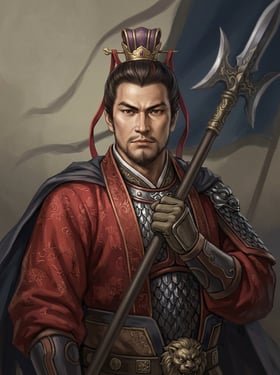
史载(Historical Record)
Lü Bu, styled Fengxian, was a native of Jiuyuan in Wuyuan Commandery, renowned throughout Bingzhou for his valor and skill in battle. He first served as registrar under Ding Yuan, the inspector of Bingzhou, and was deeply trusted and favored by him. However, when Emperor Ling died and Dong Zhuo entered the capital, Dong Zhuo, intending to absorb Ding Yuan's troops, induced Lü Bu to assassinate Ding Yuan. Lü Bu cut off Ding Yuan's head and went over to Dong Zhuo, who therefore appointed him cavalry commandant, treated him as an adopted son, and showered him with favor.
After Dong Zhuo seized power, the Minister over the Masses Wang Yun and the Supervisor of the Masters of Writing Shisun Rui secretly plotted to kill Dong Zhuo. Wang Yun, well aware of the complicated relationship between Lü Bu and Dong Zhuo, exploited Lü Bu's resentment toward Dong Zhuo and persuaded him to act as an inside agent. Lü Bu at first hesitated out of the "father-son" bond, but under Wang Yun's persuasion finally agreed to assassinate Dong Zhuo. In 192 CE, Lü Bu killed Dong Zhuo with his own hand and exterminated his clan to the third degree. When it was done, Wang Yun appointed Lü Bu General Who Exerts Valor, gave him the staff of authority, granted him ceremonial honors equal to the Three Excellencies, advanced him in fief to Marquis of Wen, and shared the governance of the court with him.
Soon after Dong Zhuo's death, his former subordinates Li Jue, Guo Si and others, out of hatred for Lü Bu, joined forces to attack Chang'an. Lü Bu could not hold out; Chang'an fell, and he was forced to flee out through Wu Pass with several hundred horsemen, intending to seek refuge with Yuan Shu. However, Yuan Shu refused to take him in because of his fickleness. Lü Bu then turned to Yuan Shao, and helped him defeat Zhang Yan. But because of his arrogance and overbearing manner, Yuan Shao came to fear him and sought to harm him. Detecting this, Lü Bu fled to Henei and joined forces with Zhang Yang.
In 194 CE, when Cao Cao campaigned east against Xu Province, Yanzhou was left empty. Chen Gong persuaded Zhang Miao to betray Cao Cao and welcome Lü Bu to take control of Yanzhou. Lü Bu thereupon occupied Puyang and waged fierce battle with Cao Cao. The two sides remained deadlocked for over a hundred days; because of drought and a locust plague, the people resorted to cannibalism, and Lü Bu was forced to move east and station at Shanyang. Two years later, Cao Cao recovered Yanzhou and defeated Lü Bu at Juye, whereupon Lü Bu went over to Liu Bei.
Liu Bei took Lü Bu in and settled him at Xiaopei. However, while Liu Bei was campaigning east against Yuan Shu, Lü Bu seized the opportunity to take Xiapi and captured Liu Bei's wife and children. Liu Bei was forced to return and made peace with Lü Bu, who settled Liu Bei at Xiaopei while styling himself inspector of Xu Province. Thereafter Lü Bu's relations with Yuan Shu were complicated; he once intended to form a marriage alliance, but abandoned it at Chen Gui's persuasion. He also once "shot the halberd at the camp gate" to defuse a conflict between Yuan Shu and Liu Bei.
In 198 CE, Lü Bu betrayed Liu Bei again, sending Gao Shun to attack Pei and defeating Liu Bei. Cao Cao personally campaigned against Lü Bu and besieged him at Xiapi. Lü Bu once wished to surrender, but was stopped by Chen Gong and others. During the siege, Lü Bu's subordinates Hou Cheng, Song Xian, Wei Xu and others rebelled, seized Chen Gong, and surrendered the city. Lü Bu was finally captured alive, and Cao Cao, on Liu Bei's advice, had him strangled. The heads of Lü Bu, Chen Gong and others were displayed and sent to Xu before they were buried.
演中(In the Novel)
The Lü Bu of Romance of the Three Kingdoms is further artistically embellished on the basis of historical fact, becoming a typical figure of unmatched martial prowess and fickleness. At his first appearance he displays an image of "imposing bearing and awe-inspiring majesty, holding a Sky-Piercing Halberd". The Romance describes in detail how Li Su tempted Lü Bu with the Red Hare horse and treasures of gold and pearl, leading him to betray Ding Yuan, and finally to "cut off Ding Yuan's head with a single stroke" and go over to Dong Zhuo, honoring Dong Zhuo as his adoptive father. This episode reinforces Lü Bu's negative image as a "slave of three surnames."
During the period of Dong Zhuo's dominance, the Romance emphasizes Lü Bu's valor and Dong Zhuo's trust in him. When the eighteen warlords campaigned against Dong Zhuo, Lü Bu once boasted, "I am willing to lead a host fierce as tigers and wolves, to cut off all their heads and hang them at the capital gate", but his subordinate Hua Xiong was slain by Guan Yu, so that Lü Bu's valorous image was not fully displayed. The Romance also invents an episode in which Lü Bu fails in an attempt to assassinate Cao Cao at Dong Zhuo's residence, Cao Cao escaping under the pretext of presenting a blade, adding dramatic tension.
Diao Chan's "chain stratagem" is the centerpiece of Lü Bu's characterization in the Romance. The Romance describes in detail how Diao Chan moved between Dong Zhuo and Lü Bu, sowing discord between them. On account of Diao Chan, Lü Bu conceived a murderous intent toward Dong Zhuo, and finally, at Wang Yun's instigation, killed Dong Zhuo with his own hand. In the Romance, after assassinating Dong Zhuo, Lü Bu also killed Li Su, which is not clearly recorded in the historical sources.
The Romance also greatly embellishes Lü Bu's many clashes with Cao Cao in Yanzhou. He repeatedly crossed swords with Cao Cao's fierce generals such as Xu Chu and Dian Wei, displaying his valor of "crossing the realm alone on a single horse". For example, in the Battle of Puyang, Lü Bu single-handedly fought six of Cao Cao's leading generals (Xu Chu, Dian Wei, Xiahou Dun, Xiahou Yuan, Li Dian, and Yue Jin); though he was finally driven back, the strength of his martial prowess is evident. The Romance also depicts Lü Bu nearly losing his life to Cao Cao's fire attack within the city of Puyang, and his wife Lady Tian refusing to open the city gate out of displeasure with Lü Bu, which further enrich Lü Bu's image.
During the siege of Xiapi, the Romance magnifies Lü Bu's character traits of indecision and failure to heed loyal counsel. Chen Gong offered stratagems many times, but Lü Bu, whether because of the words of his wives and concubines or his own suspicions, failed to adopt them. In the end, the betrayal of his subordinates Hou Cheng, Song Xian, Wei Xu and others led to Lü Bu's capture. After being captured, Lü Bu begged Cao Cao for mercy and tried to drive a wedge between Cao Cao and Liu Bei, but Liu Bei finally exposed his fickle nature with a single remark, and he was cruelly strangled. In the Romance, before his death Lü Bu rebuked Liu Bei as "the most untrustworthy of all", reflecting his resentment and distrust of Liu Bei.
关键关系
* Ding Yuan (enemy_of): The histories record that Lü Bu, tempted by Dong Zhuo, killed Ding Yuan and absorbed his troops. In the Romance, Li Su bought Lü Bu over with the Red Hare horse and money, leading him to betray and kill Ding Yuan and honor Dong Zhuo as his adoptive father, further reinforcing Lü Bu's image as a "slave of three surnames",.
* Dong Zhuo (betrayed_by): Lü Bu first attached himself to Dong Zhuo and was taken as his adopted son, deeply favored. However, owing to Dong Zhuo's cruelty and Wang Yun's stratagem of discord (Romance only), Lü Bu finally killed Dong Zhuo with his own hand,.
* Dong Zhuo's Faction (serves): While under Dong Zhuo, Lü Bu served him, but after Dong Zhuo's death his former subordinates Li Jue, Guo Si and others, out of hatred for Lü Bu, attacked Chang'an, and Lü Bu, unable to hold out, was forced to flee.
* Yuan Shu (friend_of): After being defeated by Li Jue and Guo Si, Lü Bu wished to seek refuge with Yuan Shu, but Yuan Shu refused to take him in because of his fickleness. Later, Lü Bu and Yuan Shu had brief cooperation and conflict, and once even intended to form a marriage alliance, but finally abandoned it at Chen Gui's persuasion. In the Romance, Yuan Shu sent Ji Ling to attack Liu Bei, and Lü Bu defused the conflict by "shooting the halberd at the camp gate".
* Yuan Shao: After being refused by Yuan Shu, Lü Bu went over to Yuan Shao and helped him defeat Zhang Yan. But because of Lü Bu's arrogance, Yuan Shao came to fear him and sought to harm him, so Lü Bu fled.
* Liu Bei: After being defeated by Cao Cao in Yanzhou, Lü Bu went over to Liu Bei. However, while Liu Bei was campaigning east against Yuan Shu, Lü Bu seized Xiapi and captured Liu Bei's wife and children. Thereafter their relations alternated between good and bad, and finally, in the Battle of Xiapi, Liu Bei persuaded Cao Cao to put Lü Bu to death.
* Cao Cao: Lü Bu was a long-time adversary of Cao Cao. The two fought many times in Yanzhou and Xu Province, with victories on both sides,. In the end, Cao Cao defeated and captured Lü Bu in the Battle of Xiapi.
* Chen Gong: Chen Gong was Lü Bu's important strategist, repeatedly devising plans for him,. However, Lü Bu often failed to heed his advice, leading to defeat. In the end, Chen Gong was captured and executed together with Lü Bu.
* Gao Shun: Gao Shun was a loyal general under Lü Bu, and the "Camp-Breaking Battalion" he led fought valiantly. He repeatedly remonstrated with Lü Bu, but Lü Bu would not listen. In the end, Gao Shun was captured and executed together with Lü Bu.
* Diao Chan (Romance only): In the Romance, Diao Chan was Wang Yun's adopted daughter, used by Wang Yun in the "chain stratagem" to sow discord between Dong Zhuo and Lü Bu. Diao Chan's beauty and schemes were among the important reasons Lü Bu finally assassinated Dong Zhuo.
标志性场景
* Assassinating Ding Yuan: Tempted by Dong Zhuo, Lü Bu betrayed and killed Ding Yuan and went over to Dong Zhuo, becoming his adopted son. This event established the fickleness at the base of Lü Bu's character.
* Assassinating Dong Zhuo: At Wang Yun's instigation, Lü Bu killed Dong Zhuo with his own hand, ending Dong Zhuo's tyranny. This event won Lü Bu the reputation of a "loyal minister" for a time.
* Shooting the halberd at the camp gate: To defuse the conflict between Yuan Shu and Liu Bei, Lü Bu set up a halberd before the camp gate, wagering on hitting the small branch of the halberd, and finally struck it with a single arrow, forcing both sides to cease hostilities. This scene displays Lü Bu's superb martial skill and a measure of political tact.
* The Battle of Puyang: Lü Bu waged fierce battle with Cao Cao at Puyang in Yanzhou, once gaining the upper hand and repeatedly crossing swords with Cao Cao's fierce generals. In the Romance, Lü Bu even single-handedly fought six of Cao Cao's generals, glorious even in defeat.
* The siege of Xiapi: Lü Bu was besieged by Cao Cao at Xiapi; because of his suspicion, his failure to heed loyal counsel, and the rebellion of his subordinates, he was finally captured. This scene marks the beginning of Lü Bu's tragic end.
* Death at White Gate Tower: Lü Bu was captured at White Gate Tower, begged Cao Cao for mercy, and tried to sow discord, but Liu Bei exposed his fickle nature with a single remark, and he was finally strangled by Cao Cao.
* Diao Chan's chain stratagem (Romance only): Wang Yun used Diao Chan to sow discord between Dong Zhuo and Lü Bu, so that Lü Bu, his love turning to hatred, finally assassinated Dong Zhuo. This episode greatly enriches Lü Bu's image, making him not merely a brute warrior but a tragic hero ruled by passion.
Portrait file
Character profile
- Appearance
- Lü Bu's bearing was imposing and awe-inspiring: on his head a golden crown binding his hair, draped in a hundred-flower battle robe, clad in Tangni armor, and girded with a precious lion-and-barbarian belt. He wore a three-pronged purple-gold crown binding his hair, over his body a hundred-flower robe of red brocade from Western Sichuan, was clad in linked mail with a beast-faced swallowing-head clasp, and bound at the waist with an exquisite armor-cinching lion-and-barbarian belt, his figure tall and imposing.
- Character
- Lü Bu was fierce and valiant but without strategy, full of suspicion, frivolous and crafty and fickle, seeing only profit. Brave but unstrategic, he forgot righteousness at the sight of gain; peerlessly valiant, he thought himself invincible. Lustful and easily provoked, he was jealous of his adoptive father, inconstant and unsettled, would not accept good counsel, was swayed easily between joy and anger, doted only on his wife, and regarded his subordinates like weeds.
- Manner of speech
- Lü Bu spoke bluntly and urgently, often forging and then betraying bonds in the name of 'father and son' or 'brothers.' He boasted conceitedly, as in 'I have the painted halberd and Red Hare—who dares come near me?', yet at the point of death he would also beg for mercy.
- Life
- Lü Bu was a native of Jiuyuan in Wuyuan Commandery. By his fierce martial prowess he served Bing Province, and once held the post of Registrar under Ding Yuan. He killed Ding Yuan and submitted to Dong Zhuo, then conspired with Wang Yun to kill Dong Zhuo; defeated and put to flight, he attached himself to Yuan Shu, Yuan Shao, and Zhang Yang, and later held Yanzhou and Xu Province. In the third year of Jian'an he was captured by Cao Cao and strangled to death.
- Weapons
- Lü Bu wielded spear, halberd, and bow, above all the Sky-Piercing Painted Halberd as his chief weapon, and his mount was Red Hare.
- Anecdotes
- Lü Bu, receiving Red Hare, gold and pearls, a jade belt, and Li Su's persuasions, thereupon killed Ding Yuan and honored Dong Zhuo as his adoptive father. He said of himself that he 'plotted with Minister Wang to kill Dong Zhuo,' then fled in defeat to Dingtao and was taken in by Liu Bei at Xu Province. He once personally commanded the central army as a threefold relief force, and in the end, as a prisoner below the steps, stood in contrast to Xuande above them.
Relationships
77 relationships
Family5
Lord & vassal5
Friends11
Enemies20
Other28
Quotes
131 recorded lines · 3 featured
「轅門離中軍一百五十步,吾若一箭射中戟上小枝,你兩家罷兵;如射不中時,各自回營,安排廝殺。有不從吾言者,併力拒之。」
The tale of Lü Bu shooting the halberd at the camp gate displays his martial prowess and bold spirit, and is widely renowned.
「大丈夫生居天地間,豈能鬱鬱久居人下!」
Lü Bu's inner monologue as he turned against Dong Zhuo reflects his refusal to remain beneath others.
「明公所患不過於布,今已服矣,天下不足憂。明公將步,令布將騎,則天下不足定也。」
Lü Bu's plea to Cao Cao for his life reflects his struggle at the end of the road and his confidence in his own martial might.
Chapters28 回 ▸
- 史ch.1ch.6ch.7ch.8ch.10ch.11ch.14ch.17ch.18ch.22ch.32ch.38
- 演ch.3ch.4ch.5ch.6ch.8ch.9ch.11ch.12ch.13ch.14ch.15ch.16ch.17ch.18ch.19ch.44
Relationship timeline37 条 ▸
史 ch.1
- Yuan Shu§39
friend_of
使高顺攻刘备;陈宫等求救于术
史 ch.6
enemy_of
卓使吕布杀丁原
史 ch.7
史 ch.32
- Liu Bei§6
fights_in
乘虚袭下邳虏先主妻子
史 ch.38
- Liu Bei§16
enemy_of
乘先主出拒袁术袭下邳虏先主妻子
演 ch.4
- Dong Zhuo§23
serves
揪倒伍孚以救卓;侍立卓侧
演 ch.5
- Dong Zhuo§32
kin_of
父子(吕布称卓"父亲",卓呼吕布"奉先")
演 ch.6
serves
从董卓回洛阳,受命断后
演 ch.8
serves
义子;筵上揪斬张温,又寄卓信「錯下吾兒奉先處」
- Diao Chan§25
spouse_of
凤仪亭私会,发愿「今生不能以汝為妻,非英雄也」;为卓夺所恨而生反心
演 ch.9
演 ch.11
- Zhang Yan§13
enemy_of
与袁绍共破张燕于常山
- Zhang Miao§14
defected_to
自张扬处投张邈,受邈之命袭兗州、据濮阳
演 ch.12
- Cao Cao§6
fights_in
火光中执戟击曹操盔却不识
演 ch.13
enemy_of
欲再投袁绍未果(袁绍反遣颜良助曹)
- Liu Bei§2
defected_to
自定陶败、远投刘备求容;并马入城受礼
演 ch.14
- Liu Bei§27
serves
投玄德居小沛;闻曹操密计欲杀之,泣谢玄德
演 ch.15
- Lady Gan§4
witnesses
令兵把定宅门、禁诸人不得入;常使侍妾送物未尝有缺
演 ch.16
- Liu Bei§7
oath_brother
自称兄弟、辕门射戟以解其危
演 ch.17
- Yuan Shu§7
enemy_of
公开为敌;袁术大骂「背主家奴」、吕布挺戟而前
演 ch.18
演 ch.19
Inner monologues · AI-generated3 段 ▸
- I stood atop White Gate Tower, bound with ropes, while the sounds of the troops outside the city had settled. Just momen
- I am Lü Bu, courtesy name Fengxian. People often judge me by my reputation for valor, as though a painted halberd and a
- I remember that I was born in Jiuyuan, Wuyuan, and served in Bingzhou for my skill in arms. Ding Yuan, then Inspector of
Life events21 ▸
- 0189-01-01 · LuoyangDong Zhuo's Coup· Warrior
- 0190-01-01 · HulaoguanThree Heroes Fight Lü Bu at Hulao Gate· Warrior
- 0190-01-01 · YangrenBattle of Yangren· Warrior
- 0192-01-01 · Chang'anWang Yun's Interlocking Stratagem· Warrior
- 0194-01-01 · YanzhouLü Bu's Seizure of Yanzhou· Commander
- 0194-01-01 · Xu ProvinceCao Cao's Attack on Xu Province· Instigator
- 0194-01-01 · PuyangFire Attack at Puyang· Commander
- 0194-01-01 · JuanchengCheng Yu Holds Three Cities Against Chen Gong· Commander
- 0195-01-01 · YanzhouBattle of Yanzhou· Commander
- 0195-01-01 · DingtaoDefeat of Lu Bu at Dingtao· Commander
- 0196-01-01 · XuchangStratagem of Two Tigers Fighting over Food· Victim
- 0196-01-01 · Xu ProvinceLü Bu Seizes Xu Province· Commander
- 0196-01-01 · Chang'anTurmoil of Li Jue and Guo Si· Commander
- 0196-01-01 · XiaopeiLu Bu Shoots the Halberd at the Camp Gate· Instigator
- 0197-01-01 · XiaopeiLü Bu Raids Xiaopei· Commander
- 0197-01-01 · ShouchunYuan Shu Proclaims Himself Emperor· Witness
- 0198-01-01 · XiapiBattle of Xiapi· Killed in action
- 0198-01-01 · XiapiFlooding of Xiapi via the Yi and Si Rivers· Victim
- 0198-01-01 · Xu ProvinceChen Deng's Double-Agent Stratagem Against Lu Bu· Commander
- 0199-01-01 · ShouchunCao Cao's Campaign Against Yuan Shu· Warrior
- 0199-01-01 · XiapiTrial at White Gate Tower· Victim