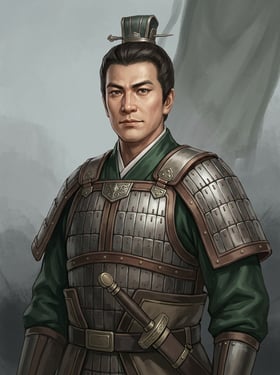
Historical Record
(No biographical material.)
In the Novel
Han Sui, styled Wenyue, is portrayed in the Romance of the Three Kingdoms as the Administrator of Xiliang, ranked alongside Ma Teng, with whom he jointly raised troops to chastise Li Jue, Guo Si, and the other remnants of Dong Zhuo's faction. He first appears in Chapter 10, leading more than a hundred thousand troops together with Ma Teng under the proclamation of punishing the rebels, and forming an inside alliance with three men in Chang'an—the Palace Attendant Ma Yu, the Grand Counselor Zhong Shao, and the Left General of the Household Gentlemen Liu Fan c:6723. Their plan, however, was seen through by Jia Xu, who advised Li Jue and Guo Si to hold firm and not give battle, waiting for the Xiliang army's provisions to run out and force its withdrawal. Li Meng and Wang Fang, ignoring Jia Xu's counsel, went out to fight and were slain by Ma Chao. In the end, owing to the shortage of provisions and the exposure of the inside plot, Han Sui and Ma Teng were forced to withdraw. During the retreat, Fan Chou pursued Han Sui, but Han Sui, with the two lines "You and I are men of the same home district; why be so heartless today?" and "I too came here only for the sake of the state; why do you press me so hard?", successfully persuaded Fan Chou to let him go c:15469.
In Chapter 58, Han Sui is mentioned again. By this time Cao Cao, wishing to win Ma Chao's surrender, wrote to Han Sui, promising that if he could capture Ma Chao he would be enfeoffed as Marquis of Xiliang c:15471. When Ma Chao learned of this, he feignedly prostrated himself on the ground and asked Han Sui to bind him and his brother and send them to Xuchang. But Han Sui raised Ma Chao up, saying that he and Ma Chao's father Ma Teng had sworn brotherhood and that he could not bear to harm him, and pledged that if Ma Chao raised troops he would lend his full support. Han Sui then slew Cao Cao's envoy and mustered his eight subordinate commanders—Hou Xuan, Cheng Yin, Li Kan, Zhang Heng, Liang Xing, Cheng Yi, Ma Wan, and Yang Qiu—who together with Ma Chao's subordinates Pang De and Ma Dai raised two hundred thousand troops and marched on Chang'an c:6724.
In the standoff with Cao Cao, Han Sui and Ma Chao differed over tactics. When Cao Cao was preparing to cross the river, Ma Chao proposed holding the north bank to keep Cao Cao from crossing, reckoning that once Cao Cao's provisions ran out his forces would fall into disorder. Han Sui, however, put forward the strategy that "when the troops are halfway across they can be struck," advising an attack from the south bank when Cao Cao's army was halfway across c:15472. Although Ma Chao adopted Han Sui's advice, it ultimately failed. In the subsequent fighting, Han Sui and Pang De led fifty thousand troops in battle with Cao's army, and Pang De rescued Han Sui from a horse-trap pit and slew Cao Yong, a subordinate general of Cao Ren c:4189.
In the end, however, the relationship between Han Sui and Ma Chao broke down. Cao Cao employed a stratagem of sowing discord, "chatting" with Han Sui before the lines and having Cao Hong deliberately say to Han Sui, "Last night the Chancellor sent his regards to you, General; by no means make any mistake," so that Ma Chao came to suspect Han Sui of harboring treacherous intent c:6725. Although Han Sui tried to explain, Ma Chao no longer trusted him. Finally, at the urging of Yang Qiu and others, Han Sui wrote a secret letter and sent Yang Qiu to surrender to Cao Cao, betraying Ma Chao.
Key Relationships
* Qu Yan (enemy_of): In the novel, Han Sui and Ma Teng jointly raised troops, intending to chastise Li Jue, Guo Si, and the other remnants of Dong Zhuo's faction, and Qu Yan (i.e., Li Jue) was his principal enemy c:6723.
* Xiliang Army (lord_of): Han Sui was the Administrator of Xiliang, commanding the Xiliang Army, and when joined with Ma Teng held more than a hundred thousand troops c:6723.
* Ma Chao (oath_brother): Han Sui had sworn brotherhood with Ma Chao's father Ma Teng and thus had the bond of uncle and nephew with Ma Chao; in the early stages they jointly raised troops against Cao Cao, but in the end they turned against each other owing to Cao Cao's stratagem of sowing discord c:15471.
* Pang De (commands_in): Pang De was an important general under Ma Chao, but in the Battle of Weinan against Cao Cao, Han Sui once made Pang De his vanguard, having him follow him into battle, and it was Pang De who rescued Han Sui at the moment of crisis c:15473, c:4189.
* Fan Chou (bond of the same district): When Han Sui withdrew his troops, Fan Chou pursued him; Han Sui, invoking the bond of the same home district and the great cause of the state, persuaded Fan Chou to let him go, displaying Han Sui's eloquence and Fan Chou's regard for their shared home c:15469 (novel only).
* Cao Cao (political opponent / eventual surrender): Han Sui at first opposed Cao Cao together with Ma Chao, but under Cao Cao's stratagem of sowing discord he finally chose to surrender to Cao Cao c:6725.
Signature Scenes
* Talking Fan Chou into retreat: After the failed chastisement of Li Jue and Guo Si alongside Ma Teng, Han Sui was overtaken by Fan Chou during the retreat. With the two lines "You and I are men of the same home district; why be so heartless today?" and "I too came here only for the sake of the state; why do you press me so hard?", Han Sui successfully moved Fan Chou, who wheeled his horse, withdrew his troops to camp, and let Han Sui go. This scene displays Han Sui's eloquence and his insight into human feeling, while also highlighting Fan Chou's regard for their shared home c:15469 (novel only).
* Raising a great army together with Ma Chao: After Cao Cao wrote to sow discord between Han Sui and Ma Chao, Han Sui outwardly pretended that he meant to capture Ma Chao, but in fact allied himself with Ma Chao and slew Cao Cao's envoy. He mustered his eight subordinate commanders and combined forces with Ma Chao's army to make two hundred thousand, marching together on Chang'an. This scene depicts Han Sui's close early cooperation with Ma Chao and his strength as a regional lord c:6724 (novel only).
* Tactical disagreement in the Battle of Weinan: In the standoff with Cao Cao along the Wei River, Ma Chao and Han Sui differed over tactics. Ma Chao advocated holding the north bank, while Han Sui put forward the strategy of "striking when the troops are halfway across." Although Han Sui's advice was ultimately adopted, it failed, reflecting the difference between the two men in military judgment c:15472 (novel only).
* Falling for Cao Cao's stratagem of sowing discord: Cao Cao employed a stratagem of sowing discord, "chatting" with Han Sui before the lines and having Cao Hong deliberately utter words hinting that Han Sui was in secret collusion with Cao Cao, so that Ma Chao came to suspect Han Sui c:6725. This scene is the key turning point in the breakdown of the relationship between Han Sui and Ma Chao, ultimately leading Han Sui to surrender to Cao Cao, and it also displays Cao Cao's masterful scheming.
Portrait file
Character profile
- Character
- Han Sui was seasoned and steady, yet easily swayed [c:4]. For the sake of shared native ties he would break a military order; he once slipped free of Fan Chou with the two phrases "a man from the same hometown" and "it is all for the sake of the state" [c:3]. Cao Cao once appraised him as "a mediocre little man, hardly worth mentioning" [c:2].
- Life
- Han Sui once surrendered together with Ma Teng, was granted the title General Who Guards the West, and was sent back to Liang Province [c:5]. In the sixteenth year of Jian'an, he rebelled together with Ma Chao and others; Cao Cao campaigned against them and defeated them, and Han Sui fled to Jincheng, where he was ultimately killed by his own subordinate general [c:5]. In the twentieth year of Jian'an, he was beheaded by Qu Yan and Jiang Shi, who sent up his head [c:6].
- Anecdotes
- Han Sui was the chief of the Jincheng rebellion, later holding Guanzhong and Liang Province, and for a long time resisting alongside Ma Chao [c:6]. He was once one of the most powerful warlords of the Liang Province and Guanzhong region, and a maker of turmoil in Liang Province, a partisan of Bian Zhang [c:7, c:9, c:10, c:18]. Han Sui and Ma Teng became sworn brothers of different surnames, then turned into enemies, but in the end again joined forces with Ma Chao to rebel against Cao [c:17]. He was once the deputy commander of the Xiliang allied army, and an uncle-figure to Ma Chao [c:27].
Relationships
17 relationships
Family1
Friends6
Enemies4
Other6
Quotes
8 recorded lines · 3 featured
「吾與汝父結為兄弟,安忍害汝?汝若興兵,吾當相助。」
This line shows the sworn-brotherhood bond between Han Sui and Ma Chao's father's generation, central to his web of relationships.
「不必如此。豈不聞兵法有云:『兵半渡可擊。』待操兵渡至一半,汝卻於南岸擊之,操兵皆死於河內矣。」
This stratagem embodies Han Sui's military cunning and reflects the classic application of the maxim 'strike when the enemy is halfway across the river.'
「吾聞曹操選極壯之人,為帳前侍衛,名曰『虎衛軍』,以驍將典韋、許褚領之。典韋已死,今救曹操者,必許褚也。此人勇力過人,人皆稱為『虎痴』;如遇之,不可輕敵。」
This line references Dian Wei, Xu Chu, and the 'Tiger Fool' allusion, carrying high cultural recognizability.
Chapters10 回 ▸
- 史ch.1ch.6ch.13ch.17ch.36
- 演ch.10ch.23ch.57ch.58ch.59
Relationship timeline3 条 ▸
Inner monologues · AI-generated1 段 ▸
- I am Han Sui, courtesy name Wenyue. I remember how, long ago, Ma Teng and I received a secret imperial edict and joined
Life events5 ▸
- 0208-01-01 · Chang'anZhong Yao Superintends Guanzhong· Warrior
- 0211-01-01 · Tong PassBattle of Weinan· Commander
- 0211-01-01 · Tong PassBattle of Tong Pass· Commander
- 0211-01-01 · Tong PassJia Xu Sows Discord Between Ma Chao and Han Sui· Victim
- 0215-01-01 · HanzhongCao Cao's Campaign Against Hanzhong