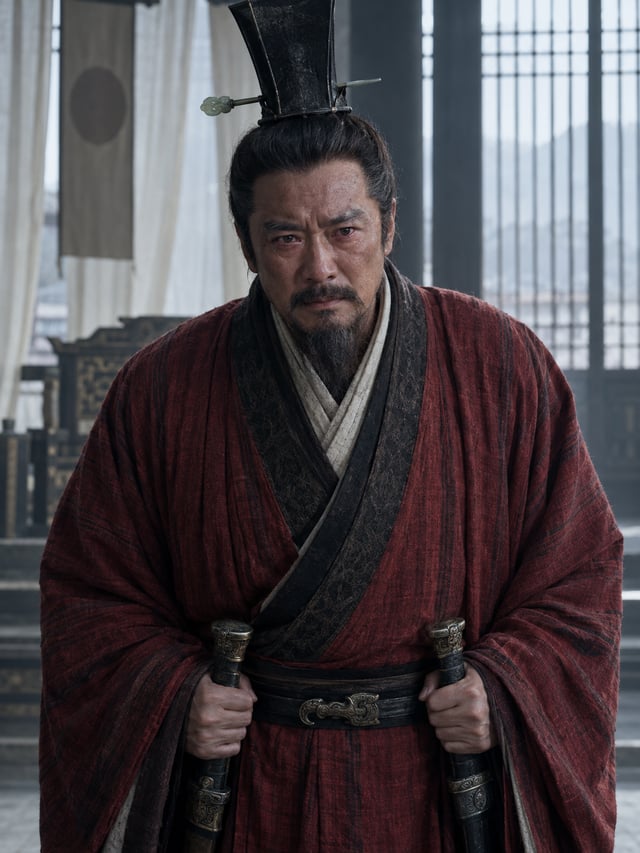
The life of Liu Bei
「They say you lose every battle and barely have time to flee. At those moments, had it been up to you, what would you have chosen?」
Liu Bei ruled Shu Han; history notes Jing Province and Hanzhong, while the novel highlights benevolence and the Oath of the Peach Garden.
Liu Bei's profile →One scene per chapter, and you are him. Underlined lines come from the books (green: Records of the Three Kingdoms, gold: the Romance); tap one to see the source. Lines without an underline connect the scenes or imagine them. At each fork you choose first, then see what he did.
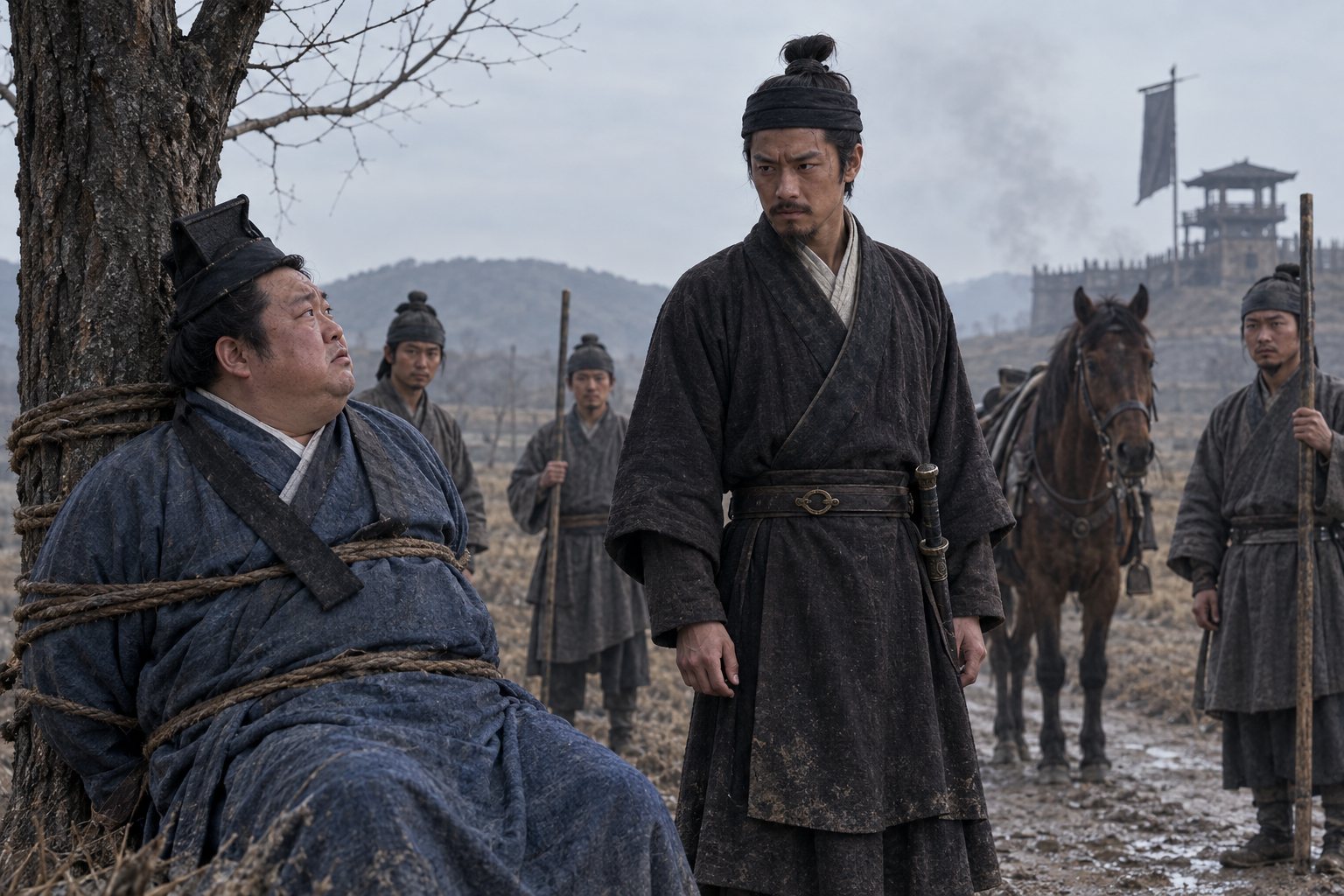
Seal and Ribbon
You are a native of Zhuo County in Zhuo Commandery, and a descendant of Liu Sheng, Prince Jing of Zhongshan, son of Emperor Jing of Han. Your father dies when you are young; you make a living with your mother by selling shoes and weaving mats. A mulberry tree, more than five zhang tall, grows by the fence at the southeast corner of your house; from afar, its rounded crown looks like a carriage canopy. As a child, you play beneath it with boys from your clan and say, “I shall surely ride in a carriage with a feathered canopy like this.” Your uncle stops you: “Do not speak recklessly, or you will bring ruin upon our family!”
You stand seven chi and five cun tall; your hands hang past your knees, and when you turn your head, you can see your own ears; you speak little, are good at deferring to others, and keep joy and anger from showing on your face. Zhang Shiping and Su Shuang, wealthy merchants from Zhongshan, bring horses to Zhuo Commandery. They meet you, find you extraordinary, and give you a great deal of gold and property, and with this you gather a band of followers. Guan Yu, having fled for his life, comes to Zhuo Commandery. You gather followers in your home district, and he and Zhang Fei help you repel attacks from outside. In the Romance, the three of you burn incense and bow twice in the Peach Garden, swearing: “We do not ask to be born in the same year, month, and day; we ask only to die in the same year, month, and day.”
When the Yellow Turbans rise, you take your own men to join Colonel Zou Jing in suppressing the rebels, earn merit, and become county commandant of Anxi County.
You have been in the county for less than four months. The province and commanderies receive an imperial edict: all senior officials appointed for military merit are to be dismissed. You suspect you are among those to be sent away.
The inspecting censor arrives in the county. You already know that you are the one he has come to dismiss.
In the Romance, you go out of the city to welcome him, but the inspecting censor remains on horseback and merely flicks his whip in a slight gesture of greeting. At the post station, he sits high in the seat facing south while you stand below the steps. He asks: “County Commandant Liu, what is your background?” You say: “I, Bei, am a descendant of Prince Jing of Zhongshan. Since suppressing and killing the Yellow Turbans in Zhuo Commandery, I have fought more than 30 battles, great and small, earning some small merit, and thus received my present appointment.” He shouts: “You falsely claim to be a kinsman of the emperor and have fabricated your achievements!”
A county clerk says to you: “The inspecting censor is putting on airs; he wants a bribe, nothing more.” You say: “I have not wronged the people in the least. Where would I get money to give him?”
He is staying at the post station. You go to ask for an audience, but he claims to be ill and refuses to see you.
The post station door is shut, and a light shines within. You stand outside and remember what you said beneath the mulberry tree, remember your uncle's words: “bring ruin upon our family.” More than 30 battles have earned you a county commandant's post; now even this post is to be taken from you outside a closed door.
You hate him.
You return to the county, gather clerks and soldiers, and go back to the post station. You force your way inside and say, “I have received secret orders from the prefect to arrest the inspecting censor.”
There on the bed, you bind him and drag him beyond the county boundary. You take off your seal and ribbon, tie them around his neck, bind him to a tree, and beat him more than 100 times with a staff, intending to kill him. The inspecting censor begs for mercy, and only then do you release him.
Your biography gives a brief account: The inspecting censor came to the county on official business. The Former Lord sought an audience, but was denied, so you went straight in, bound the inspecting censor, beat him 200 times, took off his ribbon of office and tied it around his neck, fastened him to a hitching post, abandoned your office, and fled.
The seal and ribbon hang around another man's neck as you mount your horse and ride away. You have not held this county commandant's post for long.
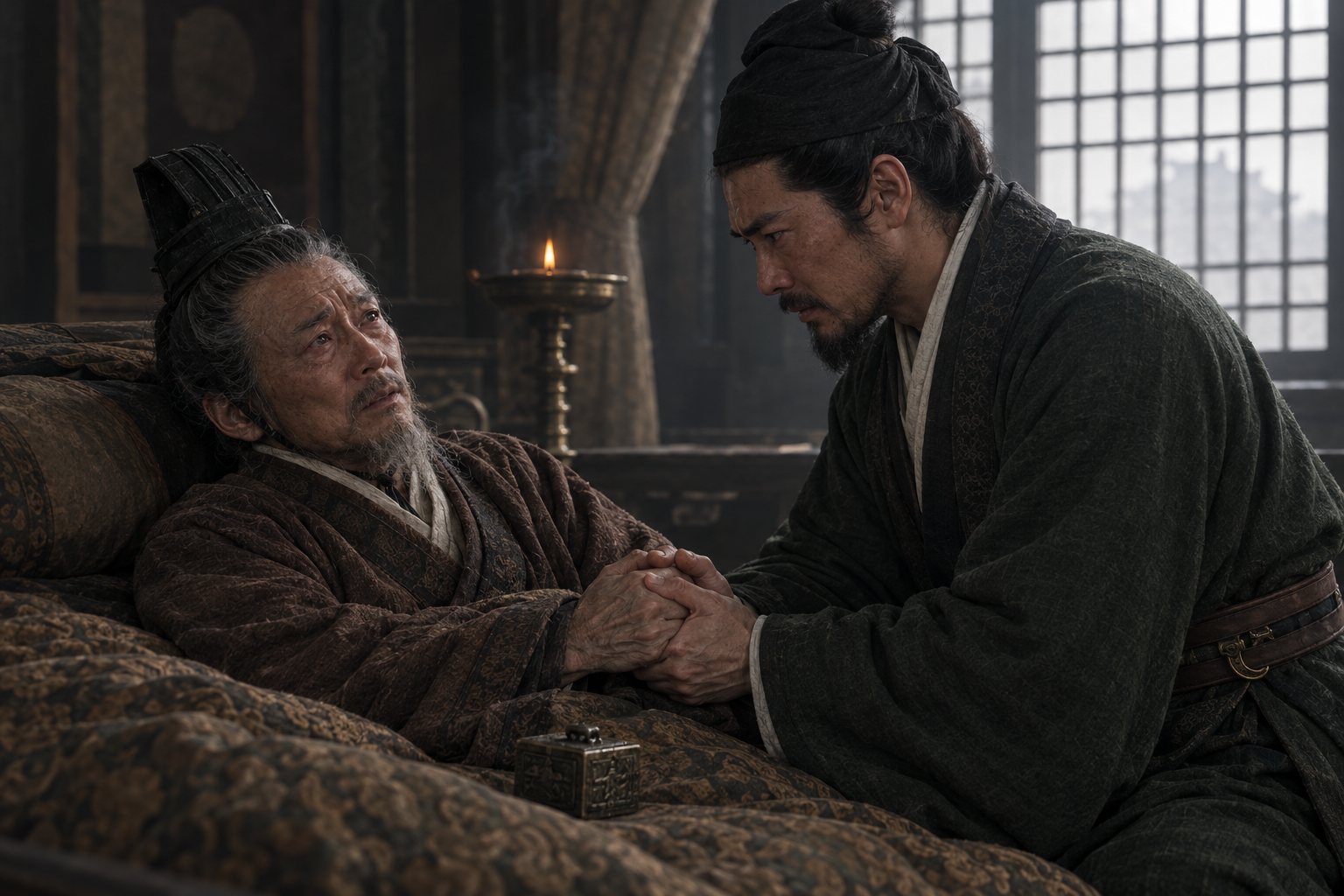
When Heaven Offers
In the final years of Emperor Ling, you spend time in the capital, then return to Pei State with Cao Cao to recruit soldiers; when Emperor Ling dies and the realm falls into chaos, you too raise troops to oppose Dong Zhuo. After bandits defeat you, you seek refuge with Gongsun Zan: you were once both pupils of Lu Zhi, and he is older, so you treat him as an elder brother. He appoints you Major of a Separate Command and has you follow Tian Kai to resist Yuan Shao; later, you become Chancellor of Pingyuan. In those years of famine, you resist raids from without and freely distribute money within; you share your mat and your dish even with scholars of low standing.
Cao Cao attacks Xu Province; Tao Qian, Governor of Xu Province, appeals to Tian Kai for urgent aid, and you go with Tian Kai to rescue him. Tao Qian assigns you 4,000 Danyang soldiers; you then leave Tian Kai and join Tao Qian. He recommends you as Inspector of Yu Province, and you garrison at Xiaopei.
Gravely ill, Tao Qian says to his Assistant Officer Mi Zhu: “None but Liu Bei can bring peace to this province.”
In the Romance, he invites you into his chamber: “I beg you, my lord, take pity on the Han realm and its cities, and accept the seal of Xu Province. Then even in death, this old man can close his eyes in peace!” You ask: “You have two sons. Why not pass it to them?” He says neither son has the talent to take on the task. You still refuse, and he points to his heart with his hand and dies.
Tao Qian dies, and Mi Zhu leads the people of Xu Province to welcome you, but you dare not accept.
Chen Deng of Xiapi says to you: “The Han house is now in decline, and the realm is overturned. The time to establish merit and accomplish great deeds is now. That province is prosperous, with a million households. We wish to prevail upon you, my lord, to take charge of its affairs.”
You say: “Yuan Gonglu is nearby in Shouchun. His family has produced five Excellencies in four generations, and the realm looks to him. You can give the province to him.”
Chen Deng says: “Gonglu is arrogant and overbearing; he is no man to govern a realm in turmoil. I now wish to raise 100,000 infantry and cavalry for you, my lord. Above, you can aid the ruler and save the people, and achieve the work of the Five Hegemons; below, you can hold territory and guard its borders, and inscribe your deeds on bamboo and silk. If you will not heed me, I too dare not heed you.”
Kong Rong, Chancellor of Beihai, is there too: “Would Yuan Gonglu truly put the realm before his family? He is a dry bone in the grave; why give him a thought? In this matter today, the people side with the able. If you do not take what Heaven offers, regret will come too late.”
In the Romance, the next day, the people of Xu Province crowd before the office and weep as they bow: “If you, Lord Liu, will not take charge of this commandery, none of us can live in peace!”
The provincial seal rests on the table, covered by a piece of cloth. Outside the office, the weeping rises and falls. You are 33. It has been 10 years since you left Zhuo County. Every office you have held has come by another man's appointment; you have not yet had a province of your own.
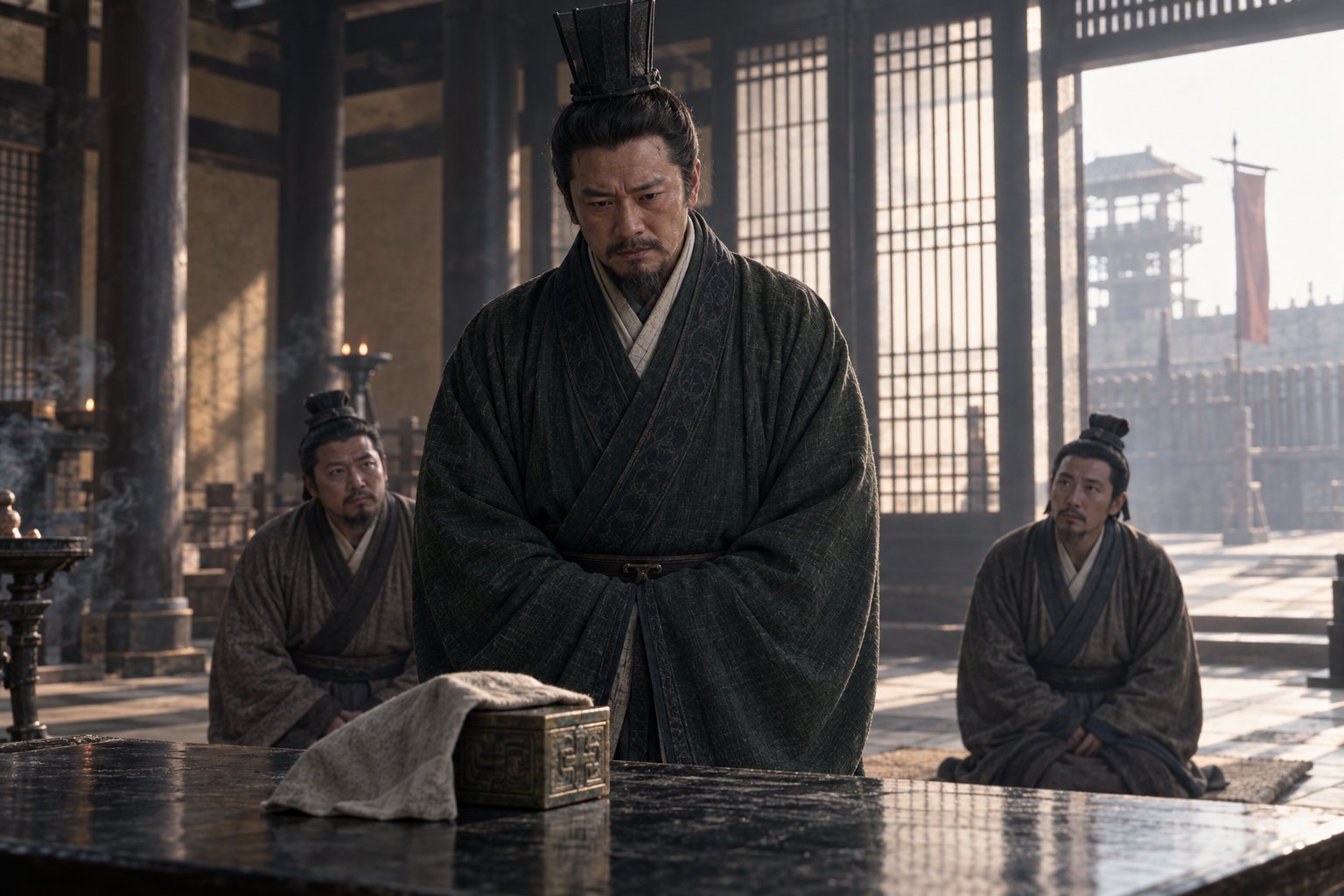
The provincial seal is right there on the table. Do you take it?
You take charge of Xu Province.
Chen Deng and the others send a messenger to Yuan Shao, saying that the provincial governor has died, the people have no ruler, and all have agreed to honor Liu Bei, the former Chancellor of Pingyuan, as their leader. Yuan Shao replies: “Liu Xuande is magnanimous, refined, and true to his word. Now the people of Xu Province are glad to honor him; he is indeed worthy of their hopes.”
In the Romance, Cao Cao hears the news in Juancheng and flies into a rage: “I have yet to avenge my grudge, and you gain Xu Province without spending a single arrow!”
You put the provincial seal away in a box. It is small, but heavy in your hand.
Bu's Younger Brother
Lü Bu is defeated by Cao Cao and comes east to seek refuge with you. When he sees you, he treats you with great respect, seats you on his wife's bed in his tent, has her bow to you, drinks with you, and calls you his younger brother. You find his words unreliable; you answer him aloud, but feel displeasure in your heart.
Yuan Shu comes to attack, and you resist him at Xuyi and Huaiyin. After you face Yuan Shu for a month, Lü Bu takes advantage of your absence and attacks Xiapi; Cao Bao, the commander defending Xiapi, rebels and opens the gates to him. He takes your wife captive.
Your troops are at Guangling, hungry and exhausted; officers and soldiers, high and low, eat one another. You have no choice but to send an official to ask Lü Bu to accept your surrender. He returns your wife, and lets you garrison Xiaopei.
Yuan Shu sends Ji Ling and others, with 30,000 infantry and cavalry, to attack you. In the Romance, you have only a little over 5,000 men in the county, and outside the city Ji Ling's camp displays banners by day, shrouding mountains and rivers; at night, fires and drums shake heaven and earth.
You ask Lü Bu for help. The letter says: “Now Yuan Shu seeks revenge for a personal grudge and has sent Ji Ling with troops to the county. Our lives are in danger at any moment; no one but you, General, can save us.”
The letter goes out, and you wait on the city wall. He has once attacked you; you have once asked to surrender to him. You can guess what the men in his camp will urge him to do.
He comes with 1,000 infantry and 200 cavalry, and makes camp one li southwest of Pei city. When Ji Ling hears he has arrived, he withdraws his troops and dares not attack again.
In the Romance, he sends someone to invite you and Ji Ling to a banquet. Guan and Zhang say: “Elder brother, you must not go. Lü Bu surely harbors treachery.” You say: “I have treated him well; he surely will not harm me.”
You enter his camp, and he invites you to sit. Someone reports that Ji Ling has arrived; you are startled and want to withdraw. He sits in the middle, puts Ji Ling on his left, and you on his right.
He says: “Xuande is my younger brother. My brother is beset by you gentlemen, so I have come to save him. By nature I do not like joining fights; I like only breaking them up.”
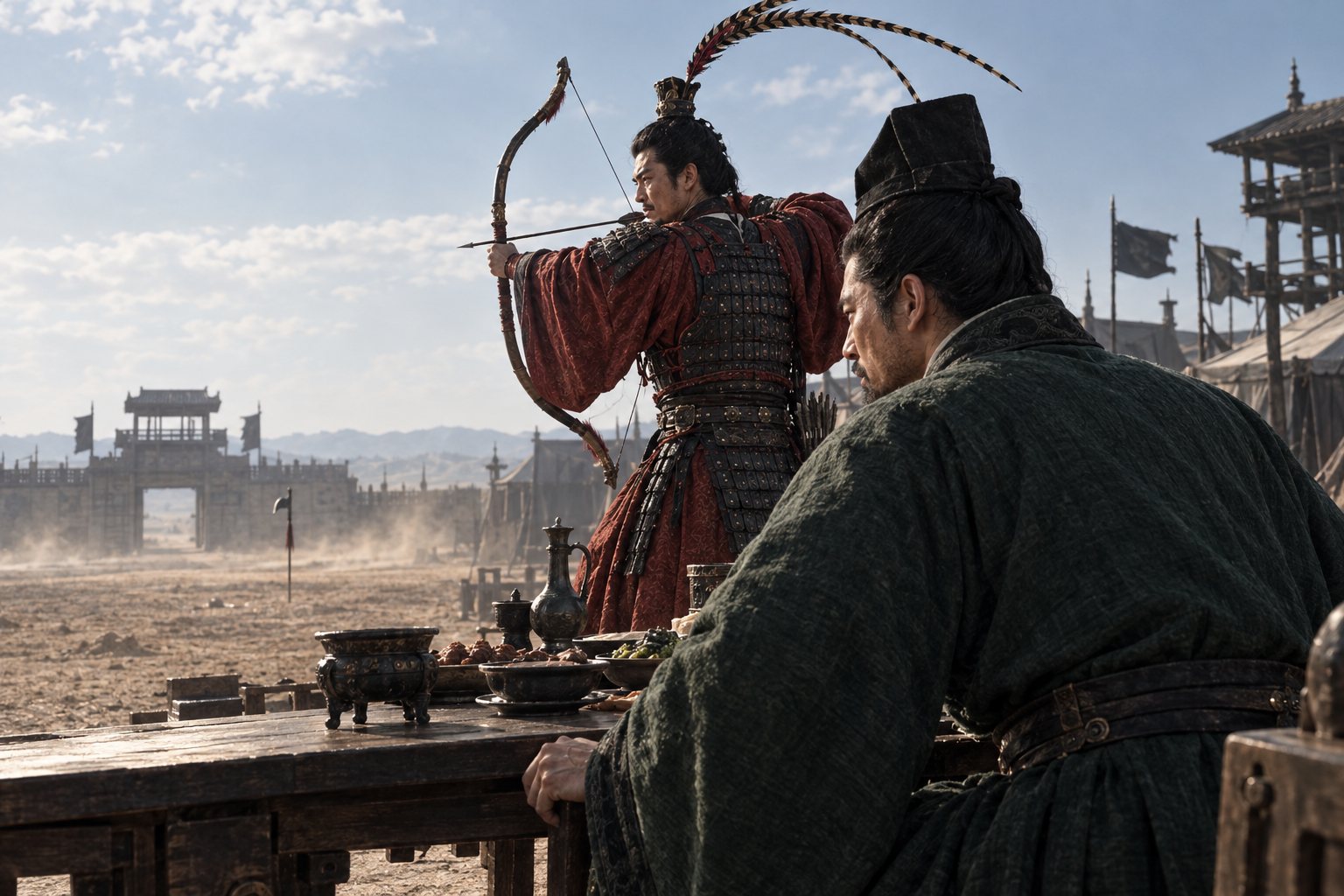
In the Romance, Ji Ling is indignant, while Zhang Fei only wants to fight. He has his attendants take the painted halberd outside the camp gate and plant it far away, 150 paces from the central camp. In the Records of the Three Kingdoms, he says: “Gentlemen, watch me shoot the small prong of my halberd. If I hit it with one shot, you must all withdraw; if I miss, you may stay and fight it out.”
You look at the halberd. It is so far away that it is only a thin line. You pray silently: “I only hope he hits it!”
The bowstring twangs. The arrow strikes the small prong of the painted halberd. All the generals are astonished: “The general's might is divine!”
He laughs heartily, casts his bow to the ground, and takes Ji Ling's hand and yours. After Ji Ling has left, he says to you: “Were it not for me, you would be in peril.”You bow to thank him.
His hand is very warm; his grip is firm. He calls you his younger brother. You remember this day; so does he.
the man who saves you by shooting the halberd → Read Lü Bu's story →
The Dropped Spoon and Chopsticks
Lü Bu resents that you have gathered troops again, and personally sets out against you; you are defeated and flee to Cao Cao. Cao Cao treats you generously and appoints you Governor of Yu Province, giving you soldiers and provisions so you can return to Pei and gather your scattered men. In the 9th month of the 3rd year of Jian'an, Lü Bu's men break through Pei; you escape alone, and your wife is captured again. Cao Cao leads a campaign against Lü Bu, and you march east with him, besieging Lü Bu at Xiapi and capturing him alive.
On the White Gate Tower, Lü Bu is bound. He turns to you: “Xuande, you are a guest here, and I am a captive. Can you not say a word to plead for me?” Cao Cao hesitates. You say: “My lord, have you not seen how Lü Bu served Ding Jianyang and Grand Preceptor Dong?” Lü Bu points at you: “He is the least trustworthy of men.” In the Romance, as they lead him down from the tower, he turns back and curses: “Big-eared boy! Have you forgotten the day I shot the halberd at the camp gate?”
You are reunited with your wife and return to Xu with Cao Cao. He recommends you as General of the Left and treats you ever more generously; when he goes out, you ride in the same carriage, and when you sit, you share a seat.
The imperial kinsman Dong Cheng says he has received a secret edict from the Son of Heaven, hidden in a girdle, ordering Cao Cao's death.
In the Romance, he comes one deep night, carrying the edict. You invite him to sit in a small pavilion, with Guan and Zhang standing nearby. He says: “The other day at the hunting grounds, when Yunchang wanted to kill Cao Cao, the general signaled with his eyes and shook his head to stop him. Why?”
You fear Cao Cao has sent him to test you, and answer with feigned nonchalance: “Chancellor Cao governs the realm. Why should you worry that it is not at peace?”
His expression changes, and he rises: “You are the Imperial Uncle of the Han. I have opened my heart and told you all. Why do you deceive me?”
He takes out the Girdle Edict and shows it to you, and you are overcome with grief and anger. He unfolds a pledge as well; six names are already written on it.
The lamp wick pops. The brush lies beside the pledge. You remember those words on the White Gate Tower: “He is the least trustworthy of men.”
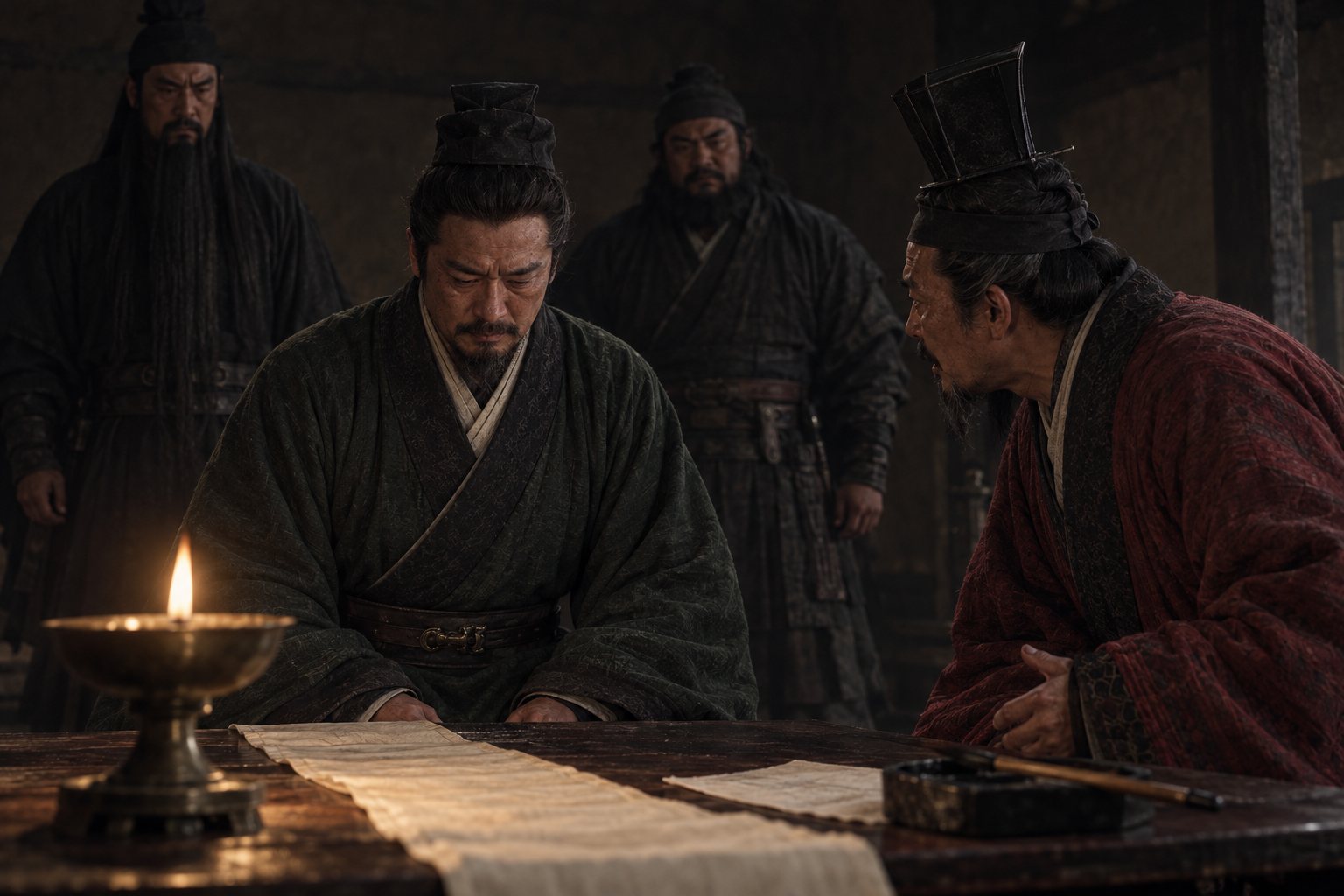
Six names are already on the pledge. The brush is beside you. Do you sign, or not?
You write “Liu Bei, General of the Left,” sign your name, and hand it to Dong Cheng. You say: “Be sure to proceed slowly. Do not let this leak out rashly.”
You plant vegetables in the garden behind your residence and water them yourself. Guan and Zhang ask why you are taking up a menial task, and you say: “This is something you two would not understand.”
One day, Xu Chu and Zhang Liao lead dozens of men into the garden: “The Chancellor has given orders. My lord, please come at once.”You have no choice but to follow them to the Chancellor's residence. Cao Cao smiles: “What a great deed you have been doing at home!”Your face turns pale with fright. He takes your hand and leads you all the way to the garden behind the house: “Xuande, tending a garden is no easy matter.”
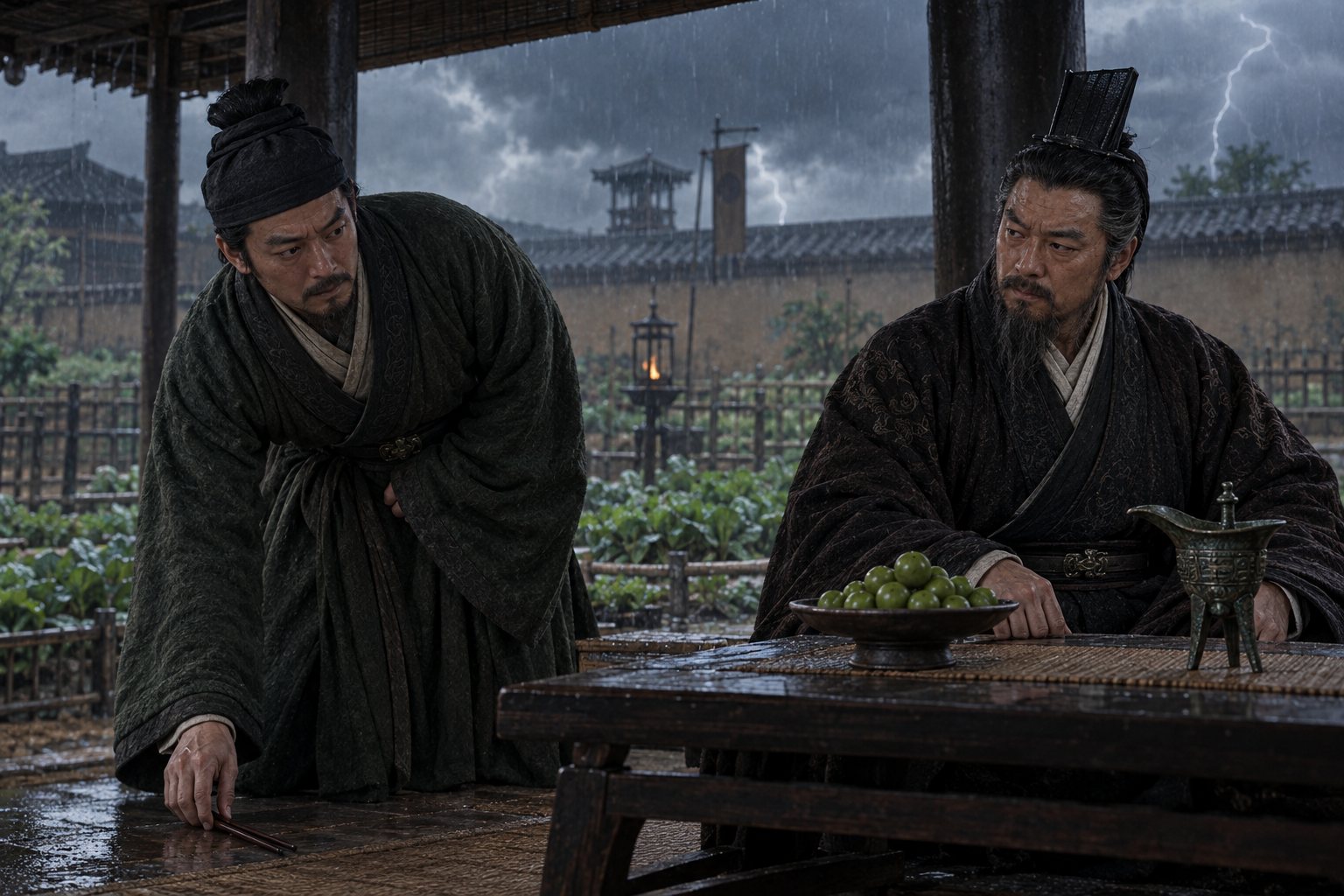
Green plums lie on a plate, and a jar of warmed wine is set out. When you are both half drunk, dark clouds gather, and a sudden rain is coming. He asks you to name the heroes of the age. You name Yuan Shu, Yuan Shao, Liu Biao, Sun Ce, and Liu Zhang; he dismisses every one. You say: “Beyond these, Bei truly knows of no one.”
He looks at you: “The heroes of the realm today are only you, my lord, and I. Men like Yuan Shao are not worth counting.”
As you eat, your spoon and chopsticks fall to the ground. At that very moment, thunder rumbles. You say: “The sage says, ‘When thunder cracks and the wind howls, one must change one's expression.’ There is good reason for it. Such a terrifying crash can indeed make one tremble!”
In the Romance, you calmly bow your head and pick up your chopsticks. He laughs: “Does a grown man fear thunder too?”From then on, he no longer suspects you.
Yuan Shu intends to travel north through Xu Province to join Yuan Shao; Cao Cao sends you to command Zhu Ling and Lu Zhao and intercept him. In the Romance, after leaving Xu, you say to Guan Yu and Zhang Fei: “I am a bird in a cage, a fish in a net. This journey is like a fish entering the sea and a bird soaring into the blue sky, free from the bonds of cage and net.”
When you reach Xiapi, you kill Che Zhou, the Inspector of Xu Province. Later, the affair is exposed, and Dong Cheng and the others are all executed. By then, you are no longer in Xu.
the man who calls you a hero → Read Cao Cao's story →
Thigh Flesh
In the 5th year of Jian'an, Cao Cao campaigns east, and you suffer a crushing defeat. You had thought he was locked in a standoff with Yuan Shao and would not come east; a scout suddenly reports that Cao Cao has arrived in person. You are shocked, and still do not believe it. You ride out with several dozen horsemen to look, see his banners and standards, and abandon your men to flee. Your wife is captured again, and Guan Yu is taken prisoner as well.
You flee to Qing Province, and Yuan Shao rides 200 li from Ye to meet you. Guan Yu escapes and returns to your side. You quietly consider leaving Yuan Shao and urge him to ally with Liu Biao in the south. Yuan Shao lets you take your own troops back to Runan. Cao Cao defeats Yuan Shao, then comes south in person to attack you.
You send Mi Zhu and Sun Qian to meet Liu Biao; Liu Biao comes in person to welcome you in the suburbs, receives you with the rites due an honored guest, and lets you garrison at Xinye. Day by day, more of Jing Province's prominent men come over to you. Liu Biao grows suspicious and secretly keeps watch on you.
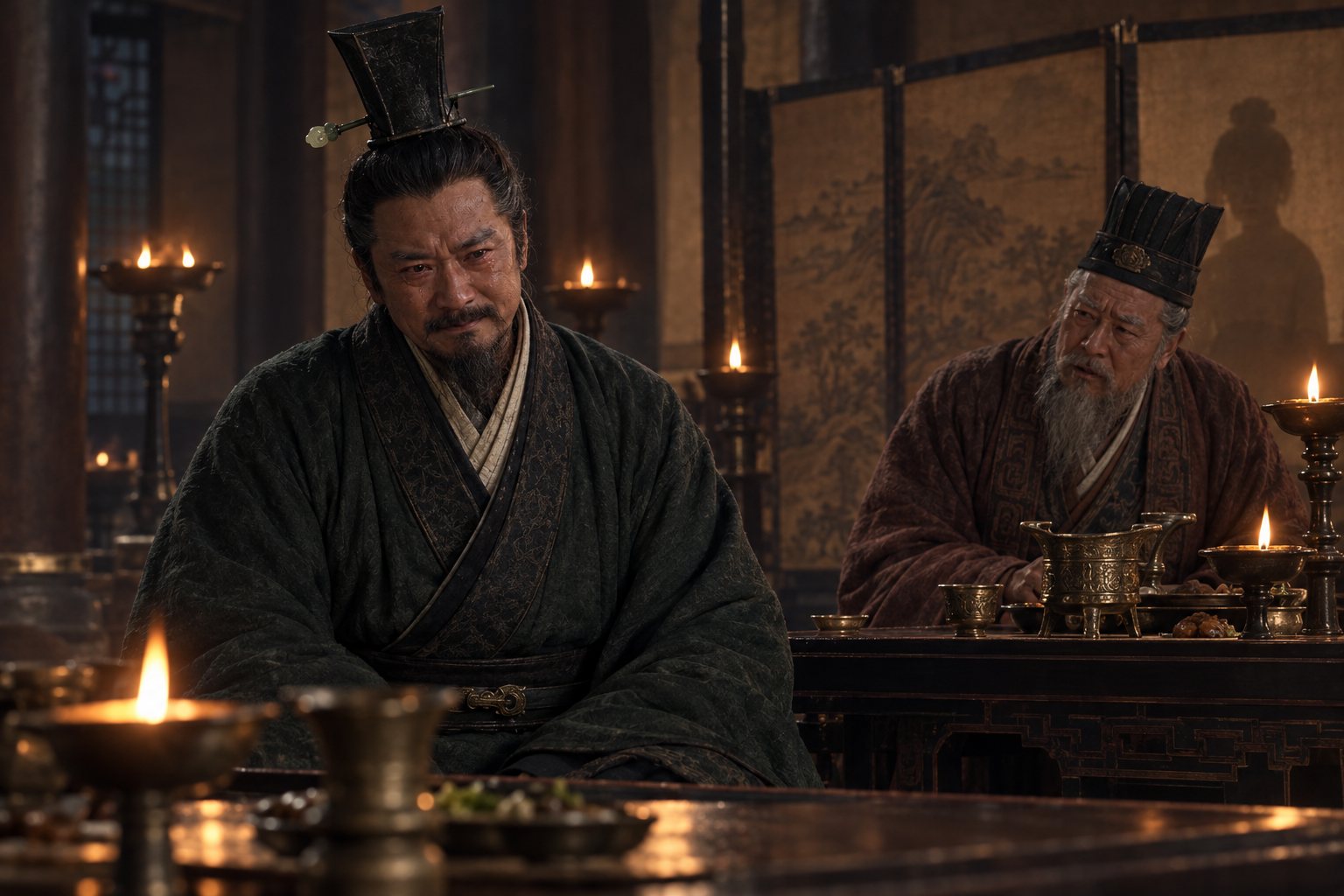
In the Romance, Liu Biao once invites you to a banquet. Deep in his cups, he suddenly bursts into tears and speaks of his two sons: his eldest, Qi, is gentle and weak; his younger, Cong, is clever. He wants to set aside the elder and install the younger, but fears offending propriety. You say: “Since ancient times, setting aside the elder to install the younger has been the way to bring disorder.”Behind the screen, Lady Cai hears you and hates you.
You rise to relieve yourself and see that the flesh on your thigh has grown back. Tears come to your eyes before you know it.
The flesh on your thigh is soft. More than 20 years have passed since you left Zhuo County. What the saddle wore away has slowly grown back over these years in Xinye. From the hall outside come the sounds of strings and flutes.
When you return to your seat, Liu Biao looks puzzled and asks what is wrong. You say: “I used to be never off my saddle, and the flesh on my thighs wore away. Now I no longer ride, and flesh has grown on my thighs. The days and months race by; old age is coming, yet I have achieved no great work. That is why I grieve.”
In the Romance, Liu Biao comforts you: he has heard that you and Cao Cao warmed wine over green plums in Xuchang and spoke of heroes, and that Cao Cao said: “The only heroes under Heaven are you, my lord, and me.”
Riding the wine's warmth, you let slip: “If I had a foothold, the mediocre men of the world would truly be no cause for worry.”
Liu Biao hears this and falls silent. Knowing you have let the truth slip, you pretend to be drunk and rise.
Three Visits
The Shiyu tells another story: Liu Biao invites you to a banquet; Kuai Yue and Cai Mao mean to seize the chance to take you, you sense the danger, pretend to go to the privy, and slip away. You ride off on Dilu, but plunge into the waters of Tanxi west of Xiangyang and cannot get out. You cry out: “Dilu! We are in peril today. Do your utmost!”Dilu leaps three zhang and clears the stream.
You ask Sima Decao about the affairs of the world, and he says: “How could conventional scholars and ordinary men understand the times? Those who understand the times are the outstanding ones. Here there are a Crouching Dragon and a Young Phoenix.” You ask who they are. He says: “Zhuge Kongming and Pang Shiyuan.”Xu Shu comes to see you, and you esteem him. He says: “Zhuge Kongming is the Crouching Dragon. Would the general like to meet him?” You say: “Bring him with you.” He says: “This man may be visited, but cannot be summoned. The general should deign to call on him.”
In the Romance, on your second visit, it is the depth of winter, the weather bitterly cold, with dark clouds gathering, and after only a few li, the north wind howls and auspicious snow falls thickly. Zhang Fei says: “The weather is freezing, and we are not even at war. Why go so far to see a useless man? We should return to Xinye and escape the snowstorm.” You say: “I want Kongming to know how earnest I am.”
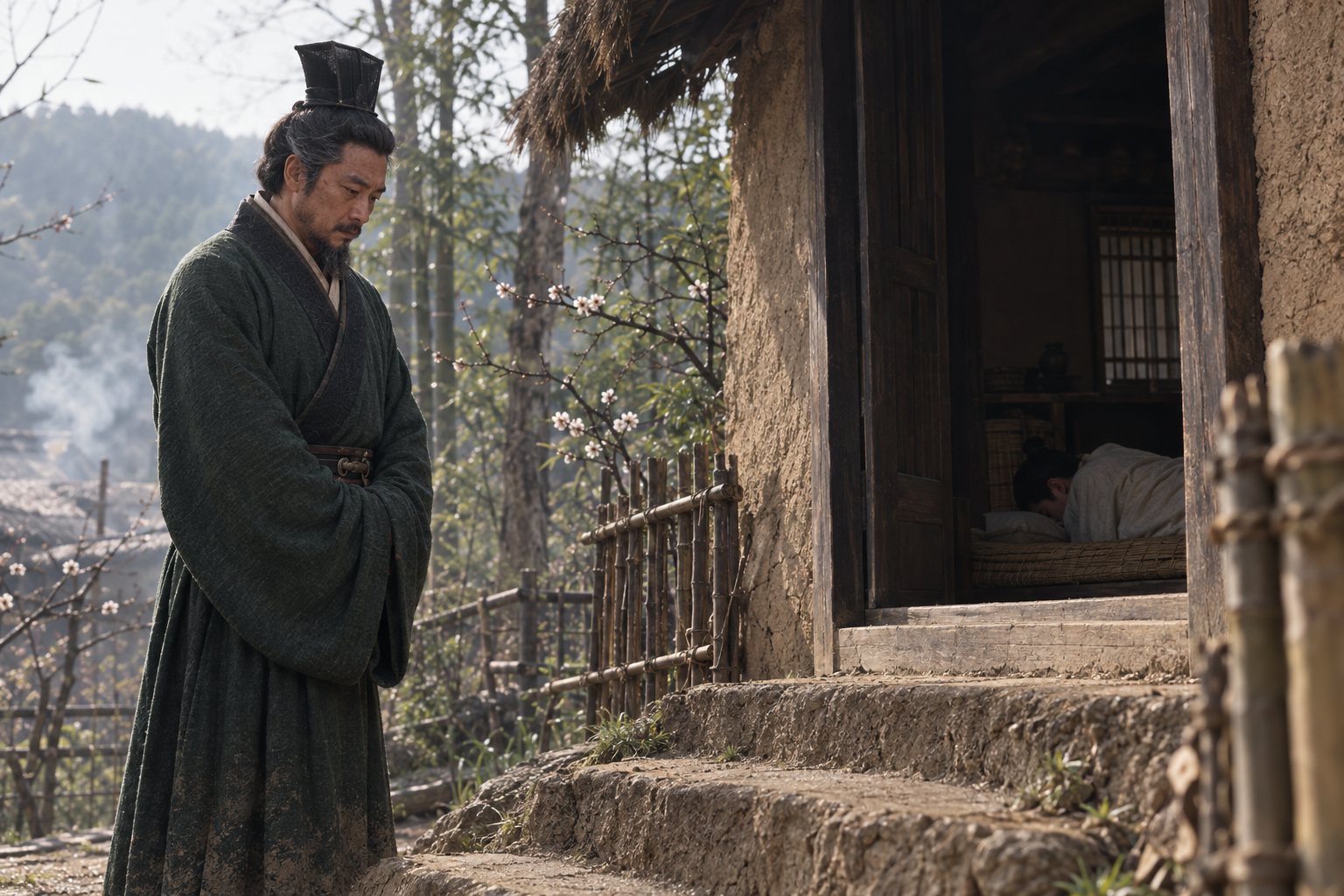
Only his younger brother Zhuge Jun is in the thatched cottage. You breathe on the frozen brush to thaw it, spread out the paper, and write a letter: “I have long admired your great reputation. I have called on you twice, but both times returned empty-handed. How distressed I am!”The wind and snow grow heavier on your way back. You look back at Wolong Ridge, downcast.
You return to Xinye, and before long the new spring arrives. You have a diviner cast the yarrow stalks to choose an auspicious day, then fast for three days, bathe, and change your clothes.
Guan Yu urges you: “Elder brother, you have gone in person twice to pay your respects. That is too much deference. I think Zhuge Liang has an empty reputation and no real learning, and so avoids meeting you. Why are you so taken in by this man?”
Zhang Fei says: “What makes this country fellow worthy of being a great sage? This time, elder brother need not go. If he will not come, I’ll just bind him with a hemp rope and bring him here!”
You are 46 this year. The flesh on your thigh is still there. Xinye is a small city with few soldiers, and Cao Cao has already pacified Hebei to the north.
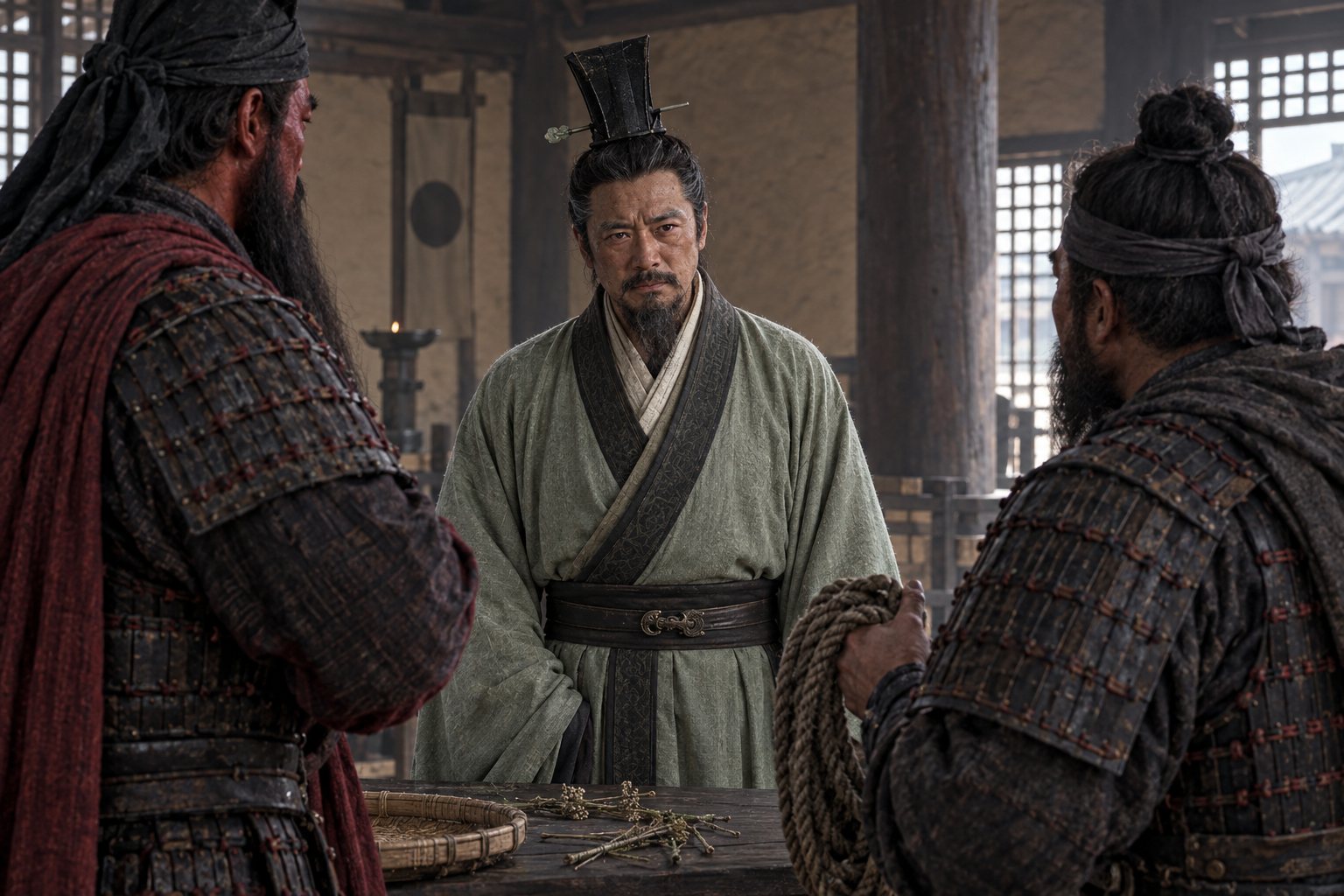
Both your brothers are watching you. Do you go a third time?
The three of you ride toward Longzhong. Half a li from the thatched cottage, you dismount and walk.
The boy says that the master is asleep in the thatched hall and has not yet woken. You say: “In that case, do not announce us.”You stand below the steps with your hands clasped. He turns over as if to rise, then faces the inner wall and falls asleep again. You stand there for another two hours.
You go three times before you finally meet him. You send everyone else away: “The Han house is in decline, treacherous ministers steal the mandate, and the sovereign is in exile. I do not measure my virtue or my strength; I wish to uphold the great cause throughout the realm. But my wisdom and skill are meager, and so I have suffered defeat, until things have come to this. Yet my resolve is still unspent. What plan, in your view, should I adopt?”
He says Cao Cao is truly not someone you can contend with, Sun Quan can serve as an ally but must not be attacked; of Jing Province, he says its lord cannot hold it; of Yi Province, a thousand miles of fertile fields, the land of Heaven's storehouse. At last he says: “If you can hold both Jing and Yi, secure their natural defenses, make peace with the western tribes, pacify the southern Yue, form ties abroad with Sun Quan, and cultivate good government at home; when change comes in the realm, then order a great general to lead the army of Jing Province toward Wan and Luo, while you yourself lead the forces of Yi Province out onto the plains of Qin. Who among the people would dare not bring baskets of food and jars of drink to welcome you? If you truly do this, then hegemony can be achieved, and the Han house can be revived.”
You say: “Good!” In the Romance, you also ask: “But Liu Biao of Jing Province and Liu Zhang of Yi Province are both kinsmen of the Han house. How could I bear to take their lands?”
From then on, you grow ever closer to him. Guan Yu and Zhang Fei are displeased, and you say to them: “In having Kongming, I am like a fish that has found water. I hope you will say no more.”
the man in the thatched cottage → Read Zhuge Liang's story →
Putting People First
In the 12th year of Jian'an, Cao Cao campaigns north against the Wuhuan, and you urge Liu Biao to seize the opportunity to attack Xu. He does not take your advice. Cao Cao returns from Liucheng. Liu Biao says to you, “I did not take your advice, and so I missed this great opportunity.” You say: “The realm is divided, and war follows day after day. How could such opportunities ever come to an end? If we can respond to one later, then this is no cause for regret.”
Pei Songzhi's notes quote the Book of Wei: Liu Biao is gravely ill and entrusts Jing Province to you: “My sons lack talent, and my generals are scattered and gone. After I die, you must take charge of Jing Province.” You say: “Your sons are worthy enough. Just look after your illness.” Someone urges you to heed him. You say: “This man has treated me generously. If I now follow his words, people will think me ungrateful. I cannot bear that.”
Liu Biao dies, and his son Liu Cong succeeds him and sends word to Cao Cao that he will surrender. You are stationed at Fancheng, unaware that Cao Cao has suddenly arrived; you hear of it only when he reaches Wancheng. The Spring and Autumn Annals of Han and Wei says that Song Zhong, sent by Liu Cong to deliver the news, arrives. You raise your blade toward Zhong: “If I cut off your head now, it would not be enough to vent my anger—and it would shame a man to kill people like you again at parting!”
You lead the people south. As you pass Xiangyang, Zhuge Liang urges you to attack Liu Cong, saying Jing Province can be yours. You say: “I cannot bear to do it.” You rein in your horse beneath the city and call out to Liu Cong. He is so frightened he cannot rise. Most of Liu Cong's attendants and the people of Jing Province follow you.
In the Romance, you pass Liu Biao's tomb and lead your officers in paying their respects before it, weeping as you say: “Your unworthy younger brother, Bei, lacks virtue and talent, and has failed the trust you placed in him. The fault is mine alone; the people are blameless. I pray your spirit will save the people of Jing and Xiang!”
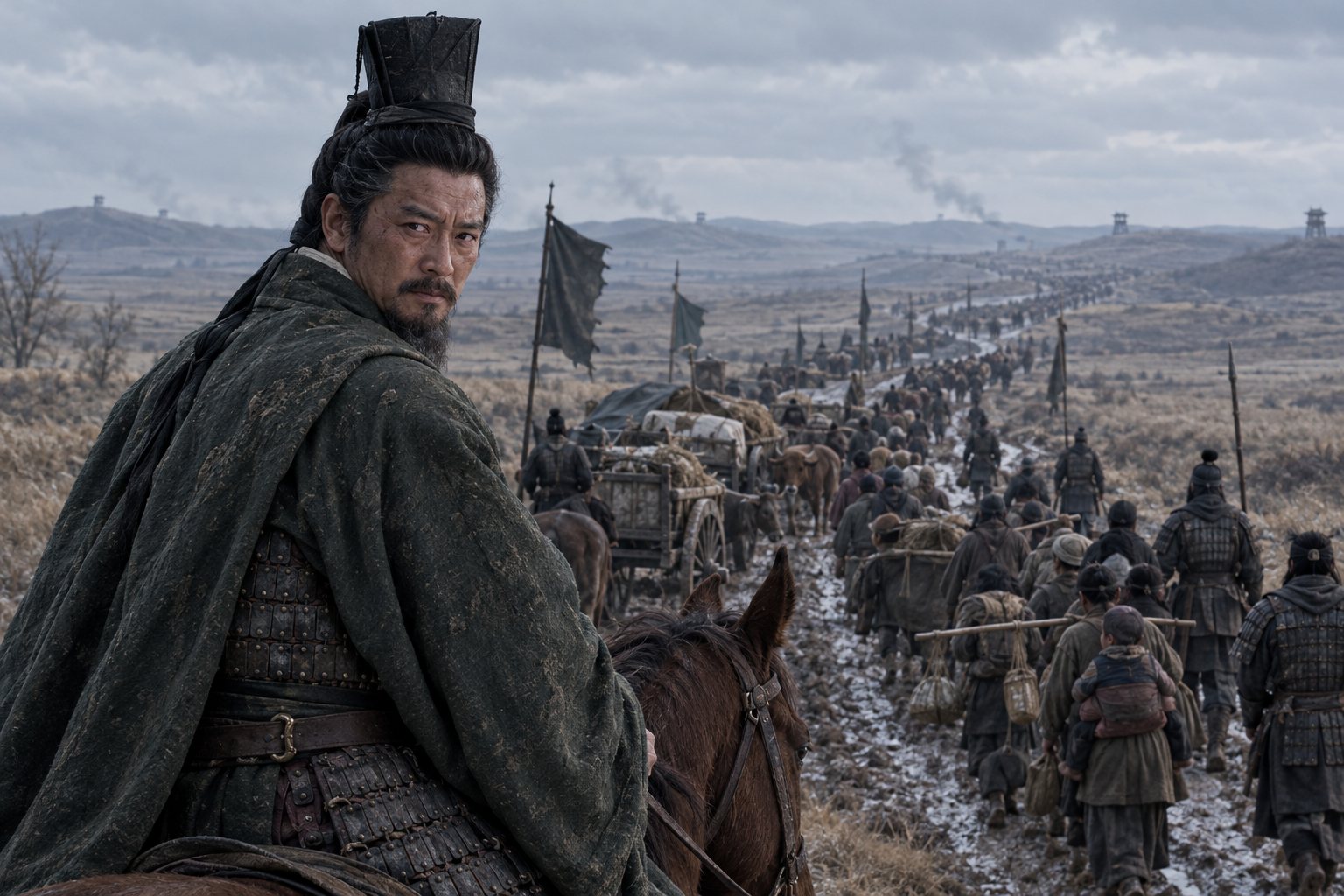
By the time you reach Dangyang, more than 100,000 people are following you, with several thousand carts of baggage; you travel only ten-odd li a day. You separately send Guan Yu by water with several hundred boats, agreeing to meet at Jiangling.
The wheels sink into the mud, one cart after another. Those carrying loads, those bearing the old on their backs, those holding children: they stretch from before your horse to where sight can no longer reach. News from the north draws nearer by the day.
Someone says to you: “You should hurry to Jiangling and secure it. Though you command a great host, few are armored. If Lord Cao's troops arrive, how will you resist them?” In the Romance, your officers also say: “Better to leave the people for now and press on ahead.”
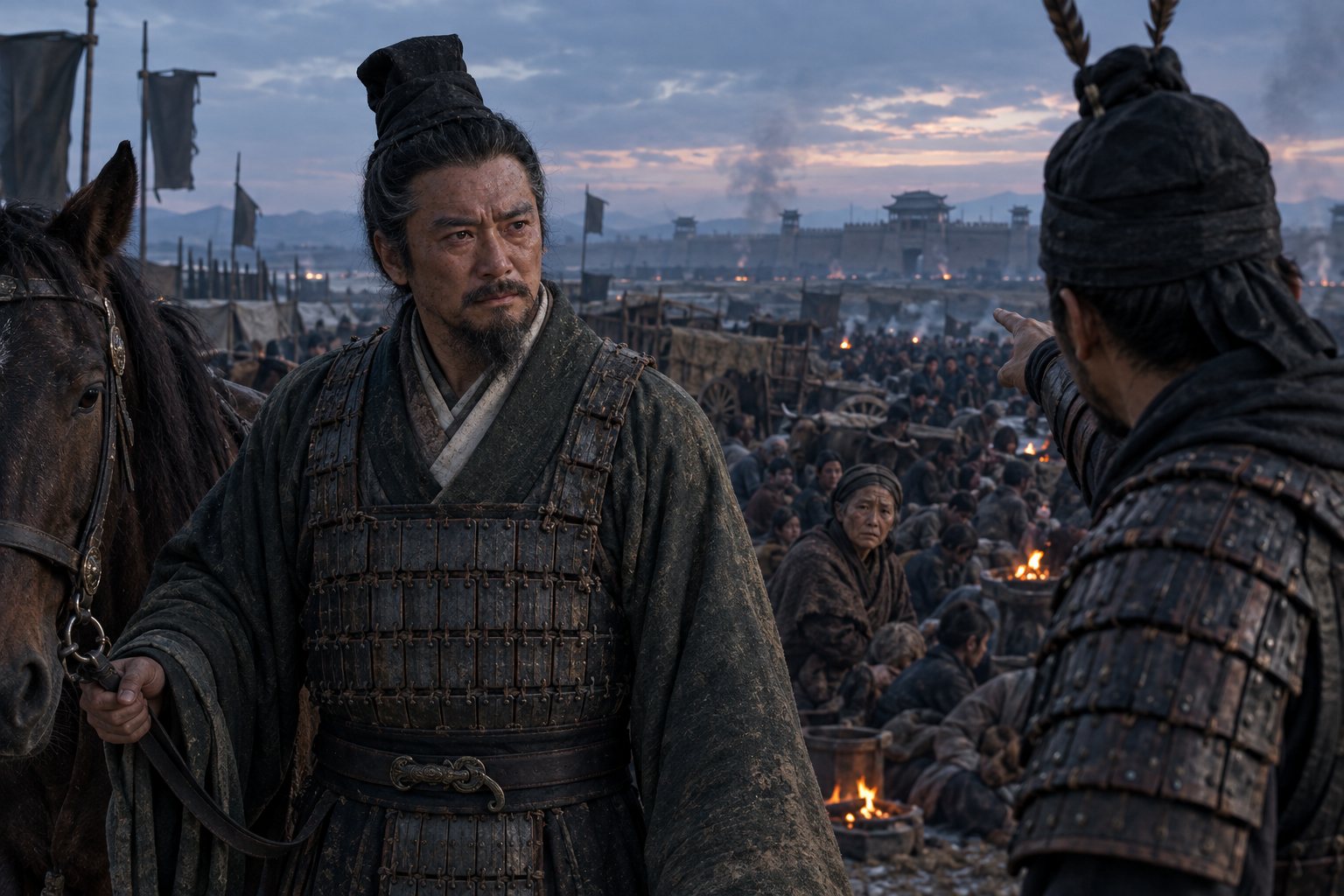
More than 100,000 people are behind you. What do you do?
Cao Cao leaves his baggage behind and hurries to Xiangyang with a light force. Hearing that you have already passed through, he personally leads 5,000 elite cavalry in pursuit. They cover more than 300 li in a day and a night, catching up with you at Changban, Dangyang.
In the Romance, it is late autumn, early winter; the cold wind cuts to the bone, and dusk draws near as cries fill the land. At the fourth watch, shouts rise from the northwest, shaking the earth.
You leave your wife behind and flee with Zhuge Liang, Zhang Fei, Zhao Yun, and several dozen horsemen. Cao Cao captures your people and baggage in a great haul.
In the Romance, at daybreak you weep: “More than 100,000 living souls suffer this great calamity because they follow me. I do not know whether my officers and their families live or die. Even a man of wood or earth would grieve!”
Someone says Zhao Yun has gone north. You hurl your hand halberd at him: “Zilong would never abandon me and flee.” A little later, Zhao Yun arrives. He carries your son in his arms and protects the child's mother, Lady Gan; both have escaped unharmed.
In the Romance, you take Adou and cast him to the ground: “For the sake of this brat, I nearly lost one of my finest generals!”
You veer toward Hanjin and happen upon Guan Yu's boats. You cross the Mian River, then meet Liu Biao's eldest son, Liu Qi; together you reach Xiakou.
the man who returns with Adou in his arms → Read Zhao Yun's story →
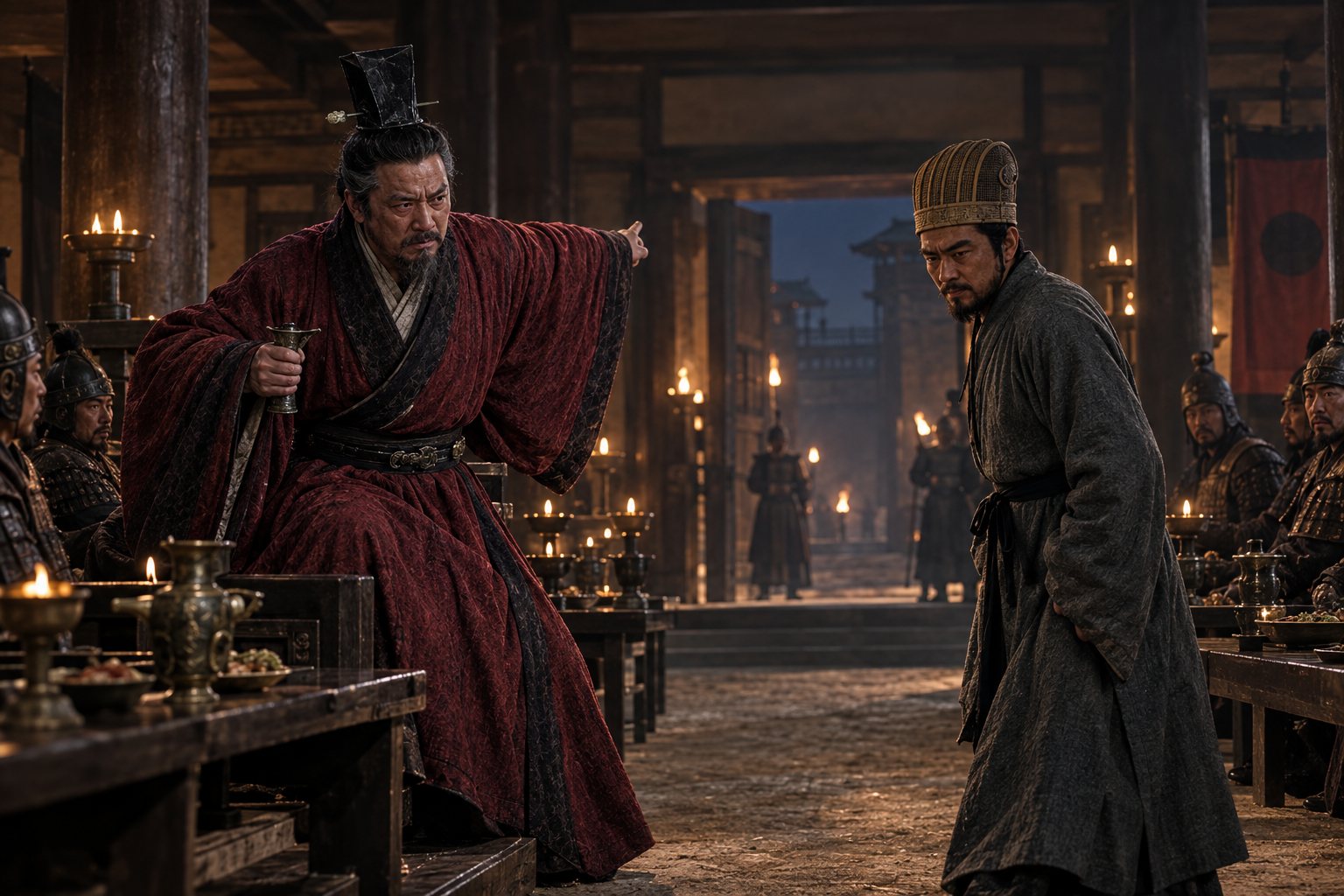
Three Plans
You join forces with Sun Quan, decisively defeat Cao Cao's army at Chibi, and burn his ships. You then campaign south against the four commanderies; the four Administrators of Wuling, Changsha, Guiyang, and Lingling all surrender. Sun Quan gradually grows wary of you and marries his sister to you to cement an alliance. You go to Jingkou to meet him, and on your return you tell those around you: “General of Chariots and Cavalry Sun is long in the body and short in the legs; it is hard to be his subordinate. I must not see him again.”So you travel day and night.
Zhang Song, Assistant Officer of Yi Province, says to Liu Zhang: “Liu of Yu Province is your kinsman and Cao Cao's bitter enemy. He is skilled in the use of troops. If you send him to attack Zhang Lu, Zhang Lu will surely be defeated.”Liu Zhang sends Fa Zheng with 4,000 men to welcome you. Pang Tong—the “Young Phoenix” whom Sima Decao spoke of—is now on your staff. He urges you to take Yi Province. You say: “The man who stands against me as fire against water is Cao Cao. Cao is harsh, I am lenient; Cao is violent, I am humane; Cao is deceitful, I am loyal. I oppose Cao in every way; only then can things be accomplished. To lose the trust of the world over a small matter is something I will not do.” He says: “Take it by irregular means, then hold it by proper ones, and repay him with righteousness. Once matters are settled, enfeoff him with a great state. How would that betray trust? If you do not take it now, it will eventually benefit someone else.”So you go.
When you reach Fucheng, Liu Zhang comes out in person to welcome you, and the meeting is full of warmth. Zhang Song has Fa Zheng convey the suggestion, and Pang Tong urges you too: seize Liu Zhang at the gathering. You say: “This is a great undertaking. We cannot act in haste.” In the “Biography of Pang Tong,” your reply is different: “We have only just entered another's territory; our kindness and trust are not yet established. This cannot be done.”
Liu Zhang gives you more troops to attack Zhang Lu, then puts you in command of the White Water army. You go north to Jiameng. Instead of attacking Zhang Lu at once, you cultivate goodwill and gather people's support.
The following year, Cao Cao campaigns against Sun Quan, and Sun Quan calls on you for aid. You ask Liu Zhang for 10,000 troops and supplies, intending to go east. Liu Zhang gives you only 4,000 troops and only half of everything else.
The Book of Wei says that you use this to stir your men to anger: “I fight a powerful enemy on behalf of Yi Province. My troops are exhausted, with no time to rest. Yet he hoards wealth in his treasury and grudges rewards for merit. How can he expect officers and gentlemen to fight to the death for him?”
Pang Tong comes to see you. He says: “Secretly select elite troops, travel day and night by forced marches, and strike straight at Chengdu. Zhang is no warrior and has made no preparations. If our army arrives suddenly, one blow will settle everything. This is the superior plan.”
“Yang Huai and Gao Pei are Zhang's famous generals. Each commands strong troops and holds a pass. I hear they have repeatedly sent letters urging Zhang to send the general back to Jing Province. Before you reach them, send them word that Jing Province is in danger and you wish to return to its aid, and have your gear packed, outwardly making it seem that you are leaving. These two men already admire your renowned name, and are glad you are going. They will surely come to see you with only a light escort. Then you can seize them, take their troops, and advance on Chengdu. This is the middle plan.”
“Withdraw to Baidi and reconnect with Jing Province, then slowly plan another move. This is the inferior plan. If you hesitate and do not leave, you will bring great trouble upon yourself. You cannot delay.”
Night is still in Jiameng; beyond the pass lie the mountains. You remember the four words you once said: oppose Cao in every way.
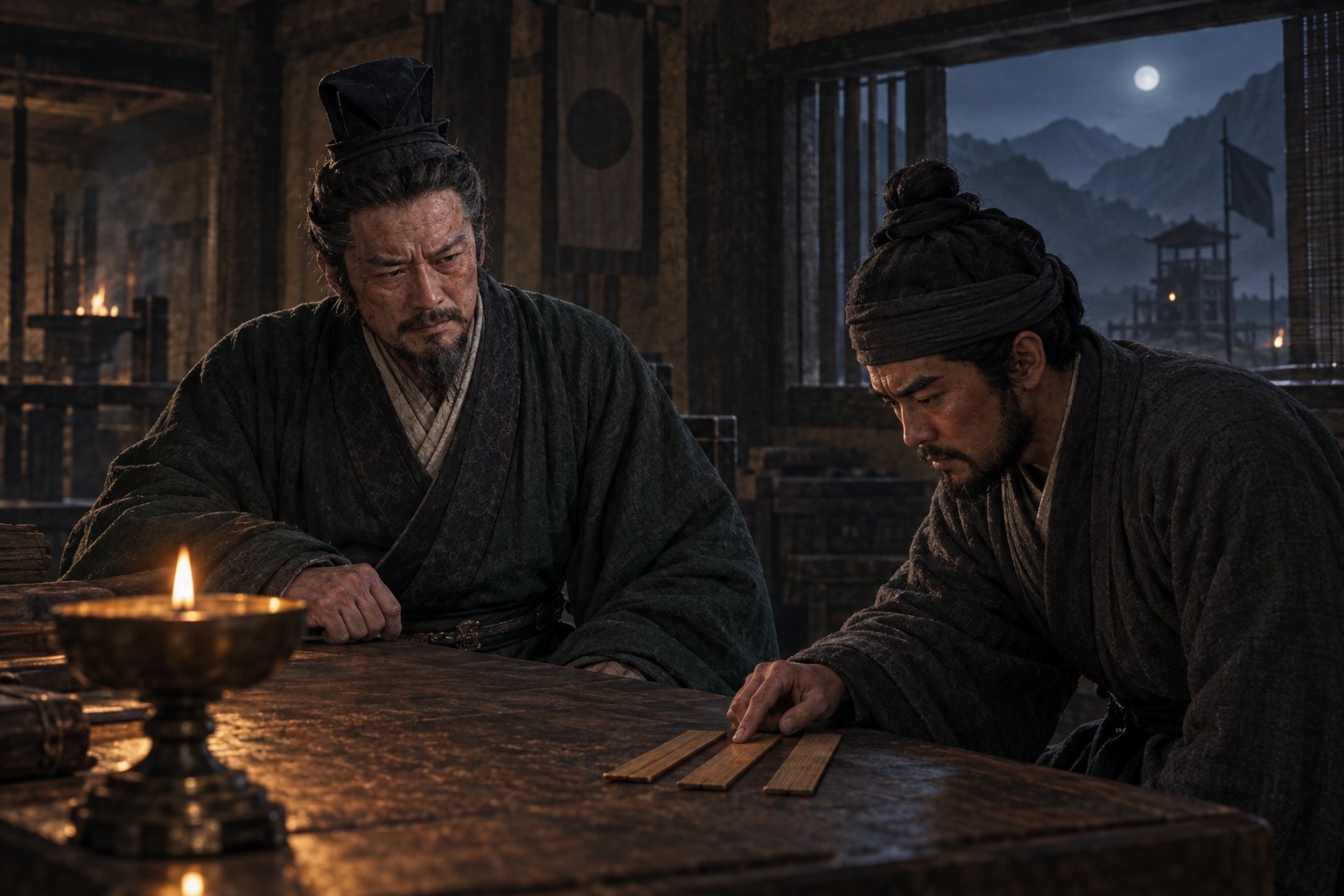
Three paths lie before you. Which do you take?
You choose the middle plan.
Zhang Song writes to you and Fa Zheng: “The great undertaking is on the verge of success. How can you drop it now and leave?”Zhang Song's older brother, Zhang Su, fears being implicated and denounces him. Liu Zhang has Zhang Song arrested and executed; from then on, there is a rift between you and him.
In great anger, you summon Yang Huai, Liu Zhang's commander of the White Water army, rebuke him for his discourtesy, and execute him. In the Romance, Yang and Gao each conceal a sharp blade on his person when they come to see you off, but the blades are found in a search. You still hesitate, unable to decide, and Pang Tong orders the executioners to kill them.
You turn your troops toward Chengdu, and every place you pass falls to you. At the great gathering in Fucheng, wine is set out and music plays. You say to Pang Tong, “This gathering today is truly joyful.” He says: “To rejoice at conquering another's state is not the conduct of a benevolent army.”
You are drunk and grow angry: “King Wu attacked Zhou; songs came before him, dances behind him. Was he not benevolent? Your words are wrong. Get up and leave at once!”
He leaves. You soon regret it and ask him to return. He returns to his place, makes no apology, and carries on eating and drinking as before. You ask: “In the argument just now, who was in the wrong?” He says: “Both lord and subject were in the wrong.”You laugh aloud, and the feast resumes as before.
Xiaozhi Takes Cover from Arrows
Pang Tong leads his men in an attack on Luocheng, is struck by a stray arrow, and dies at the age of 36. You mourn him deeply; whenever you speak of him, you weep. After you besiege Chengdu for dozens of days, Liu Zhang comes out and surrenders. Zhuge Liang serves as your chief support, Fa Zheng as your chief strategist, and Guan Yu, Zhang Fei, and Ma Chao as your claws and fangs.
Cao Cao subdues Zhang Lu, secures Hanzhong, and leaves Xiahou Yuan and Zhang He to garrison it. Fa Zheng says to you: Heaven is surely giving this to us; we must not let the moment pass. You lead your generals to advance into Hanzhong.
In the spring of the 24th year of Jian'an, you cross the Mian River south from Yangping, advance a little way along the mountain, and pitch camp at Mount Dingjun. Xiahou Yuan brings troops to contest the ground. Fa Zheng says: “Now is the time to strike.”You order Huang Zhong to attack from the heights with drums and war cries; he routs Yuan's army and beheads Xiahou Yuan.
Cao Cao marches south from Chang'an with his full force. From afar, you assess him: “Though Cao Cao comes, he can do nothing. The Han River valley will be mine.”On the road, he hears of Fa Zheng's plan, and says: “I knew Xuande could not have managed this; someone must have taught him.”
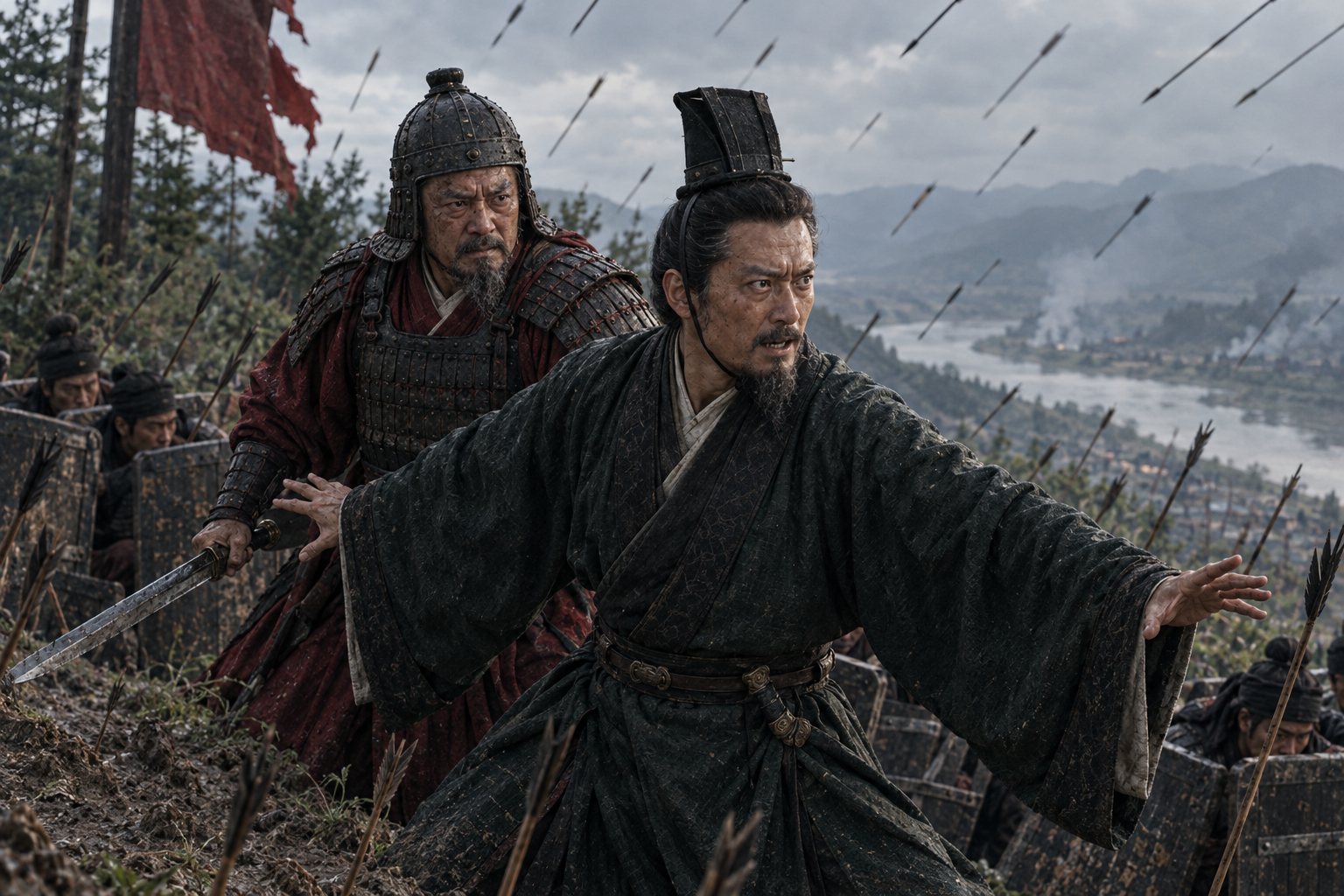
As Cao Cao's great army presses to the front of the formation, you contend with Cao Cao, the situation turns against you, and you ought to retreat. You are furious and refuse; no one dares advise you.
Arrows fall like rain. Arrow shafts stick into the earth beside your feet, one after another. You stand unmoving.
Fa Zheng steps forward and stands in front of you.
You say: “Xiaozhi, take cover from the arrows.”
He does not turn around: “My lord faces arrows and stones himself; how much more so a humble man like me?”
You watch his back. Another volley of arrows falls.
You say, “Xiaozhi, let us go together.” Then you withdraw.
After that, you gather your troops, hold the strategic passes, and never engage him in battle.
Month after month, he cannot take the place, and the number of deserters grows day by day. In summer, Cao Cao does indeed withdraw, and you take Hanzhong.
In autumn, your followers urge you to become King of Hanzhong. In the Romance, you first refuse: “Though you wish to honor me as king, without the emperor's clear edict, it would be usurpation.”
You set up an altar at Mianyang, array your troops and men, and the assembled officials take their places. When the memorial is read, they place the king's crown on your head. In your memorial to the Han emperor, you write: “Long ago, I joined with General of Chariots and Cavalry Dong Cheng in plotting to punish Cao Cao. The secret was not kept, and Cheng was ensnared and killed. I was driven from place to place and lost my footing; I could not fulfill my loyalty and righteousness.”
That night in Xu, 20 years ago: the brush, the pledge. Everyone on the list is dead. Only you remain, wearing this crown.
Too Angry for Peace
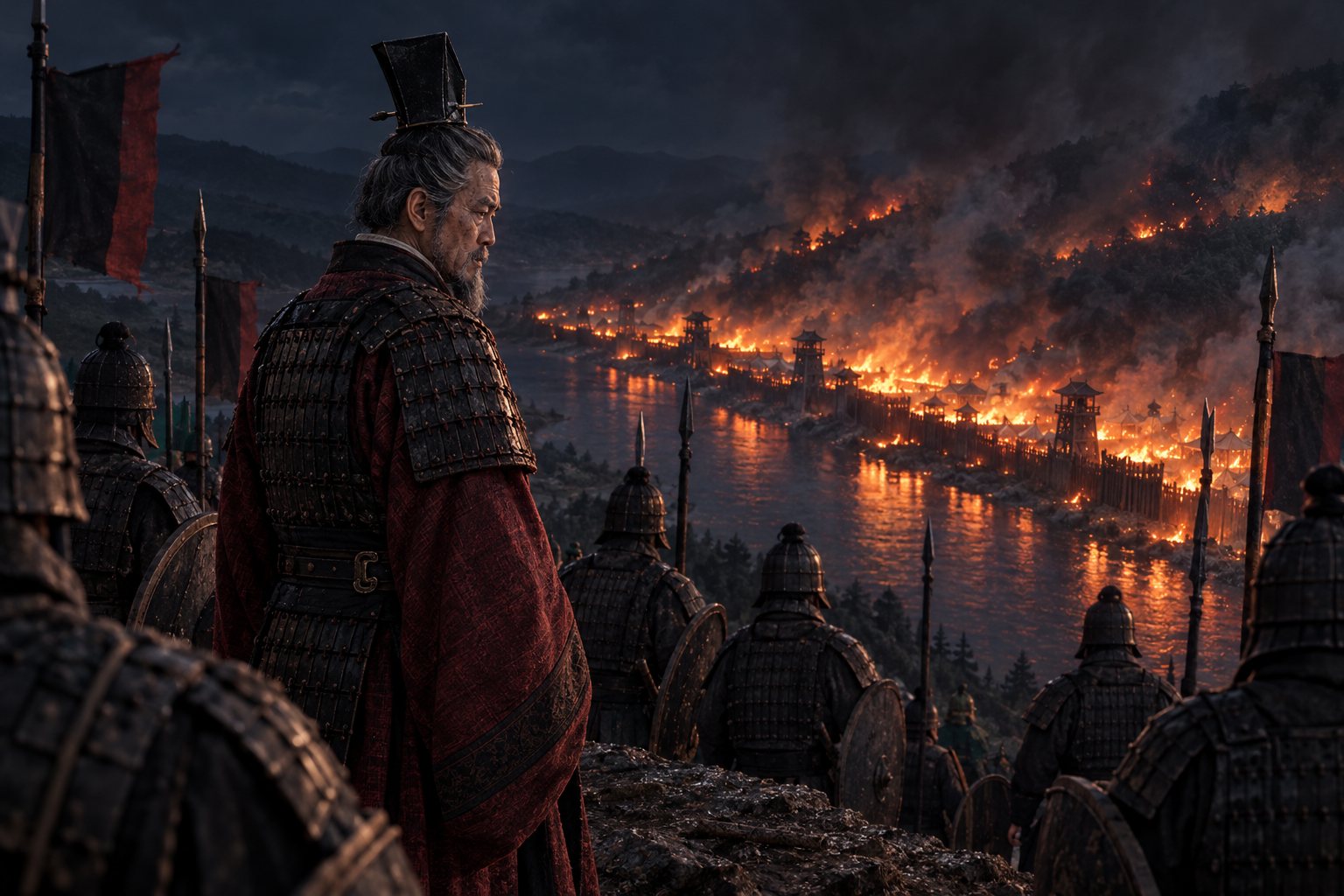
Guan Yu attacks Cao Ren and captures Yu Jin at Fancheng. Sun Quan suddenly attacks and kills Guan Yu, taking Jing Province.
Cao Pi declares himself emperor and changes the era name to Huangchu. Word reaches you that the Han emperor has been killed; you hold a funeral and put on mourning clothes. Zhuge Liang urges you to take the imperial title, quoting Geng Chun: “The heroes of the realm look to you, longing for someone to put their hopes in. If you do not accept this proposal, the grandees will each go and seek a lord, and none will follow you.”You take the throne as emperor south of Wudan Hill in Chengdu.
Beneath the mulberry tree beside the fence in Zhuo County, you once said you would ride in a carriage with a feathered canopy. Now you are the Son of Heaven. Your uncle said those words would bring ruin on the whole family. That was decades ago.
You hate Sun Quan for attacking and killing Guan Yu, and want to march east. In the Romance, you issue an edict at court: “I swore brotherhood with Guan and Zhang in the Peach Garden, vowing to live and die together. Unhappily, my younger brother Yunchang was killed by Sun Quan of Eastern Wu. If I do not avenge him, I betray our oath.”
Zhao Yun remonstrates: “The enemy of the state is Cao Cao, not Sun Quan. First destroy Wei, and Wu will submit of its own accord.”“We should not leave Wei aside and fight Wu first. Once the armies engage, there will be no quick end to it.”
Huang Quan remonstrates: “The men of Wu fight fiercely, and their fleet has the current with it: advancing is easy, retreating hard. I ask to lead the vanguard and face the enemy; Your Majesty should remain in the rear as support.”
In the Romance, the scholar Qin Mi also remonstrates: “Your Majesty would abandon the person of one who rules ten thousand chariots and pursue a lesser loyalty. The men of old would not have approved.”
In the 6th month, the General of Chariots and Cavalry Zhang Fei is killed by men close to him. The commander from Zhang Fei’s camp sends a memorial. When you hear it is a memorial from the commander, you say, “Ah! Fei is dead.”
The two men who shared your bed at night are both gone within two years.
In autumn, in the 7th month, you personally lead the armies to attack Wu. The great army leaves Chengdu and moves east downriver. Sun Quan sends a messenger with a letter asking for peace.
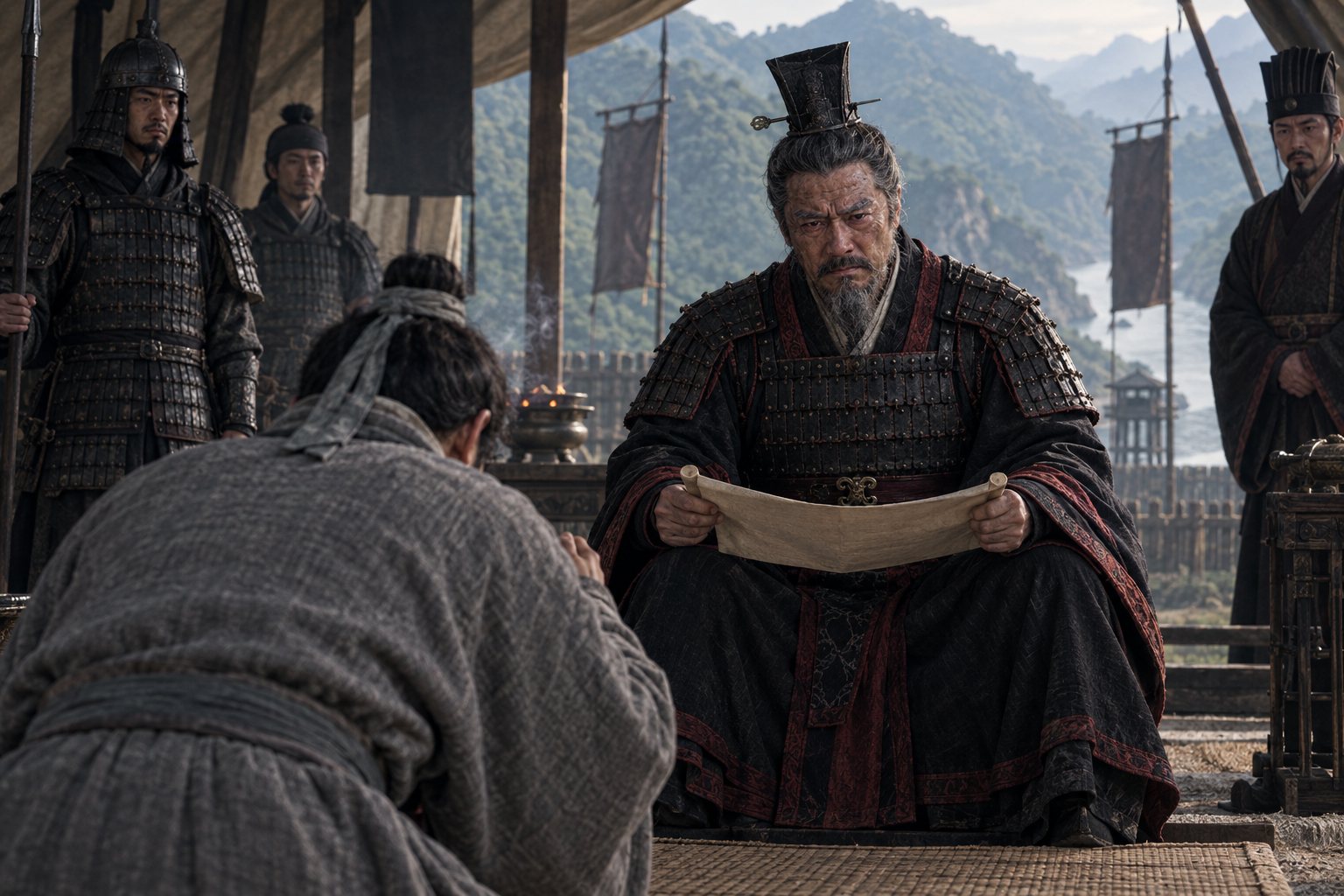
Sun Quan’s letter asking for peace catches up with the army. What do you say?
Wu Ban and Feng Xi attack from Wu County and defeat Li Yi and the others; the great army camps at Zigui.
In the 2nd month of the following year, you lead the generals from Zigui and advance, cutting across the mountains and blocking the ridges, to camp at Xiaoting in Yidao. In the Romance, your camps stretch from Xiaoting to the mouth of the river, in an unbroken line for 700 li, with 40 camps from front to rear.
The Wu general Lu Xun holds his position and does not come out, holding fast for months. He has each soldier carry a bundle of reeds, and attacks the camps with fire. He beheads Zhang Nan and Feng Xi, and destroys more than 40 camps. You climb Ma'an Hill and array your troops around yourself. The Wu army surrounds you on all sides; your forces crumble, and more than 10,000 die. You flee by night. The post-station attendants take the gongs and armor on their own shoulders and set them alight to cover your retreat; only then do you reach Baidicheng.
Deeply ashamed and furious, you cry, “I have been humiliated by Lu Xun—can this be anything but Heaven’s doing!”
Huang Quan is north of the river, his route back cut off, and has no choice but to lead his men and surrender to Wei. An official asks that his wife and children be arrested, and you say: “I have failed Huang Quan; Quan has not failed me.”
Later, you rename Yufu County Yongan.
the man who remonstrates against your eastern campaign → Read Zhao Yun's story →
You May Take the Throne Yourself
Sun Quan hears that you are staying at Baidicheng and is greatly afraid. He sends an envoy to seek peace; you agree. In winter, the 12th month, Huang Yuan, Administrator of Hanjia, hears that you are ill and raises troops in rebellion.
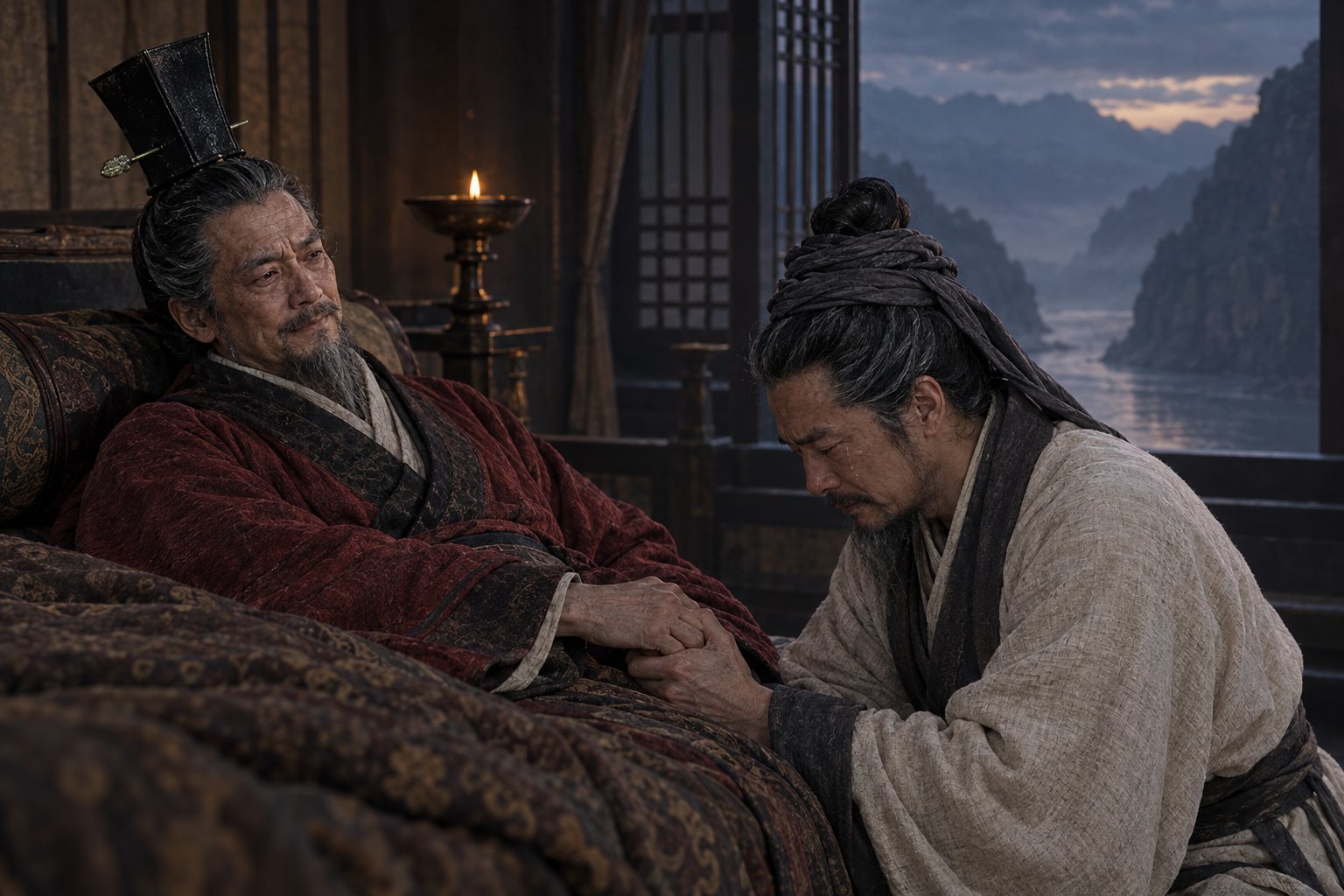
In the Romance, you weep for your younger brothers Guan and Zhang, and your illness grows worse until your eyes grow dim. One night, a dark wind suddenly rises; the lamp flickers, goes out, then lights again. Two men stand in the lamplight, Guan Yu stands above, Zhang Fei below. Guan Yu says: “Brother, we will soon be reunited.”You seize them and weep bitterly, then wake with a start. Both your younger brothers are gone.
In the spring of the 3rd year of Zhangwu, gravely ill at Yongan, you summon Zhuge Liang from Chengdu. In the 2nd month, he arrives at Yongan. In the 3rd month, Huang Yuan is defeated, bound, and sent to Chengdu to be executed.
You write an edict for the Crown Prince: “At first my illness was only dysentery; later other ailments joined it, and I can scarcely recover. A man of 50 is not said to have died young; I am already past 60. What more have I to regret? I no longer grieve for myself; I think only of you brothers.”You write again: “Do not do a wrong because it is small, nor fail to do a good because it is small. Only virtue and goodness can win people over. Your father is meager in virtue; do not follow my example.”
You say to Zhuge Liang: “Ma Su's words exceed his deeds; he must not be given great responsibility. You should take heed of this!”
You think of Liu Biao. Fifteen years ago, ill in Xiangyang, he said to you: “My sons lack talent, and my generals are scattered and gone. After I die, you must take charge of Jing Province.” You did not agree then.
You entrust your orphaned heir to the Chancellor, appointing Li Yan, Director of the Imperial Secretariat, as his deputy. You clasp his hand: “Your ability is ten times Cao Pi's. You can surely bring peace to the state and accomplish the great task. If the heir can be assisted, assist him; if he is not capable, you may take the throne yourself.”
He weeps: “I dare devote all my strength and serve with unwavering loyalty, unto death!”
You issue another edict to the Crown Prince: “Serve the Chancellor in your affairs, and honor him as your father.”As death approaches, you summon Liu Yong, Prince of Lu: “After I am gone, you brothers must serve the Chancellor as your father; you are to work together with the Chancellor.”
In the Romance, you also charge Zhao Yun: “You and I have stayed together through hardship until now. I did not think we would part here.”
The river sounds below the city. You close your eyes. The mulberry tree in Zhuo County, the inspecting censor at Anxi, the box in Xu Province, those two hours beneath the steps at Longzhong, the more than 100,000 people at Changban. Along the way you have left many things behind: cities, wives and children, troops and horses. This time, you hand over everything you have left.
On the guisi day of the 4th month in summer, you die at Yongan Palace, aged 63. In the 5th month, your coffin returns from Yongan to Chengdu, and you are given the posthumous title Emperor Zhaolie.
the man entrusted with the heir → Read Zhuge Liang's story →
How Liu Bei's story ends
The Former Lord was magnanimous, resolute, and generous. He knew men and treated the worthy with respect; he had, perhaps, the manner of Gaozu and the makings of a hero.
The shrine of Marquis Wu has long stood close by; ruler and minister, as one body, share the same rites of sacrifice.