Strategic Background
The Battle of Bailangshan in the twelfth year of Jian'an (207) was the decisive engagement of Cao Cao's northern campaign against the Three Commanderies of the Wuhuan. It was not merely a military expedition against a steppe people but the final accounting operation in Cao Cao's effort to "unify the north." From the Battle of Guandu (200) through the Hebei campaigns (203–206), Cao Cao had progressively eliminated Yuan Shao's three sons — but Yuan Shang and Yuan Xi, driven out, had fled into the three Wuhuan commanderies (Liaodong, Liaoxi, and Youbeipíng) and formed an alliance with the Wuhuan chanyu Ta Dun. This meant that so long as the combined force of the Yuan house and the Wuhuan remained, Cao Cao's unification of the north was not truly complete — the Hebei commanderies could be rolled back at any time. Cao Cao chose a scheme of "light troops, long-range campaign, surprise strike," marching out of Wuzhong (modern Jixian, Tianjin), with Tian Chou guiding the column through the mountain tracks of Luguan Pass, bypassing the conventional coastal road and pressing forward at double pace straight toward Liucheng. This was a classic "geographic gamble for strategic windfall," consistent in logic with his later strategy for the southern campaign into Jingzhou.
Deployments
Cao Cao's deployment reflected the extreme demands of a light, long-range expedition: Tian Chou served as Jinbei general, guide, and advance element; Zhang Liao commanded the second wave; and Cao Cao himself pushed forward at the rear with light cavalry at double pace. Most of the heavy infantry and supply trains were left to the rear; the vanguard was built around the Tiger-Leopard Cavalry and mounted archery units, capable of maintaining mobility through the difficult Liaodong terrain. On the Wuhuan side, Yuan Xi, Yuan Shang, Ta Dun, Louban, and Nengchen combined forces, assembling a vast host of "tens of thousands of cavalry" — but their formation was in a hastily assembled, loose mounted array, "uneven and irregular". This reflects the classic weakness of steppe armies: when forced into open battle without adequate preparation, the cavalry advantage is hard to exploit and instead becomes a burden on a chaotic chain of command.
Critical Decision Point
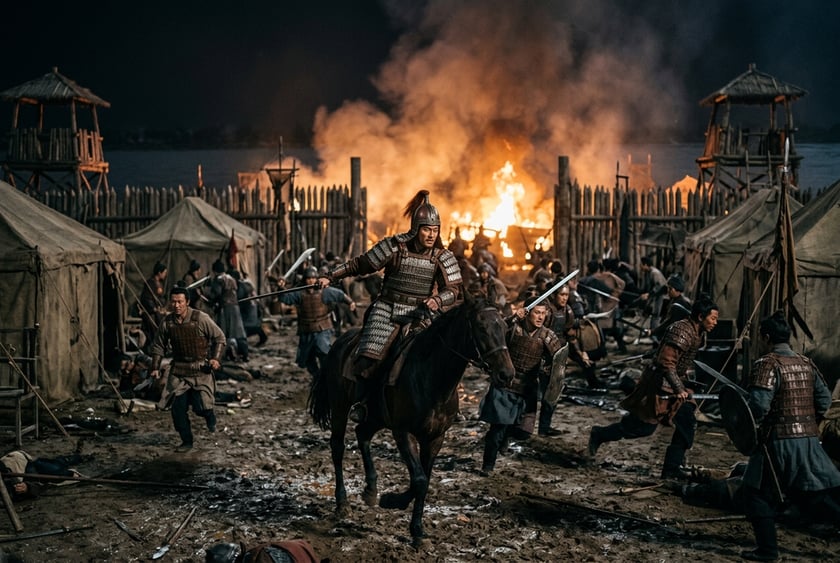
The turning point of the battle came when Cao Cao climbed high ground to observe the enemy formation. Seeing the Wuhuan ranks uneven and not yet fully deployed, he immediately ordered a strike, transferring command authority directly to Zhang Liao and sending Xu Chu, Yu Jin, and Xu Huang down the hill in four converging columns of attack. This is an extremely characteristic "Cao Cao" decision: strike the moment the enemy has not yet stabilized, giving the opponent no opportunity to dress their formation. Zhang Liao drove into the Wuhuan center with great force and cut down the chanyu Ta Dun (called "Modun" in the Romance), whereupon the leaderless Wuhuan troops instantly collapsed; the remnants surrendered, and Yuan Xi and Yuan Shang fled to Liaodong with a few thousand horsemen. The entire engagement from deployment to conclusion was brief — among the cleanest and most decisive victories of Cao Cao's career.
Results and Resonance
The results of the battle carried four profound long-range consequences. First, the political-military union of the Yuan house and the Wuhuan was completely destroyed, and Cao Cao's consolidation of the north was declared complete; Yuan Shang and Yuan Xi, having fled to Liaodong, were decapitated by Gongsun Kang and their heads sent as tribute, allowing Cao Cao to achieve the elimination of both Yuan brothers without a second campaign. Second, Zhang Liao's fame was established by his killing of Ta Dun; he became thereafter the foremost of the Five Good Generals of Caowei, and the later legend of repelling Sun Quan's army of one hundred thousand with eight hundred men at Xiaoyaojin in Hefei had its origins in the precedent set at Bailangshan. Third, on the return march Cao Cao lost his most important strategic adviser, Guo Jia — who died of illness on the journey home, a victim of the harsh conditions, at only thirty-eight years of age. This loss had far-reaching effects on Cao Cao's subsequent southern campaign into Jingzhou and the Battle of Chibi: Cao Cao later lamented after the defeat at Chibi that "if Fenxiao had been there, he would not have let me come to this pass," and many have drawn a direct causal link between the victory at Bailangshan and the defeat at Chibi through Guo Jia's death. Fourth, after the Wuhuan main force was destroyed, the surviving people of the three Wuhuan commanderies were incorporated by Cao Cao into his armies, becoming a major source of elite cavalry for later Caowei — one of the rare instances in Chinese military history of a "double treatment" combining annihilation with absorption, with far-reaching effects on the stability of the northern frontier for the following several decades.
Counterfactual Analysis
If Cao Cao had not adopted Tian Chou's mountain bypass route and had instead marched along the conventional coastal road, the Wuhuan side would have had far more time to mass their main forces, and the outcome of the entire engagement would have been far harder to predict than in actual history; Cao Cao's forces might have been dragged into a winter war of attrition by shortages of supplies, eventually forced to withdraw without result. If Cao Cao had not seized on the moment of the elevated observation post to immediately order Zhang Liao's four-column assault, but had followed the usual procedure of resting before battle, the Wuhuan formation would have had time to dress its ranks; the force disparity of "tens of thousands of steppe cavalry vs. Cao Cao's light mounted force" would have placed Cao Cao's army at enormous risk. This battle fully demonstrates Cao Cao's supreme sense of balance between strategic boldness and the seizure of tactical opportunity — abandon any single element of it, and the entire northern campaign might have ended in complete failure.
From a broader perspective, Bailangshan was one of the peaks of Cao Cao's military career — representing a pure military aesthetic of "defeating numbers through intelligence" — but it was also the point at which his strategic talent structure began to crumble, since the loss of Guo Jia meant that in facing the southern waterlogged battlefield he no longer had a strategic adviser of comparable caliber. The causal connection between the two cannot be made mechanically, but Bailangshan as a dual event — "military triumph + strategic talent loss" — is undeniably a critical node for understanding Cao Cao's decision-making style in his later years.