Background
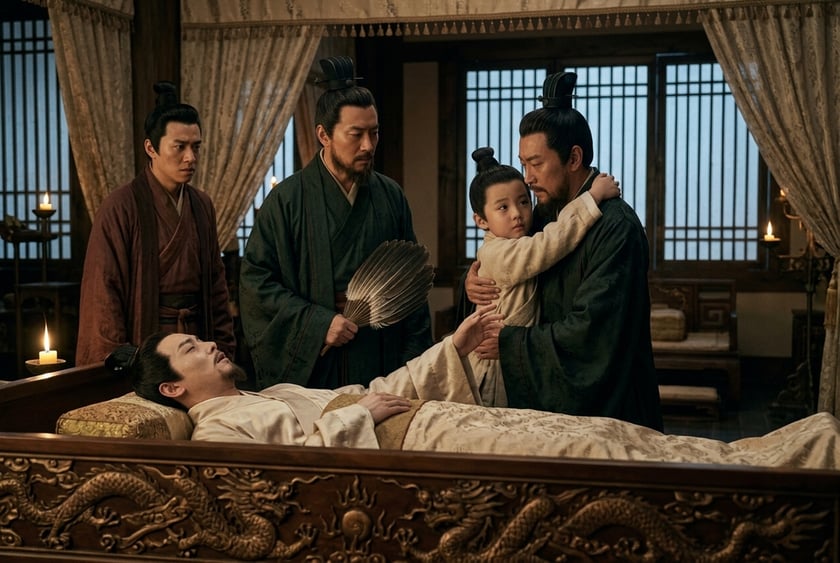
The power succession of the twenty-fifth year of Jian'an was the final live test of Cao Cao's institutional design. Starting with the enfeoffment as Duke of Wei in the eighteenth year of Jian'an, Cao Cao had spent seven years completing the full construction of "Duke — nine regalia — establishment of the kingdom — elevation to King — designation of the heir"; the most critical decision he made on his deathbed was to lock the succession onto Cao Pi. In the final testament recorded in the Romance, Cao Cao assessed each of his four sons in turn: Cao Ang died early; Cao Zhang was "brave but without strategy"; Cao Zhi was "given to empty show and lacking in sincerity"; and Cao Xiong was "frequently ill and unlikely to survive." He ultimately chose the "loyal, sincere, and respectful" Cao Pi — behind this apparently modest evaluation lay a cold-eyed assessment of succession risk: in a turbulent era's power transition, the most stable choice is often not the cleverest or most martial son but the one least likely to stir up trouble.
Principal Figures
Cao Pi was the greatest beneficiary of this transition, but his success was not accidental — it was the product of years of contest over the heir designation. He had long been assisted by counselors such as Jia Xu, Chen Qun, Sima Yi, and Huan Jie, his staff system having matured; in the Romance he goes ten li outside the city to meet the coffin and weeps aloud, performing Confucian filial piety to the fullest, providing an emotional foundation for the legitimacy of his succession. Chen Jiao was the critical figure at the scene of the transition — while the assembled officials were still waiting for Emperor Xian's edict, he drew his sword and sliced off his own sleeve, shouting that "today we hereby request the heir designate to ascend the throne; any official with a dissenting opinion shall take this sleeve as his example," using a single dramatically charged on-the-spot gesture to suppress the procedural question of "waiting for the edict". This is a classic "fait accompli takes priority" political maneuver. Hua Xin immediately thereafter rushed from Xu Chang bearing Emperor Xian's edict, clothing the entire succession process in a ritual exterior — the Romance pointedly notes that this edict was the product of Hua Xin "threatening and coercing Emperor Xian to issue it," exposing the truth behind the so-called "Han dynasty authorization." Sima Yi at this juncture was one of the assisting senior ministers, though not yet operating independently; Cao Zhen, as a representative of the imperial clan, was key to stabilizing military authority.
Core Issues
The core issue of this power transition was how to achieve legal legitimation within less than a single day between Cao Cao's death and Cao Pi's succession. Under Han official structures, succession to "King" required an imperial edict; although Cao Pi had long been established as heir designate, between his father's death and the arrival of an edict there existed a power vacuum — and this vacuum was sufficient for any brother with ambitions (such as Cao Zhang) to mount a challenge. Chen Jiao's drawing of his sword, Hua Xin's urgent journey, and Jia Kui's response to threats were all competing to seize this one time window. The very act of Cao Zhang "leading his troops to the funeral in haste" already hinted at a potential challenge: he demanded that Jia Kui tell him "where the late King's imperial seal and ribbon are," and was turned away by Jia Kui with the words "in a family there is an eldest son; in the state there is an heir designate" — a confrontation that could very easily have escalated into civil war, fortunately defused by Jia Kui's political acuity and Cao Zhang's own retreat. From the perspective of institutional history, this transition validated an important principle: when the heir designate's position is sufficiently clear and the regent team is sufficiently powerful, the power vacuum period can be compressed to an extremely short interval, preventing outside forces or internal rivals from intervening.
Political Consequences
In the months following Cao Pi's succession, he accomplished several things of lasting significance: changing the era name to Yankang, signaling the opening of a new era; enfeoffing Jia Xu, Hua Xin, and Wang Lang as Grand Commandant, Chancellor, and Imperial Counselor, establishing the core personnel of the new dynasty; constructing Gaoling mausoleum for Cao Cao and conferring the posthumous title "King Wu," completing the final political positioning of his father. In the tenth month of the same year, presided over by Hua Xin and others, he pressured Emperor Xian to abdicate and formally declared himself emperor to establish Caowei — giving rise to the title "Emperor Wen of Wei" — whereupon the remainder of Jian'an twenty-five was redesignated the first year of Huangchu. The entire transition from Han to Wei, from the father's death to the son's declaration of emperorship, was compressed into less than ten months — the most efficient dynastic transition in Chinese history, and a direct validation of all the institutional groundwork Cao Cao had laid in his lifetime. In the Romance, Yu Jin's indignation at being made to "view the painting of the flooding of the seven armies displayed in the mausoleum building" causes him to fall ill and die shortly after — offered as a side detail of this transitional period, it reveals the cruel streak in Cao Pi's character, foreshadowing the subsequent purges of his brothers (the legend of Cao Zhi's seven-step poem and Cao Zhang's poisoning).
Counterfactual Analysis
If Cao Pi had not immediately been pushed into succession by Chen Jiao and others upon news of Cao Cao's death, but had instead waited for Emperor Xian's formal edict, the arrival of Cao Zhang with his troops in haste might very likely have triggered fraternal civil war — although Cao Zhang's own force was not large, he had just pacified the Wuhuan of Dai Commandery and won over Ke Bineng, with elite northern frontier veterans under his command. If at the moment of his father's death he had gained a military advantage outside Yecheng and raised the banner of "the eldest having died, the second should be enthroned," the Caowei faction's civil war might have lasted months. If the heir had been Cao Zhi rather than Cao Pi, the entire style of the process of replacing Han would have been quite different: the literary temperament in Cao Zhi's character would have made the abdication ritual more elegant, but execution might have been insufficient to suppress opposing forces, and Sun Quan's and Liu Bei's counterstrikes might have been more effective. In the final years of his life, Cao Cao repeatedly assessed, and ultimately chose Cao Pi — at its core a precise wager on "the degree of political ruthlessness required to replace Han." He bet on the right person and on the right timing. The almost seamless power transition of Jian'an twenty-five is Cao Cao's most complete posthumous work as a statesman.