Background
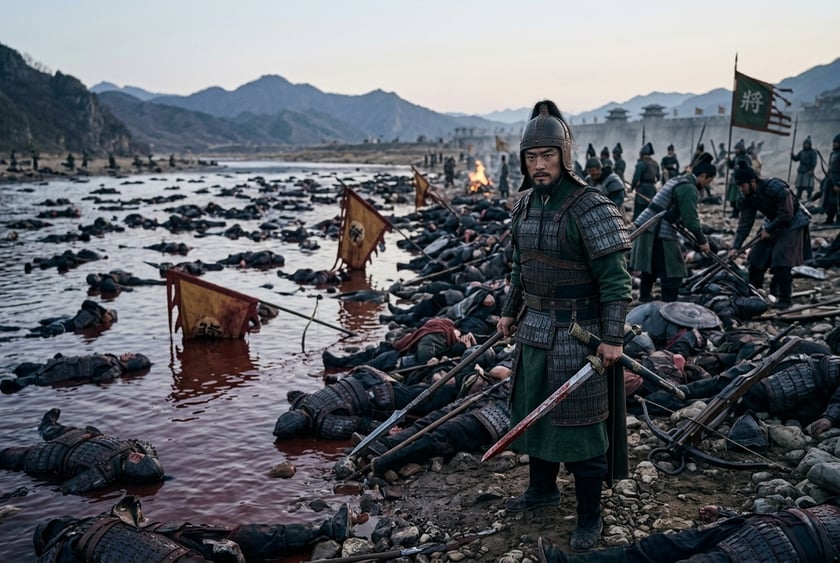
Baimenloushenqiu — the prisoner interrogation at White Gate Tower at the close of the Battle of Xiapi in the third year of Jian'an (199) — took place at a critical turning point in Cao Cao's strategy for unifying the central plains. Over the two preceding years, Lv Bu had ranged across Yanzhou and Xuzhou with a crack cavalry force, first seizing Yanzhou and nearly stripping Cao Cao of his base of operations, then holding Xuzhou and fighting Liu Bei back and forth over Xiapi, remaining for a long time the greatest source of uncertainty in Cao Cao's eastern expansion. In the autumn of the third year of Jian'an, Cao Cao personally campaigned against Xiapi, besieging it for months and flooding the city by diverting the Si and Yi rivers; internal strife within Lv Bu's army exploded, and subordinate commanders Hou Cheng, Song Xian, and Wei Xu successively defected and delivered Lv Bu, along with Gao Shun and Chen Gong, bound to Cao Cao's forces. The scene that then played out atop White Gate Tower outside the city was not merely a military interrogation but a carefully staged political performance: under the eyes of local Xuzhou aristocratic families, surrendered officers, and men of the Liu Bei faction, Cao Cao had to use the processing of each member of the Lv Bu group to transform the military victory of "Cao's absorption of Xuzhou" into political legitimacy.
Key Figures
Cao Cao was the master of the interrogation; every verdict he pronounced at White Gate Tower was simultaneously addressed to two audiences inside and outside the city: inside were Lv Bu's remaining troops and Xuzhou's scholarly clans, outside were Liu Bei, Guan Yu, and Zhang Fei — men who had nominally submitted but not yet truly been won over. Lv Bu, as the central figure under interrogation, still attempted to defend himself by saying "your excellency's greatest threat was none other than I, and now I have submitted" — pleading to be used as a cavalry instructor in exchange for his life. This half-surrender-half-bargaining posture exposed the political naivety that had characterized him consistently from his days under Dong Zhuo to his capture at Xiapi. Chen Gong was another core interrogation subject; he had twice betrayed Cao Cao (first abandoning Cao to join Lv Bu, then assisting Zhang Miao in rebelling against Cao), yet in this moment displayed a composure entirely different from Lv Bu's: he did not plead for his own survival, only asked Cao Cao to treat his elderly mother and his wife well. Gao Shun remained silent throughout, giving meaning to the word "loyalty" through his conduct alone — his name meant "charging the battle line," and he was true to it. Zhang Liao, as the highest-ranking and most complete figure among Lv Bu's subordinates, was deliberately spared by Cao Cao — the key political specimen of the entire interrogation. Liu Bei stood at Cao Cao's side, and with a brief interjected remark sealed Lv Bu's fate; Guan Yu and Zhang Fei stood in silent witness of the entire proceedings, preserving this scene in their long-term impressions of Cao Cao. The three defector commanders Hou Cheng, Song Xian, and Wei Xu, as the main agents of the "internal coup," were publicly accepted as surrendered troops by Cao Cao to demonstrate the effectiveness of inducing surrender.
Core Issue
The core issue of Baimenloushenqiu was not as simple as "who to kill and who not to kill"; it was Cao Cao establishing in a public setting a comprehensive paradigm for handling surrendered generals: those who could be used and were of unimpeachable character would be given exceptional appointments (Zhang Liao); those with sufficient ability yet posing an enormous political threat had to be killed to eliminate future dangers (Lv Bu); those loyal to their former lord who could not be converted deserved respect for their integrity before being killed (Chen Gong and Gao Shun); pure opportunists who had staged an internal revolt would be accepted as surrendered troops but not given important posts (Hou Cheng, Song Xian, Wei Xu). This paradigm was not improvised on the spot but was a complete public declaration of Cao Cao's long-refined philosophy of employing men. The phrase that decided Lv Bu's fate — "Ding Jiyang, Dong Zhuo" — came from Liu Bei's mouth; on the surface it was Liu Bei's intervention, but in reality both parties were acting in concert: Cao Cao did not wish to directly affix the label of "inconstant and faithless" to Lv Bu with his own lips, lest it create a chilling effect on other surrendering generals in the future; Liu Bei wished to use the moment to make a complete break with Lv Bu and simultaneously establish his image of "grasping the larger picture" in Cao Cao's eyes. The treatment of Chen Gong best illustrates Cao Cao's complex inner state of "respecting someone's integrity while being unable to employ that person": he and Chen Gong had a past connection, but in public he could not pardon a man who had betrayed him twice; in the end he offered to "personally provide for your mother and wife," neatly separating private feeling from political principle.
Political Consequences
After White Gate Tower, Xuzhou was thoroughly absorbed into Cao Cao's control, stabilizing the eastern front and clearing the way for concentrated force against Yuan Shao at Guandu the following year (200). In the short term, Cao Cao gained Zhang Liao — a top commander who would later sweep across Hefei — and, through receiving the three defectors, completed the incorporation of Lv Bu's old forces; the military capital thus obtained was considerable. In the medium term, the "White Gate Tower paradigm" became the standard template Cao Cao applied to handling surrendered generals thereafter: Guan Yu's treatment upon surrendering to Cao in the fifth year of Jian'an (receiving a title as marquis, being given a fine horse, receiving the richest courtesies) is an extension of this paradigm — Guan Yu and Zhang Liao alike belonged to the category of "sufficient talent to be of use, political loyalty to be determined by the individual," and Cao Cao's response was strikingly consistent. In the long term, this paradigm shaped the basic political culture of the Caowei dynasty as "employing men based on demonstrated ability, without demanding orthodox origin" — forming a sharp contrast with Liu Bei's camp ("leading troops through personal allegiance and brotherly loyalty") and Sunwu's camp ("binding generals through clan compacts and family alliances"). Yet another dimension of White Gate Tower also planted a lasting wariness in Liu Bei's camp: Guan Yu and Zhang Fei witnessed Cao Cao kill Lv Bu in public while treating Zhang Liao with ceremony, and their judgment of Cao Cao as "unpredictably inconstant" calcified from that moment — a shadow that directly influenced Guan Yu's response to Cao Cao's overtures before Chibi and, further downstream, the hesitation over whether to let Cao Cao pass at Huarongdao.
Counterfactual Analysis
If Cao Cao had not heeded Liu Bei's intervention and had instead spared Lv Bu — say, incorporating him into the cavalry instructors or the personal guard — two trajectories are possible. In one, Lv Bu genuinely trains an elite cavalry force for Cao Cao's armies in the short term, improving Cao Cao's capacity to contest Yuan Shao's cavalry in the early phase of Guandu; but in the medium term Lv Bu would almost certainly rebel again — not because of personal character alone but because the long-term survival model of the Lv Bu faction ("exchange cavalry for a granary city, exchange treaty commitments for time") was fundamentally in conflict with Cao Cao's centralized command style and would sooner or later come to a head. In the other trajectory, Lv Bu is provoked into revolt or secretly eliminated by jealous Cao commanders such as Xiahou Dun, and Cao Cao is forced to deal with the aftermath himself — damaging his own prestige among surrendering generals in the process. Conversely, if Cao Cao had pardoned Chen Gong on the spot — say, invoking the old bond of their joint anti-Dong campaign — then Chen Gong, with his network among the Yanzhou scholarly clans, would inevitably have continued as a destabilizing presence inside Cao Cao's system, playing a role similar to Kong Rong's or Mi Heng's at Xudou later on. Cao Cao's true attitude toward Chen Gong was not hatred but "inability to contain": the stability of the political system took priority over personal feeling. Both counterfactuals together demonstrate that the disposal scheme of Baimenloushenqiu was not a result of Cao Cao's individual, incidental coldness but rather the optimal solution for rapidly stabilizing the Caowei political system under the conditions of the time. The irresolvable tension between later generations' moral condemnation of Cao Cao as "I would rather wrong others than let others wrong me" and this structurally rational political logic exemplified at White Gate Tower is precisely the fundamental reason why the White Gate Tower episode has been rewritten and reinterpreted so relentlessly in the San Guo tradition.