Context
In Jian'an 4 (199), Liu Bei was a temporary resident of Xudou, nominally General of the Left within Cao Cao's administration, but in reality a high-value captive trapped in the enemy's inner sanctum. He had already received the Silk-Belt Edict secretly passed by Dong Cheng and had joined a clandestine alliance of Han loyalist ministers, but the moment for action had not yet arrived. Cao Cao's attitude toward Liu Bei was perpetually one of suspicion without murder: he could not afford to sacrifice Liu Bei as a political prop — the prestige of the "Imperial Uncle" — yet he could never quite trust this adversary of uncommon ability. During his time in Xudou, Liu Bei adopted an extreme posture of self-concealment: he shut his door to callers and spent his days personally watering vegetables in the rear garden, deflecting every inquiry from outside as "idle recreation." Such "playing the fool" was a standard survival technique among scholar-officials of the late Han, but for someone as penetrating as Cao Cao, excessive disguise was itself a tell. So Cao Cao chose to administer a psychological stress test to Liu Bei one day — an unannounced wine gathering that left no room for preparation.
The Encounter
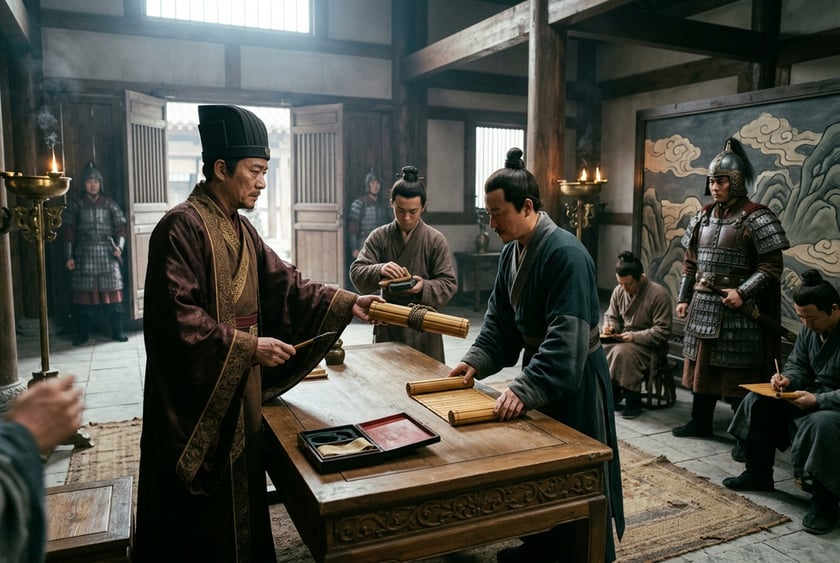
Cao Cao sent Xu Chu and Zhang Liao directly into the garden with the summons. Liu Bei instinctively asked "is there some urgent matter?" — the reflexive response of any man quartered in hostile territory. Xu Chu's answer was "I don't know; I was only told to come and invite you," which maximized the uncertainty. When Liu Bei arrived at the hall, Cao Cao opened with "you have been doing great things at home," and Liu Bei's face "turned the color of earth" — the phrase carried a deliberate double meaning (it could refer to the vegetable garden, or to a coup in preparation), functioning as the opening move of the whole probe. Cao Cao then immediately shifted the tone to something leisurely and cultured — warming wine and admiring the plum blossoms — evoking the legend of looking at plums to quench thirst, until Liu Bei's nerves had settled. When the wine was flowing freely, Cao Cao raised the real subject in a casual conversational register: he discoursed on the heroes of the age. He reviewed Yuan Shu, Yuan Shao, Liu Biao, Sun Ce, Liu Zhang, Zhang Xiu, Zhang Lu, and Han Sui — every acknowledged power of the day — dismissing each one in turn, before finally closing with "in the world today, the only true heroes are you and I". The lethal force of this statement lay in instantly dragging Liu Bei from his camouflage as a "nameless recluse" into the position of "Cao Cao's equal adversary." At these words, Liu Bei's chopsticks fell from his hand — the moment at which all his carefully maintained concealment collapsed under a single sentence. At that instant a great peal of thunder rang out overhead, and Liu Bei immediately seized on it as cover: "The sage said that one must always change one's demeanor before swift thunder and violent wind." By invoking a passage from the Analects (Book "Xiang Dang"), he attributed his startled reaction to reverence for Heaven's will, and Cao Cao's suspicion was defused.
The Outcome
The real winner and loser of this wine gathering was decided in the instant the chopsticks fell. Did Cao Cao believe Liu Bei was genuinely startled by the thunder? The novel offers no direct answer — the internal reasoning behind Cao Cao's "taking it as the truth" is left unwritten. But from what follows, Cao Cao evidently set aside his highest level of vigilance toward Liu Bei for the time being. Another theatrically charged detail at the end of this episode: Guan Yu and Zhang Fei came back from archery practice outside the city and, learning that Liu Bei had been taken away to a meeting, "rushed in a panic to the prime minister's compound to ask what had happened," fearing the worst, and "advanced on the pavilion with hands on their sword hilts". Cao Cao, seeing this, laughed: "This is no Hongmen Banquet — why would you need a Xiang Zhuang or a Xiang Bo?" He voluntarily invoked the "Hongmen Banquet" allusion to drain the tension and poured wine for "the two Fan Kui," as he called them, to calm their nerves. This gesture both expressed Cao Cao's recognition and desire to win over Guan Yu and Zhang Fei, and confirmed that in this psychological duel he had decided not to move against Liu Bei.
Historical Impact
Viewed within the novel's overall narrative, the plum-wine discourse is the turning point that moves Liu Bei from "a guest lodged in Xudou" toward "determined flight." In the short term, Liu Bei realized that Cao Cao had truly seen through him and that remaining in Xudou would sooner or later mean his death; he actively looked for a pretext to leave — and before long used the mission of "intercepting Yuan Shu" as his excuse to depart Xudou, never returning to Cao Cao's control. In terms of the novel's techniques for portraying character, this episode is one of the rare passages where words — not force of arms — determine a protagonist's fate: Liu Bei's instinctive drop of the chopsticks, and his instant recovery with a quotation from the Analects, together constitute the most finely crafted piece of psychological chess on the late-Han political stage. The episode defines two criteria by which the novel measures "heroism": first, a hero must be capable of self-concealment to survive; second, a hero must be capable of instantaneous self-rescue when exposed. In its longer literary afterlife, "the discourse on heroes over heated wine" became the most important model in classical Chinese literature for the motif of "a lord testing a minister through dialogue," imitated endlessly in later novels, drama, and oral storytelling, and establishing itself as the signature image in the Chinese literary tradition for the theme of "disguise and penetration." Cao Cao's line — "in the world today, the only true heroes are you and I" — itself became in the Chinese literary world the most authoritative characterization of Liu Bei ever spoken, carrying special weight precisely because it came from his greatest adversary. This brief wine session, in essence, provided the dramatic legitimation that made one of the main threads of the entire San Guo story — Liu Bei's independent rise — narratively inevitable.