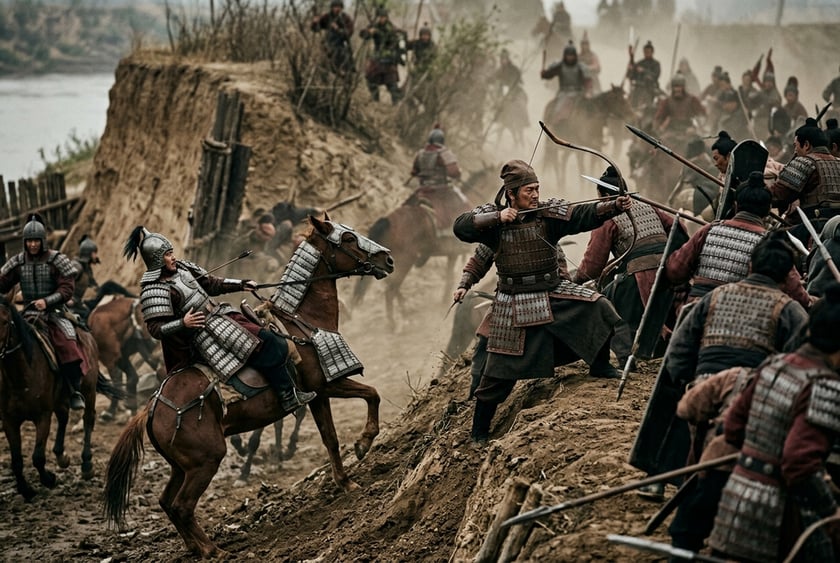
Strategic Background
In the second year of Jian'an (197), the geopolitical landscape saw Cao Cao — having escorted Emperor Xian to Xudou — steadily consolidating the central plains under the political advantage of "serving the Son of Heaven." Yuan Shao's power in Hebei was still formidable; Sun Ce had recently pacified the Jiangdong region; Liu Biao held Jingxiang; and Lv Bu was entrenched in Xuzhou. Cao Cao's strategic choice was to stabilize his southern flank before fully contending with the north. Zhang Xiu was the nephew of the western-Liang general Zhang Ji; after Zhang Ji's death he assumed command of his troops and, relying on Liu Biao, stationed himself at Wancheng — the closest threat on Cao Cao's southern perimeter. Cao Cao led a southern expedition to Wancheng that year; Zhang Xiu offered a surface surrender to avoid battle, but his internal wariness was undiminished, and the atmosphere within and around the camp remained taut.
Disposition of Forces
After entering Wancheng, Cao Cao's army did not garrison heavily inside the city; instead, the main force was encamped outside the walls, with Cao Cao himself quartered in the central command tent with his personal guard. Zhang Xiu had surrendered but not dispersed — his troops remained in place, in an "adjacent-camp" relationship with Cao Cao's army that was inherently high-risk. After receiving the surrender, Cao Cao did two things that proved catastrophically ill-judged in retrospect: first, he took Zhang Ji's widow (Zhang Xiu's aunt) as a concubine, openly humiliating the feminine honor of Zhang Xiu's clan; second, he lavished rewards on Hu Cheer, the fierce warrior at Zhang Xiu's side, covertly attempting to fracture Zhang Xiu's personal guard system. These two moves propelled Zhang Xiu in an instant from "feigned surrender" to "must rebel." Jia Xu, already serving as Zhang Xiu's chief strategist, used the pretext of "relocating the camp formation" to obtain Cao Cao's permission for Zhang Xiu's troops to shift from one flank to another — a maneuver that brought Zhang Xiu's finest soldiers into close proximity with Cao Cao's central command. This was the key deployment that made the night raid succeed.
Critical Decision Points
This battle had three critical decision points. The first was Cao Cao's decision to "take Zhang Ji's widow" — not a military decision at all but a private decision of power-display, whose consequences were entirely military. In his own later reflection Cao Cao said plainly: "I felt no deep grief over losing my eldest son and my beloved nephew; only for Dian Wei did I weep." [c:16901] This statement is at once a special lament for Dian Wei and an indirect admission of regret over his own decision at the time. The second decision point was Zhang Xiu's choice of a "night raid" over a "daytime counterattack" — the night raid most favored Zhang Xiu because he knew the terrain, Cao Cao's men were off their guard, and his numerical advantage could be maximized. The third decision point was Dian Wei's act of "holding his twin halberds and blocking the camp gate" when the incident broke out — Dian Wei's death bought the time window in which Cao Cao escaped alone on horseback, and it was the direct reason Cao Cao survived this crushing defeat. From the tactical standpoint, the core elements of a night raid — the moment of surprise, the placement of inside assets, the exploitation of terrain advantage — were executed by Zhang Xiu's side in a manner that was nearly flawless. [c:16900]
Outcome and Resonance
The night raid directly threw Cao Cao's army into chaos: the camp was burned, and much of the baggage train was lost. The human toll was especially severe: his eldest son Cao Ang gave up his own horse to Cao Cao and died fighting on foot; his nephew Cao Anmin also fell in battle; his personal guard Dian Wei fought until his halberds were spent, then waded into the enemy using men as weapons, until he too collapsed and died; even the Dawan thoroughbred Cao Cao had been riding was shot dead. In terms of battlefield outcome, Cao Cao escaped from Wancheng alone on horseback and retreated to Wuyin. In terms of political consequence, the death of Cao Ang fundamentally altered the entire trajectory of Cao Cao's succession — had Cao Ang survived, the brothers Cao Pi and Cao Zhi might never have had an opening in the contest for the heir's position, and there would have been no later political shadow of the Ode to the Luo River goddess, no life of Cao Zhi suppressed to the point of death. This battle became a wound Cao Cao grieved over for the rest of his life. The following year (198), passing by the Yu River again, he "broke into loud weeping" and held a grand sacrificial ceremony [c:16902], offering rites jointly to Dian Wei, Cao Ang, and Cao Anmin — a consecutive years-long pattern of mourning ceremonies unique in Cao Cao's career.
Counterfactual Analysis
Had Cao Cao not taken Zhang Ji's widow, had he not rewarded Hu Cheer, Zhang Xiu's impulse to rebel would have been delayed by months or longer; Cao Cao's army would have had time to methodically disarm Zhang Xiu and bring Wancheng under formal control. In that scenario, Cao Ang and Dian Wei would not have died, and the line of succession would have developed around Cao Ang as the eldest son — the political stage for the brothers Cao Pi and Cao Zhi would have been entirely different, and the generational structure of the Jian'an literary circle would have been fundamentally transformed. Had Zhang Xiu's night raid failed to breach the central command, and had Dian Wei's defense of the camp gate held longer, Cao Cao would have had the opportunity to organize a counterattack; Zhang Xiu might have been annihilated in the counterstrike, the southern threat eliminated two years ahead of schedule, and the decisive engagement with Yuan Shao at Guandu perhaps launched earlier. In other words, the battle at Wancheng was not an isolated tactical defeat: it was a political-military event that tore open a momentary breach in Cao Cao's political advantage of "serving the Son of Heaven to command the lords." Jia Xu's performance in this engagement — converting a political humiliation into a textbook night raid — was the early masterpiece of his career as a strategist, and the credentials that earned him the highest respect under both Cao Cao and his son Cao Pi. Seen from this angle, the true significance of "Zhangxiuyexiwancheng" lies not in a single battle but in how one night's defeat quietly rewrote the political script of Caowei for the next fifty years.