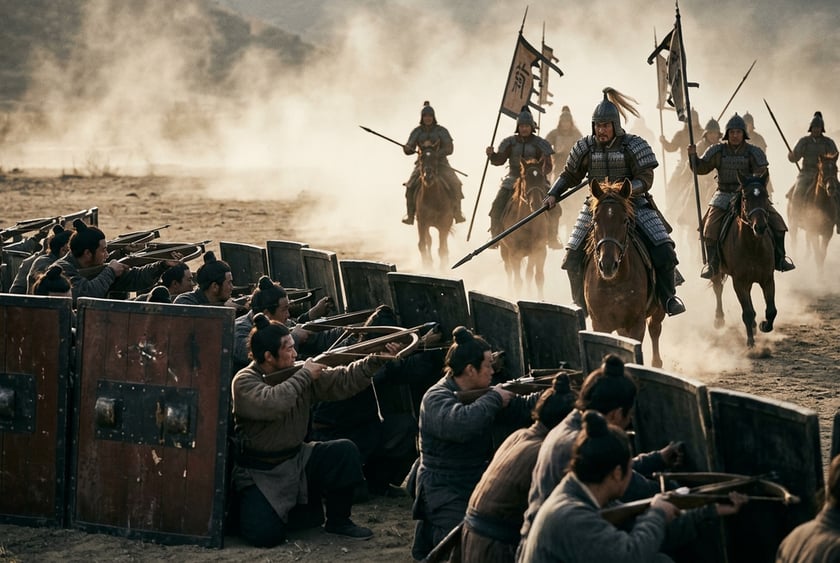
Background
Yijiaxingxu — the relocation of the imperial retinue to Xu — was the single political decision of the first year of Jian'an (196) with the most far-reaching long-term consequences. The situation can be summarized in three sentences: after Emperor Xian returned eastward from Changan to Luoyang, Luoyang was already a wasteland with no food and no defenses; Yang Feng, Han Xian, Dong Cheng, and the other warlords escorting the emperor were locked in mutual rivalry, and none could monopolize control over the Son of Heaven; and Yuan Shao in Hebei had received Ju Shou's repeated urging to welcome the emperor and establish a great enterprise, but was still hesitating. This was an extraordinarily brief political vacuum — any lord with military and administrative capability who acted decisively could take possession of the most scarce political resource of all: the Han emperor himself. Cao Cao's decisive advantage that year lay not merely in wanting to act, but in acting before every competitor and choosing the right destination. Dong Zhao had already laid out the justification for Cao Cao, telling him that "Your Excellency raised a righteous army to punish the violent and disorderly, entered the court, attended on the Son of Heaven, and sheltered the royal house — this is the achievement of the Five Hegemons." But the truly critical statement came immediately after: "Among the various commanders here below, men differ in intent; they will not necessarily comply" [c:17437]. That sentence acknowledged that the political environment in Luoyang was uncontrollable, and that the imperial retinue had to be moved into geographical space under Cao Cao's direct control — otherwise, welcoming the emperor would simply mean "doing the work for someone else."
Key Figures
The core actors in this event were Cao Cao, Dong Zhao, Yang Feng, and Han Xian. Dong Zhao, as the practical designer of the decision, showed extraordinarily sharp political instincts — seeing clearly both that "remaining in Luoyang was inconvenient" and that "forcing the relocation directly would provoke resistance," he designed a scheme that was "forced relocation under the cover of deception" [c:17437]. Cao Cao's role was judgment and execution: he immediately endorsed Dong Zhao's plan (declaring, "This is my own intention as well"), and when he heard the realistic threat that "Yang Feng is close at hand in Liang," rather than wavering on the overall direction, he pressed Dong Zhao for a concrete and executable solution [c:17437]. Yang Feng was the greatest victim of scheming in this entire episode: among the warlords who had escorted the emperor in the early Jian'an years, he was the one with the strongest military force, and he could potentially have been the other candidate for welcoming the emperor — but his character of "courage without forethought" was used by Dong Zhao as an instrument with precision. This use of a psychological profile to design a stratagem is representative of the counselor culture of early Jian'an. Han Xian was Yang Feng's collaborator and serves as supporting background in the event, disposed of alongside Yang Feng.
Core Issue
The central issue is "how to transfer a political resource from the public domain into the private domain while maintaining the appearance of legitimacy." The eight characters commonly discussed — "hold the Son of Heaven to command the lords" — are familiar, but the practical difficulty does not lie in the "holding"; it lies in "how to safely move the emperor into your own controlled territory." The elegance of Dong Zhao's plan lay in this: he did not let Cao Cao use force directly against Yang Feng (high cost, and it would damage the legitimacy narrative of "loyal service to Han"); nor did he let Cao Cao sit and wait for an opportunity (the window was short and other lords were also preparing). Instead he designed a three-step deception: first, establish the reasonableness of moving the imperial carriage to Xu in advance, citing "the capital has no grain" as the justification; second, falsely claim that the move is only "a temporary stay at Luyang," so Yang Feng believes the relocation is a short-term expedient; third, once the retinue reaches Xu and the deed is done, deal with Yang Feng then [c:17437]. This combination of "pre-established legitimacy + staged deception + accomplished fact" is a highly refined technique of power in traditional Chinese politics; the Yijiaxingxu is the earliest and cleanest specimen of it.
Political Consequences
The most immediate consequence was the transfer of the political center from Luoyang to Xudou. This spatial shift may seem minor, but it shaped the political landscape for more than twenty years afterward: every political negotiation directed at the central court had to pass through the heart of Cao Cao's Yingchuan territory, and every lord wishing to "serve the king in a time of crisis" had to first penetrate Cao Cao's defensive depth. The second consequence: Yang Feng and Han Xian lost their political capital. Leaving the emperor's side was equivalent to losing all legitimacy; their subsequent march to Dingling to plunder and demonstrate played right into Cao Cao's hands — giving him the pretext to "punish traitors in the name of the Han court." The two were eventually scattered and fled east to Yuan Shu [c:17437]. The third consequence: this established Dong Zhao's core position within Cao Cao's command; he went on to play decisive roles at such critical junctures as the investiture of the Prince of Wei and the deliberation over the nine honors, a trust built directly on this success in Cao Cao's mind. The fourth and deeper consequence: it set a "rule" for all late Han warlords — henceforth any lord wishing to "welcome the emperor" first had to break through Cao Cao's Yingchuan defenses, and this physical barrier was in effect the "moat" protecting the rise of Caowei.
Counterfactual Analysis
What if Cao Cao had adopted the plan of "remaining temporarily in Luoyang to assist in governance" — that is, staying in Luoyang rather than forcing the relocation? The most likely chain of events: Yuan Shao, under Ju Shou's repeated urgings, eventually makes up his mind and comes north to welcome the emperor; Cao Cao exhausts his strength in Luoyang in friction with Yang Feng, Han Xian, Dong Cheng, and the other commanders; the emperor is ultimately escorted to Yecheng by Yuan Shao — the card of "holding the Son of Heaven" changes hands, and the political lever underlying Cao Cao's rise in the north is completely removed. The second counterfactual: if the deception Dong Zhao designed had failed — if Yang Feng had seen through it in advance and used force to intercept the imperial retinue — Cao Cao would have been forced into a direct military confrontation with Yang Feng and Han Xian near Luoyang; even if he won, he would have incurred the stigma of "abducting the Son of Heaven" and forfeited the legitimating cloak of "attending on the emperor to punish the disloyal." The third and most macro counterfactual: if the community of late Han warlords had collectively recognized that "holding the Son of Heaven" was the true political lever and collectively prevented any single party from monopolizing it, the Eastern Han center might have persisted for a considerable time under a joint regency arrangement. But this collective action did not exist within the political culture of the first year of Jian'an; Cao Cao's decisive move filled that vacuum exactly. Seen against these alternate paths, the true weight of Yijiaxingxu lies in this: at the lowest political cost, it locked the most scarce political resource in all of late Han — the physical person of the Son of Heaven — into a single lord's heartland. From that moment, Cao Cao's question of legitimacy was never seriously challenged again across more than twenty years.