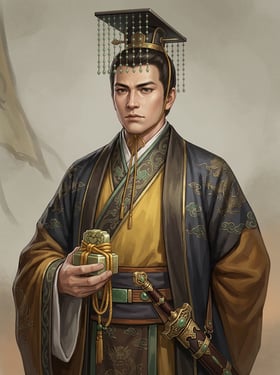
Historical Record
Cao Pi, styled Zihuan, was born in the winter of the fourth year of Zhongping (187) at Qiao County c:2060. From childhood he displayed extraordinary talent; at eight he could compose writing, read widely in the classics, commentaries, and works of the various schools of antiquity, and was skilled in mounted archery and swordsmanship c:2060. In the sixteenth year of Jian'an (211), Cao Pi was appointed General of the Household for All Purposes, concurrently serving as deputy to the Chancellor c:5503. During Cao Cao's campaigns, he often exchanged views with advisors such as Xun You and Liang Mao. When Xun You was gravely ill, Cao Pi went to visit him and even performed the bow of respect at the foot of his bed, showing his deep regard for worthy men c:2064.
In the twenty-second year of Jian'an (217), Cao Pi was made Heir Apparent of Wei c:5504. After Cao Cao died, Cao Pi succeeded him, becoming Chancellor and King of Wei, and honored Cao Cao's queen Lady Bian as Queen Dowager c:2060. In the first year of Yankang (220), Cao Pi changed the twenty-fifth year of Jian'an to the first year of Yankang c:2060. That same year, he ordered the various officials to fulfill their duties and remonstrate, the commanders to set forth military law, and the governors to make clear administrative affairs, so as to broadly gather counsel c:11092. He also expressed mourning for the soldiers who had died in battle, ordering the commanderies and kingdoms to provide them coffins and send them home, with the authorities holding sacrifices c:11093.
In the first year of Huangchu (220), Cao Pi formally proclaimed himself emperor and changed the era to Huangchu c:5510. He posthumously honored his mother Lady Zhen as Empress Wenzhao c:2061. However, Lady Zhen, after Cao Pi ascended the throne of King in the first month of the first year of Yankang (220), having lost favor and voiced resentment, was ordered to take her own life in the sixth month of the second year of Huangchu (221) and was buried at Ye c:2063. Cao Pi also once discussed with his ministers whether to retain or abolish corporal punishment; he held that corporal punishment was the law of the sage kings, but in the end let the matter drop because of the opposition of ministers such as Wang Lang and the impact of warfare c:11062.
In the third year of Huangchu (222), Cao Pi issued an edict to select talent without regard to age, stressing that those Confucians versed in the classics and those clerks proficient in statutes and law could all be tried in office c:11099. In the second month of the same year, the Western Regions states of Shanshan, Qiuci, Khotan, and others sent envoys to pay tribute; Cao Pi dispatched envoys to comfort them, opening the way to the Western Regions, and established the post of Wuji Colonel c:11100. In his warfare with Sun Quan, Cao Pi once accurately predicted Liu Bei's military dispositions, judging that he "did not understand warfare" and foretelling that he would surely be defeated; seven days later this indeed came to pass c:11089. In the fourth year of Huangchu (223), Cao Pi issued an edict forbidding women from meddling in government, stipulating that ministers were not to memorialize affairs to the Empress Dowager, that the families of empresses were not to assist in governance or receive enfeoffment, and that this edict was to be handed down to later generations c:11095. That same year, he chose his own tomb site of Shouling and devised a detailed system of frugal burial, stressing using the mountain as the body, with no mound and no trees, hiding no gold, silver, or treasures, with earthenware as grave goods, so as to guard against later grave-robbing c:11096.
In the Novel
Romance of the Three Kingdoms begins its depiction of Cao Pi in his youth, reinforcing the notion of his "imperial aura" c:2079. In the novel, after breaking Jizhou, Cao Pi, disregarding the prohibition, was the first to barge into the residence of Yuan Shao, intending to kill Yuan Shao's wives and concubines, but was moved by the beauty of Lady Zhen and took her for himself c:2079, c:2080, c:11007. This episode has no clear basis in the histories and is more a romanticized treatment of literary creation.
In Cao Cao's choice of an heir, the novel emphasizes the fierce rivalry between Cao Pi and Cao Zhi. In the novel, Cao Pi, through Jia Xu's scheme, presented before Cao Cao an image of being "sincere, generous, and respectful," while Cao Zhi lost favor for being "showy with little sincerity, and given to drink and abandon" c:2081, c:2084. Cao Pi even used the stratagem of having Wu Zhi smuggled into the residence hidden in a large hamper, then falsely accused Yang Xiu, finally leading to Yang Xiu's execution and clearing the obstacles for himself c:2082, c:2083. These episodes greatly enrich Cao Pi's image, making him appear more scheming and calculating.
After Cao Cao died, Cao Pi's succession in the novel is likewise full of drama. Hua Xin coerced and cajoled before Emperor Xian of Han to obtain the imperial decree, prompting Cao Pi to ascend the throne swiftly c:5508. Then, through Jia Kui's persuasion, Cao Pi successfully defused the crisis of Cao Zhang's contest for the throne c:2085. In handling Yu Jin, Cao Pi had the scene of Guan Yu flooding the Seven Armies and capturing Yu Jin painted on the plastered wall of the tomb chamber, so as to humiliate Yu Jin, finally driving Yu Jin to die of indignation c:2086. This episode highlights Cao Pi's harshness and ruthlessness.
After Cao Pi proclaimed himself emperor, the episode of his accepting the abdication in the novel is also rather ironic. Faced with Emperor Xian of Han's abdication, Cao Pi feigned refusal, and finally, on Jia Xu's advice, built an "Abdication Platform," having Emperor Xian of Han personally present the seal and cords, so as "to dispel the doubts of the multitude and silence all dissent" c:11019, c:5510. In foreign warfare, in the novel Cao Pi judged that Liu Bei would surely be defeated because of his linked camps stretching seven hundred li, and foretold that he would be defeated at the hands of Lu Xun, displaying his military insight c:5511. However, in his campaign against Wu, he would not heed the remonstrances of Jia Xu and Liu Ye, and in the end all three columns of his army were defeated c:11036, c:11040. In the stratagem of the Five-Route Invasion of Shu, Sima Yi offered Cao Pi the plan of uniting four routes of troops—the Xianbei, the Southern Man, Sun Quan, and Meng Da—plus one route under Cao Zhen, for a total of five hundred thousand troops to attack Shu Han c:2090. In the end, after the failure of his campaign against Wu, Cao Pi once again would not heed Xin Pi's remonstrance, personally campaigning against Wu, only to be deceived by Xu Sheng's "phantom city" stratagem and finally return without success c:5512, c:11044, c:11048.
Key Relationships
* Cao Cao (parent_of): Cao Pi was Cao Cao's eldest son and his eventual heir. In his lifetime Cao Cao much examined Cao Pi's talent and character, finally making him Heir Apparent of Wei c:2060. In the novel, though Cao Cao had once favored Cao Zhi, in the end he recognized Cao Pi's being "sincere, generous, and respectful," judging that he "could continue my enterprise" c:2084.
* Cao Rui (parent_of): Cao Rui was Cao Pi's son, later Emperor Ming of Wei. From childhood Cao Rui was favored by Cao Cao, often kept at his side, displaying an outstanding bearing c:2061.
* Empress Zhen (betrayed_by): Lady Zhen was Cao Pi's wife, but having lost favor and voiced resentment, she was finally ordered by Cao Pi to take her own life c:2063. In the novel, after breaking Jizhou, Cao Pi was drawn by the beauty of Lady Zhen and took her for himself c:11007 (unique to the novel).
* Cao Wei (serves): Cao Pi was the founder and first emperor of the Cao Wei regime; he inherited Cao Cao's enterprise and finally established the state of Wei c:5510.
* Cao Zhi (brother): Cao Pi and Cao Zhi were brothers and also rivals for the throne. In the novel, Cao Pi both admired and feared Cao Zhi's talent, once using the trials of "composing a poem in seven paces" and "boiling beans by burning beanstalks" to humiliate and suppress Cao Zhi c:11010, c:11014 (unique to the novel).
* Jia Xu (advisor): Jia Xu was an important advisor of Cao Pi. In the novel, Jia Xu devised plans for Cao Pi, helping him win Cao Cao's trust and succeed smoothly c:2081. When Cao Pi proclaimed himself emperor, Jia Xu also proposed building the "Abdication Platform" c:11019 (unique to the novel).
* Hua Xin (official): Hua Xin was an important minister of Cao Pi. At Cao Pi's accession, Hua Xin actively brought about the abdication, and in the novel played the key role of extracting the imperial decree from Emperor Xian of Han c:5508 (unique to the novel).
* Liu Ye (advisor): Liu Ye was Cao Pi's Palace Attendant. In the novel, Liu Ye remonstrated with Cao Pi several times, especially on the question of campaigning against Wu, where he tried to dissuade Cao Pi, but was not heeded c:11036.
* Sima Yi (official): Sima Yi was an important advisor of Cao Pi. In the novel, Sima Yi offered Cao Pi the stratagem of the "Five-Route Invasion of Shu" c:2090 (unique to the novel).
Iconic Scenes
* Being made Heir Apparent: In the twenty-second year of Jian'an (217), Cao Pi was made Heir Apparent of Wei by Cao Cao, formally establishing his position as heir c:5504. This event marked an important turning point in his political career.
* Proclaiming himself emperor and founding Wei: In the first year of Yankang (220), Cao Pi replaced the Han and proclaimed himself emperor, founding the state of Wei and changing the era to Huangchu c:5510. This act ended the rule of the Han dynasty and opened the tripartite balance of the Three Kingdoms.
* The frugal-burial testamentary edict: In the fourth year of Huangchu (223), Cao Pi devised for himself a detailed system of frugal burial, stressing using the mountain as the body, with no mound and no trees, hiding no gold, silver, or treasures, with earthenware as grave goods, so as to guard against later grave-robbing c:11096. This reflects his distinctive view of matters after death.
* Composing a poem in seven paces (unique to the novel): In the novel, to corner Cao Zhi, Cao Pi ordered him to compose a poem within seven paces, on pain of death. Cao Zhi finally, with the verse of "boiling beans by burning beanstalks," expressed the grief of brothers harming one another, moving Cao Pi to tears c:11010, c:11014, c:11016. This scene became a classic depiction of the strife between the brothers Cao Pi and Cao Zhi.
* Humiliating Yu Jin (unique to the novel): In the novel, Cao Pi had the scene of Guan Yu flooding the Seven Armies and capturing Yu Jin painted on the plastered wall of the tomb chamber, so as to humiliate Yu Jin, finally driving Yu Jin to die of indignation c:2086. This episode displays Cao Pi's harsh and ungracious side.
* The Five-Route Invasion of Shu (unique to the novel): In the novel, after Liu Bei died, Cao Pi adopted Sima Yi's advice and launched the military action of the "Five-Route Invasion of Shu," attempting to seize the moment of Shu Han's new ruler's accession to wipe out Shu in one stroke c:2090. Although it ultimately failed, this stratagem displayed Cao Pi's ambition to unify the realm.
* The phantom city at Guangling (unique to the novel): In the novel, Cao Pi personally campaigned against Wu and at Guangling encountered Xu Sheng's "phantom city" stratagem. Xu Sheng bound reeds into human figures, dressed them in green, gave them banners, and set them atop a false city, so that the Wei army mistakenly believed the Wu defenses were tight, and in the end Cao Pi returned without success c:11044, c:11048. This scene highlights Cao Pi's military missteps.
Portrait file
Character profile
- Appearance
- At his birth a cloudlike vapor, shaped like a canopy over a carriage, covered the room, and those who read the vapors declared it the aura of a Son of Heaven.
- Character
- Gifted in letters and eloquence, he composed at the stroke of the brush, was widely learned and of retentive memory, accomplished in many arts. Yet he was suspicious and jealous, harsh and sparing of favor, pressing hard upon both his brothers and surrendered generals—outwardly maintaining fraternal affection while in fact enforcing the law of the state. Craving swift accession, he yet cloaked the name of usurpation behind ceremonial declining, mounting the altar to receive the abdication while privately telling his ministers, 'The affair of Shun and Yu—I understand it now.'
- Manner of speech
- His words were weighty and imposing, often pressing others with the law of the state and the duty between ruler and minister. He professed to admire in secret the yielding of Tang Yao, his phrasing echoing the classics of abdication, and upon gaining the throne uttered the line about 'the affair of Shun and Yu.'
- Life
- Cao Pi was born in the winter of the fourth year of Zhongping. In the sixteenth year of Jian'an he became General of the Household of the Five Offices and Vice Chancellor, and in the twenty-second year of Jian'an was established as Crown Prince of Wei. After the Grand Progenitor died, he succeeded as Chancellor and King of Wei, and in the tenth month of the first year of Yankang received the abdication and took the imperial throne, changing the reign title to Huangchu. In the seventh year of Huangchu he died in the Jiafu Hall at the age of forty and was buried at the Shouyang tomb.
- Anecdotes
- He governed himself by artifice and cloaked his true feelings, and so was fixed upon as heir. After taking the throne he executed Ding Yi and Ding Yi, was severe in law toward his brothers, and later, campaigning east and passing Yongqiu, visited Zhi's palace and increased his fief. He enfeoffed Sun Quan as King of Wu and bestowed the Nine Bestowments upon him, and rejected Liu Ye's proposal to attack Wu.
Relationships
80 relationships
Family16
Lord & vassal4
Friends5
Enemies12
Teacher & student9
Other33
Quotes
121 recorded lines · 3 featured
「吾與汝乃兄弟也。以此為題。亦不許犯著『兄弟』字樣。」
This line introduces the allusion of 'The Quatrain of Seven Steps,' displaying Cao Pi's harassment of Cao Zhi and the cruelty of brothers turning on one another.
「舜、禹之事,朕知之矣!」
'The deeds of Shun and Yu-now I understand them!' is Cao Pi's famous line upon taking the throne, implying the legitimacy of his supplanting the Han.
「備不曉兵,豈有七百里營可以拒敵者乎!『苞原隰險阻而爲軍者,爲敵所禽』,此兵忌也。孫權上事今至矣。」
This line reflects Cao Pi's deep insight into military strategy, predicting Liu Bei's defeat and displaying his military talent.
Chapters44 回 ▸
- 史ch.1ch.2ch.3ch.5ch.9ch.10ch.11ch.12ch.13ch.14ch.15ch.16ch.17ch.18ch.19ch.20ch.21ch.22ch.23ch.24ch.25ch.26ch.27ch.29ch.32ch.35ch.43ch.47ch.56
- 演ch.32ch.33ch.34ch.68ch.72ch.78ch.79ch.80ch.82ch.84ch.85ch.86ch.91ch.94ch.109
Relationship timeline35 条 ▸
史 ch.2
- Cao Rui§9
parent_of
王子叡封武德侯
史 ch.3
- Cao Rui§1
parent_of
黄初七年夏五月帝病笃乃立为皇太子
史 ch.5
- Cao Rui§15
parent_of
父子
史 ch.10
- Xun You§51
student_of
文帝在东宫,太祖令尽礼敬之;攸病独拜床下
史 ch.11
史 ch.16
- Su Ze§13
rival_of
加其护羌校尉、关内侯;问径寸大珠;猎戏怒赦督吏;"卿,直臣也";以见惮左迁东平相
史 ch.17
史 ch.20
kin_of
卞皇后所生(嫡长,文皇帝)
- Cao Chong§15
kin_of
寛喩太祖于冲薨之时
史 ch.22
- Huan Jie§5
friend_of
帝亲临省疾,托六尺之孤
史 ch.29
- Zhou Xuan§45
witnesses
文帝多次问梦于周宣
- Empress Zhen§45
enemy_of
帝遣使赐甄后玺书,闻周宣占梦悔之,遣人追使者不及
史 ch.56
- Zhu Ran§14
enemy_of
魏文帝自住宛为江陵围之援
演 ch.33
spouse_of
入袁绍家见甄氏披发垢面,拭面观其玉肌花貌,遂纳之为妻
演 ch.68
- Cao Cao§23
kin_of
长子,立为王世子
演 ch.72
演 ch.78
- Cao Cao§19
kin_of
长子(卞氏所生);被指为继业之人
演 ch.79
演 ch.85
拜授官职
- Cao Zhen§23
命为大都督
演 ch.91
Inner monologues · AI-generated3 段 ▸
- Now that the many affairs of state have briefly subsided, whenever I enter the hall to attend to business, I often feel
- At the time of the abdication, the officials stood in their appointed places, with the mandate and the rites before thei
- When I was young, I was often at my father’s side. What I witnessed at the table was not merely the forms of dress and r
Life events28 ▸
- 0210-01-01 · Ye (Bronze Sparrow Terrace site)Cao Cao Builds the Bronze Bird Terrace· Witness
- 0213-01-01 · YeCui Yan Publicly Endorses Cao Pi as Heir· Witness
- 0216-01-01 · YeCao Cao Created King of Wei
- 0217-01-01 · YeGreat Epidemic of the 22nd Year of Jian'an· Witness
- 0217-01-01 · YeCao Pi Named Heir Apparent
- 0218-01-01 · Sanggan RiverCao Zhang's Northern Campaign Against the Wuhuan of Daijun· Advisor
- 0219-01-01 · YeWei Feng's Conspiracy· Instigator
- 0219-01-01 · YeCase of Wei Feng's Conspiracy· Instigator
- 0220-01-01 · YeExecution of Ding Yi and Ding Yi· Instigator
- 0220-01-01 · YeThe Quatrain of Seven Steps· Instigator
- 0220-01-01 · LuoyangNine-Rank System· Commander
- 0220-01-01 · LuoyangDeath of Taizu and Jia Kui's Management of the Funeral· Commander
- 0220-01-01 · ShangyongMeng Da Defects to Wei and Liu Feng Is Executed· Commander
- 0220-01-01 · XuchangCao Pi Supplants the Han· Instigator
- 0220-01-01 · XuchangCao Pi Usurps the Han Throne and Proclaims Himself Emperor· Instigator
- 0220-01-01 · YeSuccession Struggle Between Cao Pi and Cao Zhi· Instigator
- 0220-01-01 · LuoyangDeath of Cao Cao
- 0220-01-01 · YeCao Cao Dies and Emperor Wen of Wei Ascends the Throne· Instigator
- 0220-01-01 · Gaoling Mausoleum (Cao Cao Mausoleum)Burial of Cao Cao at Gaoling· Instigator
- 0220-01-01 · Abdication PlatformAbdication of Emperor Xian of Han· Instigator
- 0221-01-01 · YeYu Jin Surrenders to Guan Yu· Instigator
- 0221-01-01 · LuoyangWei Invests Sun Quan as King of Wu· Instigator
- 0222-01-01 · JianglingThree-Pronged Campaign against Wu· Commander
- 0222-01-01 · GuanglingCao Pi's Guangling Campaign· Commander
- 0223-01-01 · ChengduFive-Route Invasion of Shu· Instigator
- 0224-01-01 · JianyeXu Sheng Builds Phantom Walls to Repel Cao Pi· Commander
- 0226-01-01 · JizhouXin Pi Remonstrates Against Relocating Jizhou Soldier Families· Instigator
- 0254-01-01 · LuoyangGao Rou's Administration of Criminal Law· Witness