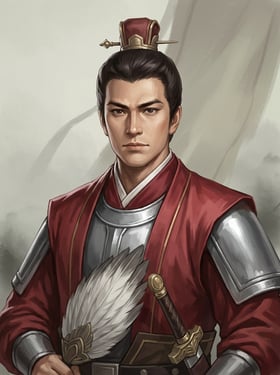
Historical Record
Zhou Yu, courtesy name Gongjin, was a native of Shu County in Lujiang. His granduncle Zhou Jing and Zhou Jing's son Zhou Zhong both served as Grand Commandant of the Han, and his father Zhou Yi served as Prefect of Luoyang. He was handsome in appearance and outstanding in bearing. When Sun Jian raised troops to campaign against Dong Zhuo, he moved his family to Shu County; Zhou Yu was the same age as Sun Jian's eldest son Sun Ce, and the two were on excellent terms. Zhou Yu even gave up his family's large mansion on the south side for Sun Ce to live in, and paid his respects to Sun Ce's mother as though to his own family, sharing everything between them.
In the third year of Jian'an (198), Zhou Yu's uncle Zhou Shang served as Grand Administrator of Danyang, and Zhou Yu went to visit him. It happened that Sun Ce was preparing to cross the Yangtze eastward; upon reaching Liyang, he wrote a letter summoning Zhou Yu. Zhou Yu led troops to welcome Sun Ce, who was delighted to see Zhou Yu and said, "With you, I shall succeed." Zhou Yu then followed Sun Ce in attacking Hengjiang and Dangli, both of which they took. After crossing the river, they attacked Moling, defeated Ze Rong and Xue Li, then took Hushu and Jiangcheng and entered Qu'e. After Liu Yao fled in defeat, Sun Ce's army had grown to tens of thousands. Sun Ce said to Zhou Yu: "With these troops I have enough to take Wu and Kuaiji and pacify the Shanyue. You return to garrison Danyang." Zhou Yu then returned to Danyang. Before long, Yuan Shu sent his cousin Yuan Yin to replace Zhou Shang as Grand Administrator of Danyang, and Zhou Yu returned to Shouchun together with Zhou Shang. Yuan Shu wished to appoint Zhou Yu as a general, but Zhou Yu saw that Yuan Shu would in the end accomplish nothing, and so requested to be Chief of Juchao in order to make his way back east by that route. Once Yuan Shu agreed, Zhou Yu returned from Juchao to the Wu region.
Sun Ce personally welcomed Zhou Yu, appointing him General Who Establishes Might and allotting him two thousand soldiers and fifty warhorses. At that time Zhou Yu was only twenty-four, and the people of Wu all called him "Master Zhou." Zhou Yu's kindness and good faith spread far and wide in Lujiang; he later marched out to garrison Niuzhu and concurrently served as Chief of Chungu. Before long, Sun Ce planned to take Jing Province and appointed Zhou Yu as Central Protector of the Army, concurrently Grand Administrator of Jiangxia, accompanying the army in attacking and taking Wan. During this time, they obtained the two daughters of Lord Qiao, both of peerless beauty. Sun Ce married Da Qiao, and Zhou Yu married Xiao Qiao.
In the fifth year of Jian'an (200), Sun Ce died and Sun Quan succeeded him. Zhou Yu led troops to attend the mourning, then remained in the Wu region, jointly managing military and administrative affairs with the Chief Clerk Zhang Zhao in his capacity as Central Protector of the Army. In the thirteenth year of Jian'an (208), Cao Cao came south, and Liu Biao's son Liu Cong surrendered. Liu Bei retreated south to Xiakou and sent Zhuge Liang to Eastern Wu to seek aid. Sun Quan adopted the advice of Zhou Yu and Lu Su and decided to resist Cao. Sun Quan appointed Zhou Yu and Cheng Pu as left and right commanders, each leading ten thousand men, who together with Liu Bei's allied forces crushed Cao Cao's army at Red Cliffs, burning his ships. The majority of Cao Cao's army died of hunger and plague, and he was forced to withdraw north. Liu Bei, Zhou Yu, and the others pursued to Nan Commandery.
After the Battle of Red Cliffs, Sun Quan appointed Zhou Yu as Lieutenant-General, concurrently Grand Administrator of Nan Commandery, and granted him Xiajun, Hanchang, Liuyang, and Zhouling as his fief, garrisoning Jiangling. Liu Bei, in his capacity as General of the Left, concurrently served as Governor of Jing Province and was stationed at Gong'an. When Liu Bei went to the capital to call upon Sun Quan, Zhou Yu submitted a memorial advising Sun Quan to move Liu Bei to the Wu region, to entertain his eyes and ears with beauties and amusements, and to separate Guan Yu and Zhang Fei, so that Zhou Yu and the others could fight alongside Liu Bei and thereby accomplish great things. He held that if territory were ceded to assist Liu Bei, putting the three men together on the frontier, it was to be feared that the dragon would gain cloud and rain and never again be a creature of the pond. But Sun Quan, considering that Cao Cao was in the north and that he needed to widely recruit champions, and fearing that Liu Bei would be hard to subdue, did not adopt the plan.
At that time Liu Zhang was Governor of Yi Province, with Zhang Lu harassing from without. Zhou Yu went to the capital to call upon Sun Quan and advised that, taking advantage of Cao Cao's recent defeat and lack of leisure to look south, he and the General Who Manifests Might should together take Yi Province and subdue Zhang Lu, then leave the General Who Manifests Might to garrison Yi Province and ally with Ma Chao. Zhou Yu would then return and, together with Sun Quan, hold Xiangyang in order to plan a northern expedition against Cao Cao. Sun Quan agreed to Zhou Yu's plan. Zhou Yu returned to Jiangling to prepare his baggage, but fell ill and died at Baqiu, aged only thirty-six. Sun Quan donned plain mourning garments and held a funeral, moving those around him. When Zhou Yu's coffin was conveyed back to the Wu region, Sun Quan met it again at Wuhu and bore all the funeral expenses. Later Sun Quan decreed: "As for the retainers of the late generals Zhou Yu and Cheng Pu, none shall be called to account." Zhou Yu had two sons and a daughter; his daughter married the heir apparent Sun Deng. His eldest son Zhou Xun married a princess and was appointed Cavalry Commandant, having the bearing of Zhou Yu, but died young. His second son Zhou Yin was first appointed Commandant Who Promotes the Enterprise, married a woman of the imperial clan, commanded a thousand troops, and was stationed at Gong'an, but was later banished to Luling Commandery for an offense.
In the Novel
In the Romance of the Three Kingdoms, Zhou Yu is shaped into a handsome, elegant, and talented scholar-general, but his character is given an added measure of narrowmindedness and envy of the worthy, especially in his repeated battles of wits with Zhuge Liang. The Romance's depiction of Zhou Yu's meeting with Sun Ce is more dramatic. When Sun Jian campaigned against Dong Zhuo, Zhou Yu, being the same age as Sun Ce, sworn brotherhood with him; Zhou Yu's uncle Zhou Shang was Grand Administrator of Danyang, and Zhou Yu, going to visit his kin, happened to meet Sun Ce. Sun Ce was overjoyed, saying, "With Gongjin, the great enterprise shall succeed," and adopted Zhou Yu's advice to engage the two worthies Zhang Zhao and Zhang Hong.
On his deathbed, Sun Ce said to his mother Lady Wu: "If you cannot decide internal matters, ask Zhang Zhao; if you cannot decide external matters, ask Zhou Yu. I regret that Zhou Yu is not here, so that I cannot instruct him face to face!" Sun Ce also charged his wife Lady Qiao to relay word to Xiao Qiao that Zhou Yu should assist Sun Quan with all his heart. When Zhou Yu heard of Sun Ce's death, he rushed through the night to attend the mourning, weeping and bowing before the coffin, and pledged his loyalty to Lady Wu and Sun Quan, declaring his willingness to "spill his brains upon the ground to repay the kindness of one who knew him". He also recommended Lu Su to Sun Quan, saying he "harbored grand strategy in his breast and hid subtle schemes within", and personally went to engage Lu Su, finally persuading Lu Su to attach himself to Sun Quan.
When Cao Cao wished Sun Quan to send a son to court, in the Romance Zhang Zhao and others advocated sending the son, while Zhou Yu firmly opposed it, holding that "the general has inherited the enterprise left by his father and brother, commands the people of six commanderies, with elite troops and ample grain, and officers and men ready to give their lives—what compulsion is there to send a hostage to another?" In the end Lady Wu adopted Zhou Yu's words, and Sun Quan accordingly did not send the son. This differs from the historical fact, in which Zhou Yu and Lady Wu privately settled the matter rather than debating it openly.
Before the Battle of Red Cliffs, the Romance lavishly embellishes the battle of wits between Zhou Yu and Zhuge Liang. When Cao Cao's great army bore down, the civil and military officials of Eastern Wu split into a surrender faction and a war faction. Civil officials such as Zhang Zhao advocated surrender, while military officers such as Cheng Pu and Huang Gai advocated war. On the surface Zhou Yu took no clear stand on either side, but in his heart he had long inclined toward war. In his conversation with Zhuge Liang, Zhou Yu at first feigned a wish to surrender to Cao Cao in order to sound out Zhuge Liang. Zhuge Liang then provoked Zhou Yu with the "two Qiaos" stratagem, claiming that Cao Cao wished to obtain Da Qiao and Xiao Qiao and place them in the Bronze Sparrow Terrace, reciting Cao Zhi's "Ode to the Bronze Sparrow Terrace" as proof. Upon hearing this, Zhou Yu flew into a rage, pointing north and cursing, "The old villain bullies me too far!" Only then did Zhuge Liang "feign a look of alarm," saying he had not known that Da Qiao was Sun Ce's wife and Xiao Qiao was Zhou Yu's wife. Zhou Yu thereupon firmed his resolve to resist Cao and agreed with Zhuge Liang to destroy Cao together.
Before Sun Quan, Zhou Yu forcefully set out the four great taboos of Cao Cao's southern campaign: "The northern lands are not yet pacified, and Ma Teng and Han Sui are a danger to his rear, yet Cao has long been engaged in a southern campaign—this is the first taboo; the northern army is unskilled in naval warfare, yet Cao abandons saddle and horse and relies on boats and oars to contend with Eastern Wu—this is the second taboo; moreover, it is now the depth of midwinter's bitter cold, and the horses have no fodder—this is the third taboo; he drives the soldiers of the Central Plains to travel far across rivers and lakes, unacclimated to the water and soil, so that many fall ill—this is the fourth taboo." Sun Quan was greatly pleased to hear this, drew his sword and hacked off a corner of the table, vowing to resist Cao, and bestowed the sword upon Zhou Yu, appointing him Grand Commander. Zhou Yu then analyzed for Sun Quan the actual strength of Cao Cao's army, pointing out that the Central Plains troops Cao led numbered no more than 150,000 or 160,000, and the forces obtained from the Yuan clan no more than 70,000 or 80,000, many of them weary and unsubmissive, declaring, "Give me fifty thousand troops, and that is enough to destroy him." This completely dispelled Sun Quan's misgivings.
Key Relationships
* Sun Jian's faction: Zhou Yu and Sun Ce were friends from childhood, as close as brothers; Sun Ce once said, "With you, I shall succeed." After Sun Ce's death, Zhou Yu assisted Sun Quan with all his heart, and Sun Quan trusted him deeply, saying, "Gongjin's words are enough to dispel my doubts. Zibu lacks foresight and has deeply failed my hopes. Only you and Zijing are of one heart with me."
* Cao Cao: Zhou Yu was the core figure of the Sun-Wu faction in resisting Cao Cao, especially at the Battle of Red Cliffs, where as commander-in-chief he crushed Cao Cao's army. In the novel, Zhou Yu deeply detested Cao Cao and was sworn never to coexist with him.
* Liu Bei's faction: At the Battle of Red Cliffs, Zhou Yu joined forces with Liu Bei to resist Cao, but after the battle he advised Sun Quan to move Liu Bei to the Wu region to prevent him from growing too strong. In the novel, there is a complex relationship of cooperation and competition between Zhou Yu and Zhuge Liang, and Zhou Yu repeatedly attempted to do harm to Zhuge Liang, but never succeeded (novel only).
* Zhou Jing: Zhou Yu's granduncle, who once served as Grand Commandant of the Han.
* Lu Su: A worthy whom Zhou Yu recommended to Sun Quan; the two were close, and he was an important strategist of the Sun-Wu faction.
* Xiao Qiao: Zhou Yu's wife, known together with Sun Ce's wife Da Qiao as the "two Qiaos". In the novel, Cao Cao's coveting of the two Qiaos became one of the fuses for Zhou Yu's resistance against Cao (novel only).
Signature Scenes
* Befriending Sun Ce: Zhou Yu and Sun Ce knew each other as youths and were as close as brothers; Zhou Yu gave up his family's large mansion for Sun Ce to live in and paid respects to Sun Ce's mother as to his own family, sharing everything between them. In the novel, when the two met, Sun Ce was overjoyed and said, "With Gongjin, the great enterprise shall succeed."
* Marrying Xiao Qiao: After following Sun Ce in taking Wan, Zhou Yu married Lord Qiao's second daughter Xiao Qiao, while Sun Ce married Da Qiao, fulfilling the celebrated tale of the "two Qiaos".
* Battle of Red Cliffs: As commander-in-chief of the Sun-Wu allied forces, Zhou Yu crushed Cao Cao's army at the Battle of Red Cliffs, burning his ships and laying the foundation for the tripartite division of the Three Kingdoms. This was the pinnacle of Zhou Yu's military career.
* Persuading Sun Quan to resist Cao: When Cao Cao's great army bore down, Zhou Yu overruled the others, firmed Sun Quan's resolve to resist Cao, and analyzed in detail the weaknesses of Cao's army, ultimately bringing about the formation of the Sun-Liu allied forces. In the novel, Zhou Yu used the "two Qiaos" stratagem to provoke Sun Quan into resolving to resist Cao (novel only).
* Dying of illness at Baqiu: While preparing to take Yi Province, Zhou Yu unfortunately fell ill and died at Baqiu, aged only thirty-six. Sun Quan donned plain mourning garments and held a funeral for him, a clear sign of his esteem and grief for Zhou Yu.
* Zhuge Liang angering Zhou Yu three times: In the novel, Zhuge Liang repeatedly employed schemes to drive Zhou Yu into furious frustration, until at last Zhou Yu died lamenting, "Since Heaven bore Yu, why did it also bear Liang?" (novel only).
Portrait file
Character profile
- Appearance
- Zhou Yu was tall and strong with a fine appearance, elegant in bearing and handsome of countenance [c:21, c:22].
- Character
- Zhou Yu was broad and generous in temperament, on the whole winning people over, and from his youth he was devoted to music [c:8]; his talent and strategy surpassed others, he bound himself as a sworn brother to Sun Ce and gave the service of a faithful dog and horse [c:9]; at the same time, he was full of wisdom and decisive, yet jealous of the worthy and envious of the able, narrow of measure and eager to win [c:12, c:15, c:16].
- Manner of speech
- Zhou Yu's manner of speech was to smile while sneering coldly, adept at citing allusions to support himself, enumerating key points, and often uttering hard, weighty oaths [c:60, c:61].
- Life
- Zhou Yu died around the fifteenth year of Jian'an, at the age of thirty-six, dying of illness at Baqiu [c:18]; he once led a naval force of tens of thousands to join with the former sovereign in fighting Cao at Red Cliffs [c:17]; before his death he sighed long, 'Since Yu was born, why was Liang also born?', and left a letter recommending Lu Su to replace himself [c:20].
- Anecdotes
- Zhou Yu once served as Grand Administrator of Nan Commandery [c:1]; he once prostrated himself before the coffin and vowed, 'How could I not offer the service of a dog and horse, and follow it to the death?', and recommended Lu Su to Sun Quan [c:2].
Relationships
97 relationships
Family2
Lord & vassal3
Friends6
Enemies15
Teacher & student1
Other63
Quotes
206 recorded lines · 3 featured
「大丈夫處世,遇知己之主,外託君臣之義,內結骨肉之恩,言必行,計必從,禍福共之,假使蘇秦、張儀、陸賈、酈生復出,口似懸河,舌如利刃,安能動我心哉!」
This line displays Zhou Yu's unwavering loyalty and lofty ambition, a classic portrait of his character.
「操雖託名漢相,實為漢賊。將軍以神武雄才,仗父兄餘業,據有江東,兵精糧足,正當橫行天下,為國家除殘去暴,奈何降賊耶?且操今此來,多犯兵家之忌:北土未平,馬騰、韓遂為其後患,而操久於南征,一忌也;北軍不諳水戰,操捨鞍馬,仗舟楫,與東吳爭衡,二忌也;又時值隆冬盛寒,馬無蒿草,三忌也;驅中國士卒,遠涉江湖,不服水土,多生疾病,四忌也。操兵犯此數忌,雖多必敗。將軍擒操,正在今日。瑜請得精兵數千,進屯夏口,為將軍破之!」
Before the Battle of Red Cliffs, Zhou Yu strongly urged resistance against Cao Cao; here his analysis of Cao Cao's four fatal weaknesses displays his outstanding military talent.
「既生瑜,何生亮!」
'Since Heaven bore Yu, why did it also bear Liang?' is Zhou Yu's dying lament over Zhuge Liang, widely renowned and become a byword for the Yu-Liang rivalry.
Chapters28 回 ▸
- 史ch.9ch.17ch.32ch.35ch.37ch.46ch.47ch.51ch.54ch.55ch.56
- 演ch.15ch.29ch.38ch.39ch.44ch.45ch.46ch.47ch.48ch.49ch.51ch.52ch.53ch.54ch.55ch.56ch.57
Relationship timeline67 条 ▸
史 ch.32
- Cao Cao§13
fights_in
率水军数万与先主并力,与曹公战于赤壁,大破之
史 ch.47
- Cao Cao§10
fights_in
赤壁主帅大破曹公
史 ch.54
演 ch.15
- Sun Ce§10
oath_brother
同年、结为昆仲;策长瑜两月、瑜以兄事策;愿施犬马之力共图大事
演 ch.29
演 ch.44
- Lu Su§6
rival_of
佯言纳降以试鲁肃;二人互相争辩
- Xiao Qiao§33
spouse_of
小喬乃瑜之妻
- Sun Quan§36
advises_in
数曹操"四忌",请精兵数千进屯夏口为将军破之
- Zhuge Liang§41
rival_of
暗忖"高我一头,久必为江东之患,不如杀之"
- Han Dang§43
commands_in
差为前部先锋,领本部战船下寨三江口
- Huang Gai§43
commands_in
差为前部先锋,领本部战船下寨三江口
- Jiang Qin§43
commands_in
调拨为第二队
- Zhou Tai§43
commands_in
调拨为第二队
- Ling Tong§43
commands_in
调拨为第三队
- Pan Zhang§43
commands_in
调拨为第三队
- Taishi Ci§43
commands_in
调拨为第四队
- Lü Meng§43
commands_in
调拨为第四队
- Lu Xun§43
commands_in
调拨为第五队
- Dong Xi§43
commands_in
调拨为第五队
- Lü Fan§43
commands_in
差为四方巡警使
- Zhu Zhi§43
commands_in
差为四方巡警使
演 ch.45
演 ch.46
rival_of
因孔明洞察反间计、料定曹操换水军都督之事,公瑾欲斩之;遂以监造十万箭为公道之由相逼
rival_of
借公事索十万箭、暗令军匠迟延不齐物料以陷孔明于必死
- Zhuge Liang§43
rival_of
借箭事毕,周瑜叹"孔明神机妙算,吾不如也"
- Zhuge Liang§48
advises_in
二人各暗写掌中字,皆为"火",定下火攻之议
- Gan Ning§50
commands_in
密令甘宁殷勤相待蔡中蔡和、就裏隄防、出兵之日先杀二人祭旗
- Huang Gai§54
commands_in
帐前借口降议震怒,喝令斩之;众官苦谏方改责脊杖五十
演 ch.47
演 ch.49
演 ch.51
演 ch.52
演 ch.54
演 ch.55
演 ch.56
- Lu Su§17
commands_in
頓足曰「子敬又中諸葛亮之計也」;獻「假途滅虢」之計授魯肅再往荊州
- Zhuge Liang§17
rival_of
獻假途滅虢之計欲擒玄德奪荊州雪恨;至荊州城下被趙雲喝破,箭瘡復裂墬於馬下
演 ch.57
Inner monologues · AI-generated3 段 ▸
- The river wind blows past Jiangling, and I often recall how I once followed Bofu in founding our cause. Though young, I
- The river wind now stirred the banners and steadied men’s hearts. Cao Cao commanded the forces of Jing Province, and his
- I recall that when I was young, I became close to Sun Bofu. Hearing that he aspired to bring order to the realm, I was w
Life events25 ▸
- 0196-01-01 · JingxianTaishi Ci Joins Sun Ce· Advisor
- 0199-01-01 · Qu'eSun Ce's Conquest of Jiangdong· Commander
- 0199-01-01 · LujiangSun Ce's Seizure of Lujiang· Commander
- 0200-01-01 · Wu CountySun Quan Succeeds to Power· Commander
- 0200-01-01 · LiyangSun Ce's Pacification of Jiangdong· Commander
- 0203-01-01 · Wu CountySun Quan Refuses to Send His Son to the Wei Court· Advisor
- 0208-01-01 · ChibiZhuge Liang Summons the Wind at the Seven-Star Altar· Commander
- 0208-01-01 · ChaisangZhou Yu Appointed Commander-in-Chief· Commander
- 0208-01-01 · ChaisangSun Quan's Decision to Resist Cao Cao· Commander
- 0208-01-01 · JiangxiaBattle of Jiangxia· Commander
- 0208-01-01 · JianglingBattle of Jiangling· Commander
- 0208-01-01 · ChibiBattle of Red Cliffs· Commander
- 0208-01-01 · ChibiBitter-Flesh Stratagem· Commander
- 0208-01-01 · Chibi stretch of the YangtzeBorrowing Arrows with Straw Boats· Instigator
- 0208-01-01 · ChibiBattle of Red Cliffs· Commander
- 0209-01-01 · NanxuLiu Bei's Marriage into Eastern Wu· Instigator
- 0209-01-01 · LiulangpuLiu Bei's Escape from Wu· Instigator
- 0209-01-01 · JianglingZhou Yu Is Wounded by an Arrow and Feigns Death· Commander
- 0209-01-01 · YilingGan Ning Holds Yiling· Commander
- 0209-01-01 · Nan CommanderyZhao Yun Seizes Nanjun· Victim
- 0210-01-01 · Jing ProvinceLiu Bei Borrows Jing Province· Advisor
- 0210-01-01 · JianglingZhou Yu's Stratagem of Borrowed Road to Destroy Guo· Instigator
- 0210-01-01 · BaqiuZhou Yu's Plan to Take Shu· Instigator
- 0210-01-01 · BaqiuZhou Yu Dies of Illness at Baqiu· Killed in action
- 0210-01-01 · Jing ProvinceLu Su's Demand for the Return of Jing Province· Commander