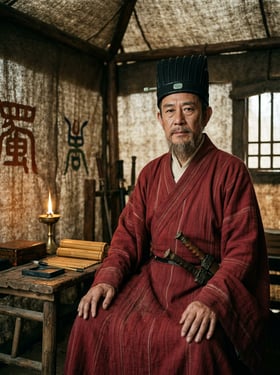
Historical Record(史载)
Liu Bei, styled Xuande, was a descendant of Liu Sheng, the Jing King of Zhongshan and a son of Emperor Jing of Han; he was a native of Zhuo County in Zhuo Commandery. He lost his father in his youth and made a living together with his mother weaving mats and selling shoes. At the southeast corner of his family's home stood a tall mulberry tree shaped like the canopy of a carriage, which was regarded as an extraordinary omen, foretelling that a person of high rank would emerge from his household. In his youth Liu Bei did not care for reading, but was fond of dogs, horses, music, and fine clothes. He was seven chi and five cun tall, his hands reached past his knees, and he could see his own ears. He spoke little, was good at dealing with people, did not show his joy or anger on his face, and was fond of associating with bold and chivalrous men, so that he was much admired by the young. Zhang Shiping, Su Shuang, and other great merchants of Zhongshan, recognizing his extraordinary nature, funded him with money, and Liu Bei was thereby able to recruit a following.
At the end of Emperor Ling's reign, when the Yellow Turban Rebellion broke out, Liu Bei led his followers to join Colonel Zou Jing in suppressing the Yellow Turban bandits, and for his merit was appointed Commandant of Anxi. Later, dissatisfied that the inspecting clerk demanded bribes, he flogged the clerk, abandoned his office, and fled. Before long he joined the commandant Wuqiu Yi in raising troops; encountering bandits at Xiapi, he fought hard and won merit, and successively held the posts of Aide of Xiami, Commandant of Gaotang, and Prefect of Gaotang. After Gaotang was overrun by bandits, Liu Bei went over to Gongsun Zan, who memorialized him as Major of a Separate Division. Together with Tian Kai, the Inspector of Qing Province, he resisted Yuan Shao, the Governor of Jizhou, and won repeated merits in battle; afterward he served on a trial basis as Prefect of Pingyuan and then held the post of Chancellor of Pingyuan.
When Cao Cao campaigned against Xu Province, Tao Qian, the Governor of Xu Province, sought aid from Tian Kai, and Liu Bei went with Tian Kai. At that time Liu Bei already had over a thousand soldiers, along with Wuhuan and miscellaneous Hu cavalry and several thousand famine refugees. Upon his arrival, Tao Qian further added four thousand Danyang troops to his command, and Liu Bei thereupon attached himself to Tao Qian. When Tao Qian was gravely ill, he believed that none but Liu Bei could bring peace to the province, and before his death he entrusted Xu Province to him. At first Liu Bei was unwilling to accept, but persuaded by Chen Deng, Kong Rong, and others, he finally took control of Xu Province.
In the first year of Jian'an, Yuan Shu attacked Liu Bei at Xuyi and Huaiyin, and Liu Bei held him off. Cao Cao memorialized Liu Bei as General Who Guards the East and enfeoffed him as Marquis of Yicheng Village. Liu Bei stood in confrontation with Yuan Shu for over a month, when Lü Bu took advantage of the opening to seize Xiapi and captured Liu Bei's wife. Liu Bei moved his army to Haixi, and later reconciled with Lü Bu, who returned his wife; Liu Bei then sent Guan Yu to garrison Xiapi. Liu Bei returned to Xiaopei and again recruited over ten thousand men. Displeased, Lü Bu attacked Liu Bei, who was defeated and fled to Cao Cao. Cao Cao treated Liu Bei generously, appointed him Governor of Yu Province, supplied him with troops and provisions, and ordered him to strike Lü Bu in the east. Lü Bu sent Gao Shun to attack Liu Bei; Cao Cao sent Xiahou Dun to the rescue, but Xiahou Dun was defeated by Gao Shun, and Liu Bei's wife was captured once again. Cao Cao personally campaigned east, and together with Liu Bei surrounded Lü Bu at Xiapi, taking Lü Bu alive. Liu Bei was thus reunited with his wife and returned with Cao Cao to Xu. Cao Cao memorialized Liu Bei as General of the Left and treated him very generously—riding in the same carriage when they went out and sitting on the same mat when they sat.
Before Liu Bei left Xu, Dong Cheng received a secret edict from Emperor Xian to plot the assassination of Cao Cao, and Liu Bei took part in it. Cao Cao once said to Liu Bei, "In all the realm today, the heroes are only you, sir, and Cao." Hearing this, Liu Bei was so startled he dropped his chopsticks. Later Liu Bei occupied Xiapi, killed Che Zhou the Inspector of Xu Province, left Guan Yu to garrison Xiapi, and himself returned to Xiaopei. Chang Ba and many commanderies and counties rebelled against Cao Cao and went over to Liu Bei, his followers reaching tens of thousands. Liu Bei sent Sun Qian to ally with Yuan Shao. Cao Cao sent Liu Dai and Wang Zhong to attack Liu Bei, but they could not prevail. In the fifth year of Jian'an, Cao Cao campaigned east against Liu Bei; Liu Bei was defeated, Cao Cao captured his wife, and took Guan Yu prisoner.
Liu Bei fled to Yuan Shao, and Yuan Shao and his sons esteemed him wholeheartedly. Later Liu Bei persuaded Yuan Shao to ally with Liu Biao in the south, and Yuan Shao sent Liu Bei with troops to Runan, where he joined forces with Gong Du and other bandits, several thousand strong. Cao Cao sent Cai Yang to attack Liu Bei, but Cai Yang was killed by Liu Bei. After Cao Cao defeated Yuan Shao, he marched south to attack Liu Bei. Liu Bei sent Mi Zhu and Sun Qian to make contact with Liu Biao, who received him with the courtesy due an honored guest, augmented his forces, and had him garrison Xinye. Many of the bold men of Jing Province went over to Liu Bei, and Liu Biao, suspecting his intentions, secretly guarded against him. Liu Bei once set an ambush and defeated Xiahou Dun, Yu Jin, and others.
In the twelfth year of Jian'an, when Cao Cao campaigned north against the Wuhuan, Liu Bei urged Liu Biao to seize Xu, but Liu Biao could not bring himself to adopt the plan. Cao Cao campaigned south against Liu Biao; Liu Biao died of illness, and after his son Liu Cong succeeded him, Liu Cong surrendered to Cao. Liu Bei was garrisoning Fancheng, unaware that Cao Cao's main army had arrived; only when he reached Wancheng did he learn of it, whereupon he led his followers in a retreat to the south. Passing through Xiangyang, Zhuge Liang urged Liu Bei to seize Liu Cong, but Liu Bei could not bring himself to do so. Liu Bei retreated south to Changban in Dangyang, where Cao Cao led elite cavalry in pursuit; Liu Bei abandoned his wife and fled with Zhuge Liang, Zhang Fei, Zhao Yun, and several dozen horsemen, while Cao Cao captured a great number of his people and baggage. Liu Bei cut across toward Hanjin, joined up with Guan Yu's naval forces, and afterward rendezvoused with Liu Qi at Xiakou. Liu Bei sent Zhuge Liang to make contact with Sun Quan, who dispatched Zhou Yu, Cheng Pu, and others with naval forces tens of thousands strong to join Liu Bei; at Red Cliffs they crushed Cao Cao and burned his ships.
After the Battle of Red Cliffs, Liu Bei memorialized Liu Qi as Inspector of Jing Province and campaigned south against the four commanderies, where Jin Xuan, Han Xuan, Zhao Fan, and Liu Du all surrendered. After Liu Qi died of illness, the assembly raised Liu Bei as Governor of Jing Province, with his seat at Gong'an. Sun Quan, somewhat wary of Liu Bei, married his younger sister to Liu Bei to cement their friendship. In the sixteenth year of Jian'an, Liu Zhang, the Governor of Yi Province, heard that Cao Cao was about to attack Zhang Lu and was filled with fear. Zhang Song urged Liu Zhang to welcome Liu Bei into Shu to campaign against Zhang Lu. Liu Zhang thereupon sent Fa Zheng to welcome Liu Bei, and bribed him with goods worth hundreds of millions. Liu Bei left Zhuge Liang, Guan Yu, and others to defend Jing Province, and led tens of thousands of foot soldiers into Yi Province. Liu Zhang personally welcomed him, and their meeting was most cordial. Liu Bei went north to Jiameng, but did not immediately campaign against Zhang Lu; instead he lavished kindness and favor to win men's hearts.
The following year, Cao Cao campaigned against Sun Quan, and Sun Quan sought aid from Liu Bei. Liu Bei seized the opportunity to demand troops and supplies from Liu Zhang, but Liu Zhang granted only four thousand soldiers and halved everything else. Zhang Song wrote to Liu Bei and Fa Zheng, urging them to seize Yi Province. Zhang Song's elder brother Zhang Su exposed the plot, and Liu Zhang thereupon executed Zhang Song, and from this the rift arose. Liu Bei was enraged; he executed Yang Huai, the commander of Liu Zhang's Baishui army, and sent Huang Zhong and Zhuo Ying to attack Liu Zhang. Liu Bei advanced and besieged Luocheng, attacking the city for nearly a year. In the summer of the nineteenth year of Jian'an, Luocheng was breached, and Liu Bei went on to besiege Chengdu for several dozen days, whereupon Liu Zhang came out and surrendered. Liu Bei thereupon took the post of Governor of Yi Province, with Zhuge Liang as Chancellor, Fa Zheng as chief strategist, and Guan Yu, Zhang Fei, and Ma Chao as his fangs and claws.
In the twentieth year of Jian'an, Sun Quan demanded Jing Province from Liu Bei. Liu Bei said he could return Jing Province only after he had obtained Liang Province, whereupon Sun Quan sent Lü Meng to seize the three commanderies of Changsha, Lingling, and Guiyang. Liu Bei led fifty thousand troops down to Gong'an and ordered Guan Yu into Yiyang. That same year, Cao Cao pacified Hanzhong, and Zhang Lu fled. Liu Bei reconciled with Sun Quan and divided Jing Province: Jiangxia, Changsha, and Guiyang in the east went to Sun Quan, while Nan Commandery, Lingling, and Wuling in the west went to Liu Bei. Liu Bei led his army back to Jiangzhou.
In the spring of the twenty-fourth year of Jian'an, Liu Bei crossed the Mian River southward from Yangping and made camp at Mount Dingjun. Huang Zhong, taking the high ground and raising a great clamor, crushed Xiahou Yuan's army and slew Xiahou Yuan. Cao Cao personally led a great army in a southern campaign, but Liu Bei drew in his forces and held the defiles, refusing to engage. Cao Cao attacked for a long time without success and finally withdrew his army, whereupon Liu Bei took possession of Hanzhong.
In the summer, the fourth month of the first year of Zhangwu, Liu Bei proclaimed himself emperor south of Wudan in Chengdu, granted a general amnesty, and changed the reign title. He appointed Zhuge Liang as Chancellor and Xu Jing as Minister over the Masses, established the full array of officials, set up the ancestral temple, and made offerings to Emperor Gao and the ancestors of every generation since. In the fifth month, he established Lady Wu as Empress and his son Liu Shan as Crown Prince. In the sixth month, he enfeoffed his son Liu Yong as King of Lu and Liu Li as King of Liang. The General of Chariots and Cavalry, Zhang Fei, was murdered by his own attendants. In autumn, the seventh month, Liu Bei, to avenge Guan Yu, led his armies in a campaign against Wu. Sun Quan sent envoys to sue for peace, but Liu Bei in his great rage refused. The Wu generals Lu Yi, Li Yi, Liu A, and others garrisoned Wu and Zigui; Liu Bei sent Wu Ban and Feng Xi to defeat Li Yi and the others, and his army encamped at Zigui, where the Man tribes of the Five Streams of Wuling sent envoys to request troops. In the spring, the second month of the third year of Zhangwu, Liu Bei fell gravely ill, and at the Yong'an Palace he entrusted his orphan to Chancellor Zhuge Liang, with the Master of Writing Li Yan as deputy. In the summer, the fourth month, on the day guisi, Liu Bei passed away at the Yong'an Palace, aged sixty-three.
In the Novel(演中)
In its portrayal of Liu Bei, the Romance of the Three Kingdoms greatly elaborates upon the historical record, making his image fuller and more legendary.
The novel opens by describing Liu Bei's origins in detail, emphasizing his status as a kinsman of the Han royal house, and through the mouth of a physiognomist foretells that "a person of high rank must emerge", laying a fatalistic foundation for his later imperial enterprise. Unlike the historical "not much fond of reading," in the Romance Liu Bei at the age of fifteen was sent by his mother to study abroad, once served under Zheng Xuan and Lu Zhi as his teachers, and was friends with Gongsun Zan and others—adding an early education under famous masters that elevated his cultural refinement.
The Oath of the Peach Garden is the signature event in the Romance's shaping of Liu Bei, and is not recorded in history. In the novel, Liu Bei sighs deeply before the proclamation board in Zhuo County, which draws out Zhang Fei; he then meets Guan Yu, and the three, hitting it off at first sight, burn incense and swear brotherhood in the peach garden behind Zhang Fei's estate, vowing "not to be born on the same year, month, and day, but to die on the same year, month, and day",. This episode greatly strengthens the brotherly bond among Liu Bei, Guan Yu, and Zhang Fei, and lays the core foundation of the Shu Han camp. Thereafter, the great Zhongshan merchants Zhang Shiping and Su Shuang funded them with gold, silver, and horses; Liu Bei had skilled craftsmen forge a pair of twin swords, Guan Yu had the Green Dragon Crescent Blade made, and Zhang Fei had the Eighteen-Span Serpent Spear made. Each provided himself with armor, and together they gathered the village braves and went to join Zou Jing.
In the early stages of suppressing the Yellow Turban bandits, in the Romance Liu Bei, Guan Yu, and Zhang Fei won repeated merits. For example, in the battle with Cheng Yuanzhi, Zhang Fei stabbed Deng Mao to death and Guan Yu slew Cheng Yuanzhi. In relieving the siege of Qing Province, Liu Bei employed stratagems, divided his troops to ambush, and crushed the Yellow Turban bandits. These details all highlight Liu Bei's military talent and his deeds of benevolence and righteousness.
The episode of flogging the inspecting clerk is portrayed more dramatically in the Romance. The historical record says Liu Bei "went straight in and bound the clerk, gave him two hundred strokes, untied the seal-cord and fastened it around his neck to a hitching post, then abandoned his office and fled". In the Romance, it is Zhang Fei who, because the clerk made things difficult for Liu Bei, bound and beat him severely. Though Liu Bei was benevolent, at Guan Yu's urging he finally hung the seal-cord around the clerk's neck and abandoned his office. This alteration both displays Zhang Fei's fiery temper and highlights Liu Bei's benevolence and reluctance, while foreshadowing his later "designs for greater and farther-reaching plans."
When the eighteen warlords campaigned against Dong Zhuo, in the Romance Liu Bei, Guan Yu, and Zhang Fei went along with Gongsun Zan, and before Hulao Gate the "Three Heroes Fought Lü Bu"—one of the most classic battle scenes in the Romance, which greatly enhanced the prestige of Liu Bei's faction. The historical record notes that Liu Bei once resisted Yuan Shao together with Gongsun Zan, but makes no mention of the specific battle of the "Three Heroes Fighting Lü Bu."
Tao Qian's Three Cessions of Xuzhou is another important embodiment of Liu Bei's "benevolent and righteous" image in the Romance. In the novel, Tao Qian, gravely ill because of Cao Cao's attack on Xu Province, repeatedly begged Liu Bei to take control of Xu Province; Liu Bei firmly declined, even saying, "Do you wish to plunge me into unrighteousness?". Finally, under Tao Qian's earnest pleading and the people's support, he "provisionally took charge of the affairs of Xu Province". This episode differs somewhat from the historical record of Liu Bei taking control of Xu Province at the urging of Chen Deng and Kong Rong; the Romance places greater emphasis on Liu Bei's modesty and his receiving the mandate from the people.
Key Relationships
* Gongsun Zan's faction (serves): After Gaotang was overrun by bandits, Liu Bei went over to Gongsun Zan, who memorialized him as Major of a Separate Division, and together with Tian Kai he resisted Yuan Shao. Gongsun Zan also memorialized Liu Bei as Chancellor of Pingyuan,. In the Romance, Gongsun Zan was an important early supporter of Liu Bei, once lending him troops to help suppress the Yellow Turbans and recommending him for the post of Chancellor of Pingyuan.
* Dong Cheng (friend_of): Liu Bei once plotted with Dong Cheng and others to kill Cao Cao.
* Che Zhou (enemy_of): When Liu Bei occupied Xiapi, he killed Che Zhou, the Inspector of Xu Province.
* Xiahou Dun (enemy_of): Cao Cao once sent Xiahou Dun to rescue Liu Bei when he was under attack by Lü Bu, but Xiahou Dun was defeated by Gao Shun. Later Xiahou Dun, together with Yu Jin and others, was defeated by an ambush set by Liu Bei at Bowang.
* Guan Yu and Zhang Fei (sworn brothers): In the Romance, Liu Bei, Guan Yu, and Zhang Fei swore brotherhood in the peach garden, became as close as kin, and toiled together for the Han royal house (unique to the Romance). In history their relationship was close, but there is no record of a sworn brotherhood.
* Tao Qian (benefactor): When Tao Qian was gravely ill, he entrusted Xu Province to Liu Bei. In the Romance, Tao Qian ceded Xuzhou three times, highlighting Liu Bei's benevolence and righteousness.
* Cao Cao (rival/temporary ally): Liu Bei once attached himself to Cao Cao, who treated him generously and memorialized him as General of the Left. But the two ultimately came into opposition, and Cao Cao once said, "Among the heroes of the realm, only you, sir, and Cao".
* Lü Bu (enemy): Lü Bu once took advantage of Liu Bei's clash with Yuan Shu to seize Xiapi and capture Liu Bei's wife. Later Liu Bei, together with Cao Cao, besieged Lü Bu at Xiapi and took him alive.
* Yuan Shu (enemy): Yuan Shu was once at odds with Yuan Shao and sought aid from Gongsun Zan, who had Liu Bei garrison Gaotang to pressure Yuan Shao. Later Yuan Shu attacked Liu Bei at Xuyi and Huaiyin.
* Yuan Shao (temporary ally/enemy): Liu Bei once fled to Yuan Shao, and Yuan Shao and his sons esteemed him wholeheartedly. Later Liu Bei persuaded Yuan Shao to ally with Liu Biao in the south, and led troops to Runan.
* Sun Quan (ally/rival): At the Battle of Red Cliffs, Liu Bei joined with Sun Quan to crush Cao Cao. Later Sun Quan demanded Jing Province from Liu Bei and sent Lü Meng to seize three commanderies, and their relationship turned from allies to rivals.
* Liu Zhang (enemy): Liu Zhang once welcomed Liu Bei into Yi Province to resist Zhang Lu; later, because of Zhang Song's betrayal being exposed, the two turned against each other, and Liu Bei finally seized Yi Province,.
Signature Scenes
* Oath of the Peach Garden: Liu Bei, Guan Yu, and Zhang Fei swore brotherhood as men of different surnames in the peach garden, taking an oath of life and death, which laid the foundation of the Shu Han camp (unique to the Romance).
* Flogging the inspecting clerk: Dissatisfied that the clerk demanded bribes, Liu Bei angrily flogged him and abandoned his office, displaying his fearless, upright, benevolent, and righteous character,.
* Three Heroes Fight Lü Bu: Before Hulao Gate, Liu Bei, Guan Yu, and Zhang Fei joined forces in a great battle against Lü Bu, manifesting the martial valor and unity of Liu Bei's faction (unique to the Romance).
* Tao Qian's Three Cessions of Xuzhou: When gravely ill, Tao Qian repeatedly offered Xuzhou to Liu Bei; Liu Bei firmly declined and only "provisionally took charge" under the people's support, highlighting his benevolence and humility,.
* Relief of Qing Province: Liu Bei led troops to relieve the siege of Qing Province, employing ambush stratagems to crush the Yellow Turban bandits and displaying his military talent (unique to the Romance).
* Discussing Heroes over Warm Wine: Cao Cao and Liu Bei warmed plum wine together, and Cao Cao said, "Among the heroes of the realm, only you, sir, and Cao." Hearing this, Liu Bei dropped his chopsticks, displaying his deeply concealed political wisdom and his wariness of Cao Cao (unique to the Romance; the historical record has a similar dialogue but without the warm-wine detail).
* Abandoning his wife at Changban: Cao Cao pursued Liu Bei to Changban, and Liu Bei abandoned his wife and fled; afterward Zhao Yun on a single horse rescued his lord, displaying Liu Bei's decisiveness at a moment of peril and Zhao Yun's loyalty and valor (the episode of Zhao Yun rescuing his lord is described in greater detail in the Romance).
* Battle of Red Cliffs: Liu Bei joined with Sun Quan to crush Cao Cao at Red Cliffs, laying the foundation for the tripartite division of the Three Kingdoms.
* Entering Shu and seizing Yi Province: Liu Bei entered Shu at Liu Zhang's invitation, later turned against Liu Zhang, and finally seized Yi Province, laying the foundation for establishing the Shu Han regime,.
* Battle of Xiaoting: To avenge Guan Yu, Liu Bei led a great army in a campaign against Wu, but was finally crushed at the Battle of Xiaoting, suffering grievous losses.
* Entrusting the Orphan at Baidicheng: Gravely ill at the Yong'an Palace, Liu Bei entrusted the Latter Lord Liu Shan to Zhuge Liang and left a final edict, charging Zhuge Liang to assist Liu Shan.
Portrait file
Character profile
- Appearance
- Seven chi five cun tall, with ears hanging to his shoulders and hands reaching past his knees; his eyes could look back upon his own ears, his face like capped jade, his lips as if rouged.
- Character
- Liu Bei spoke little, was good at humbling himself before others, showed neither joy nor anger on his face, delighted in forming ties with bold and chivalrous men, and was magnanimous, resolute, generous, a fine judge of men, and gracious to the worthy [c:28]. He valued righteousness and observed propriety, put good faith and duty first, and was modest and self-restrained [c:31, c:32]. In the face of adversity he could be deep and forbearing, adapting to circumstances, and held up benevolence and righteousness as his standard [c:35, c:48].
- Manner of speech
- Liu Bei's speech was sparing and restrained, often expressing himself with phrases like 'I cannot bear it' and 'how could I bear to abandon them' [c:187]. He was adept at invoking his imperial-clan status and the grand cause of loyalty and righteousness in his words, self-effacing and composed, resting his words upon his 'aspiration' [c:189].
- Life
- Liu Bei was a descendant of Prince Jing of Zhongshan, son of Emperor Jing of Han. Orphaned young, he and his mother made a living selling shoes and weaving mats, and at fifteen, by his mother's command, he went to study under Lu Zhi [c:58, c:60]. He rose in the campaign against the Yellow Turbans, serving in turn as Commandant of Anxi and Chancellor of Pingyuan, then relied on Gongsun Zan, Tao Qian, Cao Cao, Yuan Shao, and Liu Biao; after Red Cliffs he held Jing Province and entered Yi Province to seize Shu [c:58]. In the twenty-fourth year of Jian'an he set himself up as King of Hanzhong, in the first year of Zhangwu he ascended the throne at Chengdu, and in the third year of Zhangwu he passed away at the Yong'an Palace at the age of sixty-three [c:58, c:65].
- Weapons
- Liu Bei's weapon was a pair of twin swords [c:1, c:2, c:3, c:4, c:5].
- Anecdotes
- Liu Bei called himself a descendant of Emperor Jing of Han, and, supported by his followers, first became King of Hanzhong and then ascended the throne [c:6]. He achieved several merits in succession—serving as Zhu Jun's second in the campaign against Zhang Bao, shooting Sun Zhong dead at the Battle of Wancheng, and blunting Zhang Chun's edge at Yuyang—yet received only the post of Commandant of Anxi County [c:9]. He once served as Governor of Yu Province and later became the founding sovereign of Shu Han, Emperor Zhaolie of Shu Han [c:125, c:84, c:88].
Relationships
267 relationships
Family29
Lord & vassal23
Friends35
Enemies33
Teacher & student6
Other123
Quotes
654 recorded lines · 3 featured
「古人云:『兄弟如手足,妻子如衣服。衣服破,尚可縫;手足斷,安可續?』吾三人桃園結義,不求同生,但願同死。今雖失了城池家小,安忍教兄弟中道而亡?況城池本非吾有;家眷雖被陷,呂布必不謀害,尚可設計救之。賢弟一時之誤,何至遽欲捐生耶!」
This saying embodies Liu Bei's core value of prizing bonds of loyalty above his own life and household, and is widely renowned.
「為汝這孺子,幾損我一員大將!」
This line is a classic expression of Liu Bei cherishing his people as his own children and valuing men of talent, shaping his image as a benevolent ruler.
君才十倍曹丕,必能安邦定國,終定大事。若嗣子可輔,則輔之;如其不才,君可自為成都之主。
The entrusting of his orphan at Baidicheng reflects Liu Bei's trust in Zhuge Liang and the bond between lord and minister, with far-reaching influence.
Chapters101 回 ▸
- 史ch.1ch.6ch.7ch.9ch.11ch.14ch.17ch.18ch.22ch.23ch.26ch.31ch.32ch.33ch.34ch.35ch.36ch.37ch.38ch.39ch.40ch.41ch.42ch.43ch.45ch.47ch.49ch.51ch.56ch.58ch.61
- 演ch.1ch.2ch.5ch.6ch.7ch.11ch.12ch.13ch.14ch.15ch.16ch.17ch.18ch.19ch.20ch.21ch.22ch.24ch.25ch.26ch.27ch.28ch.31ch.32ch.33ch.34ch.35ch.36ch.37ch.38ch.39ch.40ch.41ch.42ch.45ch.48ch.49ch.51ch.52ch.53ch.54ch.55ch.56ch.57ch.58ch.60ch.61ch.62ch.63ch.64ch.65ch.66ch.67ch.69ch.70ch.71ch.72ch.73ch.74ch.77ch.78ch.79ch.80ch.81ch.82ch.83ch.84ch.85ch.96ch.103
Relationship timeline132 条 ▸
史 ch.1
- Dong Cheng§44
friend_of
阴与董承等谋反
- Che Zhou§44
enemy_of
杀徐州刺史车胄,举兵屯沛
史 ch.18
enemy_of
一旦烧屯诱惇追入伏,惇战不利
史 ch.22
史 ch.31
- Liu Zhang§13
betrayed_by
资给先主使讨张鲁;后还兵相攻
史 ch.32
- Liu Hong§3
kin_of
父子(弘为先主之父)
kin_of
祖孙(雄为先主之祖)
kin_of
同宗叔辈,受其常资给
oath_brother
少同学;瓒年长以兄事之
- Lu Zhi§4
student_of
师事之(与刘德然、公孙瓒同事卢植)
- Zou Jing§5
fights_in
率属从其讨黄巾
- Tao Qian§6
friend_of
救援徐州,陶谦益丹阳兵四千;陶谦死后嗣领徐州
- Lü Bu§6
enemy_of
先主与吕布乘虚之衅相缠:吕布袭下邳虏其妻子;先主求和布还其妻子
- Yuan Shu§6
enemy_of
拒袁术于盱眙、淮阴;袁术经徐州北就袁绍未至病死
- Yuan Shu§6
fights_in
拒袁术于盱眙、淮阴
- Cao Cao§7
enemy_of
曹公时敌时友:先表为左将军礼之愈重;后东征败之,禽其妻子并关羽
friend_of
与同谋诛曹公(衣带诏)
- Yuan Tan§10
mentor_of
袁谭为先主故所举茂才
- Yuan Shao§10
friend_of
建安五年走青州投袁绍,绍身去鄴二百里相见
- Liu Biao§11
friend_of
依附数年,待之厚而疑其心
- Cao Cao§13
fights_in
与吴军并力战于赤壁,焚其舟船;水陆并进追到南郡
- Sun Quan§14
friend_of
建安十三年遣诸葛亮自结于孙权,权进妹固好,绸缪恩纪
- Liu Zhang§18
friend_of
先主入蜀初与璋相见甚欢,互推官职
- Liu Zhang§20
enemy_of
后构隙,攻取益州,雒城破后降之
- Lady Wu§41
spouse_of
夫妻(章武元年立为皇后)
- Liu Shan§41
parent_of
父子(章武元年立为皇太子)
- Liu Yong§41
parent_of
父子(章武元年立为鲁王)
- Liu Li§41
parent_of
父子(章武元年立为梁王)
- Sun Quan§41
enemy_of
孙权袭杀关羽取荆州;先主忿之将东征伐吴
- Zhuge Liang§43
witnesses
病笃托孤
- Li Yan§43
witnesses
以尚书令为副托孤
史 ch.33
- Liu Shan§3
parent_of
父子;建安二十四年立禅为王太子
史 ch.34
史 ch.35
- Liu Shan§8
parent_of
父子(永安诏敕"汝与丞相从事,事之如父")
史 ch.38
- Xu Jing§11
commands_in
策命为司徒并以五教在宽相勖
史 ch.39
- Zhuge Liang§16
friend_of
临薨告亮马谡言过其实不可大用
史 ch.41
- Huo Jun§3
friend_of
甚悼惜,诏诸葛亮亲临弔祭留宿墓上
演 ch.1
- Zheng Xuan§10
student_of
少年游学时师事郑玄
- Lu Zhi§10
student_of
少年游学时师事卢植
- Gongsun Zan§10
friend_of
少年游学时与公孙瓒等为友
- Guan Yu§12
oath_brother
桃园结义为兄弟;拜玄德为兄、关羽次之
- Zhang Fei§12
oath_brother
桃园结义为兄弟;张飞为弟
演 ch.2
演 ch.7
friend_of
自平原引关张救援;公孙瓒谓"若非玄德远来救我,几乎狼狈"
- Zhao Yun§6
friend_of
教与赵云相见,甚相敬爱,便有不舍之心;分别时执手垂泪
演 ch.11
friend_of
应孔融求援,引兵三千北海解围
friend_of
借兵二千与赵子龙于公孙瓒以救徐州
演 ch.13
演 ch.15
- Lü Bu§4
rival_of
还屯小沛、入城拜谢;表面和好
演 ch.17
- Lü Bu§20
oath_brother
操命再约结为兄弟、互相救助、再无相侵
演 ch.18
- Cao Cao§18
serves
密书答曹愿为前驱:「丞相若興大師,備當為前驅」
演 ch.20
friend_of
攀住曹操臂膊救张辽
kin_of
帝排世谱认其为皇叔;请入偏殿叙叔姪之礼;拜为左将军宜城亭侯
- Guan Yu§10
sibling_of
摇手送目止其斩操之举;事后劝「投鼠忌器」「且宜秘之」
演 ch.21
演 ch.22
student_of
在涿郡时已师事之,为徐州牧时时造庐请教,敬礼特甚
- Wang Zhong§26
witnesses
收留监下,以为解和之地;后释之
- Liu Dai§30
witnesses
慌下马解其缚,迎入徐州;后释之
演 ch.24
- Yuan Shao§26
friend_of
玄德败军单骑投袁绍,拜谢而求收录
演 ch.25
- Yuan Shao§24
friend_of
玄德处袁绍处,劝其讨曹;颜良败时袁绍以"通谋"疑而欲斩玄德
演 ch.26
advises_in
玄德以"明公只听一面之词"自辩;又以"曹操借公之手以杀刘备"之论再脱险
演 ch.27
- Liu Pi§18
friend_of
已住汝南会合刘辟
演 ch.31
- Liu Biao§28
kin_of
同为汉室宗亲;刘表喜玄德至,亲出郭三十里迎之,分院宅居住
演 ch.32
- Cao Cao§17
enemy_of
恐操有谋不敢追袭
演 ch.33
- Liu Biao§8
advises_in
受表请商议;劝表作书婉谢袁氏,养兵自守
演 ch.34
演 ch.36
- Liu Feng§9
parent_of
嗣寇封为义子,改名刘封
演 ch.37
- Sima Hui§16
friend_of
司马徽特来探备,备请入后堂高坐、问诸葛亮其人若何
friend_of
路旁酒店中相遇,同饮人之一;备欲请同往卧龙庄上一谈,广元辞之
演 ch.38
- Guan Yu§1
oath_brother
兄长两次访孔明,关公谏其礼太过(义兄弟之间的劝诫)
oath_brother
玄德叱飞失礼,飞应诺同行(义兄弟之间的训责)
student_of
三顾草庐而拜请;待之如师,食则同桌,寝则同榻
演 ch.39
- Zhuge Liang§16
student_of
以师礼待之,比之"鱼之得水"
演 ch.40
advises_in
求拒曹兵之计,孔明献取荆州之策,玄德以受恩不忍图为辞
演 ch.41
演 ch.51
- Guan Yu§1
oath_brother
念昔三人結義誓同生死,求孔明饒過記過贖罪
演 ch.52
- Liu Biao§4
kin_of
「吾主固景升之弟也」;孔明据兄弟之份与父子之份双重立论
演 ch.53
- Wei Yan§20
friend_of
求情免死:「魏延乃有功無罪之人」
演 ch.54
- Qiao Guolao§16
friend_of
牽羊擔酒先往拜見、告呂範作媒之事
- Sun Quan§31
friend_of
甘露寺前並立觀江山;駐馬坡並轡縱馬,揚鞭大笑
- Lady Sun§41
kin_of
結親;洞房入房,槍刀簇滿諕得玄德魂不附體
演 ch.55
演 ch.56
- Lu Su§16
friend_of
掩面大哭、搥胸頓足放聲大哭;又拱手稱謝「此皆子敬善言之力」
演 ch.58
- Ma Chao§4
friend_of
致书结马超:约共讨曹,"以攻操之右"以应荆襄之兵
演 ch.60
- Zhang Song§17
friend_of
亲引伏龙凤雏出城相接;十里长亭饯别潸然泪下
演 ch.61
演 ch.62
演 ch.63
演 ch.66
witnesses
段2许割长沙、零陵、桂阳三郡还吴
演 ch.70
- Liu Feng§16
parent_of
玄德义子(追溯);玄德差来接应黄忠
演 ch.73
- Cao Cao§9
enemy_of
称王表中誓与曹操为敌,称其为"国贼"
演 ch.77
- Guan Yu§28
oath_brother
桃园结义,誓同生死;闻关公遇害大叫昏绝
演 ch.78
- Guan Yu§1
oath_brother
桃园结义;闻关公遇害哭倒于地,誓不与东吴同日月
oath_brother
桃园结义弟(追述);誓同生死
演 ch.79
演 ch.80
- Sun Quan§31
enemy_of
欲起傾國之兵伐吴生擒之,雪关羽之恨
演 ch.82
enemy_of
怒不肯通和,欲斩;"不看丞相之面,先斬汝首"
演 ch.83
演 ch.85
演 ch.96
student_of
追思先帝白帝城遗言之明,痛己之不明
Inner monologues · AI-generated3 段 ▸
- I now lie in Yongan, my illness growing ever more severe, yet what weighs on my mind is not whether I live or die. I rem
- I often reflect that the realm is divided and war has been unrelenting. If we miss this opportunity today, there may yet
- I recall my youth in Zhuo Commandery. Though my family was poor, I dared not think little of myself. I wove mats and mad
Life events84 ▸
- 0184-01-01 · Zhuo CountyOath of the Peach Garden· Instigator
- 0190-01-01 · HulaoguanThree Heroes Fight Lü Bu at Hulao Gate· Warrior
- 0190-01-01 · SuanzaoCampaign against Dong Zhuo· Warrior
- 0190-01-01 · Sishui PassBattle of Sishuiguan· Commander
- 0191-01-01 · JieqiaoBattle of Jieqiao· Warrior
- 0193-01-01 · Xu ProvinceCao Cao's Campaign Against Xu Province· Commander
- 0194-01-01 · Xu ProvinceLiu Bei Takes Control of Xu Province· Commander
- 0194-01-01 · BeihaiRelief of the Siege of Beihai· Commander
- 0194-01-01 · Xu ProvinceCao Cao's Campaign Against Tao Qian· Warrior
- 0194-01-01 · Xu ProvinceCao Cao's Attack on Xu Province· Warrior
- 0194-01-01 · Xu ProvinceTao Qian's Three Cessions of Xuzhou· Witness
- 0194-01-01 · Xu ProvinceTao Qian Yields Xuzhou to Liu Bei· Witness
- 0195-01-01 · DuchangTaishi Ci Breaks Out to Seek Relief for Duchang· Commander
- 0196-01-01 · XuchangStratagem of Two Tigers Fighting over Food· Victim
- 0196-01-01 · Xu ProvinceLü Bu Seizes Xu Province· Victim
- 0196-01-01 · XiaopeiLu Bu Shoots the Halberd at the Camp Gate· Victim
- 0197-01-01 · XiaopeiLü Bu Raids Xiaopei· Commander
- 0198-01-01 · XiapiBattle of Xiapi· Witness
- 0199-01-01 · XuchangEmperor Xian Recognizes Liu Bei as Imperial Uncle
- 0199-01-01 · ShouchunCao Cao's Campaign Against Yuan Shu· Warrior
- 0199-01-01 · Xu ProvinceLiu Bei's Defeat of Yuan Shu at Xuzhou· Commander
- 0199-01-01 · XiapiTrial at White Gate Tower· Advisor
- 0199-01-01 · JiangtingDefeat and Death of Yuan Shu· Commander
- 0199-01-01 · XuchangCao Cao and Liu Bei Discuss Heroes over Plum Wine· Witness
- 0200-01-01 · XiapiGuan Yu Surrenders to Cao Cao· Witness
- 0200-01-01 · GuchengReunion of Brothers at Gucheng· Commander
- 0200-01-01 · XuchangGirdle Edict· Instigator
- 0201-01-01 · Jing ProvinceLiu Bei Takes Refuge in Jing Province· Commander
- 0201-01-01 · RangshanBattle of Rangshan· Commander
- 0206-01-01 · TanxiLiu Bei's Horse Leaps the Tan Stream· Victim
- 0207-01-01 · LongzhongThe Three Visits (to the Thatched Cottage)· Commander
- 0207-01-01 · XinyeXu Shu (Shan Fu) Breaks the Eight Gates Golden Lock Formation· Commander
- 0207-01-01 · XinyeXu Shu Serves Liu Bei· Commander
- 0207-01-01 · Bowang SlopeFire Attack at Bowang· Commander
- 0207-01-01 · LongzhongXu Shu Recommends Zhuge Liang· Witness
- 0208-01-01 · ChangshaLiu Bei's Seizure of the Four Southern Jing Commanderies· Commander
- 0208-01-01 · DangyangLiu Bei's Retreat with Refugees across the River· Commander
- 0208-01-01 · XiangyangThe Succession Dispute of Liu Biao· Advisor
- 0208-01-01 · Jing ProvinceCao Cao's Southern Campaign Against Jing Province· Commander
- 0208-01-01 · JianglingBattle of Jiangling· Commander
- 0208-01-01 · XinyeBurning of Xinye· Commander
- 0208-01-01 · ChibiBattle of Red Cliffs· Commander
- 0208-01-01 · ChangbanBattle of Changban· Commander
- 0208-01-01 · Changban, DangyangLu Su Meets Liu Bei at Dangyang· Commander
- 0209-01-01 · ChangshaGuan Yu Fights Huang Zhong and Takes Changsha· Commander
- 0209-01-01 · NanxuLiu Bei's Marriage into Eastern Wu· Commander
- 0209-01-01 · LiulangpuLiu Bei's Escape from Wu· Commander
- 0209-01-01 · JingkouKongming's Three Sealed-Envelope Stratagems· Witness
- 0209-01-01 · GuiyangZhao Yun Takes Guiyang· Witness
- 0209-01-01 · ChangshaWei Yan Kills Han Xuan and Surrenders· Commander
- 0210-01-01 · Jing ProvinceLiu Bei Borrows Jing Province· Instigator
- 0210-01-01 · JianglingZhou Yu's Stratagem of Borrowed Road to Destroy Guo· Commander
- 0210-01-01 · Jingzhou (Gong'an)Pang Tong Joins Shu and Receives a Command· Commander
- 0210-01-01 · Jing ProvinceLu Su's Demand for the Return of Jing Province· Commander
- 0211-01-01 · ChengduZhang Song Presents the Map and Plots to Cede Shu· Commander
- 0212-01-01 · Jiameng PassLiu Bei's Takeover of Yi Province· Commander
- 0212-01-01 · Jiameng PassPang Tong Presents Three Strategies· Commander
- 0212-01-01 · FuchengMeeting at Fucheng· Instigator
- 0212-01-01 · Fushui PassExecution of Yang Gao at Fushuiguan· Instigator
- 0213-01-01 · Yi ProvinceLiu Bei's Takeover of Yi Province· Commander
- 0213-01-01 · LuochengBattle of Luocheng· Commander
- 0214-01-01 · ChengduLiu Zhang's Surrender· Commander
- 0214-01-01 · ChengduLiu Zhang's Surrender of Chengdu· Commander
- 0214-01-01 · LuochengPang Tong Killed by a Stray Arrow at Luocheng· Commander
- 0214-01-01 · ChengduJian Yong Persuades Liu Zhang to Surrender· Commander
- 0214-01-01 · Valley of the Fallen PhoenixBattle of Luofengpo· Commander
- 0214-01-01 · Valley of the Fallen PhoenixDeath of Pang Tong at Luofengpo· Commander
- 0214-01-01 · LuochengZhang Ren Captured at Golden Goose Bridge· Commander
- 0214-01-01 · Jiameng PassMa Chao's Surrender to Liu Bei· Instigator
- 0215-01-01 · Jing ProvinceEastern Wu Seizes the Three Commanderies of Jingzhou· Commander
- 0218-01-01 · ChengduPeng Yang Affair· Instigator
- 0219-01-01 · MianyangLiu Bei Proclaims Himself King of Hanzhong· Instigator
- 0219-01-01 · MianyangLiu Bei's Elevation to King of Hanzhong· Instigator
- 0219-01-01 · Mount DingjunBattle of Mount Dingjun· Commander
- 0219-01-01 · HanzhongHanzhong Campaign· Commander
- 0219-01-01 · Han RiverBattle of Han River· Commander
- 0219-01-01 · NanzhengWei Yan Appointed Administrator of Hanzhong· Instigator
- 0220-01-01 · ShangyongMeng Da Defects to Wei and Liu Feng Is Executed· Instigator
- 0221-01-01 · ChengduLiu Bei's Proclamation as Emperor· Instigator
- 0221-01-01 · Wudan HillLiu Bei Proclaims Himself Emperor· Instigator
- 0221-01-01 · LangzhongAssassination of Zhang Fei· Witness
- 0222-01-01 · YilingLiu Bei's Eastern Campaign (Battle of Xiaoting)· Commander
- 0222-01-01 · XiaotingBattle of Xiaoting· Commander
- 0223-01-01 · BaidichengLiu Bei's Deathbed Entrustment at Baidi· Instigator