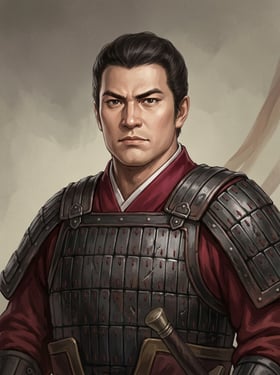
史载(Historical Record)
Cao Hong, styled Zilian, was a cousin of Cao Cao. According to the Book of Wei, his uncle Cao Ding once served as Director of the Imperial Secretariat and appointed Cao Hong as Chief of Qichun. At the end of the Eastern Han, Cao Cao raised troops to attack Dong Zhuo and fought Dong Zhuo's subordinate general Xu Rong at the Bian River near Xingyang; Cao Cao was defeated, struck by a stray arrow, and the horse he rode was wounded. At the critical moment, Cao Hong yielded his own horse to Cao Cao, enabling him to escape through the night. When Cao Cao declined, Cao Hong said: "The realm can do without Hong, but it cannot do without you." Then Cao Hong followed Cao Cao on foot to the Bian River; finding the water too deep to cross, Cao Hong searched along the bank for a boat and crossed the river together with Cao Cao, returning to Qiao County.
Afterward, Cao Hong went to Chen Wen, Inspector of Yangzhou, to recruit troops, obtaining two thousand picked men of Lujiang, and recruited several thousand more in Danyang, joining Cao Cao at Longkang. During Cao Cao's campaign against Xu Province, Zhang Miao rebelled and welcomed Lü Bu. At that time a great famine prevailed; Cao Hong led troops ahead, occupied Dongping and Fan County, and gathered provisions to supply the army. When Cao Cao attacked Zhang Miao and Lü Bu at Puyang and Lü Bu fled in defeat, Cao Hong then occupied Dong'e and fought through more than ten counties—Jiyin, Shanyang, Zhongmou, Yangwu, Jing, Mi, and others—all of which he took. For his successive battle merits, Cao Hong was appointed Colonel of Soaring Hawks, later promoted to General of the Household Who Displays Valor. After Emperor Xian of Han moved the capital to Xu County, Cao Hong was appointed Grandee Remonstrant. He once followed the army in campaigns against Liu Biao, defeating Liu Biao's detached generals at Wuyang, Yinye, Duyang, Bowang, and elsewhere, and for his merit was promoted to General Who Sharpens His Edge and enfeoffed as Marquis of Guoming-ting. Cao Hong followed the army on campaign many times and was finally appointed General Protector-General.
After Cao Pi ascended the throne, Cao Hong was appointed Guard General, later promoted to General of Agile Cavalry, advanced in enfeoffment as Marquis of Yewang, with a thousand households added, totaling two thousand one hundred households together with the former, ranking as Specially Advanced. Later he was reassigned as Marquis of Duyang. Cao Hong's household was wealthy but he was stingy by nature; in his youth Cao Pi had once sought to borrow money from him without success and thus bore him a grudge. After Cao Pi ascended the throne, on the pretext that one of Cao Hong's retainers had broken the law, he had Cao Hong cast into prison and sentenced to death. Although the ministers interceded in many ways, they could not prevail. When Empress Dowager Bian learned of it, she said to Empress Guo: "If Cao Hong dies today, tomorrow I shall command the emperor to depose you." Empress Dowager Bian wept and pleaded repeatedly, and only then was Cao Hong spared death, though he was dismissed from office, stripped of rank, and his property confiscated. Empress Dowager Bian came forward again, and only then was Cao Hong's property returned. After Emperor Ming ascended the throne, Cao Hong was appointed General of the Rear, reassigned as Marquis of Lecheng, with a stipend of a thousand households, ranking as Specially Advanced, and again appointed General of Agile Cavalry. In the sixth year of Taihe (232 CE), Cao Hong died, with the posthumous title Marquis Gong. His son Cao Fu succeeded to the marquisate.
演中(In the Novel)
In Romance of the Three Kingdoms, Cao Hong's image is further shaped, especially highlighting his loyal valor and martial skill. He first appears coming with Cao Ren to aid Cao Cao, described as "well versed in horse and arms, accomplished in martial skill". In the battle of Xingyang, Cao Cao was defeated by Xu Rong, struck by an arrow, his horse felled by a spear. Cao Hong galloped up, hacked down the pursuing soldiers, and rescued Cao Cao. When Cao Cao told him to go on ahead, Cao Hong uttered the famous line "The realm can do without Hong, but it cannot do without you," then stripped off his armor and escorted Cao Cao on foot, dragging his blade. At the river crossing, he even carried Cao Cao on his back across the water, bringing him to safety. This episode greatly strengthens Cao Hong's loyalty to Cao Cao and his spirit of risking his life; the detail of carrying Cao Cao across the river is not clearly recorded in the histories.
Cao Hong took part in many important battles in the Romance. When Cao Cao welcomed Emperor Xian of Han back to Luoyang, Cao Hong and Xiahou Dun divided their forces to intercept Li Jue and Guo Si, greatly defeating the enemy. After Cao Cao pacified the Central Plains, Cao Hong was enfeoffed as a general. On the eve of the Battle of Guandu, Cao Hong was ordered to garrison Guandu. When Yuan Tan attacked Cao Cao, Cao Hong charged the array with valor and slew Yuan Tan with his own hand. Before the Battle of Red Cliffs, Cao Hong was appointed Commissioner Coordinating the Land and Water Routes. After the Battle of Red Cliffs, Cao Hong, on Cao Ren's order, garrisoned Yiling to guard against Zhou Yu. In the Battle of Tong Pass, because Cao Hong rashly advanced in contempt of the enemy, Tong Pass fell, and he was later pursued by Ma Chao; he fought Ma Chao for forty or fifty bouts and finally escaped only because Xiahou Yuan arrived. When Cao Cao campaigned against the Eastern Wu, Cao Hong led thirty thousand armored cavalry to scout to the riverbank.
The Romance also depicts Cao Hong's stingy character and ties it to his feud with Cao Pi. While Cao Pi was in the Eastern Palace, he once sought to borrow a hundred bolts of silk from Cao Hong, who refused. After Cao Pi ascended the throne, on the pretext that one of Cao Hong's retainers had broken the law, he had Cao Hong cast into prison and meant to put him to death. In the end, through the pleading of Empress Dowager Bian and Cao Zhen, Cao Hong was spared death, though he was stripped of office and rank. This episode is largely consistent with the historical record, but the Romance, through the concrete matter of borrowing silk, makes Cao Hong's stingy image all the more vivid. At Cao Cao's deathbed, Cao Hong, as one of the regents entrusted with the heir, was summoned to his bedside to receive his final instructions. When Cao Pi usurped the Han, Cao Hong and Cao Xiu entered the hall bearing swords, forcing Emperor Xian of Han to abdicate, and beheaded the Master of the Imperial Seals, Zu Bi, who refused to hand over the jade seal, displaying his important role in the establishment of the Cao Wei regime.
关键关系
* Cao Cao (kin_of): Cao Hong was Cao Cao's cousin, and the two were close. In Cao Cao's hour of peril, Cao Hong once risked his life to save him, uttering the loyal and righteous words "The realm can do without Hong, but it cannot do without you".
* Cao Wei (serves): Cao Hong was a founding meritorious official of the Cao Wei regime, long following Cao Cao in campaigns and rendering great service to the establishment and consolidation of Cao Wei, rising to General of Agile Cavalry.
* Cao Pi (rival_of): There was bad blood between Cao Hong and Cao Pi. Out of stinginess Cao Hong once refused Cao Pi's request for a loan, leading Cao Pi, after ascending the throne, to take revenge by casting him into prison and meaning to put him to death, until Empress Dowager Bian's pleading spared him death at the cost of his office and rank.
* He Man (fights_in): The historical materials make no direct mention of Cao Hong fighting He Man, but in the Romance Cao Hong fought unfavorably against the Yellow Turban remnants Liu Pi and Gong Du at Runan and once sent urgent word to Cao Cao (novel only).
* Xu Rong (fights_in): In the battle of Xingyang, Cao Hong and Cao Cao were together defeated by Dong Zhuo's subordinate general Xu Rong, and in this battle Cao Hong saved Cao Cao.
* Yuan Tan (fights_in): In the campaign against Yuan Tan, Cao Hong charged the array with valor and slew Yuan Tan with his own hand (novel only).
* Ma Chao (fights_in): In the Battle of Tong Pass, Cao Hong once fought Ma Chao, was pursued by him, and escaped only because Xiahou Yuan arrived (novel only).
* Empress Dowager Bian (kin_of): When Cao Hong was imprisoned by Cao Pi, Empress Dowager Bian came forward many times to plead for him, sparing his life and recovering his property.
标志性场景
* Saving his lord at Xingyang: Cao Cao was defeated by Xu Rong at Xingyang, gravely wounded, his horse felled. Cao Hong yielded his own horse to Cao Cao and escorted him on foot, uttering the loyal and righteous words "The realm can do without Hong, but it cannot do without you," and finally carried Cao Cao on his back across the river to safety. This scene is the classic embodiment of Cao Hong's loyal valor.
* Slaying Yuan Tan: In Cao Cao's battle against Yuan Tan, Cao Hong charged the array with valor and slew Yuan Tan with his own hand, rendering battle merit toward Cao Cao's pacification of Hebei (novel only).
* The fall of Tong Pass and fighting Ma Chao: In the Battle of Tong Pass, Cao Hong's contempt for the enemy caused the pass to fall, and he was later pursued by Ma Chao. Cao Hong fought Ma Chao for forty or fifty bouts and finally escaped only with Xiahou Yuan's rescue (novel only).
* Imprisoned by Cao Pi: Because in earlier years Cao Hong's stinginess made him refuse Cao Pi's loan, after Cao Pi ascended the throne he was cast into prison on the pretext that a retainer had broken the law and sentenced to death. In the end, only Empress Dowager Bian's firm protection spared him death, though he was stripped of office and rank. This event reveals the flaw in Cao Hong's character and his complex relationship with Cao Pi.
* Forcing Emperor Xian to abdicate: When Cao Pi usurped the Han, Cao Hong and Cao Xiu entered the hall bearing swords, forcing Emperor Xian of Han to abdicate, and beheaded the Master of the Imperial Seals, Zu Bi, who refused to hand over the jade seal, displaying his hardline stance in the establishment of the Cao Wei regime (novel only).
Portrait file
Character profile
- Character
- Cao Hong was practiced with horse and troops and accomplished in the martial arts. He once risked his own life to shield his lord, saying, "The realm may do without Hong, but it cannot do without you, my lord." Cao Hong was impatient by temperament; Cao Ren once appraised him, saying, "Hong is hasty by nature—I truly fear he will botch the matter."
- Life
- Cao Hong was Cao Cao's younger cousin, who in his early years raised troops and joined up with Cao Cao. He repeatedly followed the army on campaign, was appointed Colonel Who Displays Hawk-like Might, promoted to General of the Household Who Displays Martial Prowess, and later rose to General of Agile Cavalry. Though his household was wealthy, Cao Hong was miserly by nature, and was once imprisoned when a retainer he had sheltered broke the law, after which he was dismissed from office and stripped of his title. After Emperor Ming ascended the throne, Cao Hong was reinstated as General of Agile Cavalry, and died in the sixth year of Taihe with the posthumous title Marquis Gong.
- Weapons
- saber
- Anecdotes
- Cao Hong was Cao Cao's younger cousin, and at the defeat at Xingyang he yielded his horse to save Cao Cao. He was left to guard Guandu, and at first doubted Zhang He when he came to surrender. Cao Hong was a noble kinsman of the imperial house; when his retainer broke the law, Man Chong once arrested and prosecuted him.
Relationships
18 relationships
Quotes
17 recorded lines · 3 featured
「勿傷吾主!曹洪在此!」
This line shows Cao Hong loyally and bravely shielding his lord, a classic portrayal of his character.
「袁熙、袁尚兵敗將亡,勢窮力盡。遠投沙漠。我今引兵西擊,倘劉備、劉表乘虛襲許都,我救應不及,為禍不淺矣。請回師勿進為上。」
These words reflect Cao Hong's strategic vision, exerting an important influence on Cao Cao's decisions.
「巴西守將張飛,非比等閒,不可輕敵。」
In this line Cao Hong warns Zhang He not to underestimate the enemy, showing his clear-eyed assessment of the opposing general.
Chapters29 回 ▸
- 史ch.1ch.9ch.15ch.17ch.25
- 演ch.5ch.6ch.12ch.14ch.17ch.22ch.24ch.26ch.32ch.33ch.40ch.41ch.48ch.50ch.51ch.56ch.57ch.58ch.61ch.69ch.70ch.71ch.78ch.80
Relationship timeline13 条 ▸
史 ch.1
- Cao Cao§7
kin_of
从弟以马与太祖
史 ch.9
演 ch.5
- Cao Cao§4
kin_of
曹氏从弟,引兵千余来助
演 ch.6
- Cao Cao§8
commands_in
救起伤主曹操,让马护行渡水
演 ch.12
- He Man§15
fights_in
用拖刀背砍计斩何曼于马下
演 ch.14
- Cao Cao§13
kin_of
称曹操为「臣兄」;引李典、乐进倍道而来助驾
演 ch.22
- Cao Cao§20
witnesses
报陈琳檄文出处
演 ch.33
- Yuan Tan§18
fights_in
奋威突阵,正迎袁谭,举刀乱砍,谭被杀于阵中
演 ch.58
- Ma Chao§19
fights_in
山坡边出,攔住马超四五十合救曹操得脱
演 ch.61
- Cao Cao§43
commands_in
先差领三万铁甲马军哨至江边
演 ch.80
rival_of
带剑入殿,逼帝出,索玉玺
- Zu Bi§4
enemy_of
索玉璽不得,喝令武士推出斩之
Inner monologues · AI-generated3 段 ▸
- I am Cao Hong, courtesy name Zilian. Now, in my twilight years, as I look back on my life, I often think of how, in my y
- I am Cao Hong, courtesy name Zilian, a younger cousin of the Grand Ancestor. I remember when our army was defeated at Xi
- My courtesy name was Zilian. My family had lived for generations in Qiao County, and in my youth, all I heard about were
Life events9 ▸
- 0189-01-01 · ChenliuCao Cao Raises an Army· Warrior
- 0196-01-01 · XuchangCao Cao Receives the Emperor and Establishes the Capital at Xu· Warrior
- 0201-01-01 · CangtingBattle of Cangting· Warrior
- 0208-01-01 · JianglingBattle of Jiangling· Warrior
- 0208-01-01 · XinyeBurning of Xinye· Warrior
- 0209-01-01 · YilingGan Ning's Capture of Yiling· Warrior
- 0210-01-01 · YeBronze Bird Terrace Inauguration Ceremony· Warrior
- 0211-01-01 · Tong PassXu Chu Fights Ma Chao Bare-Chested· Warrior
- 0220-01-01 · LuoyangDeath of Cao Cao· Witness