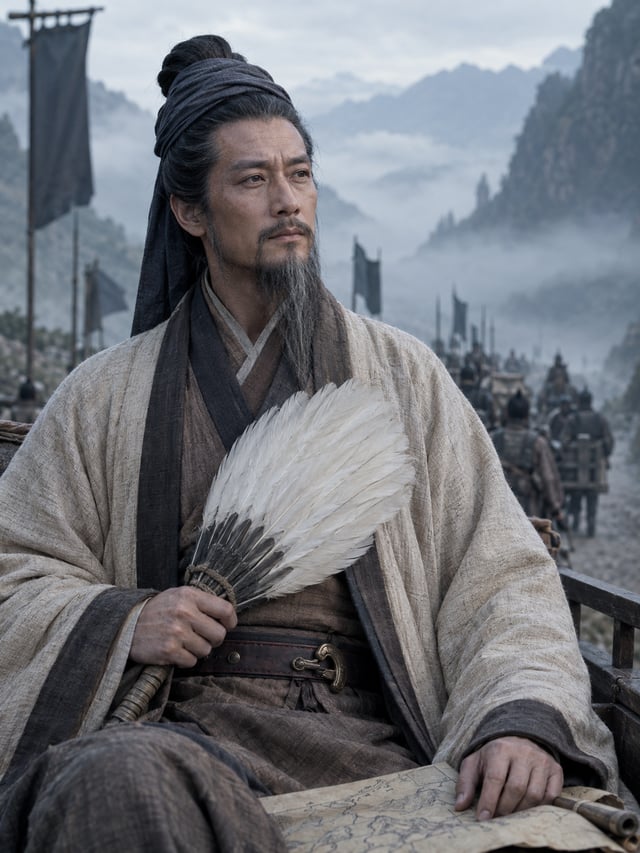
The life of Zhuge Liang
「They say your plans never miss a thing. At those turning points, in his place, what would you choose?」
Zhuge Liang, Shu Han's chancellor, was famed for governance and campaigns; the novel highlights his Longzhong strategy.
Zhuge Liang's profile →One scene per chapter, and you are him. Underlined lines come from the books (green: Records of the Three Kingdoms, gold: the Romance); tap one to see the source. Lines without an underline connect the scenes or imagine them. At each fork you choose first, then see what he did.
Three Visits
You lose your father young, and follow your uncle Zhuge Xuan to Jing Province, where you seek refuge with Liu Biao. After your uncle dies, you till the fields and are fond of chanting the Song of Liangfu (Liangfu Yin).
Your home is in Deng County, Nanyang, twenty li west of Xiangyang, in a place called Longzhong. You are eight chi tall and often compare yourself to Guan Zhong and Yue Yi, though none of your contemporaries grant the claim. Only Cui Zhouping of Boling and Xu Shu of Yingchuan believe in you.
You travel and study with Shi Guangyuan, Xu Yuanzhi, and Meng Gongwei. The three of them strive for mastery of every detail; you take in only the broad outlines. At dawn and in the evening, you often clasp your knees and whistle long and loud, telling them: “The three of you may rise to become provincial inspectors or commandery governors.” They ask how far you might rise. You only smile and say nothing.
Meng Gongwei wants to return north. You tell him: “The Central States abound in scholar-officials. Why must your travels take you home?” In the end, he goes north all the same, and rises to prominence in Wei.
This year, Liu Bei is stationed at Xinye. Xu Shu goes to see him, and Liu Bei esteems him greatly. Xu Shu tells him: “Zhuge Kongming is a Sleeping Dragon. Would the general care to meet him?” He says: “Bring him with you.” Xu Shu replies: “This is a man you may visit, but cannot summon. The general should make the journey to see him.” Liu Bei has also asked Sima Hui (Decao), who tells him: “Here there are a Crouching Dragon and a Young Phoenix.”
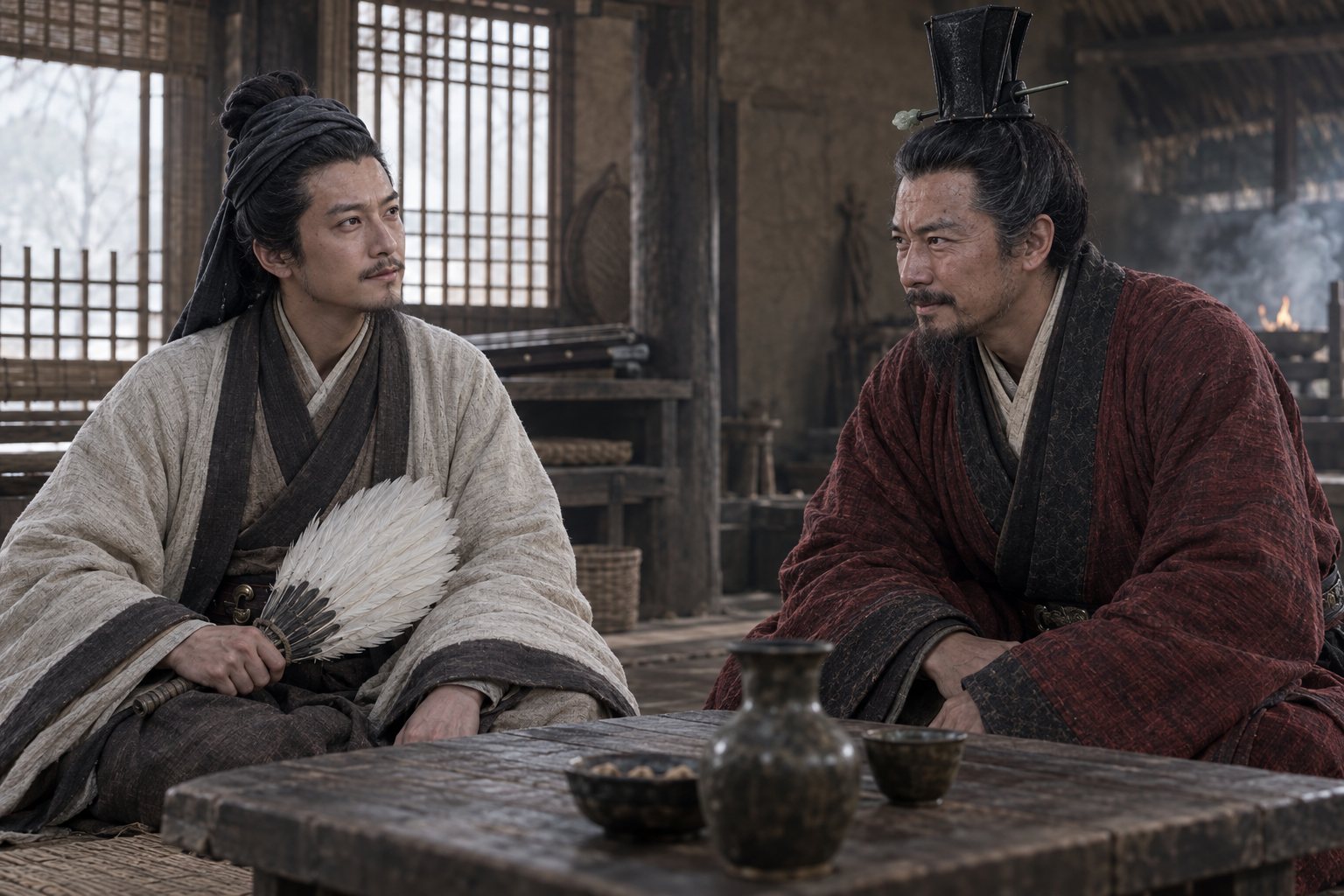
He comes three times before he sees you. In the Romance, on his third visit, you are asleep in the thatched hall at midday, and he stands below the steps with his hands clasped, waiting there for another two hours. You wake and recite: “Who first awakens from the great dream? All my life I have known it.”
He dismisses his attendants and says: “The Han house is in decline, treacherous ministers steal its mandate, and the sovereign is in exile.” He says that his own wisdom and skill are limited, and he has suffered defeat after defeat: “Yet my resolve remains. What plan do you think I should pursue?”
You have thought over these matters for many years among the fields. Of Cao Cao, you say: “Cao Cao now commands a million men and holds the Son of Heaven to command the feudal lords. Truly, he cannot be challenged. Sun Quan has held Jiangdong for three generations. Its terrain is perilous, its people are loyal, and its worthy men serve him. He may be an ally, but his lands cannot be taken.”
Of Jing Province, you say: “Jing Province is bounded by the Han and Mian rivers to the north, draws all the wealth of the southern seas, links eastward to Wu and Kuaiji, and connects westward to Ba and Shu. It is a land of military importance, but its ruler cannot hold it. Surely Heaven means it as a gift to the general. Does the general desire it?” Of Yi Province, you say: “Yi Province is rugged and defensible, with a thousand li of fertile fields. It is a land of abundance, and Emperor Gaozu relied on it to establish his imperial rule.”
At last you say: “If you can hold Jing Province and Yi Province, secure their natural defenses, make peace with the western tribes, pacify the Yi and Yue in the south, forge ties with Sun Quan abroad, and put your government in order at home; when change comes in the realm, then send a senior general to lead the army of Jing Province toward Wan and Luo, while you yourself lead the forces of Yi Province out through Qinchuan. Who among the common people would dare not greet you with baskets of food and jars of drink? If it is done this way, your hegemonic cause can be achieved, and the Han house can be revived.”
He says: “Good!” In the Romance, he then bows to you: “Though my name is obscure and my virtue slight, I hope, sir, you will not scorn my humble state, but come forth from your retreat to aid me.”
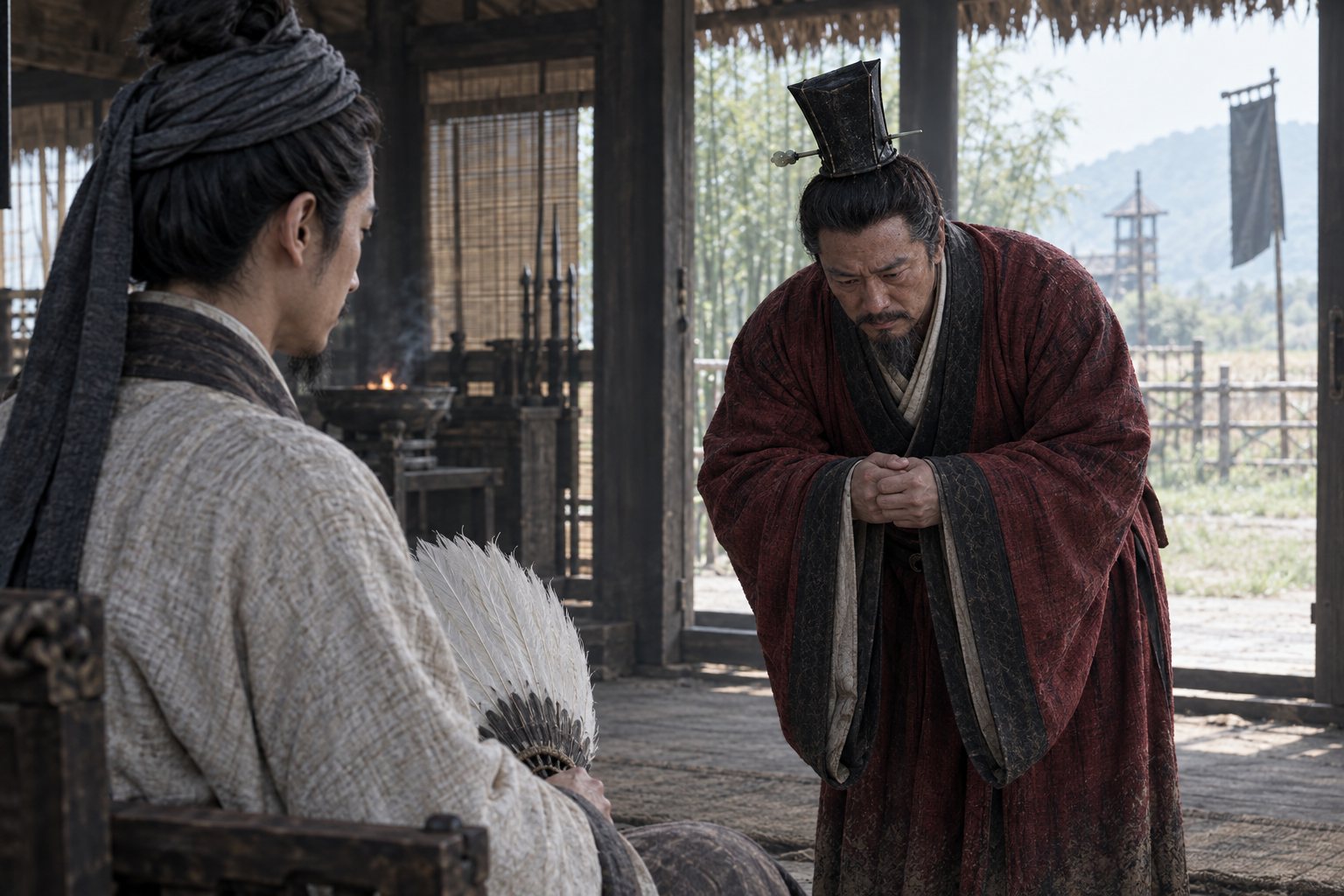
He bows before you, waiting for a word. What do you say?
Moved by his sincerity, you agree to serve him.
The next day, your younger brother Zhuge Jun returns, and you tell him: “I have received three visits from Imperial Uncle Liu, and cannot refuse to serve him. You may till the fields here yourself; do not let them lie fallow. On the day my work is done, I shall come back to live in seclusion.”
You look over those few mu of fields once more.
From then on, his bond with you grows ever closer. Guan Yu and Zhang Fei are displeased, and he tells them: “With Kongming, I am like a fish with water. I hope you will say no more.”
The man who visits three times → Read Liu Bei's story →
The Moment of Victory or Defeat
Liu Qi, Liu Biao’s eldest son, also thinks highly of you. He takes you up to a high tower for a banquet, then has the ladder removed, and asks how to keep himself safe. You answer: “Have you not seen how Shen Sheng was in danger at home, while Chong'er was safe abroad?” He then leaves to become the Administrator of Jiangxia.
Not long after, Liu Biao dies. When Liu Cong hears that Cao Cao is coming to attack, he sends an envoy to surrender. As you pass Xiangyang, you urge Liu Bei to attack Liu Cong; Jing Province could be his. He says: “I cannot bear to do it.”
Cao Cao’s army catches up with you at Changban, Dangyang, and Liu Bei abandons his wife and children and flees with you, Zhang Fei, Zhao Yun, and several dozen horsemen. Cao Cao’s army captures Xu Shu’s mother. Pointing to his heart, he bids Liu Bei farewell: “Now that I have lost my aged mother, my mind is in turmoil. I can be of no use to you. Please let me take my leave here.”
Lu Su of Jiangdong arrives at Changban to meet you. Seeing you, he says, “I am a friend of Ziyu,” and at once you become friends. Ziyu is your elder brother, Zhuge Jin, who serves Sun Quan.
When you reach Xiakou, you say to Liu Bei: “The situation is urgent. Please let me go seek aid from General Sun.”
Sun Quan has troops at Chaisang and watches to see who will prevail. Outside Chaisang, the river is quiet.
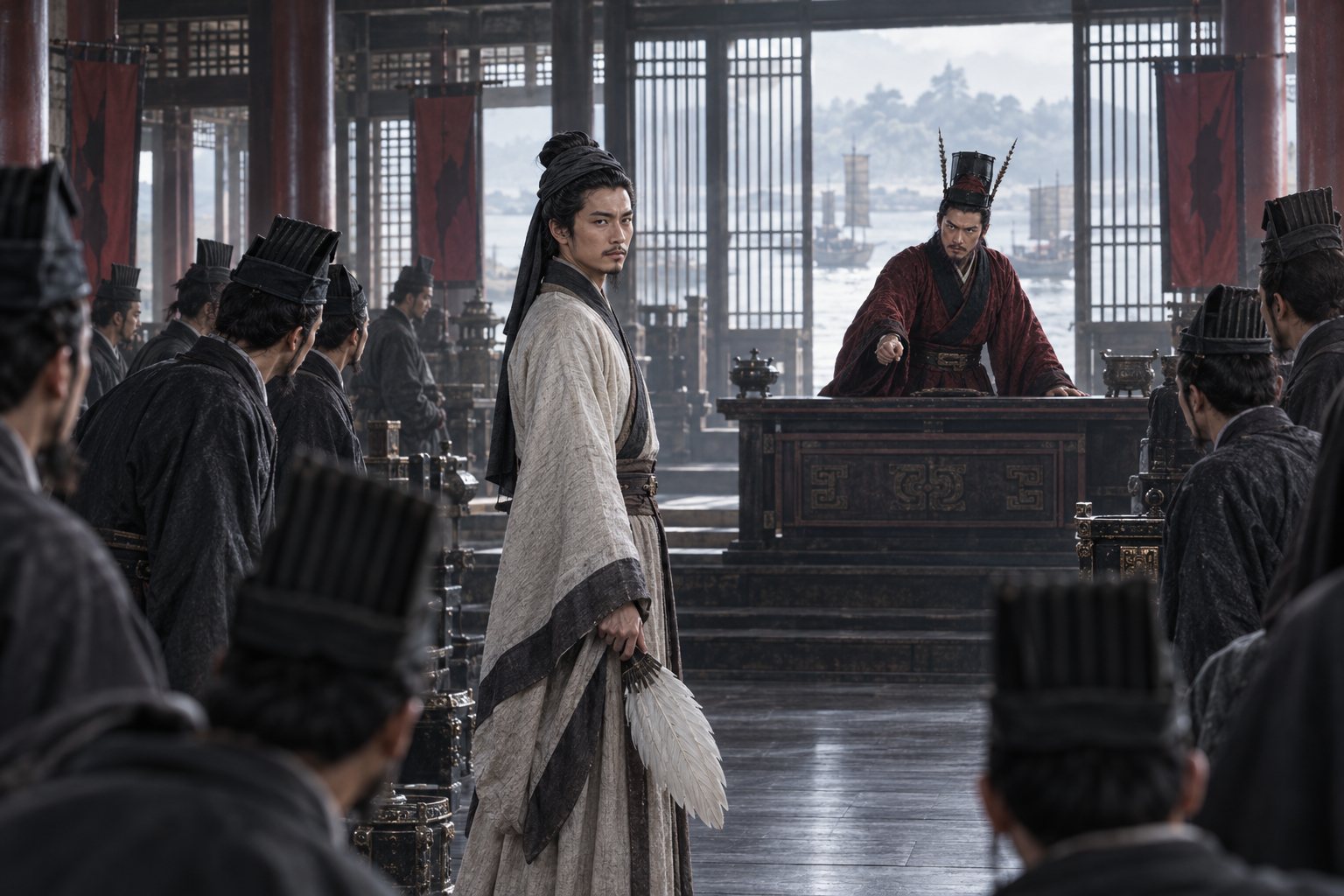
In the Romance, you first enter the tent, and meet Zhang Zhao, Gu Yong, and more than twenty civil and military officials. Zhang Zhao opens with a question: “I have long heard that you live in seclusion at Longzhong and compare yourself to Guan Zhong and Yue Yi. Is this truly what you say?” You reply: “That is a modest comparison I, Liang, have long made.”
Then you meet Sun Quan. The Romance describes him as “blue-eyed and purple-bearded, with a fine and imposing bearing”. He asks you: “If he means to swallow us up, whether to fight or not to fight—please decide for me.”
You do not ask him for help. You say: “The realm is in great disorder. The general has raised troops and taken possession of Jiangdong. Lord Liu of Yuzhou has also gathered men south of the Han and contends with Cao Cao for the realm. Now Cao Cao has eradicated great troubles and more or less pacified the land. He has then taken Jing Province, and his might shakes the four seas. Heroes have nowhere to put their strength. So Lord Liu of Yuzhou has fled here.”
“General, judge your strength and act accordingly. If you can pit the people of Wu and Yue against the Central States, then you should break with him at once. If you cannot withstand him, why not lay down your arms, bind up your armor, and face north to serve him? Now you claim outwardly to submit, while inwardly you hesitate. The crisis is urgent, yet you cannot decide. Disaster is at hand!”
He fixes his gaze on you: “If things are as you say, why does Lord Liu of Yuzhou not simply submit to him?”
You say: “Tian Heng was merely a stalwart of Qi, yet he upheld his principles and would not suffer disgrace. How much more so Lord Liu of Yuzhou, scion of the imperial house, whose talent surpasses his age and whom men admire, as waters flow back to the sea. If the undertaking does not succeed, that is Heaven’s will. How could he ever again serve beneath another?”
Sun Quan suddenly rises in anger: “I cannot take the whole land of Wu and a hundred thousand men and submit to another’s control. My decision is made!” He asks again: “No one but Lord Liu of Yuzhou can stand against Cao Cao. But after his recent defeat, how can he withstand this threat?”
Only then do you lay out the figures: Though Lord Liu’s army was defeated at Changban, the surviving soldiers, together with Guan Yu’s naval force, number ten thousand seasoned troops; Liu Qi’s men in Jiangxia number no fewer. “Cao Cao’s forces have come from afar and are exhausted. In pursuit of Lord Liu, his light cavalry covered more than three hundred li in a day and a night. This is what they call ‘an arrow at the end of its flight cannot pierce even thin silk.’” “Moreover, men from the north are not practiced in naval warfare.” “The key to victory or defeat lies in this very day.”
Sun Quan is greatly pleased. He immediately sends Zhou Yu, Cheng Pu, Lu Su, and others with thirty thousand naval troops to accompany you to Liu Bei and join forces against Cao Cao.
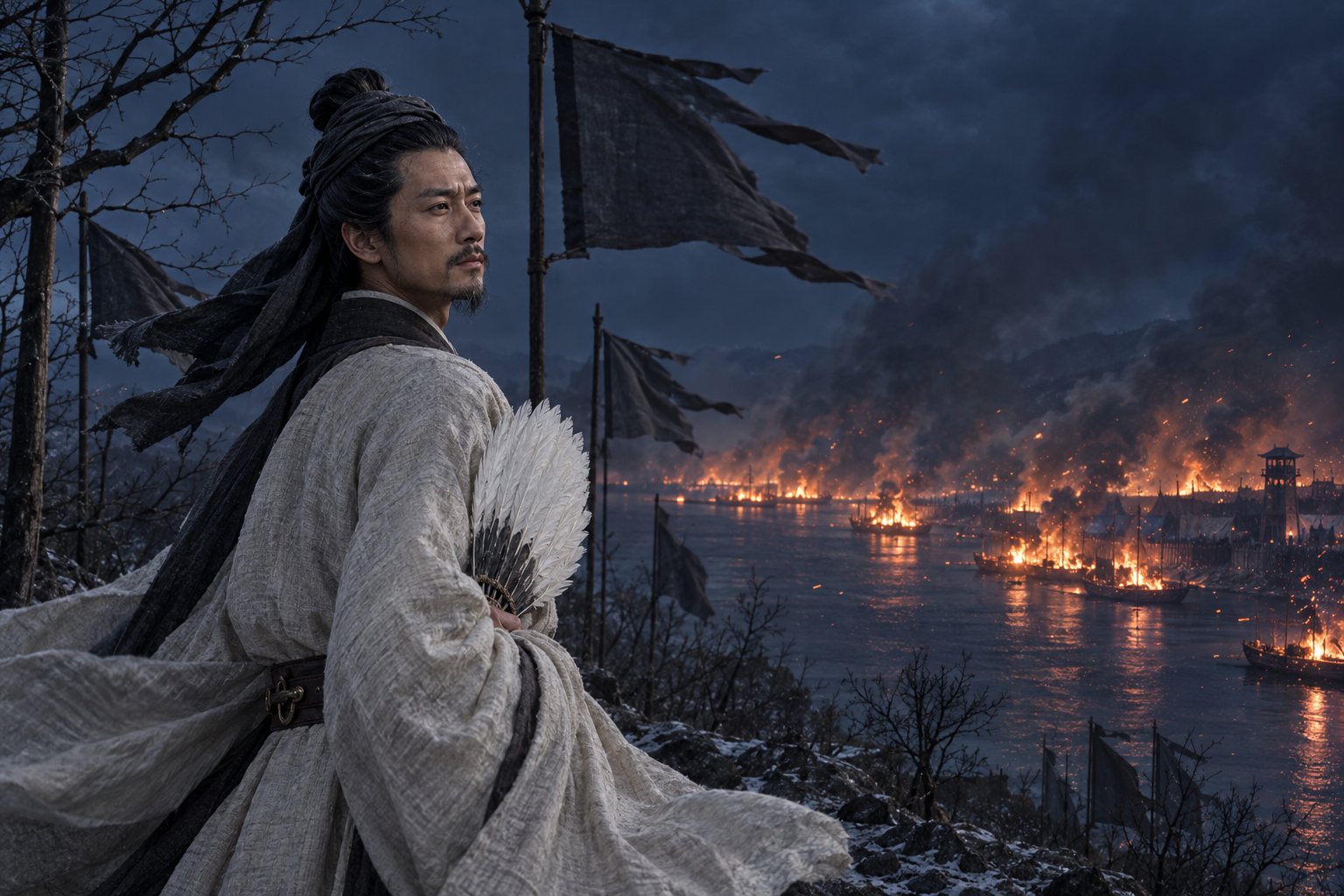
That winter, the southeast wind blows hard. Cao Cao is defeated at Chibi and leads his army back to Ye. Liu Bei takes the lands south of the Yangtze and appoints you General of the Household Who Assists the Army, in charge of Lingling, Guiyang, and Changsha. You collect their taxes to supply the army.
The man north of the river → Read Cao Cao's story →
Eight Words
In the sixteenth year of Jian'an, Liu Zhang, Governor of Yi Province, sends Fa Zheng to welcome Liu Bei and ask him to attack Zhang Lu. You and Guan Yu stay behind to guard Jing Province. The strategist who goes west with Liu Bei is another man Sima Hui once spoke of: Young Phoenix, Pang Shiyuan.
Later, Liu Bei turns back from Jiameng and attacks Liu Zhang, advancing to besiege Luocheng.
In the Romance, you and Guan Yu are sitting together when someone reports that Guan Ping has arrived. He presents Liu Bei’s letter: “On the seventh day of the seventh month this year, Zhang Ren shot Military Adviser Pang dead with an arrow in front of the Valley of the Fallen Phoenix.”
You weep bitterly, and all the officials shed tears. In the Records of the Three Kingdoms, he is below Luocheng leading his men in an assault on the city when he is struck by a stray arrow, aged 36.
You say: “With the lord at Fuguan, caught between advance and retreat, I have no choice but to go.” Guan Yu asks: “If the strategist goes, who will guard Jing Province? Jing Province is a vital place, and the stakes are high.”
The letter does not give this man’s name. You say: “Though the lord’s letter does not name him, I know what he means.” He has sent Guan Ping with the letter, meaning that Lord Yunchang should take on this great responsibility.
You remember what you said that day in Longzhong: then appoint a senior general to lead the Jing Province army toward Wan and Luo. You did not say who that general was.
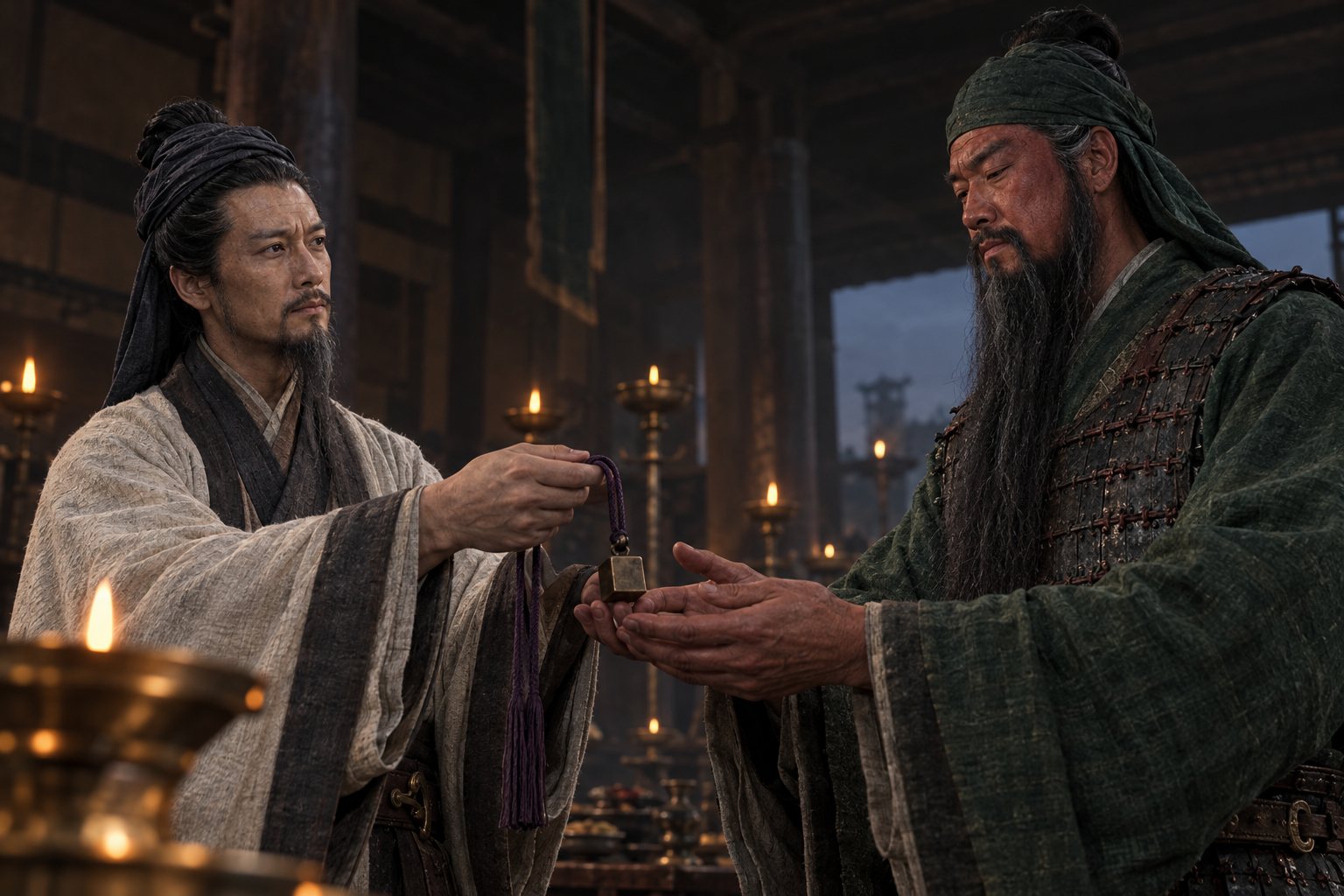
You hold a banquet and hand over the seals and ribbons; he reaches out with both hands to take them. You hold up the seal and say: “The whole responsibility rests with you, General.” He says: “Now that a man has taken on a great responsibility, he does not stop until death.”
You hear him say the word “death,” and feel displeased; you want to take the seal back, but the words have already left your mouth.
You ask: “What if Cao Cao brings his army here?” He says: “We repel him by force.” You ask again: “What if Cao Cao and Sun Quan both raise their armies?” He says: “We divide our forces and repel them.”
“If so, Jing Province is in danger. I have eight words for you, General. Keep them in mind, and you can hold Jing Province.”
“Keep Cao Cao at bay in the north; make peace with Sun Quan in the east.”
He says: “I will engrave the strategist’s words on my heart.” A river breeze blows in through the door. The ribbon on the seal stirs.
You lead Zhang Fei, Zhao Yun, and the others upstream, pacifying the commanderies and counties, and join Liu Bei in besieging Chengdu. Chengdu is pacified; you become General Military Adviser and take charge of the office of the General of the Left. When Liu Bei is away, you often remain in Chengdu to keep the troops fed and supplied.
Liu Bei appoints Guan Yu to oversee the affairs of Jing Province.
He guards Jing Province; you guard Chengdu. The Three Gorges lie between you.
You May Take It Yourself
The officials submit a memorial proposing Liu Bei as King of Hanzhong. Sun Quan takes Jiangling by surprise, and sends a general to behead Guan Yu and his son at Linju. Jing Province is lost.
The officials urge Liu Bei to take the imperial title, but he refuses. You tell him what Geng Chun said to Emperor Guangwu: “The heroes of the realm look to you, hoping for something. If you do not heed their counsel, the officers and gentlemen will each go home to seek another lord, and none will follow you.” He takes the throne and appoints you chancellor.
He means to campaign east against Sun Quan and avenge Guan Yu; most of his ministers remonstrate, but he listens to none of them. Lu Yi (Lu Xun) defeats his great army at Xiaoting, and he retreats by the mountain road to Yufu, renaming Yufu County Yongan. You sigh: “If Fa Zheng were here, he could have restrained the ruler and kept him from going east; even if he had gone east, he would not have fallen into such peril.”
In spring, in the third year of Zhangwu, he falls gravely ill at Yongan and summons you from Chengdu. In the second month, you arrive at Yongan.
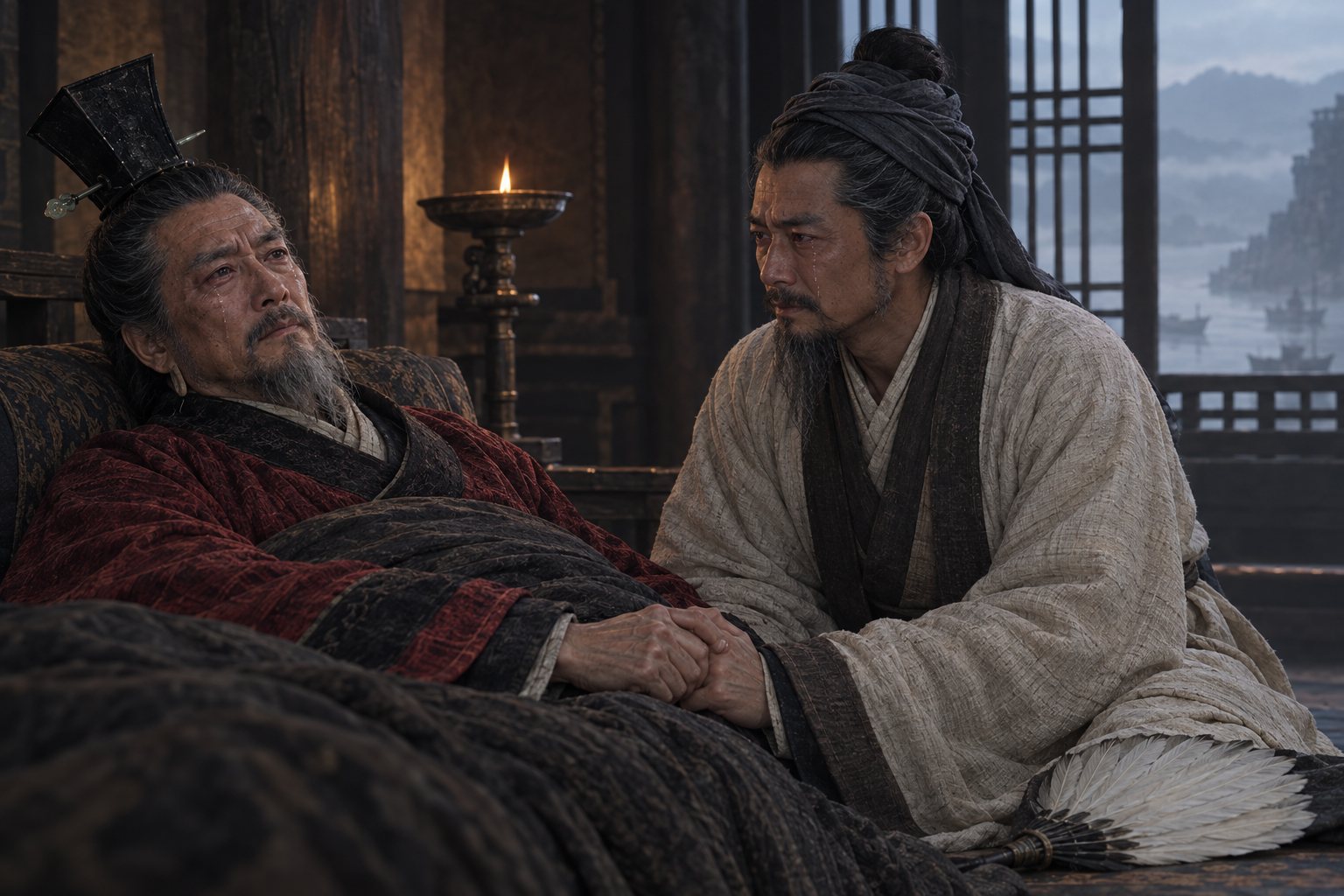
In the Romance, you see him near death and hastily kneel beneath the dragon bed. He asks you to sit beside the bed and strokes your back: “Since I gained you, Chancellor, I have been fortunate enough to achieve the imperial enterprise. Who could have expected that my shallow understanding would keep me from heeding your advice, and bring this defeat upon me? Regret has made me ill; I shall die before long.”
He looks around, sees Ma Su nearby, and tells him to step out for a while. Then he asks what you think of Ma Su’s abilities. You say: “This man is also an outstanding talent of our age.”
He says: “Ma Su’s words exceed his deeds. He must not be entrusted with major responsibilities. You must be watchful!” You remain unconvinced.
He entrusts the young ruler to you, with Li Yan, the Director of the Imperial Secretariat, as your deputy. Then he says: “Your talent is ten times Cao Pi’s. You can surely bring peace to the state and accomplish the great undertaking. If my heir can be assisted, assist him; if he is not fit, you may take the throne yourself.”
No other sound fills the hall. The river murmurs below the city.
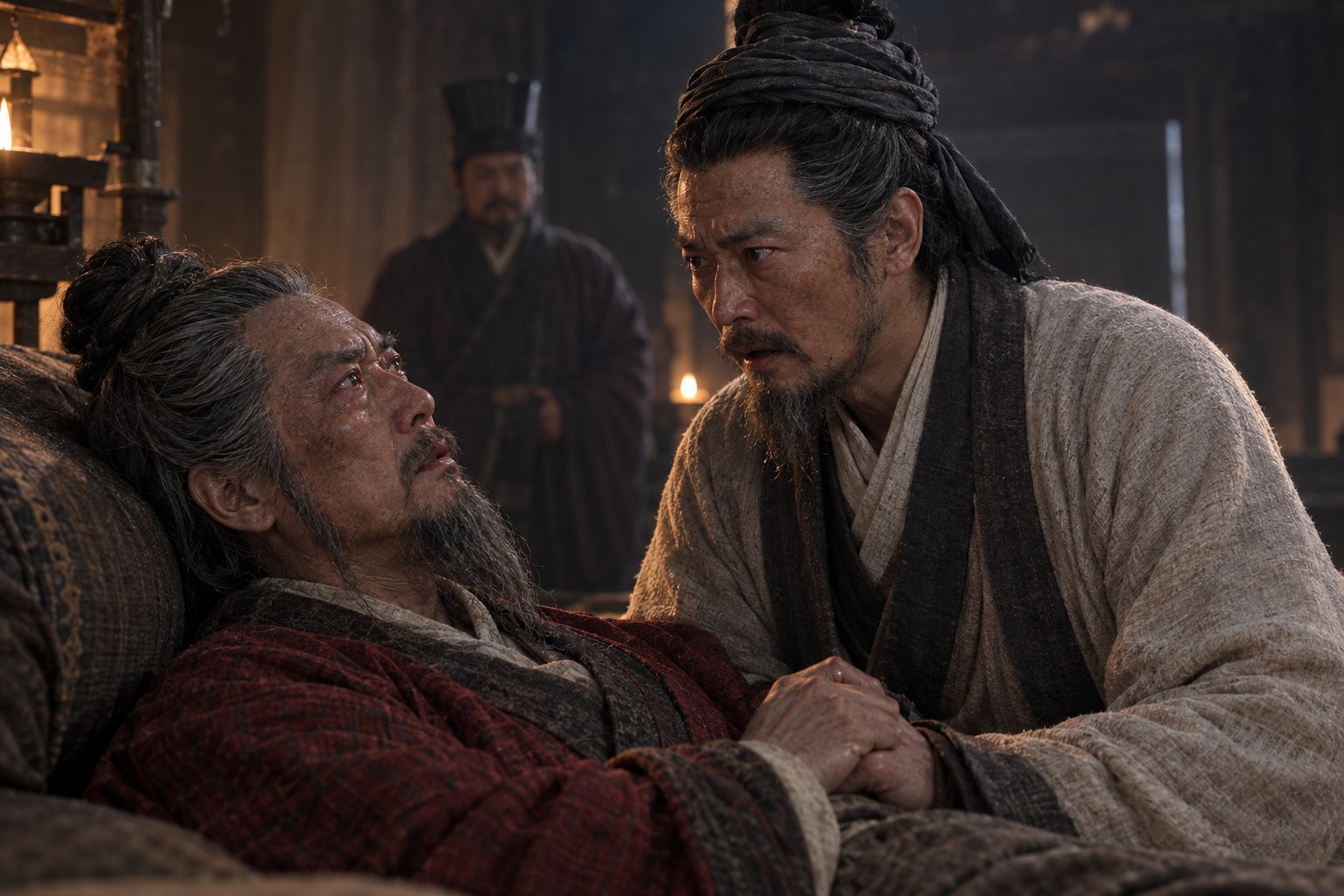
He holds your hand and waits for your answer.
“I pledge all the strength of my limbs and organs, and the full measure of my loyalty, unto death!” In the Romance, you knock your head until it bleeds.
He then issues an edict to the crown prince: “You are to work with the chancellor and serve him as your father.” The edict also says: “Do not do a wrong because it seems small; do not fail to do a good because it seems small.”
In summer, in the fourth month, he dies at Yongan Palace, aged 63.
You remember the thatched cottage at Longzhong, and the way he rose and bowed to you. Sixteen years have passed.
the man who entrusts his heir to you → Read Liu Bei's story →

Winning Hearts
In the first year of Jianxing, you are enfeoffed as Marquis of Wuxiang and establish an office to conduct state affairs; before long, you also assume the post of Governor of Yi Province. All affairs of state, great and small, are decided by you.
All the commanderies of Nanzhong have rebelled. Since you have recently suffered a great bereavement, you do not send troops at once. First, you send envoys to make peace with Wu.
In spring, in the third year of Jianxing, you lead an army south on campaign. Ma Su comes to see you off, accompanying you for dozens of li. You say: “Though we have planned together for years, I ask you now for one more piece of good advice.”
He says: “Nanzhong relies on its remoteness and rugged terrain, and has long refused to submit. Though we defeat it today, it will rebel again tomorrow.” He adds: “In the way of using troops, winning hearts is best, taking cities is lesser; a battle of hearts is best, a battle of arms is lesser. I hope you will win their hearts.”
The late emperor said his words exceeded his deeds. But these words are ones you can take to heart. You accept his counsel.
In the fifth month, you cross the Lu River and press deep into the uncultivated lands. Heat from the river valleys clings to your armor; the horses pant all day.
You reach Nanzhong, and win battles wherever you go. You hear that Meng Huo is respected by the Yi and Han, and offer a reward for his capture alive.
After capturing him, you lead him through the camp formations, and ask: “What do you think of this army?”
He says: “Before, I did not know your strengths and weaknesses, and so I was defeated. Now, thanks to your favor, I have been allowed to see your camp formations. If this is all there is to them, then I can surely defeat you easily.”
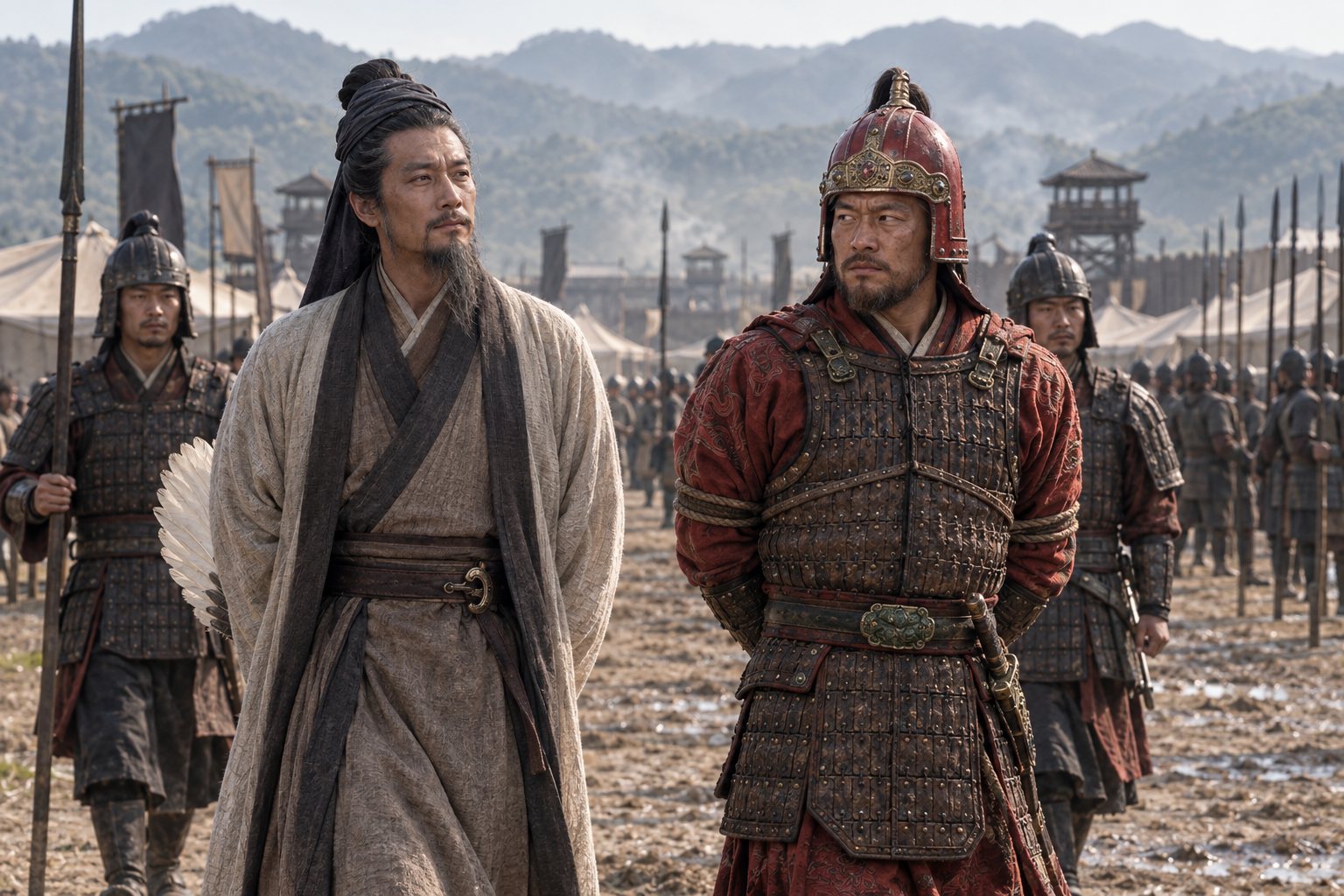
He says that if he fights again, he will surely win. What do you do?
You let him fight again. Seven times you release him, seven times you capture him, and still you let him go.
This time he will not go: “My lord, your heavenly might is manifest. The people of the south will never rebel again.”
You travel as far as Dian Lake. Once Nanzhong is pacified, you appoint its former local chiefs. When someone urges you otherwise, you say: “Now I want to leave no troops behind and transport no grain, while bringing some order to the administration and some peace to the Yi and Han.”
By autumn, the whole region is pacified. The region yields supplies for the army, and the state grows rich.
The County in Peril
After pacifying Nanzhong, you drill the troops and study the arts of war, awaiting a major campaign.
In the fifth year of Jianxing, you lead the armies north and garrison Hanzhong. Before you leave, you submit a memorial.
You write: “The late emperor had not completed half his enterprise when he died midway. Now the realm is divided in three, and Yi Province is worn out. This is truly a time of crisis, when survival or ruin hangs in the balance.”
You write that the affairs of the palace are entrusted to the Palace Attendants and Gentlemen-in-Attendance Guo Youzhi, Fei Yi, Dong Yun, and the others, and the affairs of the camp to General Xiang Chong. You write: “Be close to worthy ministers and keep petty men at a distance: this is why the Former Han flourished. Be close to petty men and keep worthy ministers at a distance: this is why the Later Han declined.”
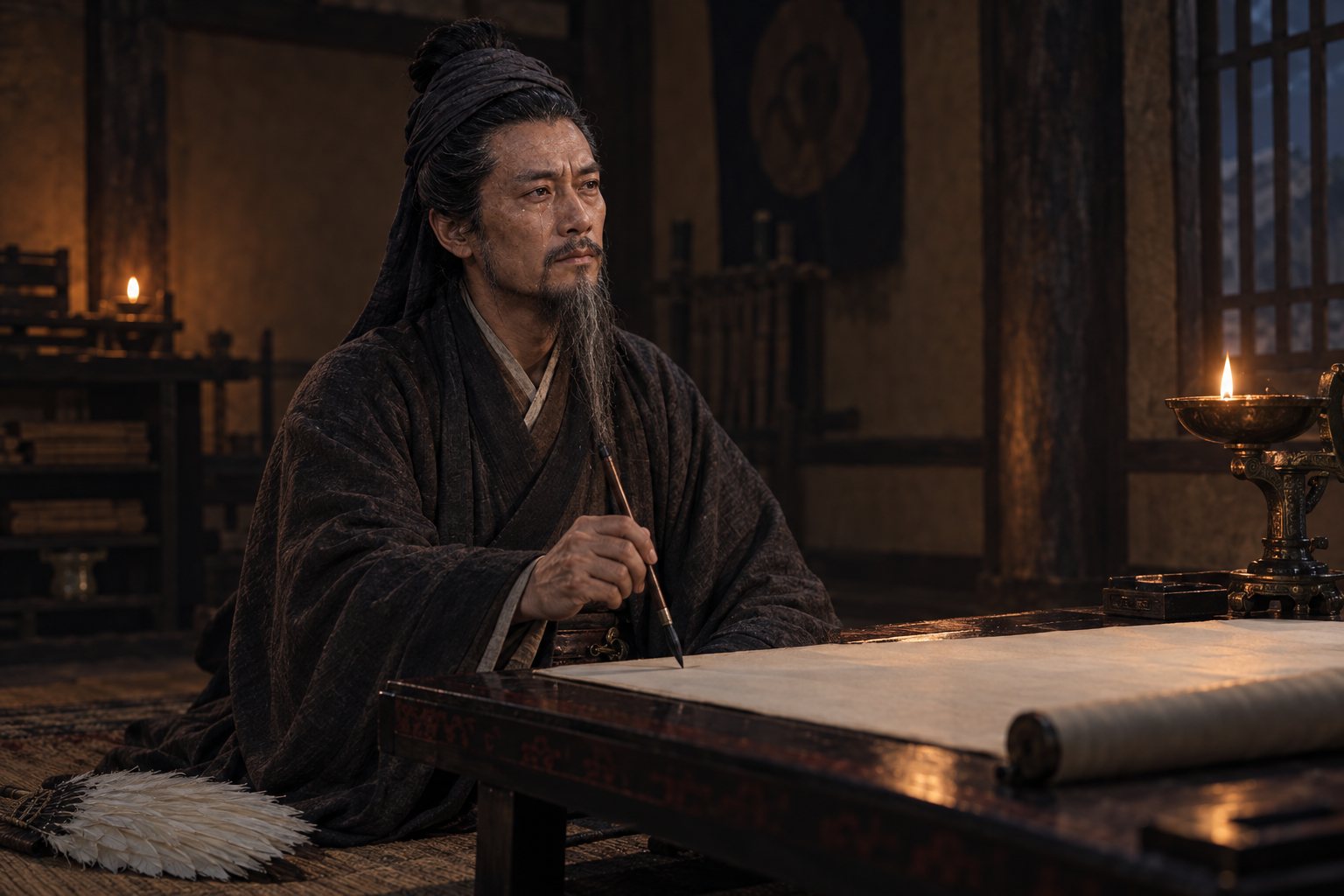
When you write of yourself, your brush pauses. “I was originally a commoner, tilling the fields in Nanyang, seeking only to preserve my life in a troubled age and not to win a name among the lords. The late emperor did not consider me lowly and unworthy, but humbled himself and visited me three times in my thatched cottage, seeking my counsel on the affairs of the age. Grateful for this, I agreed to serve the late emperor.”
“Later, when disaster struck, I received my appointment amid the defeat of our army and took up my charge in a time of danger. It has been twenty-one years since then.” “The late emperor knew me to be cautious, and so, on the eve of his death, entrusted me with great matters.”
“Now I am about to depart on a distant campaign. As I face this memorial, tears fall, and I do not know what to say.”
You set out and garrison at Mianyang. As you discuss strategy with the generals at Nanzheng, Wei Yan says: “I hear Xiahou Mao is young, the emperor’s son-in-law, timid and without strategy. Give me five thousand picked troops and five thousand men carrying grain. I will go straight out from Baozhong, follow the Qinling eastward, and turn north along the Ziwu road. In no more than ten days, I can reach Chang'an.”
He says that Xiahou Mao on hearing that Wei Yan has suddenly arrived, will surely flee by boat; while you, coming by the Xie Valley, will surely arrive in time. “In this way, we can secure everything west of Xianyang in a single stroke.”
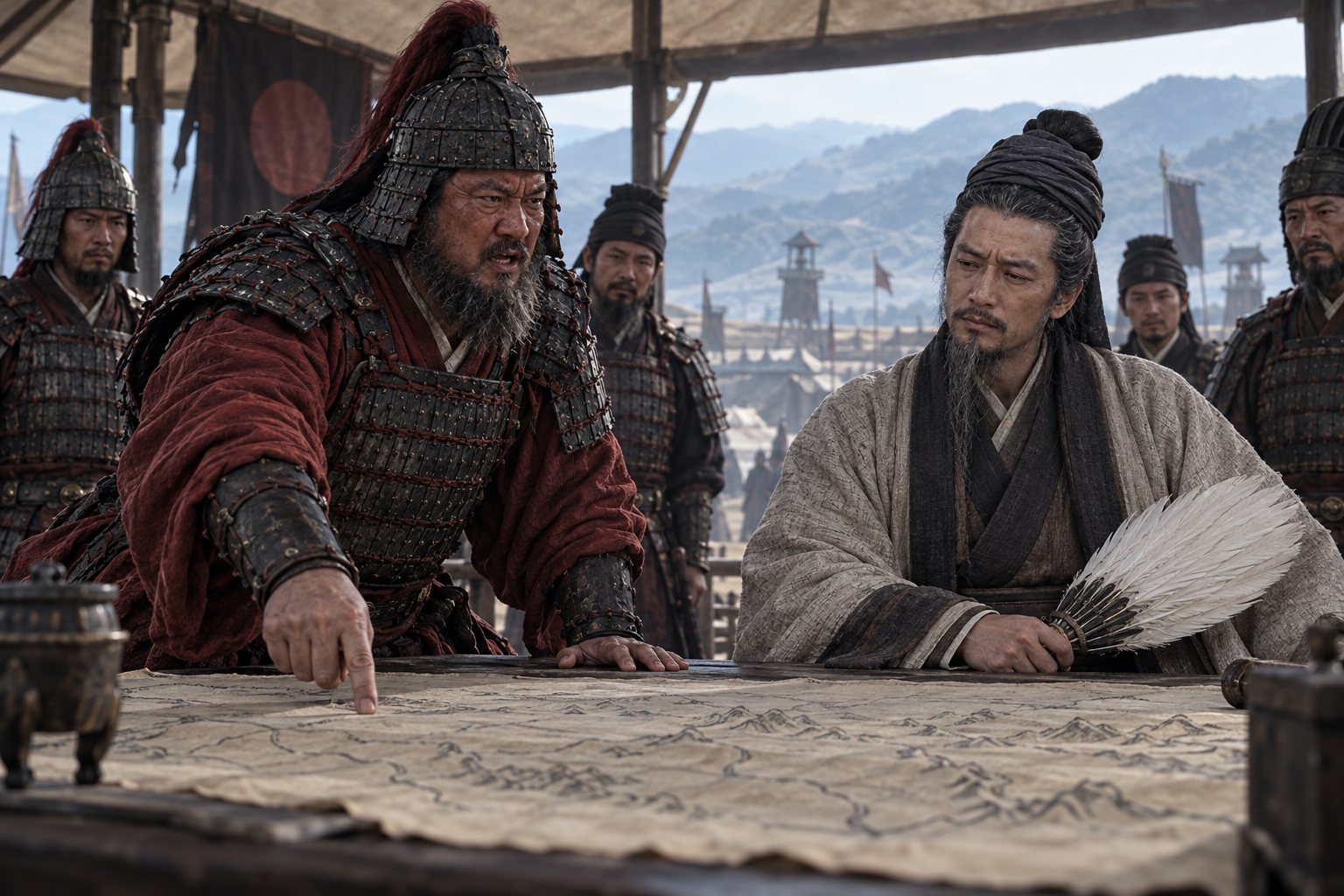
Everyone in the tent is watching you. The Ziwu Valley, or Longyou?
You judge this plan too dangerous. Better to take the broad, level road, secure Longyou steadily, and win with certainty and no risk. So you do not use his plan.
Wei Yan often says that you are timid and resents that his talents are not fully used. In the Romance, he is displeased and resentful.
You wrote it in your memorial: the late emperor knew me to be cautious.
Promoting Ma Su Against All Advice
In spring, in the sixth year, you announce that you will take the road through Xie Valley to Mei, and send Zhao Yun and Deng Zhi to hold Jigu as a feint. Wei’s Grand General Cao Zhen musters his forces to oppose you.
You personally lead your armies to attack Mount Qi. Your ranks are orderly, your rewards and punishments strict, and your commands clear. Nan'an, Tianshui, and Anding commanderies rebel against Wei and answer your call; Guanzhong is shaken. On the Wei side, the court and countryside are alarmed, especially in Longyou and around Mount Qi.
A young man from Tianshui Commandery, Jiang Wei, comes to your camp with several commandery officials.
Wei’s Emperor Ming marches west to Chang'an and orders Zhang He to oppose you. You look at Jieting on the map.
There are veteran generals in camp, Wei Yan and Wu Yi among them; everyone says they should lead the vanguard.
In the Romance, you ask: “Who dares lead troops to hold Jieting?” Before you finish speaking, Ma Su, an army adviser, says, “I am willing to go.” He says: “I have studied military books since childhood and know the art of war quite well. Can I not hold a mere Jieting?”
When he discusses strategy with you, he often talks from day until night. You still remember the words from Yongan Palace: his words exceed his deeds.
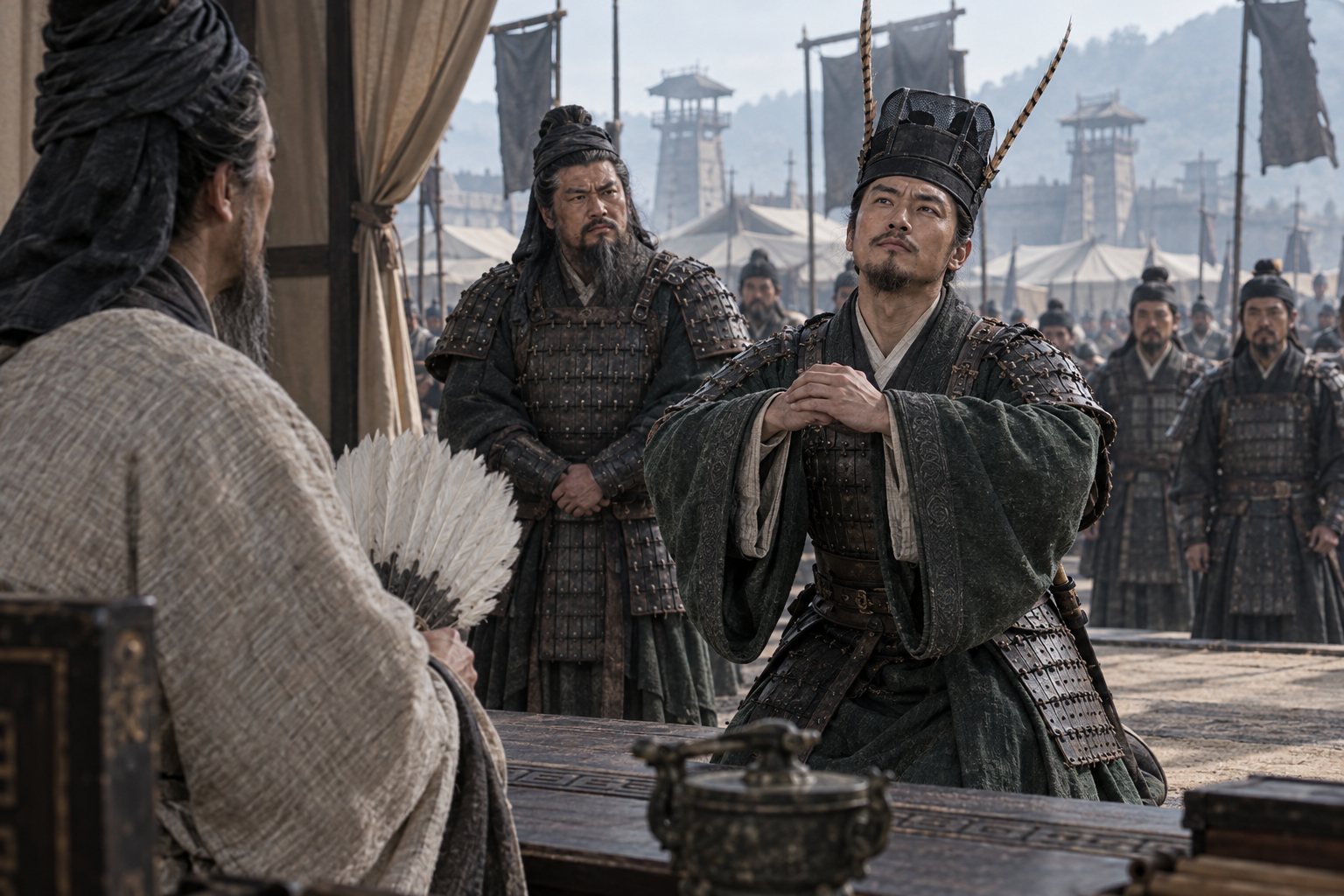
Everyone recommends Wei Yan; Ma Su volunteers. Who do you entrust with Jieting?
Ma Su disobeys your orders and acts unwisely: he leaves the water and climbs the mountain, making a confused deployment. Wang Ping repeatedly remonstrates with him, but he will not listen. In the Romance, he says to Wang Ping: “You truly have a woman’s view!”
He relies on the southern mountain for protection and does not descend to occupy the city. Zhang He cuts off his water supply and defeats him decisively, and the soldiers scatter. Only the thousand men under Wang Ping beat their drums and hold their ground; Zhang He suspects an ambush and does not dare approach.
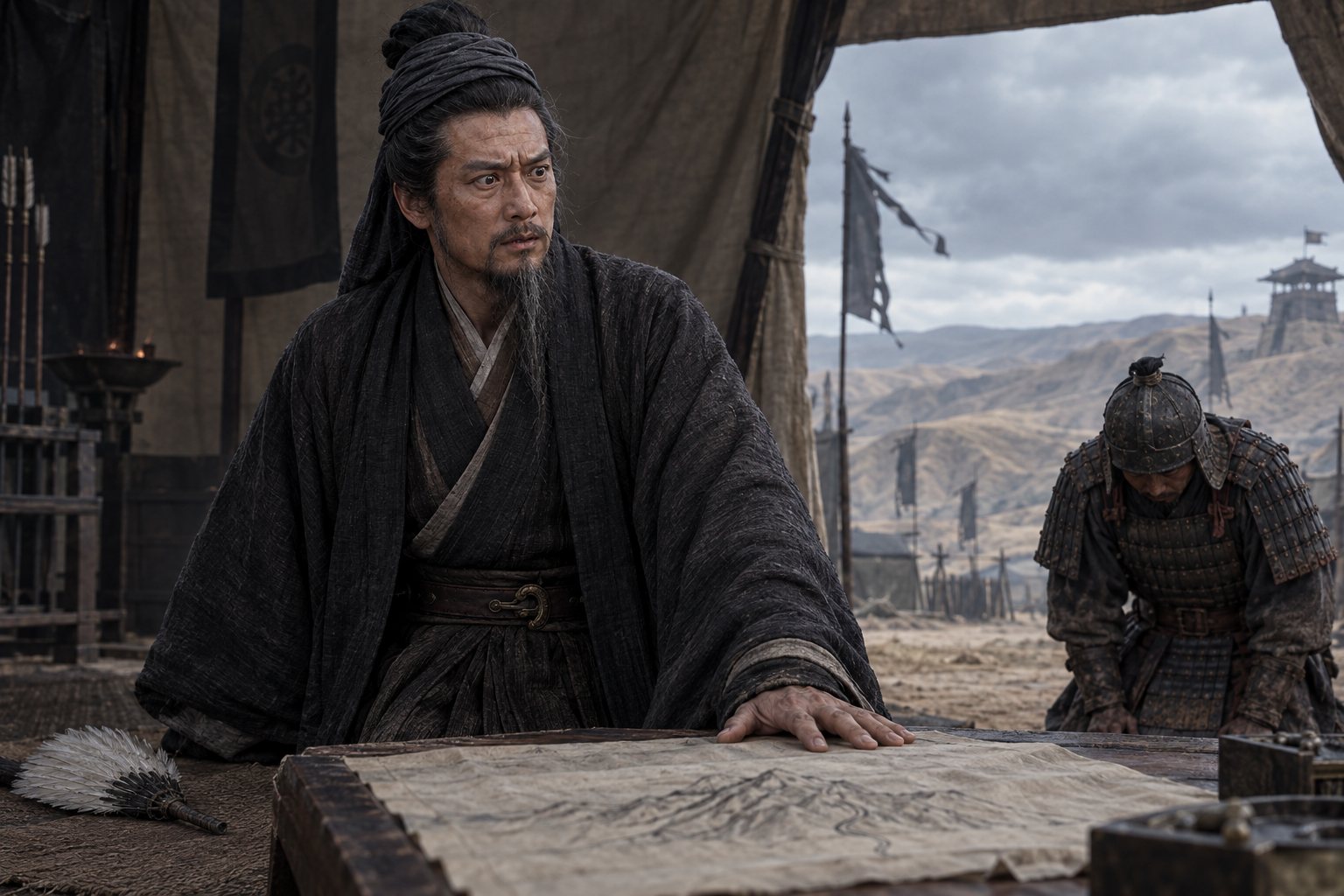
In the Romance, you receive the camp map sent by Wang Ping and slap the table in alarm: “Ma Su is a fool; he has brought ruin upon my army!”
You have no secure position to advance from, so you withdraw to Hanzhong and take more than a thousand households from Xi County with you as you leave. Jiang Wei comes with you, separated from his mother from then on.
the feint force at Jigu → Read Zhao Yun's story →
Empty City
RomanceThe Records don't tell this scene. The whole chapter comes from the Romance.
You first lead five thousand troops to Xicheng County to transport provisions. Suddenly, more than ten urgent reports arrive: Sima Yi leads an army of a hundred and fifty thousand, surging toward Xicheng.
You have no generals by your side, only a group of civil officials; half of the five thousand troops have been sent to transport provisions, leaving only two thousand five hundred soldiers in the city. All the officials turn pale.
You climb the city wall and look out. Sure enough, dust billows into the sky.
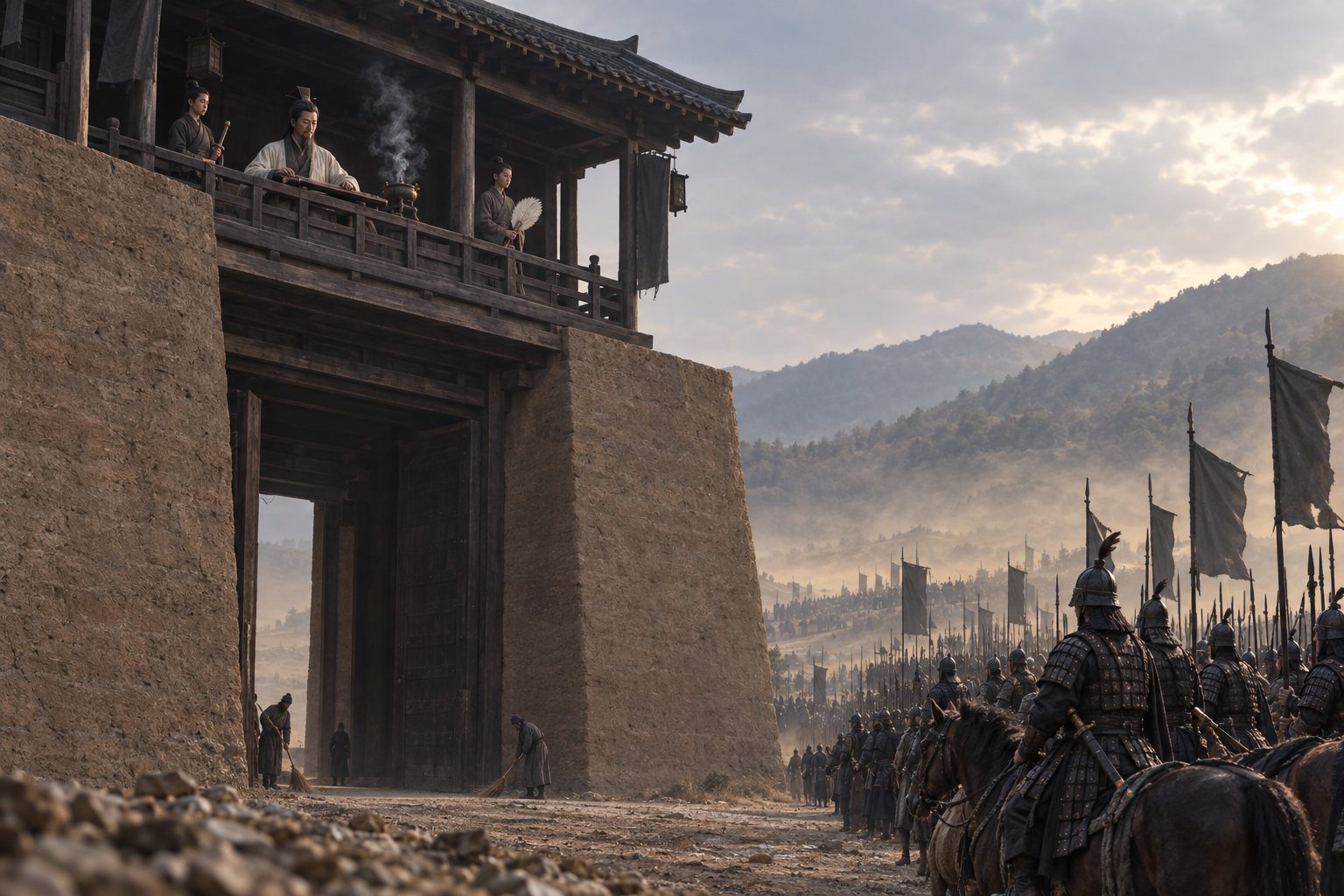
You give the order: hide all the banners; anyone who dares to come or go, or speak loudly, is to be executed; throw the four gates wide open, and place twenty soldiers at each gate, dressed as commoners and sweeping the streets.
You put on a crane-feather cloak and a silk headscarf, take two young attendants and a qin, and sit by the railing before the tower above the city gate, burning incense as you play.
The music is steady. In the gate passage, the soldiers sweeping keep their heads down; their brooms rasp, stroke after stroke.
Sima Yi’s forward scouts reach the city, but none dare enter. He laughs, unconvinced, halts the three armies, and rides forward alone to look from afar.
He sees you smiling warmly as you burn incense and play the qin. One young attendant on your left holds a precious sword; the one on your right carries a horsetail whisk. More than twenty commoners inside and outside the gates keep their heads down as they sweep, as if no one else were there.
His second son, Sima Zhao, says, “Could it be that Zhuge Liang has no troops and is putting on this show? Why should Father retreat?” He says: “Liang has always been cautious; he has never taken a risk. Now he has thrown the city gates wide open. There must be an ambush.”
Both armies withdraw completely. When you see the Wei army receding into the distance, you clap your hands and laugh.
The officials ask you. You say: “This man knows that I have always been cautious and would never take a risk. Seeing things as they are, he suspects an ambush, so he retreats. I am not taking a risk; I have no choice but to use this stratagem.”
When you finish speaking, you clap your hands and laugh: “If I were Sima Yi, I would never retreat so readily.” Then you order the people of Xicheng to follow the army to Hanzhong.
Wiping Away Tears
Back in Hanzhong, you take stock, camp by camp.
Ma Su is thrown into prison. The Biography of Xiang Lang (Xiang Lang Zhuan) says he fled, and that Chief Clerk Xiang Lang knew but did not report it.
In the Romance, he binds himself and kneels before your tent. You say: “Had you listened to Wang Ping sooner, how could this disaster have happened?”
When he hears that you mean to sentence him to death, he sends a letter from prison: “My lord regarded Su as a son, and Su regarded my lord as a father. I hope you will think deeply on the example of Yu, who rose to greatness after Gun was executed, and let the friendship we shared in life remain unbroken. Though I die, I shall have no regrets in the Yellow Springs.”
Army Adviser Li Miao comes to remonstrate, citing “Qin pardoned Meng Ming, who made the western Rong submit; Chu executed Zi Yu, and for two generations it could not prevail”.
You remember the day of the southern campaign, when he escorted you for dozens of li and said that winning hearts was paramount. You remember all these years discussing the art of war together, from daylight into the night. You remember those words in Yongan Palace.
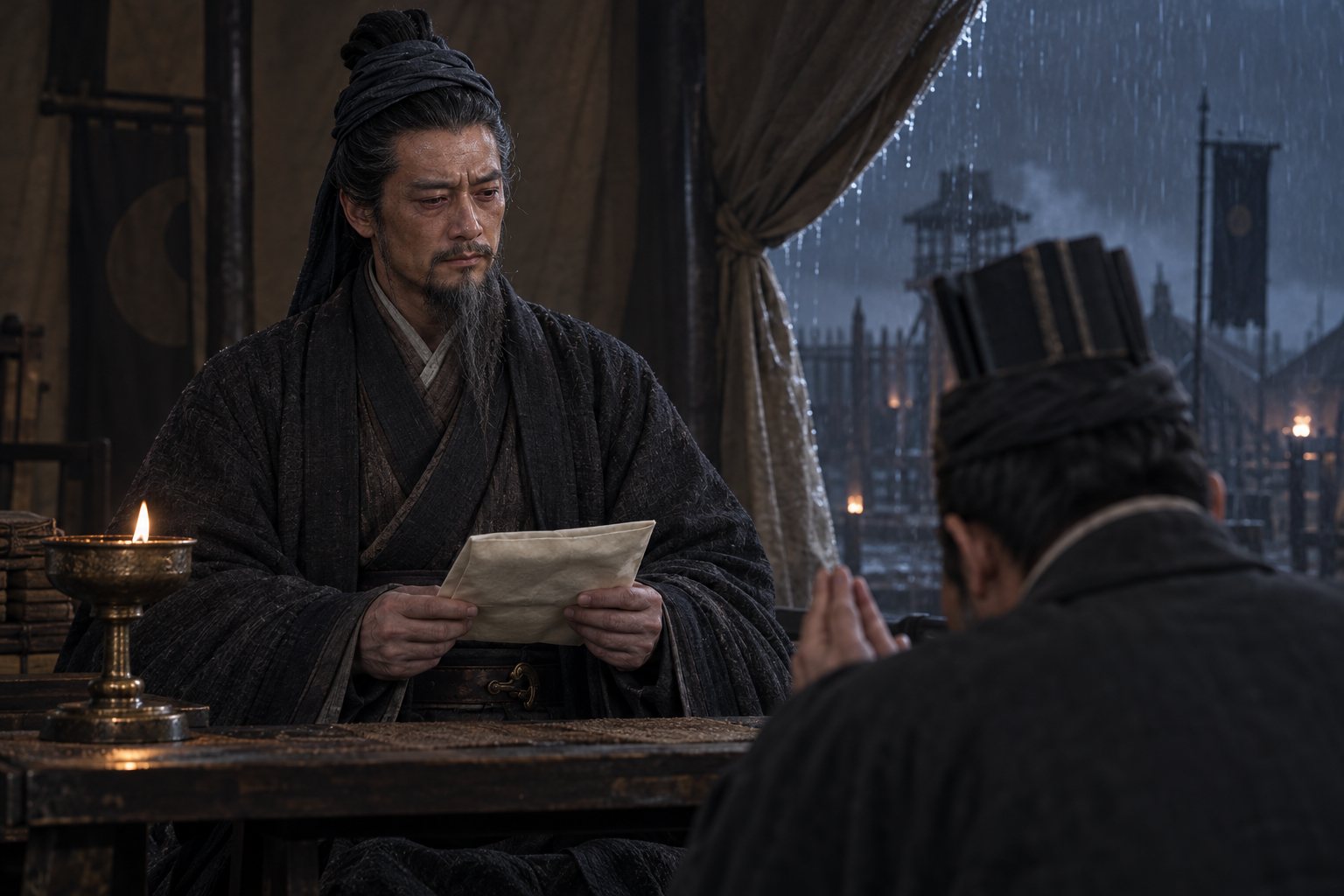
Li Miao is still in your tent. What will you do about Ma Su?
You execute Ma Su to answer to the army. The hundred thousand men all weep for him. You attend the memorial rites in person and treat his children as you did while he lived.
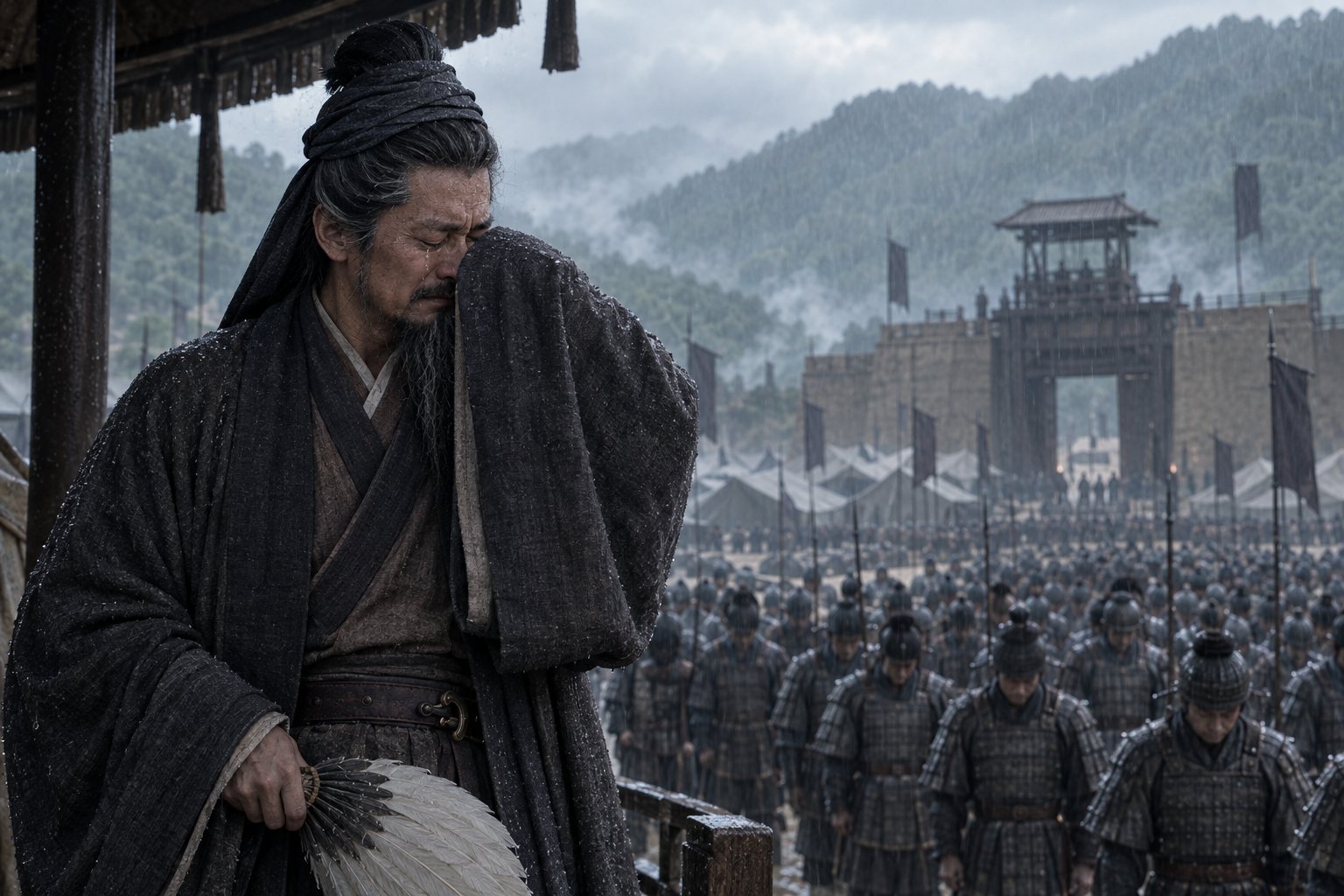
Later, Jiang Wan comes to Hanzhong and says to you: “With the realm still unsettled, is it not a pity to execute a man of intelligence and resource?” You weep and say: “Sun Wu was able to win throughout the realm because he enforced the laws clearly.” “The four seas are divided, and the armies have only just begun to clash. If we now abandon the law as well, how can we fight the rebels?”
In the Romance, you weep for another reason: “I do not weep for Ma Su. I think of the time when the late emperor, in peril at Baidicheng, told me: ‘Ma Su’s words exceed his deeds; he must not be given great responsibility.’ Now those words have come true. I deeply regret my own lack of discernment, and remember the late emperor’s wisdom. That is why I weep so bitterly!”
You submit a memorial requesting demotion: “I did not know people clearly, and in managing affairs I was often blind. The Spring and Autumn Annals (Chunqiu) hold commanders responsible; this is my duty. I ask to be demoted by three ranks, to answer for this fault.” You then become General of the Right and acting Chancellor, retaining command over the same forces as before.
Someone urges you to send still more troops, and you say: “Our great armies at Mount Qi and Jigu are both larger than the enemy’s, yet they cannot defeat the enemy and are defeated by them. The problem is not that we have too few troops, it lies with one man.”
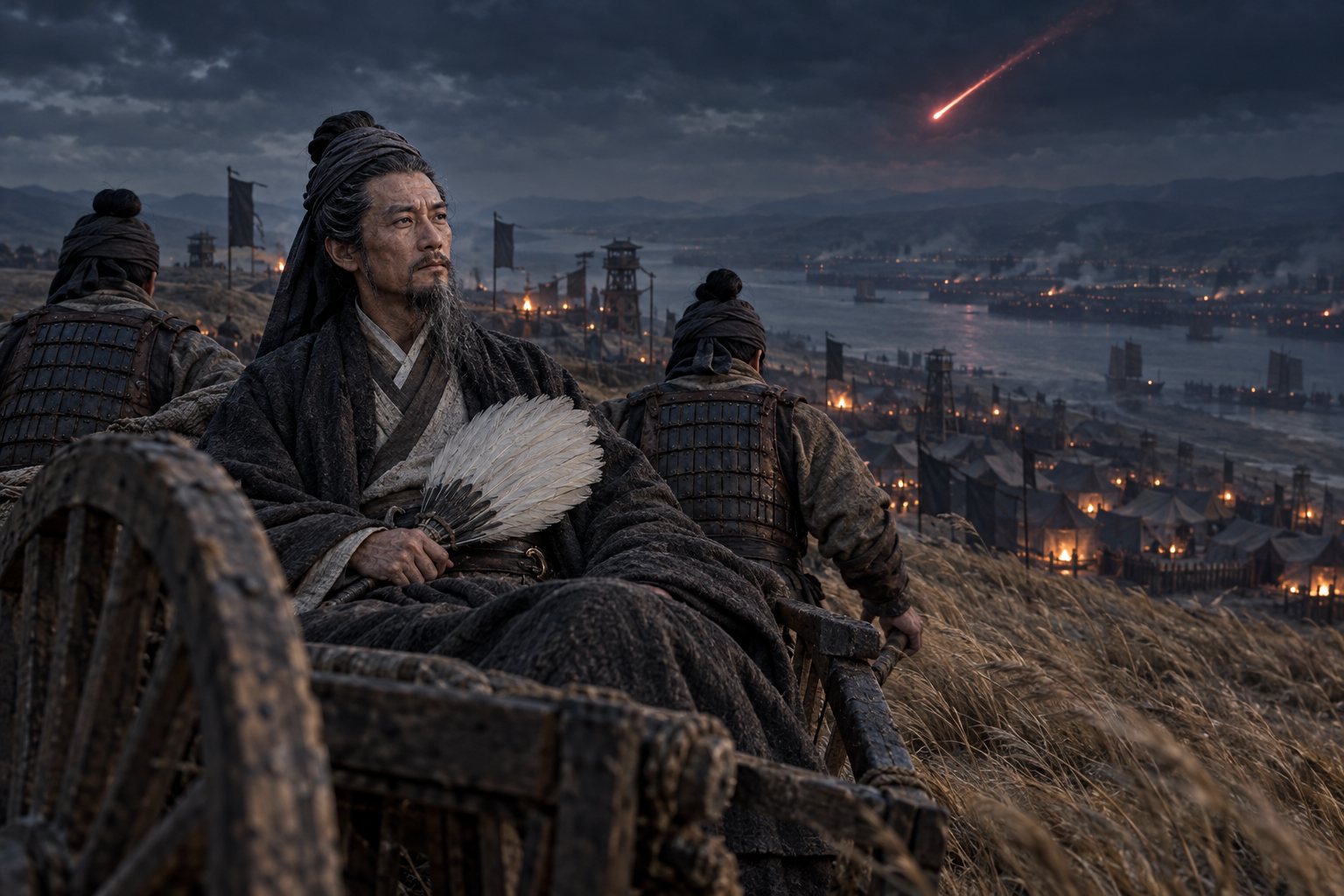
The Star Falls
That winter, you again leave San Pass, besiege Chencang, and return when your provisions run out. Three years later, you march out to Mount Qi again; when you retreat for lack of provisions, you shoot and kill the Wei general Zhang He.
In spring, in the twelfth year, you muster all your forces, emerge from Xie Valley, and use the “gliding horse” carts to carry provisions; you take up position at Wuzhang Plains in Wugong and face Sima Yi across the Wei River.
You are often troubled by the failure of your provisions to keep coming, and by your inability to fulfill your ambition, so you divide your troops and set them to farming, laying the foundation for a long stay. The farmers live among the residents along the Wei; the people are settled, and the army takes nothing for itself.
You challenge him several times, but he does not come out. You send him women’s headscarves and ornaments to provoke him. He wants to fight, but Xin Pi arrives bearing the emperor’s command and staff of authority, and stops him.
Jiang Wei says, “Xin Zuozhi arrives bearing the staff of authority; the enemy will not come out again.” You say, “He never intended to fight. He insists on fighting only to display his might before his men. A general in the field need not accept every command from his ruler. If he could control me, would he ask to fight from a thousand li away?”
Your envoy reaches the Wei camp. Sima Yi asks only about your sleep, meals, and daily workload, not military affairs. The envoy answers, “Lord Zhuge rises early and retires late. He personally handles every punishment of more than twenty strokes; he eats no more than a few sheng of food.” Sima Yi says, “Liang is near death.”
In the Romance, the envoy brings these words back, and you sigh, “He knows me well!”
You remain locked in a standoff for more than a hundred days.
In the Romance, on the day the autumn wind rises, you force your sick body to move, have your attendants help you onto a small cart, and go out to inspect every camp, feeling the autumn wind on your face, cold to the bone: “I can no longer face the enemy in battle! Vast heavens above, when will this end?”
You think of the few mu of fields in Longzhong. You once told Zhuge Jun that, when your work was done, you would retire to seclusion.
In your memorial to the Later Lord, you once wrote: “In Chengdu I have eight hundred mulberry trees and fifteen qing of poor fields. My children and younger kinsmen have more than enough for clothing and food.”
A red star with rays and horns streaks from northeast to southwest and falls into your camp; three times it plunges and twice it rises again, large as it falls and small as it returns.
In the eighth month of that year, you die of illness in the army, aged 54.
Yang Yi and the others withdraw with the army in good order. The people run to tell Sima Yi, and he pursues. Jiang Wei orders Yang Yi to turn the banners around and beat the drums, as if preparing to turn back and attack him, and Sima Yi retreats, not daring to come close. Only after entering the valley do they announce your death.
The people make up a saying about it: “Dead Zhuge makes the living Zhongda flee.” Someone tells Sima Yi, and he says, “I can judge the living, but not the dead.”
After the army withdraws, he inspects the remains of your camp and says, “A genius of the age!”
After your death, it proves just as you said: inside, no spare silk; outside, no surplus wealth.
Li Yan, who had received the regency charge alongside you that year, has long since been reduced to commoner status. When he hears you are dead, he too falls ill and dies.
How Zhuge Liang's story ends
He may be called a talent who understood how to govern, second only to Guan Zhong and Xiao He. Yet he mobilized the people year after year without success; perhaps adapting to circumstances in generalship was not his strength!
He died before his campaign could triumph;<br>ever since, heroes’ tears have soaked their robes!