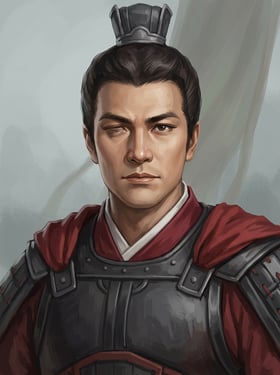
Historical Record
Xiahou Dun, styled Yuanrang, was a native of Qiao in the Pei state and a descendant of Xiahou Ying. From his youth he was known for his fierce temperament; at the age of fourteen, when someone insulted his teacher, he killed that person, showing the intensity of his nature c:5011.
When Cao Cao first raised his army, Xiahou Dun followed him closely, often serving as a deputy general and taking part in campaigns. After Cao Cao was appointed General Who Rouses Valor, Xiahou Dun was appointed major and led his troops to garrison Baima, later being promoted to Colonel Who Charges and Shatters, concurrently Administrator of Dong Commandery c:5011.
During Cao Cao's campaign against Tao Qian, Xiahou Dun was ordered to hold Puyang. However, Zhang Miao rebelled during this time and brought Lü Bu into Yanzhou. At that time Cao Cao's family was at Juancheng, and Xiahou Dun went lightly equipped to their rescue, only to encounter Lü Bu, and the two sides clashed. After Lü Bu retreated, he seized the chance to enter Puyang and raided and captured Xiahou Dun's baggage train. Lü Bu also sent generals who feigned surrender to seize the opportunity to take Xiahou Dun hostage and extort treasure. The army was thus thrown into panic. Xiahou Dun's subordinate general Han Hao acted decisively, summoning the officers and generals and sternly ordering them to hold their posts and not act rashly, thereby stabilizing the army's morale. Han Hao then personally went to where Xiahou Dun was held, angrily rebuked the captors, and gathered soldiers to prepare an attack. Seeing this, the captors kowtowed in fear, claiming they only sought wealth. Unmoved, Han Hao executed all the captors. Xiahou Dun was thereby rescued. When Cao Cao learned of this, he greatly praised Han Hao, deeming the act a model for all generations, and ordered that thereafter, whenever anyone took hostages, all should join in attacking without regard for the hostages' safety; thereafter hostage-taking ceased c:5011.
After Cao Cao returned from Xuzhou, Xiahou Dun followed him in campaigning against Lü Bu and was unfortunately struck in the left eye by a stray arrow c:1084. Thereafter he successively held the posts of Administrator of Chenliu and Jiyin, was given the title General Who Establishes Valor, and was enfeoffed as Marquis of Gao'an Village. When a great drought and locust plague struck, Xiahou Dun personally directed the soldiers and people, dammed the Taishou River to build a reservoir, and carried earth himself, encouraging the soldiers to plant rice, so that the people benefited from it c:1084.
After Cao Cao pacified Hebei, Xiahou Dun was appointed rear guard of the Grand General. After Ye was taken, he was transferred to General Who Subdues the Waves, still holding the post of Intendant of Henan, and was granted authority to act at his discretion, unbound by ordinary regulations. In the twelfth year of Jian'an, to commend Xiahou Dun's merits, his fief was increased by 1,800 households, totaling 2,500 households c:1084.
In the twenty-first year of Jian'an, after Xiahou Dun returned from Cao Cao's campaign against Sun Quan, he was appointed to command 26 armies and to garrison Chaohu. Cao Cao bestowed upon him musicians and singing girls and said: "Wei Jiang received the music of bells and chimes for his merit in pacifying the Rong; how much more should you, General!" c:1084 In the twenty-fourth year of Jian'an, when Cao Cao was encamped at Mopi, he often summoned Xiahou Dun to ride with him in the same carriage, treating him with closeness and reliance, allowing him into his private quarters in a way no other general could match. He was appointed General of the Vanguard, leading the armies back to Shouchun, and later moving to garrison Zhaoling. After Cao Pi took the throne as King of Wei, he appointed Xiahou Dun Grand General, who died a few months later c:1084.
In the Novel
In *Romance of the Three Kingdoms*, Xiahou Dun's image is further developed, emphasizing his fierce valor and loyalty to Cao Cao. He first appears alongside his clan younger brother Xiahou Yuan, each bringing a thousand stalwarts to join Cao Cao c:1087. The novel particularly stresses Xiahou Dun's blood relation to Cao Cao, noting that Cao Cao's father Cao Song was originally a son of the Xiahou clan adopted into the Cao family, so that Xiahou Dun and Cao Cao were clan brothers c:1087.
Xiahou Dun distinguished himself in the campaign against Dong Zhuo, following Cao Cao in pursuit of Dong Zhuo and personally stabbing Xu Rong to death, rescuing Cao Cao from danger c:1089. Thereafter, he repeatedly went on campaign as Cao Cao's vanguard general; for instance, during the campaign against the Yellow Turban leaders He Yi and Huang Shao, Xiahou Dun held Juancheng and other places, providing security for Cao Cao's rear c:5014.
The most famous scene in the novel is Xiahou Dun "pulling out the arrow and swallowing his eye." During the battle with Lü Bu, Xiahou Dun was pursuing Gao Shun when he was struck in the left eye by Cao Xing's hidden arrow. He cried out, "Essence of my father, blood of my mother—it cannot be cast away!" and then swallowed the eyeball, fiercely stabbing Cao Xing to death; this act greatly displayed his fierce, fearless character c:1092. In the histories this is recorded only as "struck by a stray arrow, wounding his left eye," with no mention of swallowing the eye—an artistic embellishment of the novel.
When Guan Yu "rode a thousand li alone," Xiahou Dun led troops in pursuit, wishing to capture Guan Yu alive, but was stopped in time by Zhang Liao, who conveyed Cao Cao's order to let him pass c:9460. This reflects Xiahou Dun's absolute obedience to Cao Cao's orders and his duty as a general of the Cao camp.
At the Battle of Bowang Slope, Xiahou Dun showed contempt for Zhuge Liang's ability, regarding him as mere "weeds," and boasted that he would capture Liu Bei and Zhuge Liang alive c:9466. As a result, he fell for Zhuge Liang's fire-attack stratagem, was badly defeated, and bound himself to ask for punishment c:1095. In the histories this battle is recorded as Liu Bei setting an ambush, burning his camp and feigning retreat, and Xiahou Dun being defeated when he pursued c:1086; the novel attributes the planning of this battle to Zhuge Liang and highlights Xiahou Dun's underestimation of the enemy.
Key Relationships
* Cao Wei (serves): Xiahou Dun was a veteran general of Cao Cao's group, following him from the very beginning of his uprising and rendering great service in establishing the Cao Wei regime c:5011. He rose to Grand General and was deeply trusted and relied upon by Cao Cao.
* Cao Cao (commands_in): Xiahou Dun and Cao Cao were not only lord and subject but also brothers by blood (novel only), as close as hand and foot. Cao Cao treated him without reserve, even riding in the same carriage and admitting him to his private quarters in a way no other general could match c:1084. Xiahou Dun was utterly loyal to Cao Cao, repeatedly risking his life for him.
* Gao Gan (enemy_of): After Cao Cao pacified Hebei, Gao Gan raised troops in rebellion. Xiahou Dun was ordered by Cao Cao to campaign against Gao Gan's accomplices Wei Gu, Fan Xian, and others c:1085.
* Liu Bei (fights_in): Xiahou Dun clashed with Liu Bei several times. In the histories, Liu Bei once set an ambush to defeat the pursuing Xiahou Dun c:1086. In the novel, the Battle of Bowang Slope is the classic battle in which Xiahou Dun underestimated Liu Bei and Zhuge Liang and was ultimately badly defeated c:9466.
* Lü Bu (enemy_of): Xiahou Dun followed Cao Cao in campaigning against Lü Bu and was wounded in the left eye by a stray arrow in that battle c:1084. In the novel, he fought Gao Shun and the "pulling out the arrow and swallowing his eye" incident occurred c:1092.
* Han Hao (colleague): When Xiahou Dun was taken hostage by Lü Bu's subordinates, Han Hao stepped forward, stabilized the army's morale, and executed the captors, rescuing Xiahou Dun from danger c:5011.
* Zhuge Liang (enemy_of, novel only): In the novel, Xiahou Dun clashed with Zhuge Liang several times, especially at the Battle of Bowang Slope, where Xiahou Dun fell for Zhuge Liang's fire-attack stratagem due to underestimating the enemy c:9466.
Signature Scenes
* Renowned for Killing at Fourteen: At only fourteen, Xiahou Dun killed a man who insulted his teacher, becoming renowned in his hometown for his fierce spirit c:5011. This event set the keynote of his brave, decisive character and his hatred of evil.
* Taken Hostage and Rescued by Han Hao: During Cao Cao's campaign against Tao Qian, Xiahou Dun held Puyang but was taken hostage by Lü Bu's subordinates. At the critical moment, the subordinate general Han Hao stepped forward, executed the captors, and rescued Xiahou Dun. Because of this, Cao Cao established the law of "joining in the attack without regard for the hostage" c:5011. This event displays Xiahou Dun's composure in adversity and the loyalty and valor of his subordinates.
* Pulling Out the Arrow and Swallowing His Eye (novel only): In *Romance of the Three Kingdoms*, when fighting Lü Bu's general Cao Xing, Xiahou Dun was struck in the left eye. He cried out, "Essence of my father, blood of my mother—it cannot be cast away!" then swallowed the eyeball and stabbed Cao Xing to death with a backhand thrust c:1092. This scene greatly reinforced Xiahou Dun's image of fierce valor and became his most famous signature event.
* Damming the Taishou River to Build a Reservoir: When struck by a great drought and locust plague, Xiahou Dun personally led the soldiers to dam the Taishou River to build a reservoir and carried earth himself, encouraging the people to plant rice, solving the famine and benefiting the region c:1084. This shows that he was not only a fierce battlefield general but also an official concerned with the people's livelihood and capable in governance.
* Defeat at Bowang Slope (novel only): In *Romance of the Three Kingdoms*, at the Battle of Bowang Slope, Xiahou Dun underestimated Liu Bei and Zhuge Liang, fell for Zhuge Liang's fire-attack stratagem, was badly defeated, and bound himself to ask for punishment c:1095. This scene highlights Zhuge Liang's wisdom while making Xiahou Dun pay the price for his obstinacy, rounding out his image.
* Cao Cao's Closeness and Reliance: Cao Cao's trust in and closeness to Xiahou Dun was unmatched by anyone. In the twenty-fourth year of Jian'an, when Cao Cao was encamped at Mopi, he often summoned Xiahou Dun to ride in the same carriage and admitted him to his private quarters in a way no other general could match c:1084. This fully reflects Xiahou Dun's special place in Cao Cao's heart.
Portrait file
Character profile
- Character
- Xiahou Dun was fierce and unyielding by nature, valuing loyalty and bold in valor—struck by an arrow, he swallowed his own eye and fought on. At times he was also stubborn and hard, repeatedly defying orders.
- Manner of speech
- He argued for first taking Hanzhong and Zhang Lu, holding that Wu and Shu were not yet ripe for attack.
- Life
- Xiahou Dun was a native of Qiao in the Pei state, a descendant of Xiahou Ying. From boyhood he trained with spear and staff, and at fourteen won fame for killing a man who had insulted his teacher. He followed Cao Cao in raising troops and held many offices in succession, including Administrator of Dong Commandery, Colonel Who Breaks the Ranks, and General Who Establishes Martial Might; in the twenty-fourth year of Jian'an he was appointed Front General, and when Emperor Wen took the rank of king he was promoted to Grand General, dying of illness a few months later.
- Weapons
- Xiahou Dun habitually used a spear, or a long spear.
- Anecdotes
- He was a kinsman-general of Cao Cao. At Mopi, when all the generals received Wei official titles, he alone retained a Han office, and only after firmly requesting was he appointed Front General. He once fought on after plucking out an arrow and swallowing his eye, and was mocked by Mi Heng as 'the general with the intact body.'
Relationships
26 relationships
Family5
Lord & vassal5
Friends2
Enemies4
Other10
Quotes
32 recorded lines · 3 featured
「父精母血,不可棄也!」
This line displays Xiahou Dun's loyalty, filial piety, benevolence, and righteousness, a classic footnote to his one-eyed image.
「元直之言謬矣。吾看諸葛亮如草芥耳,何足懼哉!吾若不一陣生擒劉備,活捉諸葛,願將首級獻與丞相。」
This line reflects Xiahou Dun's arrogance and his disdain for Zhuge Liang, foreshadowing the Fire Attack at Bowang.
「雞肋」
The term 'chicken ribs' became famous through Yang Xiu, and Xiahou Dun's reaction obliquely sets off the allusion.
Chapters40 回 ▸
- 史ch.2ch.9ch.10ch.11ch.15ch.16ch.18ch.22ch.32
- 演ch.5ch.6ch.10ch.12ch.14ch.16ch.17ch.18ch.19ch.25ch.26ch.27ch.28ch.30ch.31ch.33ch.39ch.40ch.41ch.42ch.48ch.50ch.51ch.66ch.69ch.70ch.71ch.72ch.78ch.79ch.91
Relationship timeline15 条 ▸
史 ch.9
- Cao Cao§4
commands_in
同宗腹心,从征伐;摩陂特见亲重,出入卧内
史 ch.16
- Gao Gan§18
enemy_of
太祖遣讨之
史 ch.32
- Liu Bei§11
fights_in
援先主不能救,为高顺所败;后于博望追先主为伏兵所破
演 ch.5
- Cao Cao§3
kin_of
同族族弟,引壮士千人来会
演 ch.6
演 ch.12
- Cao Cao§1
fights_in
引军来救援曹操,截住吕布大战
演 ch.14
- Cao Cao§12
commands_in
曹操先锋;引上将十员、精兵五万保驾;後分两翼击破傕汜
演 ch.18
- Gao Shun§26
fights_in
阵前挺槍搦战四五十合,高顺败走
演 ch.28
- Cao Cao§2
serves
夏侯惇以「丞相不肯」为名拒不放行;执行丞相之命又自加判断
演 ch.33
- Cao Cao§31
advises_in
引众入稟请速征辽东;后又议劝操回许都
演 ch.40
- Cao Cao§2
serves
败回许昌自缚伏地请死,操释之
演 ch.66
- Cao Cao§38
advises_in
段38议先取汉中张鲁,再以得胜之兵取蜀
演 ch.78
- Cao Cao§19
witnesses
入殿门见冤魂昏倒得病
演 ch.91
- Xiahou Mao§28
parent_of
嗣父("自幼嗣與夏侯惇為子")
Inner monologues · AI-generated3 段 ▸
- Now that this day has come, my life too should draw to a close. The lamp in the tent is nearly spent, yet the dust of pa
- My name is Xiahou Dun, and my courtesy name was Yuanrang. I followed the Grand Ancestor in campaigning against Lü Bu whe
- My name was Dun, and my courtesy name was Yuanrang. I was from Qiao County, Pei Commandery. As for my family background,
Life events11 ▸
- 0189-01-01 · ChenliuCao Cao Raises an Army· Warrior
- 0193-01-01 · Xu ProvinceCao Cao's Campaign Against Xu Province· Warrior
- 0194-01-01 · PuyangFire Attack at Puyang· Warrior
- 0195-01-01 · YanzhouBattle of Yanzhou· Warrior
- 0199-01-01 · ShouchunCao Cao's Campaign Against Yuan Shu· Warrior
- 0201-01-01 · CangtingBattle of Cangting· Warrior
- 0201-01-01 · RangshanBattle of Rangshan· Warrior
- 0207-01-01 · Bowang SlopeFire Attack at Bowang· Commander
- 0208-01-01 · Jing ProvinceCao Cao's Southern Campaign Against Jing Province· Warrior
- 0218-01-01 · XuRebellion of Geng Ji and Wei Huang at Xu· Commander
- 0219-01-01 · HanzhongDeath of Yang Xiu· Witness