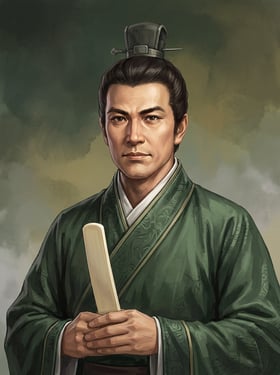
Historical Record
Dong Zhao, courtesy name Gongren, was a native of Dingtao in Jiyin. Recommended as filial and incorrupt, he served as chief of Yingtao and magistrate of Boren. Yuan Shao valued his ability and appointed him a military adviser. At the time when Yuan Shao and Gongsun Zan fought at Jieqiao, the Administrator of Julu, Li Shao, and the local gentry, seeing Gongsun Zan's military strength, mostly wished to go over to him. Learning of this, Yuan Shao sent Dong Zhao to Julu. On arriving, Dong Zhao counterfeited a dispatch from Yuan Shao, claiming that bandits intended to attack Julu and naming members of the powerful local clans, such as Sun Kang, as inside collaborators; he then executed Sun Kang and several dozen others, overawing the whole commandery and in the end pacifying its clerks and people.
Thereafter, when the Administrator of Wei Commandery, Li Pan, was killed, Yuan Shao again appointed Dong Zhao Administrator of Wei Commandery. At that time Wei Commandery was in great turmoil, with bandits numbering in the tens of thousands. Dong Zhao treated the bandits' envoys generously and used them to gather intelligence, then struck at the enemy's weak points by surprise, repeatedly winning great victories.
Dong Zhao's younger brother Dong Fang was in Zhang Miao's army. Zhang Miao was at odds with Yuan Shao, and Yuan Shao, believing slander, wished to charge Dong Zhao with a crime. Dong Zhao wished to go over to Emperor Xian of Han, but passing through Henei he was detained by Zhang Yang. He persuaded Zhang Yang to ally with Cao Cao, arguing that although Cao Cao was weak, he was truly a hero of the realm, and he wrote letters for Cao Cao to establish contact with the Chang'an generals Li Jue, Guo Si, and others, bringing about exchanges between Cao Cao and the western powers.
In the first year of Jian'an, after Cao Cao had pacified the Yellow Turbans, the Son of Heaven returned to Luoyang. Dong Zhao accompanied the Son of Heaven to Anyi and was appointed by edict a court gentleman for consultation. When Cao Cao had audience with the Son of Heaven at Luoyang, Dong Zhao advised Cao Cao to move the Son of Heaven to Xu, holding that such a move was "to do an extraordinary deed and thus to gain extraordinary merit". He also devised plans for Cao Cao, pacifying Yang Feng, and in the end enabled Cao Cao to move the capital successfully. Thereafter Dong Zhao successively held posts such as Intendant of Henan, Governor of Jizhou, Governor of Xu Province, and Administrator of Wei Commandery.
When Guan Yu besieged Cao Ren at Fancheng, Sun Quan sent an envoy to inform Cao Cao that he would seize Jing Province and requested Cao Cao to keep it secret. The assembled ministers all said it should be kept secret, but Dong Zhao alone overruled the consensus, advising Cao Cao to shoot Sun Quan's letter into Fancheng and into Guan Yu's camp, so as to raise the morale of Cao Ren's army and to make Guan Yu withdraw out of concern for Jing Province. Cao Cao adopted his plan, and in the end Guan Yu was defeated and fled.
After Cao Pi became king, Dong Zhao was appointed Grand Director of Works (jiangzuo dajiang). After Cao Pi took the throne, he was transferred to Grand Herald (da honglu) and advanced in fief to Marquis of Youxiang. Later, an additional fief of one hundred households was apportioned, and his younger brother Dong Fang was granted the rank of Marquis Within the Passes, while Dong Zhao himself was transferred to palace attendant. When Cao Xiu, facing the river, wished to cross over to give battle, Dong Zhao discerned the reluctance of his subordinates such as Zang Ba to take risks, and predicted that Cao Xiu, even on receiving the edict, would hesitate and not advance. Soon the river rose in flood, and the enemy's boats were blown by the wind down beneath Cao Xiu's camp, and Cao Xiu won a great victory. Cao Pi marveled at Dong Zhao's foresight.
After Emperor Ming of Wei took the throne, Dong Zhao advanced in fief to Marquis of Leping with a fief of one thousand households and was transferred to Commandant of the Guards. He finally died at the advanced age of eighty-one, with the posthumous title Marquis Ding.
In the Novel
In Romance of the Three Kingdoms, Dong Zhao's image is further developed as an important strategist of Cao Cao. At his first appearance, he is portrayed as a man with clear, handsome features and abundant vitality, in contrast to the famine-stricken East Commandery of the time, where officials, soldiers, and people all wore the look of hunger. Cao Cao was curious about his regimen of "eating plain fare for thirty years." Dong Zhao related that he had once been a clerk under Yuan Shao and Zhang Yang, and had come to pay court because the Son of Heaven had returned to the capital, and was enfeoffed as a court gentleman for upright deliberation. He and Cao Cao hit it off as old friends and conversed in mutual accord.
In the novel, after Cao Cao received and honored Emperor Xian of Han, Dong Zhao advised Cao Cao to move the capital to Xu Chang. He emphasized that "to do an extraordinary deed is thus to gain extraordinary merit," and devised plans for Cao Cao, pacifying Yang Feng, so that the move of the capital proceeded smoothly. This episode basically accords with historical fact, but the novel highlights more strongly Dong Zhao's key role in Cao Cao's early decisions.
At the time when Cao Cao's power grew ever greater, in the novel Dong Zhao was the first to propose that Cao Cao should receive the rank of Duke of Wei and be granted the "Nine Bestowals." He held that Cao Cao "had braved wind and rain for more than thirty years, sweeping away the various villains and ridding the people of harm, so that the house of Han survives—how could he be ranked together with the other ministers?" Although the palace attendant Xun Yu opposed this, holding that Cao Cao should maintain a will of loyal devotion and humble retreat, Dong Zhao held firm to his view, and in the end brought about Cao Cao's elevation to Duke of Wei. Though in the histories there is an episode of Dong Zhao advising the restoration of the ancient system of the five ranks of nobility, the novel renders this concretely as the granting of the Nine Bestowals and sets it in sharp contrast with Xun Yu's opposition, strengthening Dong Zhao's image as a promoter of Cao Cao's political ambitions.
Moreover, when Guan Yu besieged Fancheng, in the novel Dong Zhao also put forward the same plan as in the histories, namely using Sun Quan's letter to sow discord between Guan Yu and Sun Quan and to break the morale of the Fancheng defenders. Through these episodes, the novel shapes Dong Zhao into a brain trust skilled at discerning men's hearts, alert to the workings of events, and loyally devoted to Cao Cao.
Key Relationships
* Cao Wei (serves): Dong Zhao served chiefly the Cao Wei regime throughout his life, from the time of Cao Cao until his death in the reign of Emperor Ming of Wei. He was an important strategist of Cao Cao and contributed much to the establishment and consolidation of the Cao Wei regime.
* Yuan Shao's Faction (serves): Early on, Dong Zhao had been a military adviser to Yuan Shao and was charged with handling the affairs of Julu and Wei Commandery, displaying outstanding political and military talent.
* Zhang Yang (advises): While detained by Zhang Yang, Dong Zhao successfully persuaded Zhang Yang to ally with Cao Cao, paving the way for Cao Cao's contact with the western powers.
* Cao Cao (advises): Dong Zhao was one of Cao Cao's core strategists, repeatedly devising plans for Cao Cao, including the move of the capital to Xu Chang and the handling of Guan Yu's siege of Fancheng and other major events. Cao Cao heeded his words and praised his strategy.
* Cao Pi (advises): Dong Zhao continued to be given important employment in the time of Cao Pi, and his precise prediction of Cao Xiu's river-crossing campaign won Cao Pi's high regard.
* Xun Yu (opposed by): On the question of granting Cao Cao the Nine Bestowals, Dong Zhao held a different political view from Xun Yu, representing two different political stances within Cao Cao's faction (unique to the novel).
Defining Scenes
* Pacifying the people of Julu: Dong Zhao first displayed his political skill by quickly quelling the turmoil in Julu Commandery through counterfeiting a dispatch and executing the ringleaders, winning Yuan Shao's praise.
* Persuading Zhang Yang to ally with Cao: While detained by Zhang Yang, Dong Zhao keenly discerned the trend of affairs in the realm and persuaded Zhang Yang to ally with the then-weak Cao Cao, laying a foundation for Cao Cao's later development.
* Strongly advocating moving the capital to Xu Chang: After Cao Cao received and honored Emperor Xian of Han, Dong Zhao overruled the consensus and proposed moving the capital to Xu Chang, and solved the difficulties of its implementation for Cao Cao—a move of crucial importance to the establishment of the Cao Wei regime.
* Offering the plan to relieve the siege of Fancheng: When Guan Yu besieged Fancheng, Dong Zhao proposed making public Sun Quan's letter about his intent to seize Jing Province, which both broke Guan Yu's assault and raised Cao Ren's morale, in the end causing Guan Yu to be defeated and flee—displaying his superb military strategy.
* Advising Cao Cao to take the Nine Bestowals: Dong Zhao was the first to propose that Cao Cao should receive the rank of Duke of Wei and be granted the Nine Bestowals, advancing the process of Cao Cao supplanting the Han, reflecting his loyalty to the Cao Wei regime and his political aspirations (unique to the novel).
* Predicting Cao Xiu's river-crossing: Dong Zhao precisely predicted the reluctance of Cao Xiu's subordinates to take risks, foretelling that Cao Xiu, even on receiving the edict, would not lightly cross the river; the subsequent course of events confirmed his judgment, showing his deep insight into human nature.
Portrait file
Character profile
- Character
- Dong Zhao was skilled at scheming and quick to seize the opportune moment. As a strategist of Cao Wei, he was the one who proposed advancing Cao Cao to the rank of Duke of the Realm with the Nine Bestowments.
- Life
- Dong Zhao, styled Gongren, was a native of Dingtao in Jiyin. He served in turn Yuan Shao, Zhang Yang, and Cao Cao, devising plans and stratagems for Cao Cao. He advised moving the capital to Xu county and proposed establishing the five-rank system of noble titles and advancing Cao Cao to Duke and then King of Wei. He held such offices as Governor of Jizhou, Governor of Xu Province, and Minister over the Masses, and was enfeoffed as Marquis of Leping and posthumously as Marquis Ding.
- Anecdotes
- Dong Zhao's younger brother Dong Fang was in Zhang Miao's army. He was once enfeoffed as Prefect of Luoyang, and later rose to Commandant of the Guards and Minister over the Masses. He died in the fourth year of Qinglong at the age of eighty-one, with the posthumous title Marquis Ding. He had served as Cao Cao's chief clerk and offered a plan to sow disorder in the morale of Lord Guan's army.
Relationships
7 relationships
Lord & vassal2
Enemies2
Other3
Quotes
20 recorded lines · 3 featured
「明公興義兵以除暴亂,入朝輔佐天子,此五伯之功也。但諸將人殊意異,未必服從。今留此,恐有不便。惟移駕幸許都為上策。然朝廷播越,新還京師,遠近仰望,以冀一朝之安;今復徙駕,不厭眾心。夫行非常之事,乃有非常之功:願將軍決計之。」
These words laid the foundation for Cao Cao to hold the emperor and command the lords in his name, an influence of far-reaching consequence.
「自古以來,人臣未有如丞相之功者。雖周公、呂望,莫可及也。櫛風沐雨,三十餘年,掃蕩群凶,與百姓除害,使漢室復存,豈可與諸臣宰同列乎?合受魏公之位,加『九錫』以彰功德。」
Dong Zhao urging Cao Cao to accept the title of Duke of Wei and the Nine Bestowments was a crucial step in Cao Wei's supplanting of the Han.
「將軍興義兵以誅暴亂,入朝天子,輔翼王室,此五伯之功也。此下諸將,人殊意異,未必服從,今留匡弼,事勢不便,惟有移駕幸許耳。然朝廷播越,新還舊京,遠近跂望,冀一朝獲安。今復徙駕,不厭眾心。夫行非常之事,乃有非常之功,原將軍算其多者。」
This is the historical record of Dong Zhao advising Cao Cao to move the capital to Xu County, a matter of great significance.
Chapters6 回 ▸
- 史ch.3ch.14ch.16
- 演ch.14ch.61ch.76
Relationship timeline9 条 ▸
史 ch.14
- Zhang Yang§38
advises_in
至河内为张杨所留;杨从昭议通曹操上事
- Cao Cao§43
advises_in
议徙都许;议建五等爵;议进魏公、魏王
- Guan Yu§53
advises_in
议示露孙权书与关羽屯及围中
- Zhuge Dan§62
rival_of
上疏陈末流之弊,帝因发切诏斥免诸葛诞、邓飏等
演 ch.14
- Yuan Shao§18
serves
自陈「原為袁紹從事」(追述)
- Zhang Yang§18
serves
自陈「原為張揚從事」(追述)
- Cao Cao§19
advises_in
劝曹操移驾许都;操执其手称「凡操有所圖,惟公教之」
演 ch.61
- Cao Cao§26
advises_in
进言尊操为魏公加九锡;上表请之
演 ch.76
- Cao Cao§2
advises_in
献射书樊城之计;曹操从之
Inner monologues · AI-generated3 段 ▸
- I am Dong Zhao, courtesy name Gongren. Looking back on my life, I sought only to judge the moment and the balance of for
- I am Dong Zhao, courtesy name Gongren. Looking back now, what I remember most is not a single written decree, but the de
- I am Dong Zhao, courtesy name Gongren, from Dingtao in Jiyin. In my youth, I watched the world grow steadily more unsett
Life events6 ▸
- 196 CE · XuchangCao Cao Escorts the Emperor and Moves the Capital to Xu· Advisor
- 196 CE · LuoyangMoving the Imperial Court to Xu· Advisor
- 196 CE · JuanchengXun Yu's Counsel to Escort the Emperor· Advisor
- 212 CE · ShouchunDeath of Xun Yu· Advisor
- 212 CE · YeDeliberation on Establishing the Five-Rank Peerage· Advisor
- 213 CE · XuchangCao Cao Elevated to Duke of Wei· Advisor