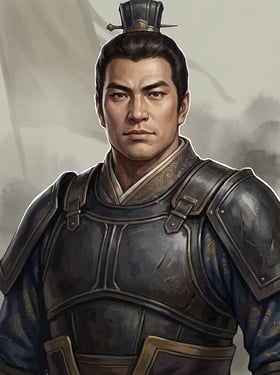
Historical Record
Dian Wei was a native of Jiwu in Chenliu, famed for his imposing physique and extraordinary strength. He was a man of principle and resolve, valuing chivalry. In his early years, to avenge a feud on behalf of Lady Liu of Xiangyi against Li Yong of Suiyang, Dian Wei disguised himself as a messenger delivering chickens and wine, slipped into the heavily guarded residence of Li Yong, and stabbed Li Yong and his wife to death with a dagger. His task accomplished, he calmly took up a blade and halberd from a cart and left on foot. Though pursued by several hundred men, none dared approach, and Dian Wei finally fought his way clear. This deed made his name resound, and he came to be recognized among bold heroes c:354.
During the Chuping era, when Zhang Miao raised troops in righteous cause, Dian Wei served under his command, attached to the Major Zhao Chong. In the army there was a massive standard pole that no one could raise alone, yet Dian Wei raised it single-handed, and Zhao Chong thereafter regarded him with new respect. Later, Dian Wei transferred to the command of Xiahou Dun, where he repeatedly distinguished himself by taking enemy heads and was appointed Major. When Cao Cao campaigned against Lü Bu at Puyang, Lü Bu had set up a separate camp more than forty li west of Puyang. Cao Cao succeeded in a night raid but, during his withdrawal, was surrounded on three sides by Lü Bu's relief forces. The fighting was fierce, with Lü Bu himself joining the battle; from dawn until dusk the two sides remained deadlocked. Cao Cao called for volunteers to break the line, and Dian Wei was the first to respond, leading several dozen soldiers in heavy armor wielding long spears and halberds in a charge. When the western front grew critical, Dian Wei stepped forward; facing arrows and crossbow bolts falling like rain, he showed no fear and ordered his men to report only when the enemy came within ten paces, then five. As the enemy closed in, Dian Wei, holding more than ten halberds, gave a great shout and leapt forward, and wherever he struck, men fell, so that Lü Bu's army was routed. At dusk, Cao Cao was able to withdraw. After the battle, Dian Wei was appointed Commandant and taken by Cao Cao as a close attendant, commanding several hundred personal guards who were stationed around Cao Cao's great tent year-round. Dian Wei was not only valiant beyond compare, but the guards he led were also elite, and in every battle he always charged at the front. He was later promoted to Colonel. Loyal and prudent by nature, he would often stand in attendance all day and lodge beside Cao Cao's tent at night, rarely returning to his own home. Dian Wei was fond of food and drink, with an astonishing appetite; each time Cao Cao bestowed food upon him, he would eat and drink heavily, with several attendants taking turns to serve him before he was satisfied, and Cao Cao therefore valued him highly. Dian Wei habitually used a great pair of halberds and a long blade, and a song circulated in the army: "Among the strong men of the tent there is Lord Dian, who wields a pair of halberds weighing eighty catties" c:354.
In the second year of Jian'an (197), Cao Cao campaigned against Jing Province, and Zhang Xiu came forth to surrender. Cao Cao held a banquet for Zhang Xiu and his officers, and Dian Wei stood behind Cao Cao holding a great axe with a blade a full foot broad. Wherever Cao Cao went, Dian Wei would display the axe, and at the feast Zhang Xiu and his officers dared not look up. More than ten days later, Zhang Xiu rebelled and raided Cao Cao's camp by night. Cao Cao fared poorly in battle and withdrew on a light horse. Dian Wei fought fiercely at the camp gate, stopping the enemy from entering, but they finally poured in through the other gates. At the time Dian Wei still had more than ten officers at his side, all fighting to the death, each worth ten men. As the enemy grew more numerous, Dian Wei swung his long halberd left and right; with each thrust, more than ten spears were broken. With his men killed or wounded around him, and bearing dozens of wounds himself, Dian Wei turned to close-quarters combat. He seized two enemy soldiers, one under each arm, and killed them, so that the rest dared not advance. Dian Wei again charged the enemy and slew several more, but his old wounds reopened, and he died cursing them with glaring eyes. Only after Dian Wei had fallen did the enemy dare to come forward; they cut off his head, passed it around for all to see, and gathered to look upon his corpse. Cao Cao retreated to Wuyin, and on hearing of Dian Wei's death he wept for him, sending men to secretly recover his body. He mourned him in person and buried him at Xiangyi. Cao Cao appointed Dian Wei's son Dian Man as a Gentleman of the Interior. Thereafter, whenever Cao Cao passed Dian Wei's grave, he offered sacrifice with the medium sacrificial rite. Out of his longing for Dian Wei, Cao Cao further appointed Dian Man as Major and took him as a close attendant. After Cao Pi became king, he enfeoffed Dian Man as Commandant and granted him the rank of Marquis Within the Passes c:357.
In the Novel
In Romance of the Three Kingdoms, Dian Wei's image is further mythologized and heroized, and his appearances and deeds are often exaggerated. He first appears in Chapter 10, introduced to Cao Cao by Xiahou Dun. The novel describes how Dian Wei once avenged a friend, killing dozens of men with his own hands and walking straight out through the busy market carrying a head, with several hundred men not daring to come near c:358. Cao Cao, seeing his imposing appearance, was told by Xiahou Dun that the pair of iron halberds he wielded weighed eighty catties, and that he could carry them onto a horse and use them with flying speed. Cao Cao ordered Dian Wei to demonstrate on the spot; just then a great wind shook the army's banner, the pole swaying as if about to fall, and the soldiers could not steady it. Dian Wei dismounted, sent the others off, and held the pole firm single-handed, standing immovable in the wind. Cao Cao praised him greatly as "an E Lai of old," bestowing on him a brocade coat and a fine horse with a carved saddle, and appointing him Commandant Before the Tent c:358. This episode has no clear basis in the histories; it is an artistic invention of the novel to highlight Dian Wei's superhuman strength.
In the Battle of Puyang, the novel's depiction of Dian Wei is likewise more vivid. When Cao Cao was surrounded by Lü Bu's army, Dian Wei, holding his pair of iron halberds, leapt down from his horse, planted the halberds, took a dozen-odd short halberds in his hands, and advanced through the arrows. He ordered his followers to report when the enemy was ten paces, then five paces away, then hurled the halberds at them—one halberd, one man knocked from his horse, never missing—killing more than ten men in an instant and rescuing Cao Cao c:360. Thereafter Dian Wei repeatedly fought Lü Bu's army within and outside Puyang, and even, when Cao Cao was trapped amid a sea of fire, used his halberd to push aside the firewood and braved smoke and flame to escort Cao Cao out of the city c:362. The novel also depicts Dian Wei pursuing He Yi and fighting a certain strong man (later revealed to be Xu Chu) from the chen hour to the wu hour, and again from dusk, with neither prevailing c:363—foreshadowing Xu Chu's later appearance and further reinforcing Dian Wei's valiant image.
Dian Wei's final end is also given more dramatic detail in the novel. On the night of Zhang Xiu's rebellion, Dian Wei, having lain drunk, could not find his pair of halberds in time and could only meet the enemy with a foot soldier's waist-blade. Without a scrap of armor, struck by dozens of spears, he still fought on, cutting down more than twenty men. When his blade was notched, he cast it aside, seized two enemy soldiers as weapons, and killed eight or nine more. At last, an arrow struck him in the back; Dian Wei gave several great shouts and died with blood pooling around him. After his death, the enemy still dared not enter by the front gate until they had confirmed that he was dead c:4616. This passage greatly amplifies Dian Wei's loyalty, valor, and tragic grandeur, embedding his name "E Lai" deeply in people's minds, but the episode of his losing his halberds while drunk has no basis in the histories and is an adaptation by the novel to create tragic conflict.
Key Relationships
* Zhang Miao (serves): In his early years Dian Wei served under Zhang Miao; when Zhang Miao raised righteous troops, Dian Wei was a soldier under his command, attached to the Major Zhao Chong c:354.
* Zhao Chong (serves): While in Zhang Miao's army, Dian Wei was attached to the Major Zhao Chong, who marveled at his strength and ability when Dian Wei single-handedly raised the huge standard pole c:354.
* Xiahou Dun (serves): Dian Wei later transferred to Xiahou Dun's command, repeatedly distinguishing himself in battle and being appointed Major c:354. In the novel, Xiahou Dun is the key figure who introduced Dian Wei to Cao Cao c:358.
* Cao Cao (serves): The principal object of Dian Wei's lifelong loyalty. He was taken by Cao Cao as a close attendant, commanding the personal guards and protecting him year-round, and was deeply valued by Cao Cao. Cao Cao marveled at his loyalty, valor, and strength, calling him "an E Lai of old" (unique to the novel) c:358. Dian Wei died to save Cao Cao, who wept for him and treated his son Dian Man generously c:357.
* Lü Bu (fights_in): In the Battle of Puyang, Dian Wei fought Lü Bu's army repeatedly, displaying his prowess in breaking the line c:354. In the novel, Dian Wei even directly engaged Lü Bu's officers and rescued Cao Cao at critical moments more than once c:360.
* Zhang Xiu (fights_in): Dian Wei finally died heroically protecting Cao Cao in the Battle of Wancheng during Zhang Xiu's rebellion c:357.
* Xu Chu (fights_in): In the novel, Dian Wei once fought Xu Chu (whom he did not yet know) fiercely at Gebei, from the chen hour to the wu hour, and again from dusk, with neither prevailing c:363. This duel displayed the two men's evenly matched might and foreshadowed Xu Chu's later submission to Cao Cao (unique to the novel).
Iconic Scenes
* Avenging a friend, walking out through the market with a head: To avenge Lady Liu of Xiangyi, Dian Wei assassinated Li Yong and his wife, then walked out through the busy market boldly carrying the head, with several hundred pursuers not daring to approach. This act displayed his chivalrous spirit and exceptional daring, making his name resound far and wide c:354. The novel gives this episode a more vivid description, saying he "walked straight out through the busy market carrying a head, with several hundred men not daring to come near" c:358.
* Raising the standard single-handed: In Zhang Miao's army, Dian Wei single-handedly raised the huge standard pole that no one else could lift, astonishing the Major Zhao Chong with his strength c:354. In the novel, this scene is adapted into Dian Wei holding firm, before Cao Cao, an army banner that was swaying as if about to fall, standing immovable, so that Cao Cao praised him as "an E Lai of old" c:358.
* Breaking the line at Puyang: In the Battle of Puyang during Cao Cao's campaign against Lü Bu, Dian Wei was the first to answer Cao Cao's call for volunteers to break the line, charging with several dozen men. Facing arrows like rain, he stayed calm and composed, attacking only when the enemy was near; holding more than ten halberds, he swept all before him, drove back Lü Bu's army, and helped Cao Cao escape danger c:354. In the novel, Dian Wei went further, hurling short halberds at the enemy—one halberd, one man knocked from his horse—rescuing Cao Cao from peril c:360.
* Guarding the tent, the great axe overawing all: After Dian Wei was made Cao Cao's close-attendant Commandant, he stood around Cao Cao's great tent year-round. When Cao Cao feasted Zhang Xiu at Wancheng, Dian Wei stood behind Cao Cao holding a great axe with a blade a full foot broad; wherever Cao Cao went, Dian Wei would display the axe, so that Zhang Xiu and his officers dared not look up—fully demonstrating his power to overawe c:357.
* Fighting to the death at Wancheng: In the Battle of Wancheng during Zhang Xiu's rebellion, Dian Wei fought to the death at the camp gate to protect Cao Cao. Bearing dozens of wounds, he still swung his long halberd left and right, then turned to close combat, seizing and killing two enemy soldiers with his arms, until at last his strength failed and he died. After his death, the enemy still dared not lightly approach; his loyal, valiant, and tragic deed moved all who heard of it c:357. In the novel, Dian Wei, having lost his halberds while drunk, fought with a waist-blade and without a scrap of armor, finally wielding two enemy soldiers as weapons before dying spent—adding still more tragic color c:4616.
Portrait file
Character profile
- Appearance
- Dian Wei was of imposing, burly build with strength surpassing others; his stout and towering frame marked him as a man of great might, able to brandish a pair of iron halberds in his hands.
- Character
- Dian Wei was loyal to the utmost, careful and grave, a man of high principle and chivalrous spirit, robust and martial with strength beyond others—he could hold a banner-pole upright in the wind and stand unmoved.
- Manner of speech
- Dian Wei's speech was clipped and commanding; in battle his orders were spare, as in 'When the foe is within ten paces, then tell me,' and 'At five paces, then report.'
- Life
- Dian Wei once killed a man to avenge a wrong, and afterward attached himself to Zhang Miao, able single-handedly to raise a great standard's pole; he then served under Xiahou Dun, and for his merit was appointed Major. At the Battle of Puyang he was first to break into the enemy ranks and closed with the bandits; afterward he served the Grand Progenitor, standing guard the whole day and lodging by night at the left and right of his tent. At the Battle of Wancheng, Dian Wei fought in the gateway; though wounded dozens of times, he seized two of the enemy under his arms and struck them dead, then died glaring and cursing aloud.
- Weapons
- Dian Wei wielded a pair of halberds weighing eighty jin, as well as a long saber and a great axe.
- Anecdotes
- Cao Cao sighed that Dian Wei was 'an Elai of old,' and made him Commandant before the tent, bestowing on him a brocade jacket and a fine horse with a carved saddle. For his merit Dian Wei was promoted to Commandant Commanding the Army; when he died, Cao Cao wept, came in person to mourn him, and established sacrifices in his honor.
Relationships
12 relationships
Quotes
10 recorded lines · 3 featured
「賊來十步乃呼我!」
This line displays Dian Wei's fierce fearlessness, a signature line of his classic image.
「五步乃呼我!」
Together with the preceding line, it forms the origin of Dian Wei's epithet 'Elai,' highly recognizable.
「虜來十步,乃白之。」
Recorded in the official histories, this line reflects Dian Wei's loyal courage and carries historical significance.
Chapters8 回 ▸
- 史ch.18
- 演ch.10ch.11ch.12ch.14ch.16ch.17ch.18
Relationship timeline11 条 ▸
史 ch.18
- Zhang Miao§49
serves
张邈举义兵,韦为士
- Xiahou Dun§49
serves
后属夏侯惇,数斩首有功,拜司马
- Lü Bu§49
fights_in
太祖讨吕布於濮阳,韦应募陷陈
- Zhang Xiu§50
dies_in
宛城张绣反袭,典韦战於门中,被数十创,瞋目大骂而死
演 ch.10
- Zhang Miao§10
defected_from
旧跟张邈,与帐下人不和,手杀数十人逃竄
- Xiahou Dun§10
serves
出射猎见韦逐鹿过涧,因收于军中
演 ch.11
- Cao Cao§25
friend_of
飞戟救曹操出敌阵
演 ch.12
演 ch.14
- Cao Cao§12
commands_in
随夏侯惇先来保驾;後受都尉职
Inner monologues · AI-generated3 段 ▸
- I am Dian Wei. My courtesy name is not recorded in the histories. Now I am gravely wounded, standing before the camp gat
- I am Dian Wei, a native of Jiwu in Chenliu. If you ask how I came to stand in the ranks of an army, I recall that in my
- My surname is Dian, and my given name is Wei. I am from Chenliu. The people of my home district say that my strength and
Life events5 ▸
- 0193-01-01 · Xu ProvinceCao Cao's Campaign Against Xu Province· Warrior
- 0194-01-01 · PuyangFire Attack at Puyang· Warrior
- 0195-01-01 · DingtaoDefeat of Lu Bu at Dingtao· Warrior
- 0197-01-01 · WanchengBattle of Wancheng· Killed in action
- 0197-01-01 · WanchengZhang Xiu's Night Raid on Wancheng· Killed in action