Strategic Background
The fire attack at Puyang in the first year of the Xingping reign (194) was one of the most dangerous military operations of Cao Cao's early career. The year before, Cao Cao's father Cao Song had been killed by a subordinate of Tao Qian, and Cao Cao raised troops to exact revenge in Xuzhou. While Cao Cao's main force was occupied with the eastern campaign, Chen Gong instigated the Zhang Miao brothers to welcome Lv Bu and seize Yanzhou, and Cao Cao's base territory almost entirely changed hands — only three isolated cities, Juancheng, Dong'a, and Fan, continued to obey Cao Cao's orders. Cao Cao hurried back with his army and fought Lv Bu back and forth across Yanzhou. Puyang was one of the most important cities in Yanzhou; occupied by Lv Bu, it became a target Cao Cao had to retake. But Puyang's fortifications were strong and it had a first-rate strategist in Chen Gong advising Lv Bu, making a direct assault prohibitively costly. This was the context that made the Tian clan's feigned surrender work — Cao Cao needed an inside contact, and Lv Bu's team had correctly read Cao Cao's psychology of "desperation to retake the city" [c:17284].
Deployments on Both Sides
On Lv Bu's side: Lv Bu and Chen Gong plotted together, using the Puyang local strongman clan Tian to dispatch an envoy to Cao Cao's camp with a letter — claiming the people of Puyang deeply resented Lv Bu's "cruelty and lack of benevolence," that Lv Bu was about to move his forces to Liyang, and that only Gao Shun would be left in the city, urging Cao Cao to come quickly to serve as inside contact. The agreed signal was a white banner inscribed with the character "righteousness" hung from the corner of the west gate [c:17284]. At the same time, Lv Bu positioned his core commanders Zhang Liao, Zang Ba, Hao Meng, Cao Xing, Gao Shun, and Hou Cheng at all four directions inside the city, forming a ring of encirclement, and had fire-attack materials prepared at all four gates. On Cao Cao's side: Liu Ye had warned that "Chen Gong has many stratagems — I fear there may be treachery within," and recommended splitting into three armies: "two armies in ambush outside the city as relief, one army entering the city — only then can we proceed." Cao Cao adopted this division: Xiahou Dun leading forces on the left, Cao Hong on the right, while Cao Cao himself led Xiahou Yuan, Li Dian, Le Jin, and Dian Wei with the main force into the city [c:17285]. In hindsight Cao Cao had hedged his risks, but his personal entry into the city was a fatal error — Li Dian had urged "let Your Excellency remain outside the city and allow us to enter first," to which Cao Cao shouted, "if I do not go myself, who will lead the charge?" — the leader's imperative to be at the front overrode risk management [c:17285].
Key Decision Points
There were three key decision points in this battle. The first was Cao Cao's choice to enter the city in person. From the perspective of commanding troops, a supreme commander taking the lead into danger is an effective means of inspiring morale; from a risk management perspective, it staked the entire operation's success or failure on the supreme commander's personal safety. In hindsight, this decision nearly cost Cao Cao his life. The second was Chen Gong's "open gate feigning emptiness" tactic. As the city gate opened, Hou Cheng and Gao Shun rode out and "feigned defeat and fled"; Dian Wei gave chase to the city gate, and Gao Shun also "unable to hold them off" withdrew into the city — this performance made the illusion of "the city being nearly empty" extremely convincing, and deceived even an experienced commander like Cao Cao [c:17285]. The third was the general assault launched at the first watch of the night. "About the first watch, before the moonlight had risen," the blast of war-horns from the west gate gave the signal — fire blazed from all four gates into the sky, drums and gongs sounded together, shouts rose like a sea upturned — Lv Bu's ambush troops converged from all four directions simultaneously onto the administrative compound, and Cao Cao found himself in a death trap almost instantly [c:17286]. This was a rare multi-point synchronized surprise attack in the cold-weapons era, demanding extremely high coordination of timing and teamwork.
Outcome and Reverberations
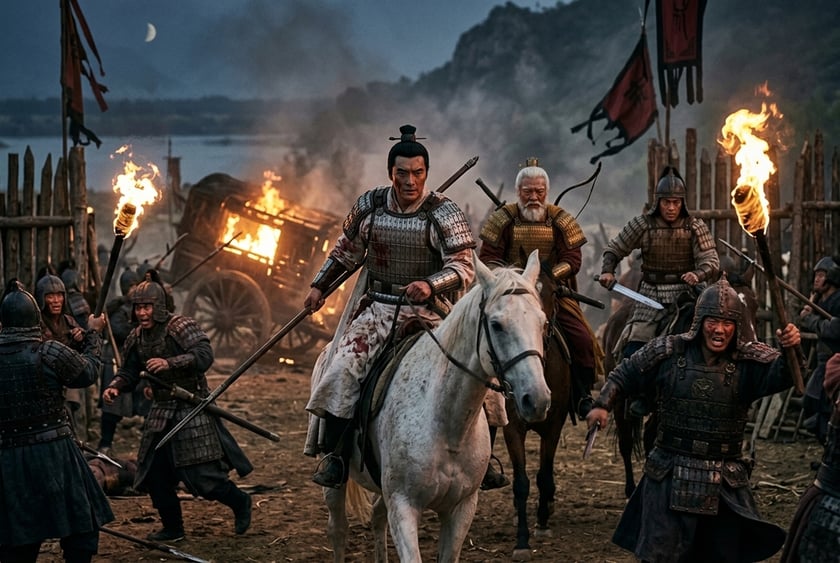
Cao Cao attempted to break through each gate in turn amid the fire at all four gates: the north gate was blocked by Hao Meng and Cao Xing, the south gate by Gao Shun and Hou Cheng; only Dian Wei's furious charge — "eyes blazing, teeth clenched, crashing out" — drove Gao Shun and Hou Cheng back and out of the city [c:17286]. At the east gate he again met Dian Wei acting as rearguard; "galloping through smoke and fire, he emerged first"; Cao Cao followed close behind, but a burning roof beam collapsing from the side of the gate road struck his horse's rear haunches, throwing the horse to the ground. Cao Cao pushed the beam away with his hands; "his arms, beard, and hair were all burned" [c:17287]. Lv Bu then came in person to give chase; Cao Cao "wheeled his horse and headed east," again relying on Dian Wei's rearguard action to escape; along the way he encountered Xiahou Dun leading a relief force that engaged Lv Bu in battle, fighting until dusk when heavy rain fell and both sides dispersed [c:17283]. After Cao Cao escaped back to camp, he "richly rewarded Dian Wei, promoting him to Commander of the Bodyguard" — from that point Dian Wei became Cao Cao's core personal guard, ranked just below the Xiahou and Cao clan generals. In terms of military losses, Cao Cao's forces in the Puyang engagement did not suffer catastrophic casualties, but Cao Cao himself had come within a hair's breadth of death; this kind of "strike the king to end the game" near-capture inflicted a profound psychological shock on Cao Cao. Afterward he became far more cautious about any "inside contact" intelligence and never again risked personally entering a city.
Counterfactual Analysis
What if Cao Cao had not entered the city himself — if Xiahou Yuan or Dian Wei had gone in first? Chen Gong's fire-attack plan was designed specifically to "capture Cao Cao in person" — four gates on fire, four ambush forces, plus Lv Bu's main force outside, capable of annihilating the several thousand troops who had entered. But if Cao Cao had remained outside the city, he could have directed Xiahou Dun and Cao Hong's two external relief forces to rescue those trapped inside, or simply abandoned that contingent and retreated to base to regroup. Cao Cao's habit of attending to everything personally was his personality — and the norm for early warlords. Only after Dian Wei's rescue of his lord did he learn to let trusted fierce commanders take the dangerous risks that would otherwise fall to the supreme commander. If Chen Gong's stratagem had lacked the "open gate performance," Cao Cao might not have entered the city so rashly. The feigned surrender letter alone was not enough to make a battle-tested commander drop his guard; the combination of "Hou Cheng riding out, Dian Wei cutting him down, the banner raised on the wall" and similar sequential theatrical actions was necessary for the ruse to work. That Chen Gong is called the finest strategist in Lv Bu's camp is precisely because he could design this kind of "multi-step deception" — on a par with Jia Xu and Guo Jia. Looking at it from the other direction: if Dian Wei had not managed to rescue Cao Cao, the entire subsequent history of San Guo might have been completely rewritten. Cao Cao dying in 194 at only forty; he would not yet have escorted Emperor Xian to his capital, had the Battle of Guandu, or unified the north. The configurations of Yuan Shao, Liu Bei, Sun Ce, and Lv Bu would all have been entirely different. In this sense, the life-saving value of Dian Wei's rearguard action at Puyang was equivalent to the survival of the Caowei regime itself. This is also why, when Dian Wei died at the Battle of Wancheng (197), Cao Cao's grief over Dian Wei exceeded his grief over his own eldest son Cao Ang — because he understood that without Dian Wei there would have been no Caowei.