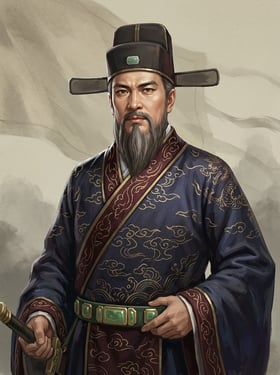
史载(Historical Record)
Cao Cao, styled Mengde, was a man of Qiao in the state of Pei, a descendant of Cao Shen, chancellor of the Han. His adoptive grandfather Cao Teng rose under Emperor Huan of Han to be Palace Attendant and Grand Steward, and was enfeoffed as Marquis of Feiting. Cao Teng's adopted son Cao Song rose to be Grand Commandant, but his true parentage is unclear, with some saying he was a son of the Xiahou clan.
In his youth Cao Cao was exceptionally alert and full of stratagems, but unrestrained and roving in his ways, neglecting proper pursuits, so that most people of the time thought little of him. Yet Qiao Xuan of the state of Liang and He Yong of Nanyang regarded him with special favor. Qiao Xuan once said to Cao Cao: "The realm is about to fall into chaos; none but a talent born to the age can save the world. The one who can bring peace to all under heaven is, I dare say, you!" Xu Shao also appraised him as "a capable minister in an age of order, a treacherous hero in an age of chaos," at which Cao Cao laughed heartily. At twenty, Cao Cao was recommended as Filial and Incorrupt and made a court gentleman, later appointed Northern Commandant of Luoyang, where he became known for strict enforcement of the law, even cudgeling to death the uncle of the Palace Attendant Jian Shuo, who had broken the prohibitions. The capital thus came to dread him, but he was also transferred to be Magistrate of Dunqiu.
In the sixth year of Zhongping (189 CE), Emperor Ling died, and the General-in-Chief He Jin plotted with Yuan Shao to execute the eunuchs, but the Empress Dowager would not allow it. He Jin thereupon summoned Dong Zhuo into the capital, intending to coerce the Empress Dowager, of which Cao Cao disapproved, holding that "the office of the eunuchs has properly existed from ancient times to now; it is only that the ruler of the age ought not to lend them power and favor until things reach this pass. Having decided to punish their crime, one should execute the chief malefactor, and a single jailer would suffice—why this clamorous summoning of generals from outside?" Before Dong Zhuo arrived, He Jin had already been killed by the eunuchs. After Dong Zhuo entered the capital, he deposed the young emperor and set up Emperor Xian, seizing control of the court, and the capital fell into great chaos. Dong Zhuo recommended Cao Cao as Colonel of Agile Cavalry and wished to plot together with him, but Cao Cao, judging that Dong Zhuo would in the end come to ruin, changed his name and made his way east in secret. He gave away all his family wealth, raised troops at Jiwu, and called upon the righteous men of the realm to join in attacking Dong Zhuo.
In the spring of the first year of Chuping (190 CE), Yuan Shu, Han Fu, Kong Zhou, Liu Dai, Wang Kuang, Yuan Shao, Zhang Miao, Qiao Mao, Yuan Yi, Bao Xin, and other lords raised troops simultaneously, honoring Yuan Shao as alliance leader, and Cao Cao was appointed General Who Rouses Valor. On hearing this, Dong Zhuo moved the Son of Heaven to Chang'an and burned the palaces of Luoyang. Fearing Dong Zhuo's strong forces, the lords mostly dared not advance. Cao Cao strongly urged advancing, holding that "this is the time when Heaven destroys him. One battle and the realm is settled—it must not be lost". He thereupon led his troops west and fought Dong Zhuo's general Xu Rong at the Bian River near Xingyang; the engagement went against him, his soldiers suffering heavy casualties, and Cao Cao himself was struck by a stray arrow, escaping only because his cousin Cao Hong yielded him his horse.
A million strong, the Yellow Turbans of Qing Province entered Yanzhou, killing Zheng Sui, Chancellor of Rencheng, and then turned into Dongping. Liu Dai, Inspector of Yanzhou, wished to strike them; Bao Xin dissuaded him, holding that they could not be met by force and that he should first hold firm and wait for them to tire. Liu Dai did not heed him and died in battle. Chen Gong thereupon urged Cao Cao to take up the post of Governor of Yanzhou. Cao Cao then led his army to strike the Yellow Turbans east of Shouzhang; Bao Xin fought hard and died, but Cao Cao finally broke the Yellow Turban army, accepting the surrender of more than three hundred thousand men and over a million men and women, and forming their elite into the "Qing Province troops".
In the spring of the first year of Xingping (194 CE), Cao Cao returned from Xu Province. Earlier, his father Cao Song, while fleeing the chaos of Dong Zhuo, had been killed by Tao Qian's subordinates, and Cao Cao was thus set on revenge. He campaigned against Tao Qian again, storming five cities, with much slaughter wherever he passed. At this time, however, Zhang Miao and Chen Gong rebelled and welcomed Lü Bu into Yanzhou, and many commanderies and counties responded. Cao Cao was forced to march his army back and stood at a stalemate with Lü Bu for more than a hundred days. Later, owing to a locust plague, the people went into great famine, Lü Bu's provisions ran out, and both sides drew off their troops. The next year, Cao Cao attacked and took Dingtao, defeated Lü Bu, and finally pacified Yanzhou. Lü Bu fled east to Liu Bei, and Cao Cao exterminated Zhang Miao's clan to the third degree.
In the first year of Jian'an (196 CE), Cao Cao welcomed Emperor Xian of Han to Xu, and from then on "held the Son of Heaven to command the lords." The emperor appointed Cao Cao General-in-Chief and enfeoffed him as Marquis of Wuping, later appointing him Minister of Works and acting General of Chariots and Cavalry. He adopted the proposals of Zao Zhi, Han Hao, and others and began to implement the agricultural-garrison system, solving the problem of military provisions and laying the foundation for his later unification of the north. In the third year of Jian'an (198 CE), Lü Bu again betrayed Liu Bei, and Cao Cao personally campaigned against Lü Bu, besieging Xiapi. On the advice of Xun You and Guo Jia, Cao Cao breached the Si and Yi rivers to flood the city, finally capturing and killing Lü Bu and Chen Gong.
In the thirteenth year of Jian'an (208 CE), the Han abolished the offices of the Three Excellencies and established a Chancellor and a Grandee Secretary, and Cao Cao was appointed Chancellor. In the summer of the twenty-first year of Jian'an (216 CE), Emperor Xian of Han advanced Cao Cao to be King of Wei. During his rule, Cao Cao gathered worthy talents far and wide, promoted agricultural garrisons, pacified the north, and laid the foundation for the establishment of the state of Wei. His son Cao Pi inherited his position and posthumously honored Cao Cao as Emperor Wu.
演中(In the Novel)
The Cao Cao of Romance of the Three Kingdoms has his image elaborated upon the historical basis, made more dramatic and controversial. The novel opens by depicting Cao Cao's youth: he "loved roaming and hunting, delighted in song and dance; was full of stratagems and quick to adapt". In the Romance, to rid himself of his uncle's tale-bearing to his father, Cao Cao feigned a stroke, so that his father no longer believed the uncle's words, and he was thus able to "indulge himself as he pleased"—echoing the historical record of being "unrestrained and roving, neglecting proper pursuits," though the specific episode is exaggerated. As for Xu Shao's appraisal, in the Romance Cao Cao actively asked for it; Xu Shao at first would not answer, and only under Cao Cao's pressing said, "you are a capable minister in an age of order, a treacherous hero in an age of chaos," at which Cao Cao "was greatly delighted"—highlighting Cao Cao's clear-eyed self-awareness and his acceptance of the name of "treacherous hero."
In his post as Northern Commandant of Luoyang, the Romance emphasizes Cao Cao's iron-handed enforcement of the law: he "set up more than ten five-colored staves at the four gates of the county, and any who broke the prohibitions, sparing not the rich and powerful, were all punished," even cudgeling the uncle of the Palace Attendant Jian Shuo—largely consistent with the historical record, but with greater stress on how his "awesome name shook the realm."
When He Jin summoned outside troops into the capital to attack the eunuchs, Cao Cao's remonstrance in the Romance is more direct and pointed. He not only noted that "the disaster of the eunuchs has existed in every age; it is only that the ruler of the age ought not to lend them power and favor until things reach this pass," but also foretold that "the one who throws the realm into chaos will surely be He Jin"—making Cao Cao's foresight and insight into the times all the more prominent. After He Jin was killed, Cao Cao, together with Yuan Shao, cut through the gates and entered, quelling the disorder within the palace, and "on one hand put out the fire in the palace, requested that Empress Dowager He provisionally take charge of great affairs, dispatched troops to pursue and attack Zhang Rang and the others, and sought out the young emperor", displaying his decisiveness and "loyalty" to the house of Han.
The episode of the attempt to assassinate Dong Zhuo is a highlight of the Romance's shaping of Cao Cao. He borrowed the Seven-Star Treasure Sword from Wang Yun, wishing to "at once cut off Dong Zhuo's head, hang it at the capital's gate, and thereby answer to the realm", displaying his daring and his resolve to rid the country of harm. In the chancellor's residence, he seized the moment when Lü Bu had left and Dong Zhuo was sleeping soundly to draw his blade for the strike, but because Dong Zhuo suddenly awoke he failed, and finally escaped under the pretext of presenting the sword. On his flight, he mistakenly killed the family of Lü Boshe, and uttered the classic line "I would rather wrong all the world than let the world wrong me"—a line that profoundly reveals Cao Cao's cold-blooded, ends-justify-any-means side and became a signature annotation to his image as a "treacherous hero." The historical record holds that Lü Boshe's family was robbed and killed by his son and guests, or that Cao Cao, suspecting they meant him harm, killed them, and there is no line of "I would rather wrong others than let others wrong me"; the Romance made a bold artistic elaboration here.
During the alliance against Dong Zhuo, Cao Cao, displeased at the lords' passive attitude, angrily rebuked them: "these brats are not worth plotting with", and alone led his troops in pursuit of Dong Zhuo—glorious though defeated—displaying his valor and enterprising spirit. In the battle of Xu Province, the Romance emphasizes that Cao Cao, on account of his father's death, slaughtered the people of Xu Province, ordering that "once a city or fortress is taken, all the people within be put to the sword, to avenge my father's death", further intensifying his cruel side and laying the groundwork for Liu Bei's appearance. Chen Gong remonstrated, urging Cao Cao not to slaughter the innocent, but Cao Cao angrily rebuked him: "Long ago you abandoned me and left; with what face do you now come to see me again?" and insisted on revenge, finally causing Chen Gong to leave and join Zhang Miao.
关键关系
* Cao Song (parent_of): Cao Cao's father, who rose to be Grand Commandant. In the histories, Cao Song was Cao Teng's adopted son and his true parentage is unclear. In the Romance, Cao Song is plainly stated to have been originally surnamed Xiahou, taking the surname Cao because Cao Teng adopted him. Cao Cao's attack on Xu Province to avenge his father was one of his important early military actions.
* Qiao Xuan (mentor_of): A famous gentleman of the state of Liang, renowned for judging men. In the histories, Qiao Xuan foretold that Cao Cao was "the one who can bring peace to the realm". In the Romance, Qiao Xuan likewise gave a similar appraisal, holding that "the realm is about to fall into chaos; none but a talent born to the age can save it. The one who can bring peace, is it not you?", affirming Cao Cao's ability.
* He Yong (friend_of): A famous gentleman of Nanyang. In the histories, He Yong, together with Qiao Xuan, esteemed Cao Cao. In the Romance, He Yong likewise foretold that "the house of Han is about to fall; the one who brings peace to the realm must be this man", further raising Cao Cao's repute.
* Wang Fen (rival_of): The provided materials make no direct mention of a rivalry between Wang Fen and Cao Cao. This information may derive from other historical sources or versions of the Romance, or be a general description.
* Xu Shao (acquaintance_of): A famous gentleman of Runan, renowned for judging men. In the histories, Cao Cao once asked Xu Shao, "What sort of man am I?" and Xu Shao answered, "you are a capable minister in an age of order, a treacherous hero in an age of chaos". In the Romance, this episode is preserved, emphasizing that Cao Cao "was greatly delighted" upon hearing it, reflecting his acceptance of his own self-assessment.
* Dong Zhuo (rival_of): A powerful minister at the end of the Eastern Han. In the histories, Cao Cao, displeased at Dong Zhuo's misrule, refused his appointment and raised troops to attack him. In the Romance, Cao Cao further enacted the perilous scene of attempting to assassinate Dong Zhuo; though he did not succeed, it displayed his extraordinary daring and his "loyalty" to the house of Han.
* Yuan Shao (rival_of): Alliance leader against Dong Zhuo. In the histories, Yuan Shao once raised troops together with Cao Cao, but later, owing to differing ideals, friction arose, and Cao Cao refused Yuan Shao's proposal to set up Liu Yu as emperor. In the Romance, Cao Cao showed displeasure at Yuan Shao's hesitation in the campaign against Dong Zhuo, angrily rebuking him: "these brats are not worth plotting with", laying the groundwork for the later Battle of Guandu.
* Chen Gong (ally_turned_rival): An officer of Yanzhou. In the histories, Chen Gong once urged Cao Cao to take up the post of Governor of Yanzhou, then later betrayed Cao Cao and welcomed Lü Bu into Yanzhou. In the Romance, after Cao Cao's failed assassination of Dong Zhuo, Chen Gong traveled with Cao Cao, but later abandoned him because Cao Cao mistakenly killed the family of Lü Boshe and uttered "I would rather wrong all the world than let the world wrong me". In the battle of Xu Province, Chen Gong again remonstrated with Cao Cao not to slaughter the innocent, but Cao Cao would not listen, and Chen Gong finally went over to Zhang Miao and, together with Lü Bu, opposed Cao Cao.
* Lü Bu (rival_of): The foremost warrior of the Three Kingdoms. In the histories, Lü Bu once contended with Cao Cao for Yanzhou, was later defeated by Cao Cao, and captured and killed. In the Romance, Lü Bu's image is more vivid: he betrayed Ding Yuan and Dong Zhuo, later fought Cao Cao many times, and was finally captured and killed by Cao Cao at Xiapi.
* Liu Bei (rival_of): The Brilliant Founding Emperor of Shu Han. In the histories, Liu Bei once attached himself to Cao Cao, then later opposed him. Cao Cao once defeated Liu Bei and accepted the surrender of his subordinate generals. In the Romance, the relationship between Liu Bei and Cao Cao is more complex, with both brief cooperation and long-standing opposition, and Cao Cao's appraisal of Liu Bei—"the heroes of the realm are only you, sir, and Cao"—became a classic.
标志性场景
* Strict enforcement of the law as Northern Commandant of Luoyang: On first taking up the post of Northern Commandant of Luoyang, Cao Cao "made five-colored staves, more than ten on each side of the county gate, and any who broke the prohibitions, sparing not the rich and powerful, were all cudgeled to death," even cudgeling to death the uncle of the Palace Attendant Jian Shuo, so that "the capital reined itself in and none dared offend". This event is depicted in detail in the Romance, becoming an early manifestation of Cao Cao's iron-handed governance.
* Assassination attempt on Dong Zhuo (novel only): Cao Cao borrowed the Seven-Star Treasure Sword from Wang Yun and slipped into the chancellor's residence intending to assassinate Dong Zhuo. Though he did not succeed, his daring was extraordinary, and he left behind the timeless line "I would rather wrong all the world than let the world wrong me". This episode is unrecorded in the Records of the Three Kingdoms and is a classic shaping of Cao Cao's image by Romance of the Three Kingdoms.
* Raising troops against Dong Zhuo: After Dong Zhuo's misrule, Cao Cao "gave away his family wealth, gathered a righteous host, and would thereby execute Zhuo," raising troops at Jiwu. In the Romance, he first issued a forged edict, sent word galloping along every route, then mustered righteous troops and raised a white recruiting banner bearing the words "loyalty and righteousness", displaying his appeal as a regional lord.
* Battle of the Bian River at Xingyang: Among the alliance against Dong Zhuo, only Cao Cao strongly urged advancing, leading his troops west and fighting Dong Zhuo's general Xu Rong at the Bian River near Xingyang; though defeated, his courage and enterprising spirit were displayed.
* Incorporating the Qing Province troops: Cao Cao broke the Yellow Turban army in Yanzhou, accepting the surrender of more than three hundred thousand men and over a million men and women, and forming their elite into the "Qing Province troops". This army became an important early military force for Cao Cao, laying the foundation for his later unification of the north.
* Revenge campaign against Xu Province: Cao Cao's father Cao Song was killed by Tao Qian's subordinates, and Cao Cao was thus set on revenge, campaigning twice against Xu Province with much slaughter wherever he passed. In the Romance, this episode is rendered as a manifestation of Cao Cao's cruel side, with his order that "once a city or fortress is taken, all the people within be put to the sword, to avenge my hatred".
* Contending with Lü Bu for Yanzhou: Zhang Miao and Chen Gong rebelled and welcomed Lü Bu into Yanzhou; Cao Cao was forced to march his army back and stand at a stalemate with Lü Bu, finally defeating Lü Bu and pacifying Yanzhou. This series of battles displayed Cao Cao's outstanding military talent.
* Welcoming Emperor Xian of Han to Xu: Cao Cao welcomed Emperor Xian of Han to Xu, and from then on "held the Son of Heaven to command the lords," providing political legitimacy for his later growth in strength.
* Implementing the agricultural-garrison system: Cao Cao adopted the proposals of Zao Zhi, Han Hao, and others and began to implement the agricultural-garrison system, solving the problem of military provisions and providing a solid logistical basis for campaigns on every front.
* Capturing and killing Lü Bu at Xiapi: Cao Cao personally campaigned against Lü Bu, besieged Xiapi, and finally breached the Si and Yi rivers to flood the city, capturing and killing Lü Bu and Chen Gong. This battle entirely removed the powerful military threat of Lü Bu.
* Enfeoffed as King of Wei: In the twenty-first year of Jian'an (216 CE), Emperor Xian of Han advanced Cao Cao to be King of Wei, marking a great rise in Cao Cao's political standing and laying the foundation for Cao Wei's replacement of the Han.
* Recruiting worthy men and gentlemen: Cao Cao recruited worthy men and gentlemen in Yanzhou, and many civil officials and military officers—Xun Yu, Xun You, Cheng Yu, Guo Jia, Liu Ye, Man Chong, Lu Qian, Mao Jie, Yu Jin, Dian Wei, and others—came to join him, laying the foundation in talent for the strength of Cao Cao's faction. Dian Wei's valor and loyalty to Cao Cao are emphatically depicted in the Romance.
Portrait file
Character profile
- Appearance
- Cao Cao stood seven chi tall, with narrow eyes and a long beard, riding a white horse with a golden saddle, in a jade belt and brocade robe.
- Character
- In his youth Cao Cao was alert and resourceful, full of scheming, chivalrous and unrestrained, and did not tend to any occupation; he said of himself, 'I will employ the wits and strength of all under Heaven, governing them with the Way.' Suspicious and decisive, clever and adaptable, ruthless and conceited, he held great ambitions and a keen desire to uphold the altars of state with all his strength.
- Manner of speech
- Cao Cao defended himself cleverly: even as a youth he could clear himself of his uncle's slander, and he was delighted to hear Xu Shao's verdict of 'a crafty hero.' Impassioned and stirring, he was adept at rousing his comrades with words, and often analyzed the advantages and disadvantages of a situation; on the question of the Mandate of Heaven he held to a forbearing refusal: 'If the Mandate of Heaven rests with me, then I shall be King Wen of Zhou.'
- Life
- Cao Cao was a native of Qiao in the Pei state, surnamed Cao, named Cao and styled Mengde, a descendant of the Han Chancellor Cao Can and the son of Cao Song, who was the adopted son of Cao Teng. At twenty he was recommended as a Filial and Incorrupt candidate and made a Gentleman, appointed Commandant of the Northern Section of Luoyang, and later promoted to Chancellor of Jinan; in the sixth year of Zhongping he raised troops to attack Dong. He received the Son of Heaven and made Xu the capital, was appointed Grand General and enfeoffed as Marquis of Wuping, defeated Yuan Shao at Guandu and thereupon pacified the region north of the Yellow River, and later became Chancellor, Duke of Wei, and King of Wei, dying at Luoyang in the twenty-fifth year of Jian'an at the age of sixty-six.
- Weapons
- Cao Cao once borrowed the Seven-Star treasured sword from Wang Yun.
- Anecdotes
- Cao Cao was a powerful minister at the end of the Eastern Han and the founder of the state of Wei, posthumously honored in the first year of Huangchu as Emperor Wu. He used the various Xiahou and Cao kinsmen as his trusted intimates, established a military and political foundation, repeatedly tested his sons by asking about their aspirations, and loved to cultivate talent.
Relationships
310 relationships
Family27
Lord & vassal38
Friends23
Enemies65
Teacher & student4
Other132
Quotes
767 recorded lines · 3 featured
「寧教我負天下人,休教天下人負我。」
A classic maxim of Cao Cao, embodying his true nature as a ruthless hero and his pragmatism.
今天下英雄,惟使君與操耳。
The heart of 'Cao Cao and Liu Bei Discuss Heroes over Plum Wine,' displaying Cao Cao's discerning eye for men and his political ambition.
「諸公佳作,過譽甚矣。孤本愚陋,始舉孝廉。後值天下大亂,築精舍於譙東五十里,欲春夏讀書,秋冬射獵,以待天下清平,方出仕耳。不意朝廷徵孤為點軍校尉,遂更其意,專欲為國家討賊立功,圖死後得題墓道曰:『漢故征西將軍曹侯之墓』,平生願足矣。念自討董卓、剿黃巾以來,除袁術、破呂布、滅袁紹、定劉表,遂平天下。身為宰相,人臣之貴已極,又復何望哉?如國家無孤一人,正不知幾人稱帝,幾人稱王。或見孤權重,妄相忖度,疑孤有異心,此大謬也。孤常念孔子稱文王之至,此言耿耿在心。但欲孤委捐兵眾,歸就所封武平侯之職,實不可耳。誠恐一解兵柄,為人所害;孤敗則國家傾危,是以不得慕虛名而處實禍也。諸公必無知孤意者。」
Cao Cao recounts the ambition of his life, voicing his true thought that 'were it not for me, there is no telling how many would have proclaimed themselves emperor.'
Chapters102 回 ▸
- 史ch.1ch.2ch.3ch.5ch.6ch.7ch.9ch.10ch.11ch.12ch.13ch.14ch.15ch.16ch.17ch.18ch.19ch.20ch.22ch.23ch.25ch.26ch.27ch.29ch.30ch.32ch.34ch.35ch.36ch.37ch.38ch.46ch.47ch.49ch.53ch.54ch.57
- 演ch.1ch.2ch.3ch.4ch.5ch.6ch.10ch.11ch.12ch.13ch.14ch.16ch.17ch.18ch.19ch.20ch.21ch.22ch.23ch.24ch.25ch.26ch.27ch.28ch.29ch.30ch.31ch.32ch.33ch.34ch.36ch.37ch.39ch.40ch.41ch.42ch.44ch.45ch.46ch.47ch.48ch.49ch.50ch.51ch.56ch.57ch.58ch.59ch.60ch.61ch.66ch.67ch.68ch.69ch.70ch.71ch.72ch.73ch.74ch.75ch.76ch.77ch.78ch.80ch.114
Relationship timeline137 条 ▸
史 ch.1
- He Yong§2
friend_of
唯梁国乔玄、南阳何颙异焉
enemy_of
拒卓署,逃归乡里,散家财合义兵将以诛卓
- Xu Rong§7
fights_in
与战于荥阳汴水,不利
- Yuan Shao§11
rival_of
拒其立虞为帝议;又拒其玉印之示,"由是益不直绍,图诛灭之"
- Yuan Shao§19
friend_of
与绍会击袁术、公孙瓒等,皆破之
- Tao Qian§23
enemy_of
父嵩为陶谦所害,志在复仇东伐
- Lü Bu§24
enemy_of
与布相守百余日;后于下邳擒杀之
- Zhang Xiu§35
betrayed_by
降而复反,杀长子昂、弟子安民
- Lü Bu§39
enemy_of
决泗、沂水灌下邳;执陈宫,生擒布、宫,皆杀之
- Gao Gan§67
betrayed_by
公之拔邺,幹降;后以州叛
史 ch.2
- Cao Pi§1
parent_of
太祖立丕为魏太子;崩后丕嗣位为丞相魏王
史 ch.3
- Cao Rui§1
kin_of
生而太祖爱之,常令在左右
史 ch.6
史 ch.12
史 ch.16
史 ch.17
史 ch.29
- Hua Tuo§19
enemy_of
太祖怒收华佗付许狱拷竟
史 ch.30
- Tadun§9
enemy_of
自征于柳城,临阵斩之
史 ch.32
史 ch.34
- Liu Bei§6
fights_in
曹公军至,追及先主于当阳长阪
史 ch.36
- Ma Chao§19
enemy_of
曹公用贾诩谋,离间超、遂,更相猜疑,军以大败
史 ch.49
- Taishi Ci§22
friend_of
闻其名遗书,发省无所道,但贮当归(隐辞招纳)
史 ch.53
- Sun Ce§4
enemy_of
闻策薨欲乘丧伐吴,被张纮谏止
演 ch.2
- He Jin§14
advises_in
议者;劝勿尽诛宦官("倘機不密,必有滅族之禍")
演 ch.3
演 ch.4
演 ch.5
- Cao Song§1
kin_of
父子;操归陈留见父,备说前事并谋起兵
betrayed_by
弃曹而去(不忍刺杀,自投东郡)
演 ch.6
rival_of
责其按兵不动,怒呼"竖子不足与谋"
演 ch.10
- Bao Xin§7
commands_in
共同受诏破青州黄巾;鲍信殺入重地为贼所害
演 ch.11
- Tao Qian§7
enemy_of
因父之冤兴兵围徐州;后纳郭嘉之议退兵
演 ch.14
serves
应诏起山东之兵救驾;受封司隶校尉、假节钺、录尚书事;後自封大将军武平侯
演 ch.16
- Liu Bei§34
friend_of
称「玄德與吾兄弟也」、上宾相待、与并力诛吕布
演 ch.18
演 ch.19
演 ch.20
friend_of
释其缚解衣衣之延上坐;拜为中郎将赐爵关内侯
enemy_of
密使人诬告杨彪交通袁术,遂收下狱
- Zhao Yan§7
enemy_of
大怒收赵彦杀之
enemy_of
借田猎以观动静;纵马遮于天子之前迎受呼贺;不献还宝雕弓亲自悬带
- Dong Cheng§15
rival_of
赶至探看,索袍带细察试探,疑「莫非其中有謀乎」
演 ch.21
演 ch.23
- Mi Heng§8
enemy_of
命为鼓吏以辱之;遣往荆州为使,以借刀杀人
演 ch.24
enemy_of
曹操将董承等五人并全家老小押送各门处斩,死者七百余人
enemy_of
王子服等四人同被斩,后人有诗叹之
演 ch.25
演 ch.27
- Guan Yu§1
friend_of
不忘故主,来去明白,真丈夫;亲送征袍路费
演 ch.30
enemy_of
公开为敌;阵上以鞭指相骂
演 ch.32
演 ch.33
演 ch.34
演 ch.40
演 ch.41
- Zhao Yun§48
witnesses
景山顶上望见赵云之威,叹"真虎将也",令各处不许放冷箭只要捉活的
演 ch.44
演 ch.45
演 ch.46
演 ch.47
演 ch.48
演 ch.56
- Zhou Yu§13
rival_of
從程昱計,表奏周瑜為南郡太守,意在令周瑜自與劉備為讎敵
演 ch.58
- Han Sui§5
betrayed_by
密书诱韩遂擒马超送许都,封以西凉侯
演 ch.59
- Han Sui§9
witnesses
阵前单骑会话叙旧,作疑兵
serves
凯旋入朝;获赞拜不名、入朝不趋、剑履上殿之礼
演 ch.60
enemy_of
因人物猥琐、语言冲撞而拂袖怠慢
- Zhang Song§14
enemy_of
西教场点虎卫五万耀威;怒其揭短,喝令斩之
演 ch.61
- Sun Quan§43
rival_of
兴四十万兵报赤壁之雠;遥望叹生子當如孫仲謀;山上对话各责其逆顺;相持月余互有胜负
演 ch.66
演 ch.67
- Yang Song§14
betrayed_by
受金甲与密书贿赂,譖庞德、为内应
演 ch.69
- Ji Tai§25
enemy_of
因衣带诏事昔曾杀吉平
演 ch.71
- Cai Yong§3
friend_of
操与蔡邕相善,故访蓝田之庄
演 ch.73
演 ch.74
- Pang De§2
witnesses
先疑令纳先锋印,后扶起抚慰;闻其抬榇出师大喜「孤何忧焉」
演 ch.75
- Sun Quan§8
friend_of
遣使致书结好,许割江南之地以封孙权,令袭关公之后
演 ch.76
- Xu Huang§10
friend_of
阅其军容比之周亚夫,封平南将军
演 ch.77
- Guan Yu§25
friend_of
设牲醴祭祀,以王侯之礼葬于洛阳南门外,赠为荆王
演 ch.78
Inner monologues · AI-generated3 段 ▸
- Throughout my life, I have often cleared the way with the edge of my army, and often settled matters by winning people’s
- I, Cao Mengde, have come this far relying neither on valor in a single moment nor on the words “Mandate of Heaven” alone
- In my youth, I was quick-witted and alert, and always thinking of ways to adapt. Yet I was also unruly and free-spirited
Life events125 ▸
- 0189-01-01 · LuoyangAssassination of He Jin· Witness
- 0189-01-01 · ChenliuCao Cao Raises an Army· Instigator
- 0190-01-01 · SuanzaoCampaign against Dong Zhuo· Commander
- 0190-01-01 · Sishui PassBattle of Sishuiguan· Witness
- 0192-01-01 · Qing ProvinceCao Cao Defeats the Qingzhou Yellow Turbans· Commander
- 0192-01-01 · JuanchengMao Jie Advocates the Strategy of Serving the Emperor· Commander
- 0193-01-01 · Xu ProvinceCao Cao's Campaign Against Xu Province· Commander
- 0194-01-01 · YanzhouLü Bu's Seizure of Yanzhou· Commander
- 0194-01-01 · Xu ProvinceCao Cao's Campaign Against Tao Qian· Commander
- 0194-01-01 · Xu ProvinceCao Cao's Attack on Xu Province· Commander
- 0194-01-01 · PuyangFire Attack at Puyang· Commander
- 0195-01-01 · YanzhouBattle of Yanzhou· Commander
- 0195-01-01 · DingtaoDefeat of Lu Bu at Dingtao· Commander
- 0196-01-01 · XuchangStratagem of Two Tigers Fighting over Food· Instigator
- 0196-01-01 · XuchangBeginning of the Tuntian Military-Agricultural Colonies· Instigator
- 0196-01-01 · LuoyangXu Huang Joins Cao Cao· Commander
- 0196-01-01 · XuchangCao Cao Escorts the Emperor and Moves the Capital to Xu· Instigator
- 0196-01-01 · XuchangCao Cao Receives the Emperor and Establishes the Capital at Xu· Instigator
- 0196-01-01 · XuchangCao Cao Receives and Serves the Emperor· Instigator
- 0196-01-01 · LuoyangEmperor Xian of Han Returns East· Instigator
- 0196-01-01 · LuoyangMoving the Imperial Court to Xu· Instigator
- 0196-01-01 · JuanchengXun Yu's Counsel to Escort the Emperor· Commander
- 0196-01-01 · YeGuo Jia Leaves Yuan Shao and Joins Cao Cao· Commander
- 0197-01-01 · WanchengBattle of Wancheng· Commander
- 0197-01-01 · WanchengZhang Xiu's Night Raid on Wancheng· Commander
- 0197-01-01 · YingchuanCao Cao Cuts His Hair in Place of His Head· Commander
- 0198-01-01 · XiapiBattle of Xiapi· Commander
- 0198-01-01 · XiapiFlooding of Xiapi via the Yi and Si Rivers· Commander
- 0198-01-01 · Chang'anDuan Wei and Wu Xi Execute Li Jue and Guo Si· Witness
- 0198-01-01 · XuMi Heng Beats the Drum and Reviles Cao Cao· Instigator
- 0198-01-01 · LangyaZang Ba Submits to Cao Cao· Commander
- 0198-01-01 · XuchangGuo Jia's Ten Advantages and Ten Disadvantages· Commander
- 0199-01-01 · XuchangZhang Xiu Surrenders to Cao Cao· Instigator
- 0199-01-01 · ShouchunCao Cao's Campaign Against Yuan Shu· Commander
- 0199-01-01 · XiapiTrial at White Gate Tower· Commander
- 0199-01-01 · XuchangCao Cao and Liu Bei Discuss Heroes over Plum Wine· Instigator
- 0200-01-01 · BaimaGuan Yu Slays Yan Liang· Commander
- 0200-01-01 · XuchangGuan Yu Passes Five Passes and Slays Six Generals· Witness
- 0200-01-01 · XiapiGuan Yu Surrenders to Cao Cao· Instigator
- 0200-01-01 · XuchangThe Ten Victories and Ten Defeats Theory· Commander
- 0200-01-01 · YuzhangHua Xin Leaves Wu and Enters Xu (Capital)· Instigator
- 0200-01-01 · XiapiGuan Yu's Three Conditions at Tushan· Commander
- 0200-01-01 · XuchangBattle of Guandu· Commander
- 0200-01-01 · XuchangGuan Yu Hangs Up His Seal and Returns the Gold· Witness
- 0200-01-01 · YeCao Chong Weighs the Elephant· Witness
- 0200-01-01 · BaimaBattle of Boma· Commander
- 0200-01-01 · XuchangGirdle Edict· Victim
- 0201-01-01 · CangtingBattle of Cangting· Commander
- 0201-01-01 · Chang'anWei Ji's Salt Office Policy· Instigator
- 0201-01-01 · RangshanBattle of Rangshan· Commander
- 0203-01-01 · DonghaiYu Jin Executes Chang Xi· Instigator
- 0203-01-01 · Wu CountySun Quan Refuses to Send His Son to the Wei Court
- 0203-01-01 · LiyangBattle of Liyang· Commander
- 0204-01-01 · YeBattle of Ye· Commander
- 0205-01-01 · NanpiBattle of Nanpi· Commander
- 0205-01-01 · PingyuanYuan Tan Slain at Pingyuan· Commander
- 0205-01-01 · ZhendingZhang Yan and the Black Mountain Army· Instigator
- 0206-01-01 · Huguan PassBattle of Hugouguan· Commander
- 0206-01-01 · HuguanGao Gan's Rebellion in Bing Province· Commander
- 0207-01-01 · LiuchengCao Cao's Northern Campaign against the Wuhuan· Commander
- 0207-01-01 · YeCao Cao Pacifies Hebei· Commander
- 0207-01-01 · Yi PrefectureCao Cao Defeats the Yuan Clan· Commander
- 0207-01-01 · White Wolf MountainCao Cao's Campaign Against the Wuhuan· Commander
- 0207-01-01 · White Wolf MountainBattle of White Wolf Mountain· Commander
- 0207-01-01 · XuchangCheng Yu's Forged Letter Lures Xu Shu· Commander
- 0207-01-01 · Yi PrefectureDeath of Guo Jia· Witness
- 0207-01-01 · YixianGuo Jia Dies Young· Witness
- 0208-01-01 · XiangyangLiu Cong's Surrender to Cao Cao· Instigator
- 0208-01-01 · Huarong RoadHuarong Road· Commander
- 0208-01-01 · XuchangExecution of Kong Rong· Instigator
- 0208-01-01 · Jing ProvinceCao Cao's Southern Campaign Against Jing Province· Commander
- 0208-01-01 · XuchangCao Cao Abolishes the Three Excellencies and Appoints Himself Chancellor· Instigator
- 0208-01-01 · XuchangCao Cao Has Hua Tuo Executed· Instigator
- 0208-01-01 · ChibiBattle of Red Cliffs· Commander
- 0208-01-01 · ChibiBitter-Flesh Stratagem· Victim
- 0208-01-01 · ChibiBattle of Red Cliffs· Commander
- 0208-01-01 · Chang'anZhong Yao Superintends Guanzhong· Instigator
- 0208-01-01 · ChangbanBattle of Changban· Commander
- 0210-01-01 · Ye (Bronze Sparrow Terrace site)Cao Cao Builds the Bronze Bird Terrace· Instigator
- 0210-01-01 · YeBronze Bird Terrace Inauguration Ceremony· Instigator
- 0211-01-01 · HuayinZhang Ji Defeats Ma Chao at Huayin· Commander
- 0211-01-01 · ChengduZhang Song Presents the Map and Plots to Cede Shu· Witness
- 0211-01-01 · Tong PassCao Cao Cuts His Beard and Discards His Robe· Commander
- 0211-01-01 · Tong PassBattle of Weinan· Commander
- 0211-01-01 · Tong PassBattle of Tong Pass· Commander
- 0211-01-01 · Tong PassJia Xu Sows Discord Between Ma Chao and Han Sui· Commander
- 0212-01-01 · ShouchunDeath of Xun Yu· Instigator
- 0212-01-01 · YeDeliberation on Establishing the Five-Rank Peerage· Instigator
- 0212-01-01 · XuchangExecution of Ma Teng· Instigator
- 0213-01-01 · YeCui Yan Publicly Endorses Cao Pi as Heir· Witness
- 0213-01-01 · YeCao Cao Created Duke of Wei· Instigator
- 0213-01-01 · XuchangCao Cao Elevated to Duke of Wei· Instigator
- 0213-01-01 · RuxukouBattle of Ruxukou· Commander
- 0213-01-01 · RuxukouGan Ning's Hundred Horsemen Raid on the Wei Camp· Commander
- 0214-01-01 · XuchangDeath of Empress Fu· Instigator
- 0214-01-01 · XuchangDeath of Empress Fu· Instigator
- 0214-01-01 · XuchangDeposition and Execution of Empress Fu· Instigator
- 0215-01-01 · NanzhengZhang Lu Surrenders to Cao Cao· Commander
- 0215-01-01 · HanzhongCao Cao's Campaign Against Zhang Lu· Commander
- 0215-01-01 · HanzhongCao Cao's Campaign Against Hanzhong· Commander
- 0215-01-01 · HefeiGan Ning's Raid with a Hundred Horsemen· Commander
- 0215-01-01 · Yangping PassBattle of Yangping Pass· Commander
- 0215-01-01 · Danyang CommanderyLu Xun Defeats Fei Zhan· Instigator
- 0216-01-01 · YeEstablishment of the Wei State· Instigator
- 0216-01-01 · YeDeath of Cui Yan· Instigator
- 0216-01-01 · YeThe Cui Yan Affair· Instigator
- 0216-01-01 · YeCao Cao Created King of Wei· Instigator
- 0216-01-01 · YeCao Cao Elevated to King of Wei· Instigator
- 0217-01-01 · YeCao Zhi's Sima Gate Incident· Instigator
- 0217-01-01 · YeCao Pi Named Heir Apparent· Instigator
- 0217-01-01 · RuxukouBattle of Ruxu (217)· Commander
- 0218-01-01 · Sanggan RiverCao Zhang's Northern Campaign Against the Wuhuan of Daijun
- 0218-01-01 · XuRebellion of Geng Ji and Wei Huang at Xu· Victim
- 0219-01-01 · HanzhongDeath of Yang Xiu· Instigator
- 0219-01-01 · YeExecution of Yang Xiu· Instigator
- 0219-01-01 · HanzhongHanzhong Campaign· Commander
- 0219-01-01 · Han RiverBattle of Han River· Commander
- 0219-01-01 · YeCase of Wei Feng's Conspiracy· Commander
- 0220-01-01 · XuchangThe Death of Hua Tuo· Instigator
- 0220-01-01 · LuoyangDeath of Taizu and Jia Kui's Management of the Funeral· Victim
- 0220-01-01 · YeSuccession Struggle Between Cao Pi and Cao Zhi· Instigator
- 0220-01-01 · LuoyangDeath of Cao Cao· Victim
- 0220-01-01 · YeCao Cao Dies and Emperor Wen of Wei Ascends the Throne
- 0220-01-01 · Gaoling Mausoleum (Cao Cao Mausoleum)Burial of Cao Cao at Gaoling· Victim
- 0254-01-01 · LuoyangGao Rou's Administration of Criminal Law· Witness