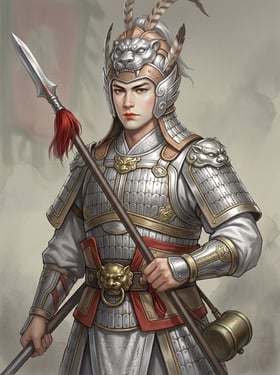
Historical Record
Ma Chao, styled Mengqi, was a native of Maoling in the Right Fufeng and a descendant of Ma Yuan, the General Who Subdues the Waves. His father Ma Teng rose up in the western region together with Bian Zhang, Han Sui, and others at the end of Emperor Ling's reign. In the third year of Chuping (192), Ma Teng and Han Sui led their forces to Chang'an. The Han court appointed Han Sui General Who Guards the West and sent him back to Jincheng, and appointed Ma Teng General Who Conquers the West, stationing him at Mei County. Later Ma Teng's assault on Chang'an failed, and he withdrew to Liang Province. While the Colonel-Director of Retainers Zhong Yao garrisoned Guanzhong, he wrote to Ma Teng and Han Sui analyzing where their interests lay, prompting them to send their sons to attend at court. In the tenth year of Jian'an (205), Ma Teng dispatched Ma Chao to follow Zhong Yao in the campaign against Guo Yuan and Gao Gan at Pingyang, and Ma Chao's subordinate general Pang De personally took Guo Yuan's head. Afterward Ma Teng fell out with Han Sui and asked to return to the capital region. The court therefore summoned Ma Teng as Commandant of the Guards and appointed Ma Chao General of the Vanguard, enfeoffing him as Marquis of Duting and giving him command of Ma Teng's troops. In the sixteenth year of Jian'an (211), when Cao Cao campaigned against Zhang Lu and passed through Guanzhong, he aroused the suspicions of Ma Chao and others. Ma Chao thereupon rebelled together with Han Sui, Yang Qiu, Li Kan, Cheng Yi, and others, stationing his troops at Tong Pass. Cao Cao personally led a great army west and confronted Ma Chao and the others at Tong Pass. Adopting Jia Xu's strategem, Cao Cao sowed discord between Ma Chao and Han Sui, making them suspicious of each other, and finally routed Ma Chao's coalition, slaying Cheng Yi, Li Kan, and others. Ma Chao and his men fled to Liang Province, Yang Qiu fled to Anding, and Guanzhong was pacified. Cao Cao pursued as far as Anding, but because matters arose in the north, he led his army back east. Yang Fu advised Cao Cao, pointing out that Ma Chao had the valor of Lü Bu and Ying Bu and deeply won the hearts of the Qiang and Hu, and that if he were not strictly guarded against, the commanderies of Long would no longer belong to the state. Cao Cao agreed, but his hasty withdrawal left his defenses incomplete. As expected, Ma Chao led the chieftains of the various Rong to attack the commanderies and counties of Long, where the various counties answered him in turn, and only Jicheng held out. Ma Chao won over all the host of Longyou, and Zhang Lu further sent his great general Yang Ang to aid him, with over ten thousand men besieging Jicheng. Yang Fu, the defending general of Jicheng, led the people and soldiers in holding out for several months, until the Inspector Wei Kang finally opened the gates and surrendered. After Ma Chao entered the city, he detained Yang Fu's younger cousin Yang Yue and killed the Inspector Wei Kang. Yang Fu, Jiang Xu, Liang Kuan, Zhao Qu, and others conspired to strike back at Ma Chao; Yang Fu and Jiang Xu rose up at Lucheng, but Ma Chao could not take it. Liang Kuan and Zhao Qu shut the gates of Jicheng, leaving Ma Chao unable to enter. Caught between advance and retreat, Ma Chao fled to Hanzhong to attach himself to Zhang Lu. Zhang Lu wished to give his daughter to him in marriage, but someone remonstrated that a man who did not love his own kin could hardly love others, and Zhang Lu desisted. Ma Chao went unused at Hanzhong and grew inwardly resentful. In the nineteenth year of Jian'an (214), hearing that Liu Bei was besieging Liu Zhang at Chengdu, he secretly wrote to ask to surrender. After Liu Bei took control of Yi Province, he regarded Ma Chao as one of his "claws and fangs." c:6765 In the first year of Zhangwu (221), Liu Bei proclaimed himself emperor and appointed Ma Chao Cavalry General, with concurrent governorship of Liang Province, and advanced his enfeoffment to Marquis of Lixiang. In the second year of Zhangwu (222), Ma Chao died at the age of forty-seven. On his deathbed he submitted a memorial to Liu Bei, saying that his clan of more than two hundred members had been almost entirely slaughtered by Cao Cao, and that only his younger cousin Ma Dai remained; he begged His Majesty to entrust him with the continuance of the clan's sacrifices, and said nothing more. c:4273 Liu Bei posthumously honored Ma Chao as Marquis Wei, and his son Ma Cheng inherited the title. Ma Dai rose to General Who Pacifies the North and was advanced to Marquis of Chencang. Ma Chao's daughter was married to Liu Li, Prince of Anping.
In the Novel
The Ma Chao of Romance of the Three Kingdoms has his image greatly elaborated and embellished upon the historical foundation, making him still more legendary. He first appears in Chapter 10 at the age of only seventeen, with "a face like polished jade, eyes like shooting stars, a tiger's frame and ape's arms, a panther's belly and wolf's waist," wielding a long spear and mounted on a fine steed, valiant and unmatched. In his first battle he stabbed Wang Fang to death and captured Li Meng alive, displaying the extraordinary martial skill of a youthful hero. c:4276
In the novel, Ma Chao's uprising against Cao is depicted as a tragic act of avenging his father. When Ma Teng was summoned into Xu, Ma Chao had urged his father to "raise all the troops of Xiliang and follow you, Father, in storming into Xuchang to rid the realm of this evil," but Ma Teng would not heed him, taking only his second and third sons Ma Xiu and Ma Tie and his nephew Ma Dai with him. c:15570 Later, when Ma Teng's plot with Huang Kui to assassinate Cao Cao was exposed, his father and brothers were all killed by Cao Cao, and Ma Dai fled back to Xiliang through the night to bring word. c:4278 This deepened Ma Chao's hatred of Cao Cao still further and provided ample motive for his later revolt. Joining forces with Han Sui to attack Cao Cao, Ma Chao's valor was greatly exaggerated in the Battle of Tong Pass. He once pursued Cao Cao alone, and Cao Cao was so startled that "the whip dropped from his hand," and he "cut his beard and cast off his robe" to escape the pursuit. c:15577 The scene of Xu Chu "fighting Ma Chao stripped to the waist" pushes Ma Chao's martial prowess to its peak; battling Cao Cao's "Tiger Idiot" Xu Chu for over a hundred bouts without a victor, it became a classic passage of the novel. The novel also describes Ma Chao's parley on horseback with Cao Cao on the Wei Bridge, where Xu Chu glared furiously at Ma Chao, making him not dare to act rashly—slightly different from the historical record, but bringing out all the more Xu Chu's valor and Ma Chao's wariness. c:15608
Before joining Liu Bei, Ma Chao had attached himself to Zhang Lu and was sent by Zhang Lu to attack Jiameng Pass. During this time he fought a thrilling night battle with Zhang Fei, the two "battling for over a hundred bouts without a victor," their "spirits redoubling," until they each withdrew because of the late hour; this fight greatly raised Ma Chao's standing in the readers' eyes. c:15589 Later Zhuge Liang sent Li Hui to persuade Ma Chao to surrender; Li Hui urged Ma Chao with the warning "General, your calamity is not far off," pointing out that he had "no place in all the world and no lord to call his own," and in the end Ma Chao, "greatly ashamed," beheaded Yang Bai and submitted to Liu Bei. c:4286 After surrendering to Liu Bei, when taking Chengdu, Ma Chao used the power of his own renown to persuade Liu Zhang to surrender, turning Liu Zhang's "face the color of earth," so that he finally opened the gates and surrendered, sparing the people from slaughter. c:4288 After Liu Bei proclaimed himself King of Hanzhong, Ma Chao was ranked among the "Five Tiger Generals" alongside Guan Yu, Zhang Fei, Zhao Yun, and Huang Zhong, a position of high distinction. c:6776 The novel also depicts Ma Chao patrolling the army camp and seizing a trusted aide of Peng Yang, thereby exposing Peng Yang's plot of rebellion, further demonstrating Ma Chao's loyalty and vigilance. c:4290
Key Relationships
* Ma Teng (parent_of): In the histories, the father of Ma Chao, who rose up with Han Sui and was later summoned by Cao Cao as Commandant of the Guards and finally killed by Cao Cao. In the novel, Ma Teng was lured into Xu by Cao Cao, and when his plot with Huang Kui was exposed, father and sons were all beheaded, becoming the direct cause of Ma Chao's revolt against Cao. c:4278
* Han Sui (friend_of): In the histories, a Xiliang warlord like Ma Teng, who later rebelled against Cao together with Ma Chao but was broken by Cao Cao's stratagem of sowing discord. In the novel, Han Sui sworn brotherhood with Ma Chao and rose up against Cao together, but under Cao Cao's stratagem Ma Chao grew suspicious of him, and in the end Ma Chao cut off one of Han Sui's arms, and the two became bitter enemies. c:4282
* Cao Cao (enemy_of): In the histories, Ma Chao rose in revolt out of suspicion at Cao Cao's campaign against Zhang Lu and was later defeated by Cao Cao. In the novel, Cao Cao was the slayer of Ma Chao's father, whom Ma Chao hated to the bone; he pursued Cao Cao many times and vowed to "take you alive and devour your flesh." c:4279
* Guo Yuan (enemy_of): In the histories, Ma Chao once followed Zhong Yao in the campaign against Guo Yuan, whose head was taken by his subordinate general Pang De. c:4269 The novel mentions this as well, but without detailed description.
* Liu Bei (lord_of): In the histories, when Ma Chao was thwarted at Hanzhong, he surrendered to Liu Bei, who regarded him as one of his "claws and fangs." c:6765 In the novel, after surrendering to Liu Bei, Ma Chao was moved by Liu Bei's deference to worthy men, saying "Now I have met an enlightened lord, as if parting the clouds and mist to see the blue sky," and was made one of the Five Tiger Generals. c:4286
* Zhang Lu (temporary_lord_of): In the histories, after his defeat Ma Chao attached himself to Zhang Lu but went unused. In the novel, Zhang Lu once wished to take Ma Chao as his son-in-law, but desisted because of Yang Bai's remonstrance, and later, believing slander, left Ma Chao caught between advance and retreat. c:6772
* Zhang Fei (rival_turned_ally): Unique to the novel. At Jiameng Pass, Ma Chao battled Zhang Fei for several hundred bouts without a victor, displaying the extraordinary martial skill of both and laying the foundation for Ma Chao's standing after surrendering to Liu Bei. c:15588
* Xu Chu (rival): Unique to the novel. In the Battle of Tong Pass, Xu Chu "fought Ma Chao stripped to the waist," the two battling without a victor, in a famous duel scene of the novel. c:15580
* Pang De (subordinate): In the histories, Pang De was a subordinate general of Ma Chao who took Guo Yuan's head. In the novel, Pang De was a trusted general of Ma Chao who campaigned with him many times, later unable to follow Ma Chao into Shu because of illness, and finally submitting to Cao. c:4285
* Ma Dai (cousin_and_subordinate): In the histories, Ma Chao's younger cousin, who later followed Ma Chao into Shu and was entrusted by the dying Ma Chao to Liu Bei. c:4273 In the novel, after Ma Teng's death Ma Dai fled back to Xiliang through the night to bring word, and always followed Ma Chao, being an important kinsman and subordinate general of his. c:4278
Iconic Scenes
* The Battle of Tong Pass: In the histories, Ma Chao and Han Sui's coalition confronted Cao Cao at Tong Pass and were later routed when Cao Cao sowed discord. c:4264 In the novel, this battle is depicted as Ma Chao's tragic struggle to avenge his father; in it Ma Chao displayed astonishing valor, even pursuing Cao Cao until he "cut his beard and cast off his robe." c:15577
* The Battle of the Wei Bridge: In the histories, Cao Cao parleyed on horseback with Han Sui and Ma Chao at the Wei Bridge, then used the stratagem of sowing discord to turn Ma and Han against each other. c:4264 In the novel, when Cao Cao parleyed on horseback with Ma Chao, Xu Chu glared furiously at Ma Chao, making him not dare to act rashly, bringing out Xu Chu's valor. c:15608
* Taking Jicheng: In the histories, after his defeat at Tong Pass Ma Chao seized the commanderies and counties of Long and besieged Jicheng, finally killing the Inspector Wei Kang. c:4268 In the novel, after taking Jicheng Ma Chao killed Wei Kang and wished to kill Yang Fu, but spared him because Yang Fu "kept faith." c:15585
* The great battle with Zhang Fei at Jiameng Pass (unique to the novel): Ma Chao engaged Zhang Fei in a fierce duel at Jiameng Pass, the two battling for several hundred bouts without a victor, in a classic duel of generals in the novel, which laid the foundation for Ma Chao's standing after surrendering to Liu Bei. c:15588
* Surrendering to Liu Bei: In the histories, thwarted at Hanzhong, Ma Chao secretly wrote to ask to surrender to Liu Bei. c:4271 In the novel, Zhuge Liang sent Li Hui to persuade Ma Chao, and Li Hui, with his eloquence, urged Ma Chao to surrender to Liu Bei; Ma Chao finally, "greatly ashamed," beheaded Yang Bai and submitted to Liu Bei. c:4286
* Persuading Liu Zhang to surrender: Unique to the novel. After surrendering to Liu Bei, Ma Chao used his renown to persuade Liu Zhang to surrender, causing Liu Zhang to open the gates and surrender, sparing the people of Chengdu from the fires of war. c:4288
* Ranked among the Five Tiger Generals (unique to the novel): After Liu Bei proclaimed himself King of Hanzhong, Ma Chao was ranked among the "Five Tiger Generals" alongside Guan Yu, Zhang Fei, Zhao Yun, and Huang Zhong, marking his important position in the Shu Han regime. c:6776
* The deathbed entrustment: In the histories, on his deathbed Ma Chao submitted a memorial to Liu Bei entrusting his younger cousin Ma Dai, saying that his clan of more than two hundred members had been slaughtered by Cao Cao. c:4273 The novel mentions this as well, but without detailed elaboration.
Portrait file
Character profile
- Appearance
- His face like capped jade, his eyes like shooting stars, a tiger's frame and an ape's arms, a leopard's belly and a wolf's waist; his face as if powdered, his lips as if smeared with cinnabar, slender at the waist and broad at the shoulders, his voice powerful and his strength fierce; in a lion helmet and beast-figured belt, silver armor and a white robe, extraordinary in array and outstanding in talent.
- Character
- Relying on the frontier tribes and presuming on his valor, matchlessly brave, fierce and skilled in battle, staunch but lacking in strategy and prone to suspicion, conceited in his great strength.
- Manner of speech
- Sorrowful and indignant at his death.
- Life
- The son of Ma Teng, a native of Maoling in Youfufeng. He once rebelled against Cao Cao together with Han Sui and others, then fled in defeat to Hanzhong to attach himself to Zhang Lu, and at last submitted to Liu Bei, helping him besiege Chengdu. He was enfeoffed as General Who Pacifies the West, General of Agile Cavalry, Governor of Liang Province, and Marquis of Tai precinct. In the second year of Zhangwu he died of illness at the age of forty-seven, and was posthumously titled Marquis Wei.
- Weapons
- A long spear and a bronze mace.
- Anecdotes
- When the Xiliang Army retreated in defeat he covered the rear, fighting to the death and driving back Zhang Ji; after his army's defeat he entered the lands of the Qiang for more than two years, befriending the Qiang soldiers and taking commanderies in Longxi. Later, falling for Yang Fu's stratagem, he lost his wife, children, and kinsmen to slaughter; he himself took up a sword and killed the Mother of Jiang Xu, then fled in defeat to Hanzhong to join Zhang Lu. A sojourner returned to his country, he lived in constant fear and dread; hearing Peng Yang's words, he was greatly alarmed and made no reply, and then reported him. Ranked with Guan and Zhang as claws and fangs, his name was listed among those urging Liu Bei to become King of Hanzhong.
Relationships
57 relationships
Family7
Lord & vassal3
Friends5
Enemies10
Other30
Quotes
45 recorded lines · 3 featured
「操賊欺君罔上,罪不容誅!害我父弟,不共戴天之讎!吾當活捉生啖汝肉!」
This line displays Ma Chao's deep and bitter hatred for Cao Cao, shaping his image as an 'avenger'.
「短髯者是曹操!」
'The one with the short beard is Cao Cao!' is a classic scene in Romance of the Three Kingdoms depicting Cao Cao's disgraceful flight, and is widely renowned.
「今遇明主,如撥雲霧而見青天!」
This line expresses Ma Chao's state of mind after submitting to Liu Bei, a pivotal line at a turning point in his life.
Chapters27 回 ▸
- 史ch.1ch.13ch.15ch.17ch.18ch.25ch.32ch.36ch.40ch.43
- 演ch.10ch.57ch.58ch.59ch.64ch.65ch.67ch.69ch.72ch.73ch.74ch.79ch.81ch.85ch.86ch.87ch.92
Relationship timeline25 条 ▸
史 ch.1
- Han Sui§77
friend_of
与韩遂等叛
史 ch.15
史 ch.25
- Wei Kang§15
enemy_of
拘岳于冀,使杨昂杀刺史、太守
史 ch.36
史 ch.40
- Liu Bei§21
advises_in
闻彭羕言大惊,具表羕辞
演 ch.10
- Ma Teng§4
kin_of
子;本回首次登场即阵前杀敌
演 ch.57
- Ma Teng§51
kin_of
马腾长子
演 ch.58
演 ch.59
- Cao Cao§1
fights_in
渭口对垒,火烧浮桥寨栅
- Han Sui§1
kin_of
并力袭曹寨;以叔事之
- Han Sui§15
enemy_of
揭破阴谋,挥剑砍其左手
- Ma Wan§15
fights_in
砍翻于乱军
- Liang Xing§15
fights_in
剁倒于乱军
演 ch.65
演 ch.72
- Wu Lan§8
friend_of
马超与吴兰兩軍夾攻曹彰
Inner monologues · AI-generated3 段 ▸
- I am about to die. Looking back on my life, what weighs most heavily on me is not my defeat at Tong Pass, nor my flight
- I am Ma Chao, courtesy name Mengqi. The height of my fortunes came when I raised troops south of the Wei River and the v
- My courtesy name was Mengqi, and I was from Maoling, Fufeng. In my youth, I saw my father, Ma Teng, establish himself in
Life events16 ▸
- 0202-01-01 · PingyangZhong Yao Defeats Guo Yuan and Receives the Xiongnu Chanyu's Submission· Warrior
- 0211-01-01 · HuayinZhang Ji Defeats Ma Chao at Huayin· Killed in action
- 0211-01-01 · Tong PassCao Cao Cuts His Beard and Discards His Robe· Warrior
- 0211-01-01 · Tong PassBattle of Weinan· Commander
- 0211-01-01 · Tong PassBattle of Tong Pass· Commander
- 0211-01-01 · Tong PassXu Chu Fights Ma Chao Bare-Chested· Warrior
- 0211-01-01 · Tong PassJia Xu Sows Discord Between Ma Chao and Han Sui· Warrior
- 0213-01-01 · JichengSiege of Jicheng· Commander
- 0213-01-01 · LuchengYang Fu Raises Troops Against Ma Chao· Victim
- 0214-01-01 · ChengduLiu Zhang's Surrender· Warrior
- 0214-01-01 · ChengduLiu Zhang's Surrender of Chengdu· Warrior
- 0214-01-01 · Jiameng PassMa Chao's Surrender to Liu Bei· Warrior
- 0218-01-01 · ChengduPeng Yang Affair· Witness
- 0219-01-01 · MianyangLiu Bei Proclaims Himself King of Hanzhong· Witness
- 0219-01-01 · MianyangLiu Bei's Elevation to King of Hanzhong· Witness
- 0223-01-01 · ChengduZhuge Liang Repels the Five Armies· Commander