Strategic Background
The Battle of Tongguan in the sixteenth year of Jian'an (211) was the final piece in Cao Cao's unification of the north. After the defeat at Chibi (208), Cao Cao had abandoned any plan to swallow Jiangdong in the short term and refocused his strategic attention northward: first he purged internal dissidents (as in the Romance's account of the execution of Ma Teng), then dealt with the semi-independent warlords of the western passes — Ma Chao, Han Sui, and others — to secure the rear for any future southern campaign [c:17250]. The western passes had been in a state of semi-autonomy since the turmoil of Dong Zhuo. Ma Teng and Han Sui, though nominally subjects of the court, actually controlled Liangzhou and the western reaches of the Guanzhong plain. After Cao Cao executed Ma Teng, Ma Tie, and Ma Xiu, Ma Chao raised his banner in the Romance under the cry of "my father's blood — we cannot share the sky" [c:17251], giving the western-pass warlords a pretext for a grand alliance: eight contingents plus Ma Chao and Han Sui's core forces totaling over two hundred thousand, their momentum for a time enormous as they drove toward Changan and Tongguan.
Deployments on Both Sides
On the western-pass coalition side, Ma Chao and Han Sui were supreme commanders, with the eight contingents under Hou Xuan, Cheng Yin, Li Kan, Zhang Heng, Liang Xing, Cheng Yi, Ma Wan, and Yang Qiu, plus core battle commanders such as Pang De and Ma Dai [c:17251]. This was a force whose strength lay in cavalry — highly mobile but internally loose. The eight contingents were in essence the private troops of eight warlords united by Ma Chao's personal prestige and a shared enmity toward Cao Cao. On Cao Cao's side, Cao Cao personally led the army, with Zhong Yao, Cao Hong, Xu Huang, Xiahou Yuan, Cao Ren, Yu Jin, Zhang He, Xu Chu, Jia Xu, Xun You, and a large complement of civil and military officers accompanying the campaign. The advance guard of Cao Hong and Xu Huang arrived at Tongguan first to help Zhong Yao hold the pass, with Cao Cao's main force pressing up behind [c:17253]. Cao Cao's deployment followed his invariable principle of "main force pressing the front, surprise force flanking the rear" — but in the early stages he was caught off guard by Ma Chao's Liangzhou cavalry.
Key Decision Points
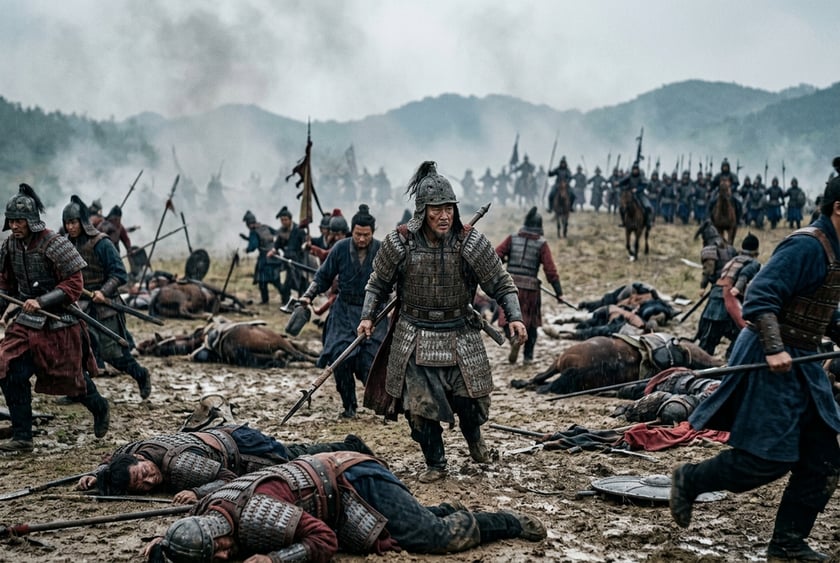
This campaign can be broken down into three decision points. The first was the phase of direct confrontation. Cao Cao underestimated Ma Chao's valor, rode out personally to parley, and was nearly overwhelmed when Ma Chao charged with his spear; Yu Jin, Zhang He, and Li Tong fought and lost repeatedly. Cao Cao barely escaped being captured, forced to shed his red robe, cut off his long beard, and tear a corner from a banner to wrap around his neck as he fled — the famous episode of "cutting the beard and discarding the robe" [c:17256]. From a tactical standpoint, this exposed Cao Cao's underestimation of Liangzhou cavalry's shock power, and confirmed that Ma Chao's personal combat skill was indeed sufficient to tear open Cao Cao's battle lines. The second was the river-west flanking phase. Adopting Xu Huang's suggestion, Cao Cao ordered Xu Huang and Zhu Ling to cross the Puban Ford with four thousand elite troops under cover of night and seize the west bank of the river, cutting off the western coalition's line of retreat, while he himself led the main force to cross the Wei River northward [c:17258]. This move expanded the battlefield from the single front at Tongguan to two fronts — the main front and the river-west flank — forcing Ma Chao to split his forces to respond. The third and most critical step was the estrangement stratagem proposed by Jia Xu and Xun You. Cao Cao deliberately held a prolonged private "chat" with Han Sui in full view of Ma Chao's forces while saying nothing of substance, then sent Han Sui a letter with numerous places crossed out and altered, sowing in Ma Chao's mind the suspicion that Han Sui was "secretly communicating with Cao Cao" [c:17263]. Sure enough, five of Han Sui's subordinate commanders including Yang Qiu proposed betraying Ma Chao and going over to Cao Cao; Han Sui hesitated but ultimately agreed, and the western-pass coalition cracked from within.
Outcome and Reverberations
After internal suspicion erupted, the western-pass coalition was swiftly surrounded and routed by Cao Cao. Ma Chao, Pang De, and Ma Dai broke through with barely thirty-odd horsemen and fled west to Longxi and Lintao [c:17264]. Cao Cao personally pursued as far as Anding before calling off the chase, bestowed marquisates on the surrendered commanders Yang Qiu and Hou Xuan, granted Han Sui the empty title of "Marquis of Liangzhou" (by then already crippled), and ordered the army to return [c:17265]. After the battle, Liangzhou staff officer Yang Fu warned Cao Cao: Ma Chao was as brave as Lv Bu and had deep ties with the Qiang peoples — if he was not eliminated while the opportunity presented itself, he would surely become a great menace later [c:17265]. Cao Cao replied that "the central plains had pressing affairs and the south was not yet settled," and decided to return first to Xudou to handle internal matters, delegating the pursuit of Ma Chao to the officials left to hold Liangzhou — Yang Fu, Wei Kang, and others. This decision later proved costly: after 213, Ma Chao exploited a Qiang and Di counterattack to besiege Liangzhou, killing Wei Kang, until Xiahou Yuan's expedition suppressed him again. At the strategic level, the victory at Tongguan removed the threat from the northwest entirely, laying the foundation for stable control of Hanzhong and Guanzhong thereafter. In the Romance's narrative, this battle also sculpted Ma Chao's image as the tragic hero "the Brocade-clad Ma Chao" — a commander whose personal combat skill could match Cao Cao in open battle, yet who was ultimately undone by insufficient political acumen.
Counterfactual Analysis
What if Cao Cao had not employed the estrangement stratagem and had pressed for a direct decisive battle instead? With the western coalition's manpower and cavalry advantage, they could at minimum have maintained a protracted stalemate on the tactical level. But the coalition's fatal weakness was logistics: two hundred thousand troops operating far from their Liangzhou home base, dependent on plunder to sustain themselves, would inevitably collapse over time. Even without the stratagem, Cao Cao could have worn the coalition down within half a year to a year; but the cost would have been greater expenditure of troops and materiel, and he would have lost the political deterrent effect of "internal betrayal" on the western-pass warlords. Conversely, if Ma Chao had pressed his early-battle successes and driven directly toward Changan and Luoyang, what would have happened? The Romance does hint at this possibility, but Ma Chao's eight warlord contingents each governed their own affairs and could never have formed a united will to advance. Cao Cao dared to campaign personally at Tongguan precisely because he judged that this coalition could cohere on "attacking Cao Cao" but would fracture on "taking Changan." This precise reading of the enemy's internal structure was one of Cao Cao's core capacities that set him apart from the warlords of his era. Another counterfactual: if Cao Cao had, after his initial defeat, chosen to fall back on Changan and shift to a protracted defense, the western-pass coalition might paradoxically have collapsed even faster — because its cohesion depended on the shared goal of "taking revenge on Cao Cao"; once the objective shifted to besieging cities, the eight contingents' interests would begin to diverge. Yet Cao Cao chose active offense and a rapid decision, compressing the campaign's duration to a few months — reflecting his precise calculation of the cost of time.