Background
Cao Pi's replacement of the Han was a sweeping political transformation completed within less than a year of Cao Cao's death in the first month of the twenty-fifth year of Jian'an (220) and Cao Pi's succession as King of Wei. At the institutional level, Cao Cao had already laid virtually all the groundwork for supplanting the Han while still alive: in the eighteenth year of Jian'an he received the title of Duke of Wei along with the nine bestowments, and in the twenty-first year he advanced to King of Wei and established the Wei state's ancestral temples and altars — in effect building a miniature court that ran parallel to the Han imperial administration. Cao Cao himself never crossed the final threshold, declaring, "If Heaven's mandate falls to me, I shall be like the Duke of Zhou to King Wen of Zhou." This statement was in practice a testamentary political directive — leaving the act of "replacing the Han," the move most capable of cementing the new dynasty's legitimacy yet also most prone to public censure, for his successor to complete. In the narrative of the eightieth chapter of the San Guo novel, mere months after Cao Pi's succession, Hua Xin, Wang Lang, and others launched a joint memorial from the assembled ministers urging acceptance of the abdication, compelling Emperor Xian of Han to issue edicts of abdication twice over, each time working through the full ritual of three offers and three refusals in the manner established by the Western Han. The crucial technical advice Sima Yi offered during the urging process was: "Although the edict and seal have arrived, Your Highness should first submit a memorial of humble refusal, so as to silence all criticism under Heaven" — this was not genuine humility but the first instance in Chinese political history of the abdication procedure being refined into a repeatable ceremonial script.
Key Figures
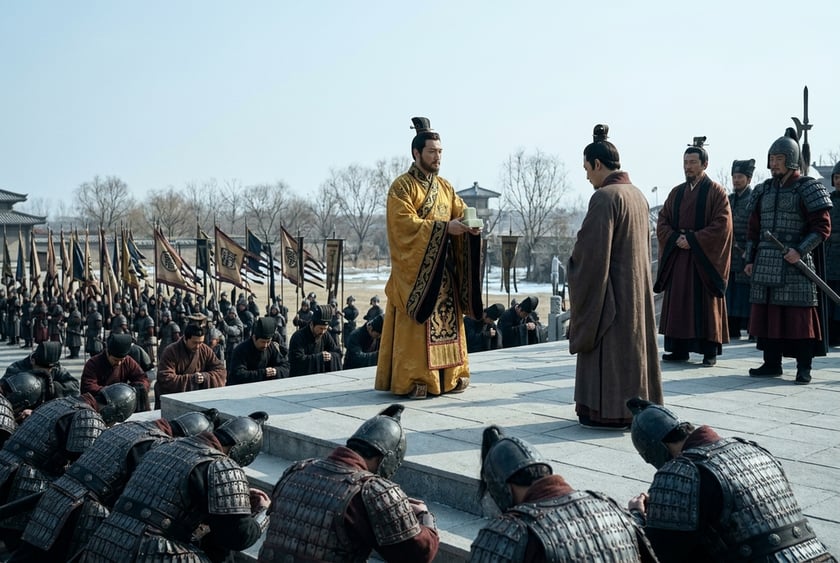
Behind the script of this Han succession stood a planning coalition with a clear division of roles. Hua Xin played the role of "driving force" in the court, repeatedly leading the assembled ministers into the hall to request the Emperor to hold audience and read out the entreaty memorials, and on the day of enthronement personally gripping his sword and pointing directly at Emperor Xian while loudly declaring the end of the Han emperor's reign. Wang Lang was the "literary brain," responsible for drafting Cao Pi's letters of refusal and providing textual support for the entire process. Jia Xu "led all officials great and small to pay court below the terrace" on the day of enthronement, serving as master of ceremonies. Sima Yi appeared in the procedural design phase, proposing the "three refusals" to forestall criticism, as the behind-the-scenes architect of the procedure. Chen Qun, Chen Jiao, and others handled the administrative transition of official systems during the interregnum; Zhang Yin served as the emissary conveying the imperial seal back and forth. Cao Pi himself deliberately maintained a passive posture throughout the script — he was pushed along at each step, and the political value of this posture lay in making everything appear to be "the ministers urging, Heaven's will pointing the way," rather than personal ambition. By contrast, the opposing force was Cao Pi's sister, Empress Cao (wife of Emperor Xian of Han), who berated him openly in the hall: "How can my brother do such a treacherous and disloyal thing?... Heaven will surely not bless you" — this was the sole moral rebuke the novel preserved within the abdication narrative.
Core Issues
The core issue of supplanting the Han was the mechanism by which legitimacy was transferred. The novel devoted extensive passages to describing the ceremonial procedures of the abdication: Empress Cao's passionate denunciation, Hua Xin gripping his sword, Emperor Xian kneeling to listen, the change of reign name to Huangchu, the posthumous title of Taizu Wuhuangdi conferred on Cao Cao — the true function of this entire sequence was not to have Cao Pi "receive" the throne, but to have Emperor Xian "voluntarily relinquish" it. This differs fundamentally from Wang Mang's usurpation of the Western Han: Wang Mang transitioned through stages of "acting emperor" and then "provisional emperor," the entire process depending purely on opinion-shaping and auspicious signs, lacking procedural legitimacy. Cao Pi, by contrast, invented a "abdication template" that could be applied by later generations over and over — petition for acceptance, refusal, renewed petition, renewed refusal, third petition, third refusal, acceptance of abdication, change of reign name, enfeoffment of the former ruler. The political efficiency of this template was extremely high: it packaged violent seizure of power as a consensual compact between two sovereigns, diluting to the maximum extent the moral burden of "rebellion against one's superior." Thereafter Sima Yan's supplanting of Wei, Liu Yu's supplanting of Jin, Xiao Daocheng's supplanting of Song, Chen Baxian's supplanting of Liang, and Emperor Wen of Sui's supplanting of Zhou — nearly all were replications of the same procedure. From the perspective of political institutional history, the true legacy of Cao Pi's supplanting of Han was not the event of "Wei replacing Han" itself, but this invented, replicable ritual of "peaceful abdication."
Political Consequences
In the short term, supplanting the Han immediately provoked a counterattack from Liu Bei's side. When news reached Shuhan, his ministers used the argument that "the Han imperial house cannot go even a day without a sovereign" to urge Liu Bei to declare himself emperor; Liu Bei accordingly ascended the imperial throne in Chengdu the following year (221), adopting "Han" as the state name and "Zhangwu" as the reign title, explicitly proclaiming his legitimacy as the successor of the Han imperial house. Sun Quan adopted a more cautious strategy, first accepting the title of King of Wu from the Wei state to buffer northern pressure, then only openly breaking away in 222 before declaring himself emperor in 229. The "three-emperor structure" of the tripartite San Guo was thus formally set. In the medium term, supplanting the Han brought Caowei a thorny legitimacy paradox: since the realm had been transferred from Emperor Xian of Han through "abdication," when the Simashi demanded that the Wei emperors transfer power in the same manner thirty years later, Caowei had no moral instrument with which to refuse. The ritual Cao Pi invented on the abdication terrace at Shouchantai ultimately became the rope binding Caowei's own successors. In the long term, "Duke of Shanyang" Liu Xie actually became a uniquely fortunate precedent of the abdication template's capacity for a peaceful ending: he lived contentedly at Shanyang for fourteen years and died peacefully with the ceremonial honors of Emperor Xian of Han. Compared with almost all former rulers who were subsequently forced to abdicate (the last emperor of Wei, Emperor Gong of Jin, Emperor Shun of Song, Emperor He of Qi, and others), Liu Xie's end was remarkably fortunate. This in turn testifies that the ritual packaging Cao Pi employed when supplanting the Han did achieve, at least in its initial phase, the political effect of a "soft landing."
Counterfactual Analysis
The most worthwhile counterfactual to consider is: what if Cao Pi had refused to supplant the Han and maintained the old framework of "holding the Son of Heaven in order to command the lords"? This path had been demonstrated over Cao Cao's preceding twenty years to be highly sustainable — the ceremonial authority of Emperor Xian had in fact served as a legitimacy resource for the Cao clan's military campaigns. But Cao Pi's choice to supplant the Han was not impulsive. The "three refusals" procedure proposed by Sima Yi reflects that the new generation of Caowei statesmen had a clear sense of the costs of "declaring the emperor": the legitimacy resource of Emperor Xian had been spent down to its limit by the end of the Jian'an period, and what Cao Pi needed was no longer to borrow the Han shell, but to establish a state identity independent of the Han, so as to give the Caowei bureaucratic apparatus, clan members, and the emerging scholar-gentry class a defined political future. From this perspective, supplanting the Han was not about "becoming emperor" but about "changing the system." Another counterfactual is: what if Empress Cao's open denunciation had triggered a split within the Cao clan? In practice, her opposition won no response from any member of the Cao bloodline — a fact reflecting that during Cao Cao's era the Cao clan had already completed the role transition from "Cao family retainers" to "Caowei sovereign and ministers." For them, supplanting the Han was not "betraying the father's will" but "fulfilling the father's work." This internal cohesion is precisely the deepest reason Cao Pi was able to complete the Han succession within barely nine months of inheriting the throne.