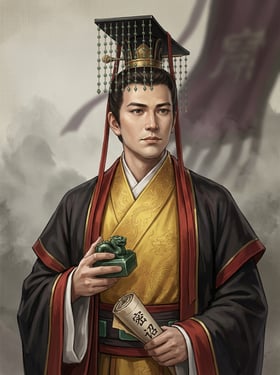
Historical Record
Emperor Xian of Han, Liu Xie, courtesy name Bohe, appears in the official records chiefly around his role as the symbol of the Han house and the momentous historical event of his eventual abdication of the throne to Cao Pi, King of Wei. During his reign the Han house declined, power fell into others' hands, and he himself was more a focal point of contention among the various powers and a political pawn. In the spring, first month, of the twentieth year of Jian'an (215 CE), the Son of Heaven established Cao Cao's daughter as Empress—an act that further consolidated the Cao family's influence at court and foreshadowed the further erosion of the Han house's power.
In the first year of Yankang (220 CE), Emperor Xian, Liu Xie, knowing well that the Han house's mandate was exhausted and that the hopes of the realm had turned to Wei, summoned the lords and high officials and made announcement at the High Ancestor's temple. He issued an edict, plainly declaring that "the count of the flaming essence is now ended, and the moving fortune lies with the house of Cao," holding this to be the turning of Heaven's mandate, and, emulating Tang Yao's abdication to Yu Shun, yielded the imperial throne to Cao Pi, King of Wei. In the edict Liu Xie reviewed the decline of the Han house and the merits of Cao Cao and his son in pacifying the realm and stabilizing the altars of state, emphasizing that the house of Cao "shone in its virtue and revived the great enterprise of the civil and the martial." He dispatched the Acting Imperial Counsellor Zhang Yin, bearing the staff of authority, to present the imperial seal and ribbon, formally completing the great rite of abdication and investing Cao Pi as the new Emperor, charging him to "truly hold to the mean, that Heaven's bounty may endure to the end," in hopes that the Cao Wei regime might be long and stable. From the historical sources, Liu Xie displayed in the abdication an attitude of yielding to Heaven's mandate and recognizing the times; though not without its helplessness and sorrow, his outward voluntary abdication provided the basis for the legitimacy of the Cao Wei regime. After the abdication, Liu Xie was enfeoffed as Duke of Shanyang, with a fief of ten thousand households, still enjoying the ceremonies of a Son of Heaven, but he had withdrawn entirely from the political stage.
In the Novel
In the Romance of the Three Kingdoms, Liu Xie is given more tragic color and human feeling, his early experiences and the trials of his reign rendered in detail to highlight the decline of the Han house and the power of Cao Cao. At his first appearance he is the Prince of Chenliu, who flees together with the young Emperor Liu Bian during the turmoil of the Ten Attendants, showing his helplessness and brotherly affection in his youth. On Mount Beimang he and the young Emperor embraced and wept, starving and exhausted, even needing to be guided by drifting fireflies, until at last they were saved by Cui Yi. After Dong Zhuo entered the capital, the Prince of Chenliu, Xie, because he calmly met Dong Zhuo's questioning, was "secretly marveled at by Dong Zhuo, who already harbored the intent to depose and replace," and was ultimately set up as Emperor Xian, at only nine years of age. Though this episode does not entirely accord with Dong Zhuo's historical motive for the deposition and replacement, it highlights Liu Xie's early precocity and Dong Zhuo's cruelty.
During his reign Emperor Xian was long under the control of powerful ministers. After Dong Zhuo's death, the Xiliang warlords Li Jue, Guo Si, and others continued to wreak havoc, and Emperor Xian was repeatedly held hostage by them, even facing the danger of being killed. During the strife between Li Jue and Guo Si, Emperor Xian was once trapped in Meiwu, his food and drink failing, suffering every humiliation, even being angrily rebuked by Li Jue for requesting rice and grain, able only to "bow his head in silence, tears soaking his sleeves." Jia Xu secretly aided Emperor Xian, and Emperor Xian too once wept to Jia Xu, hoping that he might "pity the Han dynasty and save my life." Under the escort of Yang Feng, Dong Cheng, and others, Emperor Xian once fled Chang'an, but the road was perilous and they were repeatedly pursued.
After Cao Cao "held the Son of Heaven to command the lords," Emperor Xian's situation did not improve but rather fell into deeper straits. Though nominally Emperor, he was in fact constrained by Cao Cao at every turn. In the hunting incident at Xutian, Cao Cao "galloped straight out, blocking before the Son of Heaven to receive the acclaim," openly usurping precedence and leaving Emperor Xian as if "thorns pricked his back." Emperor Xian secretly conferred with Empress Fu, and with Dong Cheng plotted the killing of Cao through the "Girdle Edict," biting his fingertip to write the edict in blood and sewing it into a jade girdle. The plot was ultimately exposed, however; Dong Cheng and Consort Dong (then with child) were killed, and Empress Fu too was forced out by Cao Cao, in the end dragged from the palace by Hua Xin and brutally murdered., These episodes greatly intensify Emperor Xian's tragic image, displaying his helplessness and struggle as the last Emperor. In the novel, Emperor Xian placed great hopes in Liu Bei, calling him "Imperial Uncle" and reckoning that "I now have help," which has no clear basis in the histories and is the Romance's artistic embellishment in service of shaping Liu Bei's image as one who "upholds and rescues the Han house."
Key Relationships
* Cao Cao (kin_of): In history, Cao Cao married his daughter to Liu Xie, making himself the Emperor's father-in-law and thereby establishing, in name, a kinship tie with the imperial house, further consolidating his political position. In the Romance, Cao Cao is Liu Xie's actual controller, dominating court affairs through "holding the Son of Heaven to command the lords," and ultimately forcing Liu Xie to abdicate. Liu Xie's dread of Cao was "as if thorns pricked his back," deeply feeling Cao's overbearing tyranny.
* Dong Zhuo (rival_of): Dong Zhuo was a great threat in Liu Xie's early political life. In the Romance, Dong Zhuo deposed the young Emperor and set up Liu Xie as Emperor, but immediately placed Liu Xie under tight control, making him a puppet. Under Dong Zhuo's tyrannical power, Liu Xie suffered "as ordinary men do not."
* Liu Bian (sibling_of): Liu Bian was Liu Xie's elder brother; in the Romance, the two fled together during the turmoil of the Ten Attendants, showing deep brotherly affection.
* Fu Shou (spouse_of): Fu Shou was Liu Xie's Empress. In the Romance, Empress Fu faced Cao Cao's oppression together with Liu Xie and took part in the "Girdle Edict" plot, for which she was ultimately killed by Cao Cao—a wife who shared his hardships.,
* Dong Cheng (ally_of, Romance only): In the Romance, Dong Cheng is Liu Xie's imperial brother-in-law and a loyal minister of the "Girdle Edict" plot to kill Cao, in whom Liu Xie placed great hopes.,
* Liu Bei (ally_of, Romance only): In the Romance, Liu Bei was confirmed by Emperor Xian as "Imperial Uncle" and invested with the great hope that "I now have help," becoming a potential force for Emperor Xian against Cao Cao.
Signature Scenes
* Fleeing on Mount Beimang (Romance only): The young Prince of Chenliu, Liu Xie, and the young Emperor Liu Bian, after the turmoil of the Ten Attendants, embraced and wept on Mount Beimang, starving and cold, guided by drifting fireflies, until at last saved by Cui Yi. This scene depicts Liu Xie's miserable early plight and helplessness.
* Dong Zhuo's deposition and replacement (Romance only): After Dong Zhuo entered the capital, because the Prince of Chenliu, Liu Xie, showed composure and wit in the face of questioning, Dong Zhuo "secretly marveled at him," and ultimately deposed the young Emperor and set up Liu Xie as Emperor. This act sealed Liu Xie's tragic fate as a puppet Emperor.,
* Humiliation at Meiwu (Romance only): During the chaos wrought by Li Jue and Guo Si, Emperor Xian was trapped at Meiwu, his life impoverished, even angrily rebuked by Li Jue for requesting rice and grain, able only to "bow his head in silence, tears soaking his sleeves"—displaying his extreme humiliation and powerlessness as Emperor.
* The hunt at Xutian (Romance only): When Cao Cao hunted at Xutian, he openly usurped precedence, taking the acclaim of the assembled officials ahead of the Son of Heaven, leaving Emperor Xian feeling "as if thorns pricked his back"—foreshadowing Cao Cao's ambition to usurp the Han.
* The Girdle Edict plot (Romance only): Emperor Xian bit his fingertip and wrote a secret edict in blood, sewing it into a jade girdle which he bestowed on Dong Cheng, plotting to kill Cao Cao. This scene is the climax of Emperor Xian's resistance against Cao Cao and displays his last struggle and courage as Emperor.
* The killing of Empress Fu (Romance only): After Cao Cao learned of the "Girdle Edict" plot, he sent Hua Xin into the palace, who forcibly hauled Empress Fu out from a hollow wall and dragged her outside the hall to be killed. Emperor Xian, witnessing this, was overcome with grief and collapsed weeping to the ground—a scene that greatly heightens the tragedy of the Han house and Cao Cao's cruelty.,
* Abdicating the throne: In the first year of Yankang, Emperor Xian, Liu Xie, summoned the lords and high officials and issued an edict yielding the imperial throne to Cao Pi, King of Wei, formally ending the Han dynasty's four hundred years of rule. This event is recorded in both the histories and the Romance; it is the end of Liu Xie's life and a turning point in the history of the Three Kingdoms.
Portrait file
Character profile
- Character
- Emperor Xian of Han was suspicious by nature—toward Cao Cao he felt 'as though a thorn were at his back'—yet he pinned his hopes on Liu Bei, thinking 'now I have help.' He was fearful and anxious but capable of secret scheming, though in the face of overwhelming power he often showed the timid helplessness of one who trembles, beats his breast in grief, and collapses weeping to the ground, so that in the end he could only say, 'How dare I not obey.'
- Manner of speech
- Emperor Xian's manner of speech was respectful and courteous in court deliberations, but in his inner monologues it was full of indignation. He was adept at winning men over with words like 'We recall your merit, sir, in rescuing the imperial carriage at the western capital,' and he once invoked the ancestral enterprise of Gaozu, who rose in revolt by slaying the serpent, and declared that 'auspicious omens and prophetic charts are all empty and false things.'
- Life
- Emperor Xian was the youngest son of Emperor Ling, the Prince of Chenliu, and was later installed by Dong Zhuo as Emperor Xian. In the first year of the Huangchu era he abdicated in favor of Cao Pi and was enfeoffed as Duke of Shanyang; he died in the third month of the second year of the Qinglong era, and was given the posthumous title Filial and Presented Emperor of Han.
- Anecdotes
- In the course of his flight Emperor Xian several times answered on behalf of the young emperor; on first meeting Dong Zhuo he was neither flustered nor afraid, and Dong Zhuo, marking his cleverness and composure, 'secretly wondered at him, and already harbored the intent to depose and replace.' He suffered hunger and hardship and sighed, 'Long have I been bullied by these two traitors,' and in the first year of the Jian'an era he moved the capital to Xu. He issued a secret decree, promulgated the girdle edict, and witnessed the murder of Consort Dong without being able to save her, until at last, pressed by his ministers, he abdicated in favor of Cao Pi.
Relationships
48 relationships
Family8
Lord & vassal19
Friends1
Enemies7
Other11
Quotes
60 recorded lines · 3 featured
「方離狼窩,又逢虎口,如之奈何?」
It vividly depicts Emperor Xian of Han's tragic fate—drifting and helpless amid an age of chaos.
「朕自即位以來,奸雄並起:先受董卓之殃,後遭傕、汜之亂。常人未受之苦,吾與汝當之。後得曹操,以為社稷之臣;不意專國弄權,擅作威福。朕每見之,背若芒刺。今日在圍場上,身迎呼賀,無禮已極!早晚必有異謀,吾夫婦不知死所也!」
It profoundly reveals Emperor Xian of Han's resentment and helplessness toward Cao Cao's monopoly of power, a portrait of his inner struggle.
「朕願將天下禪於魏王,幸留殘喘,以終天年。」
It marks the end of the Han dynasty—Emperor Xian of Han's reluctant act of abdicating the throne to Cao Wei.
Chapters15 回 ▸
- 史ch.1ch.2
- 演ch.2ch.3ch.4ch.9ch.10ch.13ch.14ch.20ch.24ch.25ch.59ch.66ch.80
Relationship timeline9 条 ▸
史 ch.1
- Cao Cao§97
kin_of
立公中女为皇后
演 ch.3
- Dong Zhuo§13
rival_of
叱问"汝來保駕耶?汝來劫駕耶?",自初至终并无失语
演 ch.4
- Liu Bian§7
sibling_of
兄弟;陈留王取代少帝即位
演 ch.13
演 ch.20
- Fu Shou§12
spouse_of
归宫泣对皇后诉操之专横
- Dong Cheng§14
friend_of
引承入太庙功臣阁观高祖画像;以袍带为赐密语「卿歸可細視之,勿負朕意」
演 ch.24
- Fu Shou§11
spouse_of
帝在后宫与伏皇后私论董承之事
演 ch.25
- Guan Yu§13
witnesses
帝命关公为偏将军;后呼为"美髯公"
Inner monologues · AI-generated3 段 ▸
- On the day of the abdication, the officials stood before me and armored soldiers stood at my side. I held the jade seal
- I often reflect that, as Son of Heaven, I ought to honor the ancestral temples and bring peace to the people. Yet the li
- When I was young, I lived in the palace and could not have known all that went on in the world. I remember the night at
Life events7 ▸
- 0196-01-01 · XuchangCao Cao Receives the Emperor and Establishes the Capital at Xu· Witness
- 0199-01-01 · XuchangEmperor Xian Recognizes Liu Bei as Imperial Uncle
- 0213-01-01 · YeCao Cao Created Duke of Wei· Witness
- 0214-01-01 · XuchangDeposition and Execution of Empress Fu· Witness
- 0216-01-01 · YeEstablishment of the Wei State· Victim
- 0216-01-01 · YeCao Cao Elevated to King of Wei· Witness
- 0220-01-01 · XuchangCao Pi Usurps the Han Throne and Proclaims Himself Emperor· Victim