Background
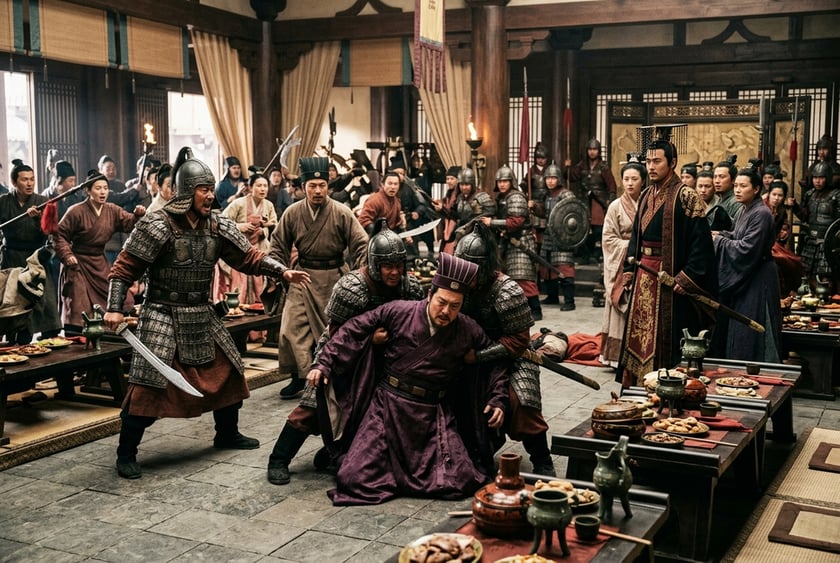
Liu Bei's entry into Yizhou began in the sixteenth year of Jian'an (211), nominally at Liu Zhang's invitation to go north to Jiameng and defend against Zhang Lu of Hanzhong. Over the following year or more, Liu Bei "broadly distributed his benevolence and grace, to win the hearts of the people" at Jiameng — nominally Yizhou's external auxiliary force, but in reality quietly completing military deployments and building popular trust along Yizhou's northern fringe. At the end of the seventeenth year of Jian'an (212), an important shift occurred in the Jian'an strategic landscape: Cao Cao raised his army against Ruxu, Sun Quan appealed to Liu Bei for help, and Liu Bei faced a strategic choice — return to reinforce Jingzhou, or seize the moment and betray Liu Zhang to take Shu. Pang Tong and Fa Zheng were pushing him from the front line and from Chengdu respectively to make up his mind. Liu Bei first demanded resources from Liu Zhang on the pretext of "Cao Cao attacking Sun Quan — need to borrow elite soldiers and grain to aid him," and Liu Zhang reduced the offer to four thousand aging and infirm soldiers plus ten thousand hu of rice — this refusal in effect gave Liu Bei the pretext he needed to break relations openly.
Key Figures
Liu Bei was fifty-two at this time, having endured half a lifetime of wandering, and maintained an extraordinarily patient attitude toward every short-term opportunity. His posture at Jiameng — "tearing up the reply letter and roundly cursing" — appears emotional but was in reality the fabrication of a justification for open rupture. Pang Tong, as Deputy Chancellor-Commandant, was the actual operator of this strategic pivot; he had already earlier at the banquet suggested directly eliminating Liu Zhang — overruled by Liu Bei on the grounds of "credibility and trust not yet established" — demonstrating that Pang Tong's risk tolerance had consistently run one notch higher than Liu Bei's. On Liu Zhang's side, Huang Quan, Wang Lei, Liu Ba, and other counselors had long since seen through Liu Bei's intentions, but Liu Zhang's "feelings of common clan" combined with personal timidity made him unable to bring himself to break relations, and it was precisely this hesitation that gave Liu Bei ample preparation time. Yang Huai and Gao Pei, as renowned commanders of Shu, were under Liu Zhang's orders to guard the Jiameng-Fuguan line and were the first real military barrier of the Yizhou campaign.
Core Issue
The true value of Pang Tong's Three Strategies lay in translating "decision" into a "cost-benefit matrix of decisions." The upper strategy — march day and night straight to Chengdu — carried high risk and the fastest reward: if successful, it would settle Yizhou at a stroke, but failure would mean a deep penetration with all lines of retreat cut. The middle strategy — feign withdrawal to Jingzhou and lure out the renowned generals guarding the passes to their deaths, capture Fucheng first, then advance toward Chengdu — carried moderate risk and reliable reward: eliminating Yang Huai and Gao Pei alone would dissolve the entire northern Shu defensive line, leaving room for measured pacing in subsequent military advances. The lower strategy — withdraw to Baidicheng and take Yizhou gradually — carried low risk and the most distant reward: abandoning entirely the immediate opportunity to enter Yizhou. Pang Tong presented the three paths side by side and let Liu Bei choose; this was fundamentally an act of internalizing "the threshold of the Lord's patience" into the strategic options. Liu Bei's selection of the middle strategy precisely reflected his consistent tendency toward a middle path of "neither recklessly bold nor willing to give up entirely."
Political Consequences
The first consequence of executing the middle strategy was that Yang Huai and Gao Pei were seized and killed at the farewell banquet, instantly dissolving the backbone of the Shu forces along the Jiameng and Fuguan line. This allowed Liu Bei to push the military frontline from Jiameng to Fucheng without deploying large-scale forces — compressing the direct-line distance to Chengdu from roughly 230 kilometers to roughly 100. The second consequence was a complete political rupture: before this, Liu Bei had occupied the moral high ground as an "external auxiliary force"; after this, he was a declared conqueror. The exposure and execution of Zhang Song as an internal collaborator (see event 195) occurred in the same time period — Liu Bei's camp's scheme to enter Yizhou could no longer be disguised under the name of an alliance. The third consequence was a polarization of Yizhou scholars' loyalties: some of the major Yizhou clans that had been waiting and watching now began to move toward Liu Bei, since they recognized that Liu Zhang's defeat was inevitable and needed to secure a position in the new regime early.
Counterfactual Analysis
If Liu Bei had adopted the upper strategy and charged straight at Chengdu — given the size of his force at Jiameng and his intelligence preparation, there was theoretically a 30–40% chance of success, but failure would mean a lone army cut off deep in enemy territory: having broken with Liu Zhang while unable to take Chengdu, with pressure from the Zhang Lu and Cao Cao directions immediately closing in, the Shuhan regime would have been almost impossible to establish. If he had adopted the lower strategy and withdrawn to Baidicheng — Liu Bei would have avoided direct war against Liu Zhang but would have forfeited the opportunity to enter Yizhou; he could not permanently occupy Jiangling, which Sun Quan already had his eye on, and returning to Jingzhou would merely relocate his strategic disadvantage. In other words, the middle strategy was the "maximin" of the three options — preserving the possibility of entering Yizhou while distributing the pressure of war across a series of localized engagements by creating facts on the ground. Later military scholars have long treated Pang Tong's Three Strategies as a classic case study in "the design of decision options" — precisely because the design of the options was itself the strategy. The true genius of the Three Strategies lay not in which one was chosen but in translating Liu Bei's threshold of patience into executable military plans. Pang Tong died in battle at Luocheng two years later, making this elegant design the peak moment of his strategic career; after his death, Shuhan never again produced strategic planning of comparable precision as a "tiered risk matrix."