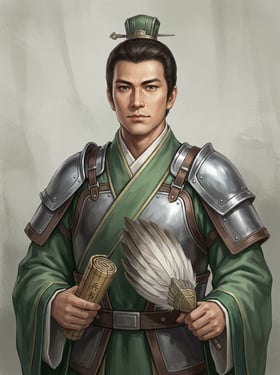
Historical Record
Lu Xun, styled Boyan, was a man of Wu County in Wu Commandery and a member of a great Southland clan. He lost his father in childhood and followed his grand-uncle Lu Kang, Administrator of Lujiang, in office. When Sun Quan was a general, Lu Xun, only twenty-one, began serving in his headquarters, holding posts as Clerk of the Eastern and Western Sections, then going out as Commandant of the Agricultural Garrison at Haichang and concurrently managing the county's affairs. When Haichang suffered drought year after year, Lu Xun opened the granaries to relieve the poor and encouraged farming and sericulture, winning the people's devotion c:6593.
Sun Quan gave Lu Xun in marriage the daughter of his elder brother Sun Ce, and often consulted him on the affairs of the age. Lu Xun advised Sun Quan that, before seeking to plan for distant regions, he should first quell internal threats such as the Shanyue c:4041. He led troops to campaign against the Kuaiji mountain bandit Pan Lin and the Poyang bandit chieftain You Tu, sweeping all before him, his own forces growing to more than two thousand men. Later, when the Danyang bandit chieftain Fei Zhan, incited by a seal and ribbon from Cao Cao, stirred the Shanyue to revolt, Lu Xun, with the few against the many, set decoy troops by night and greatly defeated Fei Zhan, incorporating tens of thousands of elite troops and clearing three commanderies c:4041.
In the twenty-fourth year of Jian'an (219), when Guan Yu was besieging Cao Ren at Xiangyang, Sun Quan wished to seize Jing Province. Lü Meng feigned illness and recommended Lu Xun to Sun Quan, holding that Lu Xun "is deep in thought and able to bear heavy responsibility; observing his planning, he can in the end be given great tasks. And as he has no distant fame, he is not feared by Guan Yu," and advising that he "outwardly conceal himself and inwardly watch for opportunity" c:4042. Sun Quan adopted Lü Meng's plan and appointed Lu Xun General of the Vanguard and Commander of the Right Section, replacing Lü Meng in holding Lukou. Lu Xun sent Guan Yu a letter of humble words to lull him; Guan Yu indeed fell for the ruse and relaxed his guard. Sun Quan thereupon sent Lü Meng and Lu Xun as the vanguard, who successfully seized Gong'an and Nan Commandery. Lu Xun then advanced into Yidu, taking Zigui, Zhijiang, and Yidao, accepting the surrender of Shu generals such as Fan You and of barbarian chieftains, and incorporating tens of thousands of troops c:6595.
In the first year of Huangwu (222), Liu Bei led a great army to attack Wu, and Lu Xun was appointed Grand Commander with a staff of authority, commanding fifty thousand men, including Zhu Ran and Pan Zhang, to repel the foe. Faced with the Shu army's camps stretching hundreds of li, the generals were eager to give battle, but Lu Xun overrode them all, holding fast and not fighting, judging that the Shu army's spirit was at its height and should not be met head-on, but should be attacked once it had wearied c:4043. He used the stratagem of fire, greatly defeating the Shu army at Xiaoting near Yiling, slaying Shu generals such as Zhang Nan and Feng Xi, while Liu Bei barely escaped with his life, retreating to Baidicheng c:15220. After this battle, Sun Quan further appointed Lu Xun General Who Upholds the State and Governor of Jing Province, and changed his enfeoffment to Marquis of Jiangling c:6598.
In the seventh year of Huangwu (228), the Wei Grand Marshal Cao Xiu fell for Zhou Fang's stratagem of feigned surrender and led his army deep toward Wan. Sun Quan summoned Lu Xun, granting him the yellow battle-axe and making him Grand Commander to meet Cao Xiu. Lu Xun, with Zhu Huan and Quan Cong as his left and right wings, advanced by three routes and greatly defeated Cao Xiu at Shiting, taking more than ten thousand heads and capturing vast military supplies c:4046.
In the first year of Chiwu (238), Lu Xun was appointed Supreme Grand General and Protector of the Right. When Sun Quan toured east to Jianye, he left the Heir Apparent Sun Deng and the prince Sun He behind, and summoned Lu Xun to assist the Heir Apparent and to oversee the affairs of Jing Province and three commanderies of Yuzhang, directing military and state matters c:4047. In his later years Lu Xun was caught up in the "Struggle of the Two Palaces"; because he repeatedly submitted memorials urging Sun Quan to establish the Heir Apparent Sun He, he angered Sun Quan and finally died of grief and indignation at the age of sixty-three, with no surplus wealth in his household c:4051.
In the Novel
Lu Xun in the *Romance of the Three Kingdoms* has his image embellished and strengthened beyond the historical record, especially in the Battle of Xiaoting and the Battle of Shiting, where his cunning is portrayed as more prominent and legendary. At his first appearance, he is regarded by Sun Quan's faction as one of the worthies in its "abundance of able men" c:6601.
Before the Battle of Red Cliffs, Lu Xun, as a fifth-rank general, went out on campaign with Dong Xi following Zhou Yu; though his part was small, he already ranked among the important generals c:6602. In the Battle of Ruxukou, as Sun Ce's son-in-law, he arrived in time with a hundred thousand troops, shot back the Cao soldiers, and pressed the pursuit, recovering several thousand warhorses, so that Cao Cao returned in great defeat — displaying his military talent c:4056.
In the episode of Guan Yu carelessly losing Jing Province, Lu Xun's cunning is displayed to the full. When Lü Meng feigned illness, Lu Xun came to visit and offered the stratagem of "feigning illness and resigning office, yielding the Lukou post to another, and having that other humbly praise Lord Guan so as to make him arrogant in heart" c:4057. Lü Meng adopted this plan and recommended Lu Xun to Sun Quan. Sun Quan thereupon appointed Lu Xun General of the Vanguard and Commander of the Right, replacing Lü Meng in holding Lukou. On taking up the post, Lu Xun at once wrote to Lord Guan in humble words and sent gifts, further lulling Guan Yu so that he withdrew all his Jing Province troops to relieve Fancheng, thereby creating the conditions for Eastern Wu to seize Jing Province c:4058. In history this was planned jointly by Lü Meng and Lu Xun, but in the novel Lu Xun's cunning is highlighted as the core driving force.
In the Battle of Xiaoting, Lu Xun was appointed Grand Commander by Sun Quan to direct all forces in breaking Liu Bei. Facing the generals' insubordination and doubt — especially the contempt of veteran generals like Han Dang and Zhou Tai — he displayed extraordinary patience and resolve c:15178. He held to the strategy of "occupying the heights and guarding the strong points, not lightly going out," letting the Shu army challenge and revile him without wavering, even being mocked by the generals as "cowardly" c:15180. By observing the Shu army's weariness and slackness, he finally unleashed the stratagem of fire, greatly defeating Liu Bei, who lamented, "That I should be humiliated by Lu Xun — is this not Heaven's will!" c:15220 The novel also adds the episode of Lu Xun, while pursuing Liu Bei, blundering into the "Eightfold Battle Array" laid out by Zhuge Liang, and escaping only through the guidance of Huang Chengyan c:15194, further setting off Zhuge Liang's marvelous calculation, while at the same time affirming from the side Lu Xun's military insight, for he could sense the killing aura within the array c:15194.
In the Battle of Shiting, Lu Xun was again appointed Grand Commander to meet Cao Xiu. He saw through Zhou Fang's stratagem of feigned surrender and foresaw that Cao Xiu would fall for it and advance deep. He deftly deployed his forces, ordering Zhu Huan and Quan Cong to outflank Cao Xiu's camp from the rear while he himself led the main army to attack down the center, finally greatly defeating Cao Xiu. The novel also depicts the detail of Jia Kui dissuading Cao Xiu, but Cao Xiu would not listen and was finally defeated c:15207. After the battle, Lu Xun also advised Sun Quan to ally with Shu and attack Wei, so as to pin down Sima Yi and create conditions for Shu Han's northern expeditions c:15209, displaying his far-reaching strategic vision. During Zhuge Liang's northern expeditions, Lu Xun also once attacked Xiangyang together with Zhuge Jin, saw through Cao Rui's scheme, and successfully withdrew his troops c:6610.
Key Relationships
* Sun Quan's Faction (serves): Lu Xun was a core figure of Sun Quan's faction, deeply valued by Sun Quan. He served Sun Quan from his youth, holding important posts and repeatedly rendering extraordinary service. Sun Quan not only gave him his elder brother's daughter in marriage but at critical moments entrusted him with great responsibility, as Grand Commander in the Battles of Xiaoting and Shiting, and even in his later years had him assist the Heir Apparent and manage military and state affairs c:4047. Sun Quan's trust in and reliance on Lu Xun ran throughout, though in the later period there was some suspicion owing to the "Struggle of the Two Palaces"; yet Lu Xun remained ever loyal.
* Liu Bei (fights_in): Lu Xun and Liu Bei were deadly foes. In the Battle of Xiaoting, Lu Xun, with his outstanding military talent, greatly defeated Liu Bei's Shu Han army, inflicting on Liu Bei a great disgrace, so that he finally died of illness at Baidicheng c:15220. This battle was the summit of Lu Xun's military career and the most crucial conflict between him and Liu Bei.
* Eastern Wu (serves): Lu Xun served Eastern Wu all his life, rendering great service in the founding and consolidation of the state. Beyond his repeated military exploits, he actively took part in internal governance, encouraging learning and cherishing the people, making great contributions to Wu's stability and development c:15211.
* Tang Gu (student_of): The histories do not clearly record that Lu Xun was Tang Gu's student, but the "Biography of Lu Xun" in the *Records of the Three Kingdoms* records that Lu Xun encouraged learning and passed judgment on certain doctrines of the day, showing his deep scholarly background c:4052.
* Lü Meng (recommends): Before the seizure of Jing Province, Lü Meng strongly recommended Lu Xun to Sun Quan, holding that he was "deep in thought and able to bear heavy responsibility," and pointing out that Lu Xun "has no distant fame and is not feared by Guan Yu," making him the best choice to replace himself and lull Guan Yu c:4042. Lü Meng's recommendation was an important turning point in Lu Xun's military career.
* Zhuge Liang (rivals in strategy): In the novel, Lu Xun and Zhuge Liang are shaped as rivals in cunning. After the Battle of Xiaoting, Lu Xun blundered into Zhuge Liang's "Eightfold Battle Array" and sighed, "Kongming is truly a 'Sleeping Dragon'! I cannot match him!" c:15196 In addition, Lu Xun once saw through Zhuge Liang's scheme of using Eastern Wu's strength to pin down Cao Wei c:15210 (unique to the novel).
* Cao Cao / Cao Pi / Cao Xiu (fights_in): Lu Xun fought the armies of Cao Wei many times, repelling Cao Cao in the Battle of Ruxukou c:4056 (unique to the novel) and greatly defeating Cao Xiu in the Battle of Shiting c:4046, displaying his outstanding ability to resist Cao Wei's invasions.
Iconic Scenes
* Seizing Jing Province: Lu Xun, conspiring with Lü Meng, lulled Guan Yu through the stratagem of "outwardly concealing himself and inwardly watching for opportunity," and successfully seized Jing Province, laying the foundation of Eastern Wu's hold over the middle and lower Yangtze c:4042. This was the starting point of Lu Xun's military career and displayed his deep-laid planning.
* The fire attack at Yiling: In the Battle of Xiaoting, faced with Liu Bei's camps stretching hundreds of li, Lu Xun overrode all and held fast without fighting, and once the Shu army had wearied, used fire to greatly defeat Liu Bei, gravely sapping Shu Han's strength c:15220. This battle was Lu Xun's crowning work, establishing his core position in Eastern Wu's military.
* Breaking Cao Xiu at Shiting: Lu Xun saw through Zhou Fang's stratagem of feigned surrender and, by deft deployment, greatly defeated Cao Xiu at Shiting, once again displaying his outstanding military command c:4046.
* Blundering into the Eightfold Battle Array: In the novel, while pursuing Liu Bei after the Battle of Xiaoting, Lu Xun blundered into the "Eightfold Battle Array" laid out by Zhuge Liang, and escaped only through the guidance of Huang Chengyan c:15194 (unique to the novel). Though fictional, this scene further highlights Lu Xun's cunning and the image of Zhuge Liang as one step superior.
* Dying of grief and indignation in the "Struggle of the Two Palaces": In his later years, caught up in Eastern Wu's "Struggle of the Two Palaces," Lu Xun repeatedly submitted memorials remonstrating with Sun Quan, and finally died of grief and indignation when they went unheeded c:4051. This tragic end displayed Lu Xun's unwavering loyalty and his spirit of devoting himself utterly to the altars of state.
Portrait file
Character profile
- Appearance
- Lu Xun stood eight chi tall, his face like fine jade.
- Character
- Lu Xun's deliberations were deep and far-reaching; he could endure humiliation and bear heavy burdens, concealing himself outwardly while inwardly discerning advantage. Humble in bearing, he encouraged learning and cherished the people. Calm and full of wisdom, he seemed timid on the outside yet held strategy within, and being mature and steady, his judgment of the whole situation was accurate.
- Manner of speech
- Lu Xun spoke earnestly, deep in scheme and gentle in words, often citing the classics and histories to persuade the assembly, and reassuring his officers and men with short phrases such as 'I have my own plan.'
- Life
- Lu Xun was originally named Yi, a native of Wu in Wu Commandery. Orphaned young, he followed his grand-uncle Lu Kang, Grand Administrator of Lujiang, and Sun Quan later gave him the daughter of his elder brother Ce in marriage. He held many posts, seized Jing Province by surprise, crushed Liu Bei at Yiling, and defeated Cao Xiu at Shiting. In the end he was appointed Supreme Grand General and Right Protector-General, and succeeded Gu Yong as Chancellor.
- Anecdotes
- Lu Xun's posthumous title was Marquis Zhao. Originally named Lu Yi, he later changed his name to Xun and was styled Boyan. He once served as Sun Quan's vanguard and was appointed General Who Upholds the State, Marquis of Jiangling, and Governor of Jing Province.
Relationships
58 relationships
Family5
Friends7
Enemies7
Teacher & student4
Other32
Quotes
67 recorded lines · 3 featured
「羽矜其驍氣,陵轢於人。始有大功,意驕志逸,但務北進,未嫌於我,有相聞病,必益無備。今出其不意,自可禽制。下見至尊,宜好為計。」
This stratagem enabled Lü Meng to cross the river in white robes, a classic scheme marking Lu Xun's first display of brilliance.
「備是猾虜,更嘗事多,其軍始集,思慮精專,未可干也。今住己久,不得我便,兵疲意沮,計不復生,掎角此寇,正在今日。」
This line reflects Lu Xun's precise reading of Liu Bei's troop dispositions and the opportunities of battle during the Battle of Xiaoting.
「孔明真『臥龍』也!吾不能及!」
This line shows Lu Xun's heartfelt admiration for Zhuge Liang's genius, and is widely renowned.
Chapters26 回 ▸
- 史ch.3ch.32ch.47ch.51ch.56ch.57ch.58ch.59ch.60ch.61ch.64
- 演ch.38ch.44ch.49ch.50ch.53ch.68ch.75ch.83ch.84ch.85ch.86ch.96ch.97ch.98ch.103
Relationship timeline28 条 ▸
史 ch.32
- Liu Bei§42
fights_in
夏六月大破先主军于猇亭
史 ch.47
- Liu Bei§24
fights_in
黄武元年正月—闰月大破刘备
史 ch.58
- Lu Kang§3
kin_of
少孤随从祖庐江太守陆康在官
- Lu Ji§3
kin_of
长于陆绩数岁,为之纲纪门户
- Sun Quan§5
advises_in
数访世务,纳其策;夷陵之后受恩深重
- Guan Yu§6
enemy_of
至陆口书与关羽,谦下自托使其无备;后与吕蒙为前部袭取公安、南郡
- Liu Bei§11
commands_in
为大都督、假节,督诸将拒之;火攻破其四十余营
- Sun Huan§15
commands_in
不救安东而坐令自解
- Zhuge Liang§19
friend_of
孙权刻己印置陆逊所,所书亮辄过示,可否便令改定
- Cao Xiu§20
commands_in
假黄钺为大都督逆休;交战于皖斩获万余,休还疽发背死
- Sun Lü§21
advises_in
正色谏其勿作斗鸭栏,宜勤览经典
- Sun Song§21
mentor_of
戏兵不整,髡其职吏
- Zhuge Jin§31
commands_in
共攻襄阳;密立计令瑾督舟船,逊上兵马以示退兵之机
- Pan Jun§33
friend_of
同心忧吕壹之事,言至流涕
- Sun He§40
advises_in
上疏陈太子正统宜有磐石之固,欲口论嫡庶之分
- Zhuge Ke§41
rival_of
谓其气陵其上、意蔑乎下,非安德之基
- Lu Kang§45
parent_of
陆逊次子
史 ch.59
史 ch.64
- Zhuge Ke§9
mentor_of
嫌恪好谤毁苛克;恪致书广其旨
演 ch.53
- Taishi Ci§29
friend_of
与董袭杀出救太史慈
演 ch.68
- Sun Ce§13
kin_of
孙策女婿
演 ch.75
演 ch.85
演 ch.86
- Sun Quan§1
advises_in
进策"勉强应允魏,整军预备,候四路之势"
演 ch.103
commands_in
共议退兵;令其先督船诈拒,自向襄阳进为疑兵
Inner monologues · AI-generated3 段 ▸
- I was appointed Grand Commander, granted authority to wield the tally and command the various armies against Bei, with f
- Looking back in my later years, I had risen to the office of chancellor, yet what troubled me was not the height of my p
- My given name was Yi, and my courtesy name was Boyan. I was from Wu County in Wu Commandery. The Lu family had lived in
Life events19 ▸
- 0215-01-01 · Danyang CommanderyLu Xun Defeats Fei Zhan· Commander
- 0217-01-01 · RuxukouBattle of Ruxu (217)· Warrior
- 0219-01-01 · FanchengGuan Yu's Northern Campaign· Instigator
- 0219-01-01 · JianglingLü Meng Crosses the River in White Robes· Advisor
- 0219-01-01 · JianglingLü Meng's River Crossing in White· Instigator
- 0222-01-01 · JianglingThree-Pronged Campaign against Wu· Advisor
- 0222-01-01 · YilingLiu Bei's Eastern Campaign (Battle of Xiaoting)· Commander
- 0222-01-01 · XiaotingBattle of Xiaoting· Commander
- 0228-01-01 · ShitingZhou Fang's Feigned Surrender to Lure Cao Xiu· Commander
- 0228-01-01 · WanDefeat of Cao Xiu at Wan· Commander
- 0228-01-01 · ShitingBattle of Shiting· Commander
- 0229-01-01 · WuchangSun Quan and Shu Han Renew Their Alliance· Advisor
- 0229-01-01 · WuchangSun Quan Proclaims Himself Emperor and Founds Wu· Advisor
- 0230-01-01 · JianyeThe Lü Yi Abuse of Power Case· Victim
- 0230-01-01 · YizhouSun Quan's Expedition to Yizhou· Advisor
- 0234-01-01 · HefeiBattle of Hefei (234)· Commander
- 0236-01-01 · XiangyangWu's Attack on Xiangyang in the Fifth Year of Jiahe· Commander
- 0241-01-01 · HefeiMan Chong's Defense of Huainan· Commander
- 0250-01-01 · JianyeStruggle of the Two Palaces· Killed in action