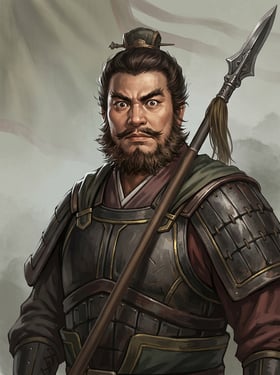
Historical Record
Zhang Fei, courtesy name Yide, was a man of Zhuo Commandery who in his early years followed Liu Bei together with Guan Yu. Guan Yu was several years older than Zhang Fei, and Zhang Fei treated him with the deference due an elder brother. After Liu Bei, then under Cao Cao, defeated Lü Bu, Cao Cao appointed Zhang Fei a General of the Household (zhonglang jiang). When Liu Bei broke away from Cao Cao and turned to Yuan Shao and then Liu Biao, Zhang Fei followed him. After Liu Biao's death, Cao Cao advanced his troops into Jing Province, and Liu Bei fled south toward the Jiangnan region, pursued urgently by Cao Cao. At Changban in Dangyang, Liu Bei was overtaken by Cao Cao; he abandoned his wife and children and fled, escaping danger with only a few dozen riders, including Zhuge Liang, Zhang Fei, and Zhao Yun. Zhang Fei led twenty horsemen to cover the retreat, holding the riverbank and cutting the bridge; with glaring eyes and leveled spear he roared aloud, "I am Zhang Yide; come and we shall fight to the death!" None of Cao Cao's troops dared approach, and Liu Bei was thereby able to escape.
After Liu Bei pacified the Jiangnan region, he appointed Zhang Fei Grand Administrator of Yidu and General Who Conquers Bandits, enfeoffing him as Marquis of Xinting, and later transferred him to Nan Commandery. During Liu Bei's entry into Yi Province to attack Liu Zhang, Zhang Fei and others such as Zhuge Liang advanced up the river, dividing and pacifying commanderies and counties. At Jiangzhou he defeated and captured alive Yan Yan, Grand Administrator of Ba Commandery and a general under Liu Zhang. Zhang Fei at first angrily rebuked Yan Yan for refusing to surrender, but Yan Yan replied with stirring words: "This province has only beheaded generals; it has no surrendered generals." Moved by Yan Yan's heroism, Zhang Fei released him and made him an honored guest. After Yi Province was pacified, Zhang Fei was rewarded for his merit with five hundred catties of gold, a thousand catties of silver, fifty million cash, and a thousand bolts of brocade, and was made Grand Administrator of Baxi.
After Cao Cao defeated Zhang Lu, he left Xiahou Yuan and Zhang He to garrison Hanchuan. Zhang He led his army south into Baxi, intending to relocate the local populace to Hanzhong, and faced off against Zhang Fei in the area of Dangqu, Mengtou, and Dangshi for more than fifty days. Zhang Fei led over ten thousand elite troops by another route and engaged Zhang He in a narrow mountain path, ultimately routing Zhang He's army. Zhang He abandoned his horse and climbed the mountain, escaping back to Nanzheng by a small path with only some ten followers, and the Baxi region was thereby pacified. After Liu Bei proclaimed himself King of Hanzhong, he appointed Zhang Fei General of the Right with authority of the tally. In the first year of Zhangwu (221 CE), Zhang Fei was transferred to General of Chariots and Cavalry, concurrently Colonel-Director of Retainers (Sili), and his fief was raised to Marquis of Xixiang. The histories record that Zhang Fei was mighty and fierce, second only to Guan Yu; Cao Wei advisers such as Cheng Yu all called Guan Yu and Zhang Fei "matches for ten thousand men". However, Zhang Fei "loved and respected gentlemen but had no compassion for common soldiers," and Liu Bei once warned him: "Your punishments and executions are already excessive, and you daily flog stout soldiers yet keep them at your side—this is the way to bring disaster upon yourself." But Zhang Fei did not reform. In the fourth month of summer in the first year of Zhangwu (221 CE), Liu Bei proclaimed himself emperor. In the sixth month of that same year, Zhang Fei was murdered by his subordinate generals Zhang Da and Fan Qiang, who took his head and fled to Sun Quan. When Liu Bei heard the news, he sighed, "Alas! Fei is dead." He posthumously honored Zhang Fei with the title Marquis Huan. His eldest son Zhang Bao died young; his second son Zhang Shao inherited the title and rose to Palace Attendant and Vice Director of the Masters of Writing. Zhang Bao's son Zhang Zun served as a Master of Writing and died fighting Deng Ai at Mianzhu alongside Zhuge Zhan.
In the Novel
In Romance of the Three Kingdoms, Zhang Fei's image is given even more vivid color and legend. He first appears with the image of "a leopard's head and round eyes, a swallow's jaw and tiger's whiskers, a voice like thunder, and a bearing like a galloping horse," and swears brotherhood with Liu Bei and Guan Yu in the Peach Garden, vowing, "We seek not to be born on the same year, month, and day, but only to die on the same year, month, and day," establishing the deep bond between the three. The weapon he wields is the eighteen-foot serpent-spear of tempered steel (novel only; no clear record in the histories).
In the novel, Zhang Fei's temperament is more hot and impulsive, yet this also makes his loyalty and valor more apparent. For example, after the Yellow Turban turmoil was pacified, when Dong Zhuo treated Liu Bei with disdain and rudeness, Zhang Fei "flew into a rage and said: 'We risked our lives in bloody battle and saved this fellow, yet he treats us so rudely! If I do not kill him, my anger cannot be quelled!'" and tried to draw his blade to kill Dong Zhuo, but was stopped by Liu Bei and Guan Yu. When Liu Bei was serving as constable of Anxi County and the inspector (duyou) came to extort, Zhang Fei, ignoring Liu Bei's dissuasion, tied the inspector to the hitching post and flogged him with willow switches, ultimately causing Liu Bei to abandon his office. This differs from the histories, in which Liu Bei resigned the office of his own accord; through Zhang Fei's violent action the novel highlights both Liu Bei's benevolence and Zhang Fei's straightforwardness.
Before Hulao Gate, the "Three Heroes Fight Lü Bu" featuring Zhang Fei is a classic scene of the novel. He was the first to go out and battle Lü Bu, loudly cursing him as a "slave of three surnames," displaying his fearless fighting spirit. At Xu Province, Liu Bei entrusted the city to Zhang Fei and warned him about being "harsh and unyielding after drink, flogging his soldiers; and second, acting rashly and not heeding others' counsel," and Zhang Fei solemnly vowed to reform. Yet he got drunk and flogged Cao Bao, causing Cao Bao to bring Lü Bu to raid Xu Province by surprise, plunging Liu Bei into difficulty. Although this episode highlights Zhang Fei's flaws, it also lays the groundwork for Liu Bei's later benevolence and Zhang Fei's remorse. When Xu Province fell and his sisters-in-law were trapped, Zhang Fei felt deep guilt and even drew his sword to kill himself, but was stopped by Liu Bei's words: "Brothers are like hands and feet; wives and children are like clothing".
In the novel, Zhang Fei's cause of death is consistent with the histories—he was murdered by his subordinate generals Zhang Da and Fan Qiang. But the novel further emphasizes that before his death he was grief-stricken and indignant over Guan Yu's death, flogging his soldiers, which ultimately led his subordinates to rebel, deepening the tragedy of his "violent and merciless" character.
Key Relationships
* Liu Bei's faction (serves): Zhang Fei was one of the core members of Liu Bei's faction, loyally following Liu Bei from the Oath of the Peach Garden onward and rendering illustrious service in the founding of Shu Han.
* Liu Bei (fights_in): Zhang Fei and Liu Bei were as close as brothers, sharing the same bed and bound by brotherly affection. He repeatedly charged into battle for Liu Bei, such as covering the retreat at Changban, sharing countless hardships with Liu Bei.
* Guan Yu (brother): Zhang Fei and Guan Yu were sworn brothers with deep affection. Although they sometimes quarreled (novel only), they always supported each other and worked together for Liu Bei.
* Zhang He (fights_in): Zhang Fei once fought the renowned Cao Wei general Zhang He in the Dangqu area and ultimately routed Zhang He's army, forcing him to abandon his horse and flee, displaying his outstanding military talent.
* Shu Han (serves): Zhang Fei was an important general of Shu Han, rising to General of Chariots and Cavalry, concurrently Colonel-Director of Retainers, and enfeoffed as Marquis of Xixiang, making great contributions to the founding and consolidation of Shu Han.
* Yan Yan (captures_and_releases): Zhang Fei captured Yan Yan alive during his entry into Shu and, moved by his loyalty and righteousness, ultimately released him and made him an honored guest, showing the careful side beneath Zhang Fei's roughness.
* Lü Bu (rival): In the novel, Zhang Fei clashed with Lü Bu several times, especially at Hulao Gate and Xu Province, and the conflict between the two is an important plot thread.
* Zhang Da and Fan Qiang (murderers): Zhang Fei was ultimately murdered by his subordinate generals Zhang Da and Fan Qiang, who took his head and fled to Sun Quan, the direct cause of Zhang Fei's tragic end.
Iconic Scenes
* Oath of the Peach Garden: Zhang Fei, Liu Bei, and Guan Yu burned incense and swore brotherhood in the Peach Garden, vowing to share life and death—one of the most classic opening scenes in Romance of the Three Kingdoms, establishing the deep bond among the three (novel only).
* Flogging the Inspector: Discontented with the inspector's oppression of the people and of Liu Bei, Zhang Fei tied him to the hitching post and flogged him, displaying his hatred of evil and his violent, impulsive nature (novel episode; no clear record in the histories).
* Covering the Retreat at Changban: When Cao Cao's great army pursued Liu Bei, Zhang Fei led twenty horsemen to hold the riverbank and cut the bridge, leveling his spear and roaring to frighten off Cao Cao's troops and allow Liu Bei to escape, fully showing his valor as a match for ten thousand men.
* Righteously Releasing Yan Yan: When attacking Yi Province, Zhang Fei captured Yan Yan alive and, moved by his unyielding loyalty, ultimately released him and made him an honored guest, displaying Zhang Fei's heroic and magnanimous side.
* Routing Zhang He: Zhang Fei faced off against Zhang He at Baxi and ultimately, using surprise tactics, routed Zhang He's army and sent it fleeing in disorder, consolidating Liu Bei's position in Hanzhong.
* Losing Xu Province While Drunk: Zhang Fei, drunk, flogged Cao Bao, causing Cao Bao to bring Lü Bu to raid Xu Province by surprise and Liu Bei to lose his base. This incident profoundly reveals the flaw in Zhang Fei's "violent and merciless" character (novel only).
* Murdered by His Subordinate Generals: Zhang Fei was ultimately killed by his subordinate generals Zhang Da and Fan Qiang; this ending is both an embodiment of his character tragedy and a foreshadowing of Liu Bei's campaign against Wu.
Portrait file
Character profile
- Appearance
- Eight chi tall, with a leopard's head and round eyes, a swallow's jaw and tiger's whiskers, his voice like great thunder and his momentum like a galloping horse. His round eyes glared wide and his tiger's whiskers bristled upright.
- Character
- Zhang Fei was mighty and fierce in character, loving and respecting gentlemen but showing no pity to the lowly, violent and ungrateful, excessive in punishment and killing, daily flogging his stout soldiers. He was violent, upright, hated evil like an enemy, brave, fierce and hot-tempered, and spoke without restraint.
- Manner of speech
- Zhang Fei spoke bluntly and gave orders decisively, often shouting at the top of his voice, his words full of provocation and slogans, and at times boasting in his rough, blunt way. Frank and coarse-hearted, he freely called others brothers.
- Life
- Zhang Fei's family had long dwelt in Zhuo Commandery. In his youth he served the former sovereign Liu Bei together with Guan Yu, and later they swore the Oath of the Peach Garden. He followed Lord Cao in defeating Lü Bu, at Changban in Dangyang held the river and cut off the bridge to drive back Cao's army single-handed, entered Shu advancing upstream to pacify the commanderies and counties, and fought at Wakou to defeat Zhang He. In the first year of Zhangwu he was promoted to General of Chariots and Cavalry and concurrently Colonel-Director of Retainers, and was advanced in fief to Marquis of Xixiang; he was later killed by his subordinates Zhang Da and Fan Qiang.
- Weapons
- Zhang Fei habitually used the eighteen-chi tempered-steel spear, also called the eighteen-chi serpent spear.
- Anecdotes
- Zhang Fei once turned back in fury wishing to kill Dong Zhuo, angrily flogged the Postal Inspector at the county seat, and once, in a moment of peril, wished to draw his sword and cut his own throat. He once shouted back Cao's army at Changban Bridge, and did battle with Ma Chao before Jiameng Pass.
Relationships
72 relationships
Family6
Lord & vassal6
Friends5
Enemies18
Other33
Quotes
144 recorded lines · 3 featured
「我乃燕人張翼德也!誰敢與我決一死戰?」
With a single roar at Changban, Zhang Fei's valiant image took deep root in people's hearts and is widely renowned.
「三姓家奴休走!燕人張飛在此!」
'Slave of three surnames' is Zhang Fei's classic taunt against Lü Bu, instantly recognizable in the culture.
「吾莊後有一桃園,花開正盛;明日當於園中祭告天地,我三人結為兄弟,協力同心,然後可圖大事。」
The Oath of the Peach Garden marks the beginning of the bond among Liu Bei, Guan Yu, and Zhang Fei, and this line lays its cornerstone.
Chapters55 回 ▸
- 史ch.17ch.32ch.35ch.36ch.41ch.45
- 演ch.1ch.2ch.5ch.6ch.7ch.11ch.12ch.13ch.14ch.15ch.16ch.17ch.18ch.19ch.21ch.22ch.24ch.28ch.31ch.34ch.35ch.36ch.37ch.38ch.39ch.40ch.41ch.42ch.45ch.49ch.50ch.51ch.52ch.53ch.56ch.57ch.60ch.61ch.63ch.64ch.65ch.69ch.70ch.72ch.73ch.78ch.81ch.83ch.85
Relationship timeline75 条 ▸
史 ch.32
史 ch.35
rival_of
不悦(与关羽同),先主以鱼水之喻解之
史 ch.36
演 ch.2
fights_in
阵前刺其落马
- Liu Bei§8
oath_brother
痛打督邮以救兄;逼迫弃官
演 ch.5
演 ch.6
- Liu Bei§13
commands_in
随刘备从公孙瓒拔寨北归,赴平原
演 ch.7
- Liu Bei§6
commands_in
同来救公孙瓒
演 ch.11
- Yu Jin§10
fights_in
杀入曹寨与于禁数合相战,玄德掣剑助攻使于禁败走
演 ch.12
- Liu Bei§12
advises_in
与关羽再三相劝玄德受徐州
演 ch.13
演 ch.14
演 ch.15
- Liu Bei§1
oath_brother
失徐州悔欲自刎;玄德抱住夺剑、申『兄弟如手足』之义
演 ch.16
- Liu Bei§2
oath_brother
哥哥;同护小沛、同投许都
演 ch.17
- Liu Bei§13
oath_brother
义弟;同参与诈宴斩韩杨
演 ch.18
- Liu Bei§20
serves
守东门
演 ch.19
- Lü Bu§11
fights_in
阵前迎敌高顺;后追擒郝萌
演 ch.21
演 ch.22
演 ch.24
- Liu Bei§18
advises_in
张飞献劫寨之策,玄德赞其用计中兵法
演 ch.28
- Liu Bei§21
oath_brother
闻汝南音信而欲再聚;末日全员入古城拜诉
演 ch.34
演 ch.35
演 ch.36
- Liu Bei§7
fights_in
北河岸伏击曹仁
演 ch.39
- Zhuge Liang§18
commands_in
受令引一千军伏安林山谷,烧博望旧粮
- Xiahou Lan§26
enemy_of
一枪刺夏侯兰于马下
演 ch.40
- Song Zhong§25
enemy_of
主张先斩宋忠,玄德止之
- Zhuge Liang§29
serves
受命引一千军于博陵渡口埋伏
演 ch.41
演 ch.42
演 ch.45
- Liu Bei§16
oath_brother
因恐玄德有失,独引五六十只船接应
演 ch.50
- Cao Cao§17
enemy_of
葫蘆口橫矛立馬攔截,從後追趕
演 ch.51
- Zhuge Liang§29
commands_in
受孔明使兵符诈调荆州守軍,襲取荊州
演 ch.52
演 ch.57
- Pang Tong§47
witnesses
巡至耒阳见统理事神速,下席谢罪,许极力举荐
演 ch.60
- Liu Bei§30
commands_in
领四郡巡江
演 ch.61
演 ch.63
- Zhuge Liang§24
serves
受孔明撥精兵一万取大路杀奔巴州;临行受嘱不可轻敌、勿擄百姓
- Yan Yan§31
friend_of
智擒嚴顏后回嗔作喜,亲解其缚扶坐拜之;嚴顏感其恩义乃降
演 ch.65
演 ch.70
演 ch.72
- Xu Chu§6
enemy_of
张飞夜伏褒州,乘许褚酒醉一矛刺中肩膀夺其糧草
演 ch.81
演 ch.83
- Zhang Bao§23
parent_of
张飞之子;自仗利刀将范疆张达万剮凌迟祭父之灵
演 ch.85
- Liu Bei§9
鬼魂入梦于
Inner monologues · AI-generated3 段 ▸
- I am Zhang Fei, courtesy name Yide. The moment has come: white flags and white armor are being prepared in the camp, and
- I am Zhang Fei, courtesy name Yide. I remember campaigning alongside my elder brother. With blades and weapons bearing d
- I remember our home in Zhuo Commandery, where the world was in turmoil and the Yellow Turbans rose up everywhere, leavin
Life events37 ▸
- 0184-01-01 · Zhuo CountyOath of the Peach Garden· Witness
- 0190-01-01 · HulaoguanThree Heroes Fight Lü Bu at Hulao Gate· Warrior
- 0190-01-01 · Sishui PassBattle of Sishuiguan· Witness
- 0191-01-01 · JieqiaoBattle of Jieqiao· Warrior
- 0194-01-01 · Xu ProvinceLiu Bei Takes Control of Xu Province· Warrior
- 0194-01-01 · BeihaiRelief of the Siege of Beihai· Warrior
- 0194-01-01 · Xu ProvinceTao Qian's Three Cessions of Xuzhou· Witness
- 0196-01-01 · Xu ProvinceLü Bu Seizes Xu Province· Commander
- 0197-01-01 · XiaopeiLü Bu Raids Xiaopei· Warrior
- 0199-01-01 · Xu ProvinceLiu Bei's Defeat of Yuan Shu at Xuzhou· Warrior
- 0199-01-01 · XiapiTrial at White Gate Tower· Witness
- 0199-01-01 · JiangtingDefeat and Death of Yuan Shu· Warrior
- 0200-01-01 · BaimaGuan Yu Slays Yan Liang· Witness
- 0200-01-01 · GuchengReunion of Brothers at Gucheng· Commander
- 0201-01-01 · Jing ProvinceLiu Bei Takes Refuge in Jing Province· Warrior
- 0201-01-01 · RangshanBattle of Rangshan· Warrior
- 0207-01-01 · LongzhongThe Three Visits (to the Thatched Cottage)· Witness
- 0207-01-01 · XinyeXu Shu Serves Liu Bei· Warrior
- 0208-01-01 · ChangshaLiu Bei's Seizure of the Four Southern Jing Commanderies· Warrior
- 0208-01-01 · DangyangLiu Bei's Retreat with Refugees across the River· Warrior
- 0208-01-01 · ChangbanBattle of Changban· Warrior
- 0209-01-01 · Jing ProvinceZhang Fei Takes Wuling· Commander
- 0209-01-01 · Nan CommanderyZhao Yun Seizes Nanjun· Warrior
- 0210-01-01 · JianglingZhou Yu's Stratagem of Borrowed Road to Destroy Guo· Warrior
- 0210-01-01 · Jingzhou (Gong'an)Pang Tong Joins Shu and Receives a Command· Warrior
- 0212-01-01 · YoujiangkouSeizing Liu Shan on the River· Warrior
- 0213-01-01 · JiangzhouZhang Fei Captures Yan Yan at Jiangzhou· Commander
- 0213-01-01 · Yi ProvinceLiu Bei's Takeover of Yi Province· Warrior
- 0213-01-01 · LuochengBattle of Luocheng· Warrior
- 0214-01-01 · LuochengZhang Ren Captured at Golden Goose Bridge· Warrior
- 0214-01-01 · Jiameng PassMa Chao's Surrender to Liu Bei· Warrior
- 0215-01-01 · LangzhongBattle of Baxi· Commander
- 0219-01-01 · MianyangLiu Bei's Elevation to King of Hanzhong· Witness
- 0219-01-01 · NanzhengWei Yan Appointed Administrator of Hanzhong· Witness
- 0221-01-01 · Wudan HillLiu Bei Proclaims Himself Emperor· Witness
- 0221-01-01 · LangzhongAssassination of Zhang Fei· Victim
- 0223-01-01 · ChengduLiu Shan's Accession to the Throne