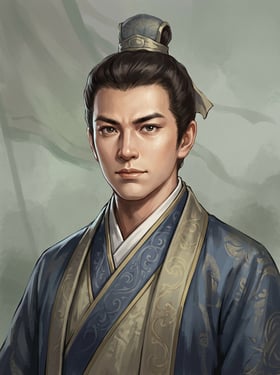
Historical Record
Liu Cong was the younger son of the Governor of Jing Province Liu Biao. During the Jian'an era, Liu Biao and his wife Lady Cai favored Liu Cong and wished to make him heir. Cai Mao, Zhang Yun, and others were also staunch supporters of Liu Cong. To exclude the elder son Liu Qi from the succession, Cai Mao and Zhang Yun transferred Liu Qi away from Xiangyang, making him Administrator of Jiangxia. While Liu Biao was gravely ill, Liu Qi once returned to Xiangyang to visit, but was obstructed by Cai Mao and Zhang Yun and could not see his father. In the end, after Liu Biao died, Liu Cong smoothly succeeded him and became master of Jing Province.
In autumn, the seventh month of the thirteenth year of Jian'an (208 CE), Cao Cao led a great army south to campaign against Liu Biao. In the eighth month, Liu Biao died of illness, and Liu Cong took his place, garrisoning Xiangyang, while Liu Bei garrisoned Fancheng. In the ninth month, Cao Cao's great army reached Xinye. At this point, the Bureau Director Fu Xun and others advised Liu Cong, analyzing the disadvantages of resisting Cao Cao: they pointed out that for "a subject to resist his sovereign" was to go against the trend, that for "a newly founded Chu to oppose the state" was a hopeless balance of forces, and that Liu Bei too was no match for Cao Cao. Fu Xun further asked Liu Cong how he rated himself against Liu Bei, and Liu Cong frankly admitted, "I am not his equal." Fu Xun thereupon urged him to submit to Cao Cao. In the end, Liu Cong adopted the advice of Fu Xun and the others and surrendered the whole of Jing Province to Cao Cao.
After Liu Cong surrendered, Cao Cao appointed him Inspector of Qing Province and enfeoffed him as a full marquis. Cao Cao rated Liu Cong highly, calling him "lofty in heart and pure in aim, deep in wisdom and broad in thought, light of glory and weighty of duty, slight in profit and rich in virtue," and holding that he "disdained a domain of ten thousand li, made light of an army of three hosts, was firm in the substance of central rectitude, and earnest in the repute of a good name." Cao Cao even held that enfeoffing him as a full marquis and giving him the post of a province was still not enough to match the man. Later, Liu Cong petitioned to return to Jing Province; Cao Cao complied with his wish and memorialized to make Liu Cong a Grand Master of Remonstrance, participating in military affairs.
Liu Cong's surrender had a major impact on Liu Bei. At the time Liu Bei was garrisoned at Fancheng and was wholly unaware of Liu Cong's surrender to Cao Cao, learning of it only when Cao Cao's great army had already reached Wancheng. Liu Bei sent men to question Liu Cong, and Liu Cong sent Song Zhong to inform him. Liu Bei was greatly alarmed at the news and angry at Song Zhong's late report, but in the end did not harm him. Faced with Cao Cao's approach, Liu Bei led his people south. When passing through Xiangyang, Zhuge Liang advised Liu Bei to seize Liu Cong and take Jing Province, but Liu Bei refused with the words, "I cannot bear to." Many of Liu Cong's subordinates and the people of Jing Province came over to Liu Bei.
In the Novel
In the Romance of the Three Kingdoms, Liu Cong is portrayed as a young, weak puppet acting under the control of his mother Lady Cai and his uncles Cai Mao and Zhang Yun. He first appears in Chapter 34, coming out together with his elder brother Liu Qi to welcome Liu Bei while Liu Biao was still alive.
After Liu Biao died, Lady Cai conspired with Cai Mao and Zhang Yun to forge a will and install the fourteen-year-old Liu Cong as master of Jing Province. Liu Cong showed some misgivings, fearing that Liu Qi and Liu Bei would raise troops to call him to account. But when Cao Cao's great army approached Xiangyang, Liu Cong's cowardice and lack of resolve were fully exposed. He gathered Kuai Yue, Cai Mao, and others to discuss what to do. The Bureau Director Fu Xun directly proposed offering the nine commanderies of Jingxiang to Cao Cao to preserve his own name and rank. Liu Cong at first showed a posture of unwillingness to abandon his late father's foundation, but was soon persuaded by Kuai Yue, Fu Xun, Wang Can, and others with the theory that "rebellion and submission have a great pattern, strength and weakness a fixed disposition." Wang Can went on to enumerate in detail Cao Cao's brilliant military achievements, stressing the difficulty of resisting him. In the end, with the direct intervention of Lady Cai, Liu Cong wholly abandoned resistance and decided to surrender.
Liu Cong sent Song Zhong to present the letter of surrender to Cao Cao. Cao Cao was overjoyed and promised that Liu Cong would forever hold Jingxiang. This, however, was only Cao Cao's expedient. When Liu Cong and Lady Cai personally crossed the river to receive Cao Cao and presented the seals and military tallies, Cao Cao, though outwardly consoling them and enfeoffing Kuai Yue, Fu Xun, and others with high office, appointed Liu Cong only as Inspector of Qing Province and pressed him to set out at once. Liu Cong was greatly alarmed at this and said he did not wish to hold office but only to guard his parents' native soil, but Cao Cao would not permit it. In the end, Liu Cong and Lady Cai were forced to go to Qing Province, and on the way were pursued and killed by Yu Jin, whom Cao Cao had sent to eliminate future trouble. This ending differs from the historical record, in which Liu Cong was made a Grand Master of Remonstrance participating in military affairs and rated highly by Cao Cao; through this episode the novel further intensifies Liu Cong's tragic quality and Cao Cao's treacherous image.
Key Relationships
* Cao Cao (defected_to) / Cao Wei (defected_to): With Cao Cao's great army bearing down, Liu Cong followed his advisors' counsel and surrendered the whole of Jing Province to Cao Cao, becoming a member of the Cao Wei camp. The histories record that Cao Cao valued him highly, enfeoffing him as Inspector of Qing Province and a full marquis, later changing his post to Grand Master of Remonstrance participating in military affairs. In the novel, Cao Cao feigns promises but in fact has him killed to eliminate future trouble (novel only).
* Liu Biao's faction (lord_of): Liu Cong was Liu Biao's younger son, who with the support of Lady Cai, Cai Mao, Zhang Yun, and others took Liu Biao's place as master of Jing Province. He inherited Liu Biao's foundation in Jing Province but, after only a very short reign, chose to surrender to Cao Cao. In the novel, he is wholly controlled by Lady Cai, Cai Mao, and others, unable to decide independently.
* Liu Bei (kin_of): Liu Cong was Liu Bei's nephew. The histories record that when Liu Cong surrendered to Cao Cao, Liu Bei was unaware of it; though angry on learning of it, he did not harm the messenger and refused Zhuge Liang's advice to seize Liu Cong, embodying his "unbearing" heart. In the novel, on learning of Liu Cong's surrender, Liu Bei showed great anger at Song Zhong's late report and even wished to kill him, but in the end still chose to retreat south, avoiding a direct clash with Liu Cong.
Iconic Scenes
* Succeeding as Governor of Jing Province: After Liu Biao died of illness, Liu Cong, with the support of Lady Cai, Cai Mao, Zhang Yun, and others, smoothly inherited the post of Governor of Jing Province. This event was the beginning of his political career and laid the groundwork for his later surrender to Cao Cao. In the novel, this succession is depicted as the result of Lady Cai and others forging a will, highlighting Liu Cong's passive, puppet position.
* Deliberating surrender beneath the walls of Xiangyang: Cao Cao's great army marched south and reached the walls of Xiangyang. Liu Cong gathered his advisors to discuss what to do, and in the end, on the urging of Fu Xun, Kuai Yue, and others, decided to surrender to Cao Cao. This was the most important decision of Liu Cong's life, directly changing the ownership of Jing Province. In the novel, this scene is depicted in detail; Liu Cong's hesitation and cowardice and Lady Cai's forceful intervention all make the scene more dramatic.
* Presenting the surrender to Cao Cao: Liu Cong, in person or through an envoy, presented the surrender memorial of Jing Province to Cao Cao, marking Jing Province's formal passage to Cao Cao. The histories record that Cao Cao therefore gave Liu Cong important treatment. In the novel, after Liu Cong presented the surrender, Cao Cao made promises on the surface but in fact had him and his mother killed, an episode that greatly heightens Cao Cao's treacherous image and makes Liu Cong's end all the more tragic. (novel only)
* Liu Bei refusing to attack Liu Cong: On learning of Liu Cong's surrender to Cao Cao, Liu Bei was advised by Zhuge Liang to seize Liu Cong and take Jing Province. But Liu Bei refused this proposal with the words "I cannot bear to," choosing instead to lead his people south. This scene displays Liu Bei's benevolent and righteous character and indirectly affected Liu Cong's fate.
Portrait file
Character profile
- Character
- Liu Cong was rather clever and only fourteen years old, the youngest son borne by Lady Cai, Liu Biao's second wife, and was installed by Lady Cai as lord of Jing Province [c:15, c:16]. Hearing that Xuande had arrived, he was afraid and would not come out, and later, together with his mother Lady Cai, he offered up the seal and surrendered to Cao [c:17].
- Life
- Cai Mao and Zhang Yun upheld Liu Cong as heir. Kuai Yue, Han Song, Fu Xun, and others persuaded Liu Cong to submit to Cao Cao; when Cao Cao's army reached Xiangyang, Liu Cong surrendered the whole province. Cao Cao appointed him Inspector of Qing Province and enfeoffed him as a full marquis, and later memorialized to make him Grand Counselor participating in military affairs [c:2]. After Liu Biao's death, Liu Cong succeeded him and sent an envoy to request surrender; Liu Bei reined in his horse and called out to him, but he was too afraid to come out [c:3].
- Anecdotes
- Liu Cong was the youngest son of Liu Biao; after Liu Biao's death he succeeded as lord of Jing Province, and in the thirteenth year of Jian'an surrendered to Cao Cao [c:4, c:5, c:10]. He has been cited to illustrate how Jing Province came to surrender to Cao [c:19].
Relationships
10 relationships
Quotes
7 recorded lines · 3 featured
「是何言也!孤受先君之基業,坐尚未穩,豈可便棄之他人?」
This line shows Liu Cong's hesitation to lightly give up his family's estate, an important expression of his character.
「先生見教極是。但須稟告母親知道。」
This line highlights Liu Cong's indecisiveness and reliance on his mother, foreshadowing his tragic fate.
「琮不願為官,願守父母鄉土。」
This line is Liu Cong's direct statement of his final choice to surrender, reflecting his indifference to power and position.
Chapters9 回 ▸
- 史ch.1ch.6ch.21ch.32ch.35
- 演ch.34ch.40ch.41ch.42
Relationship timeline5 条 ▸
Inner monologues · AI-generated3 段 ▸
- I am Liu Cong; my courtesy name is unknown. After my father died, the affairs of Jing Province suddenly fell upon me. Th
- I inherited my late father’s legacy, and the people accepted me as his successor. Yet my position in Xiangyang was still
- After my father passed away, Jing Province suddenly fell to me. The histories record only that I succeeded him and garri
Life events3 ▸
- 0208-01-01 · XiangyangLiu Cong's Surrender to Cao Cao· Victim
- 0208-01-01 · XiangyangThe Succession Dispute of Liu Biao· Victim
- 0208-01-01 · Jing ProvinceCao Cao's Southern Campaign Against Jing Province