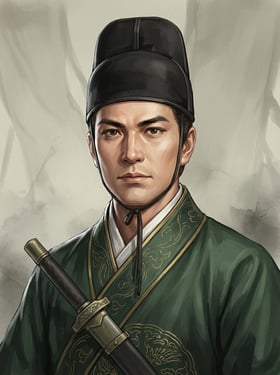
Historical Record
Chen Deng, courtesy name Yuanlong, was a native of Guangling. His father, Chen Gui, once served as Chancellor of Pei. In his early years Chen Deng was recruited by Tao Qian to serve as Aide-de-camp (biejia) of Xu Province. When Tao Qian was gravely ill, he expressed to Liu Bei his wish to yield his position, but Liu Bei dared not accept. At this point Chen Deng strongly urged Liu Bei to take charge of Xu Province, pointing out that with the House of Han in decline, this was precisely the time to achieve great deeds, and emphasizing that Xu Province was rich, with a population of a million households; if Liu Bei did not take it, he would later regret it. He even declared that if Liu Bei would not heed him, he too would not dare to follow Liu Bei's decisions. With Kong Rong's concurrence, Liu Bei at last took up the post of Governor of Xu Province c:6635.
After Lü Bu seized Xu Province, Yuan Shu sought to form a marriage alliance with Lü Bu to secure his support. Chen Gui, fearing that a union of Yuan Shu and Lü Bu would threaten the state, persuaded Lü Bu to reject Yuan Shu's proposal and instead cooperate with Cao Cao. Lü Bu adopted Chen Gui's advice and sent Chen Deng to Xu to have an audience with Cao Cao. When Chen Deng met Cao Cao, he stated bluntly that Lü Bu was "brave but without strategy, and fickle in his loyalties," advising Cao Cao to deal with him early. Cao Cao thoroughly agreed, declaring that Lü Bu was "a wolf-cub by nature, truly hard to keep for long," and entrusted Chen Deng with important duties: he raised Chen Gui's official salary, appointed Chen Deng as Administrator of Guangling, and charged him, "The affairs of the east I hand over to you," ordering him to secretly gather forces to serve as an inside ally c:6634.
While serving as Administrator of Guangling, Chen Deng invited Chen Jiao to serve as his Officer of Merit. Chen Deng sent Chen Jiao to Xu, hoping he could observe how the court regarded him. After Chen Jiao returned, he told Chen Deng that the discussants at Xu mostly considered him "arrogant and self-important." Chen Deng explained that those he admired were all men of lofty virtue and outstanding ability—such as the Chen Yuan brothers, Hua Ziyu, Zhao Yuanda, Kong Wenju, and Liu Xuande, who possessed the strategy of a king and hegemon—while as for the other mediocre fellows, they were not worth mentioning, thereby showing that he was not arrogant c:15364. These remarks of Chen Deng displayed his superb discernment in judging and employing men, and his distinctive character.
In the Novel
In Romance of the Three Kingdoms, Chen Deng's image is further developed, especially with his cunning and his loyalty to Liu Bei and Cao Cao strengthened. He first appears in Chapter 11, when Tao Qian was being attacked by Cao Cao; Chen Deng, together with Mi Zhu, offered strategies to Tao Qian and volunteered to go to Qing Province to request aid from Tian Kai c:6636.
When Tao Qian was gravely ill, Chen Deng and Mi Zhu again strongly urged Liu Bei to take charge of Xu Province, pointing out that Yuan Shu was "arrogant and overbearing, not a lord fit to govern in troubled times," and emphasizing that Liu Bei was the man who could bring stability to Xu Province c:15336. On his deathbed, Tao Qian once more had Chen Deng persuade Liu Bei, and at last Liu Bei "took temporary charge of the affairs of Xu Province" and appointed Chen Deng as a staff officer c:6637.
During Liu Bei's war with Yuan Shu, Zhang Fei was left to guard Xiapi; while drunk, he flogged Cao Bao, which gave Lü Bu the chance to slip in and seize Xiapi. Deeply worried that Zhang Fei might err again, Liu Bei entrusted Chen Deng to assist Zhang Fei, urging him to drink less and avoid mishaps c:4115. Nevertheless, Zhang Fei in the end still erred through drunkenness, causing the loss of Xiapi, and in the novel Chen Deng was unable to effectively prevent this from happening c:15337.
In the novel, the scheme of Chen Deng and his father to sow discord against Lü Bu is portrayed in greater detail and with more drama. Chen Deng went to Xu on Lü Bu's orders, and when Cao Cao asked about Lü Bu, Chen Deng stated bluntly that Lü Bu "is a jackal and wolf, brave but without cunning, fickle in his loyalties, and should be dealt with early." Cao Cao was delighted and appointed Chen Deng Administrator of Guangling. When Lü Bu demanded to know why Chen Deng had not sought a post for him, Chen Deng instead used Cao Cao's appraisal of Lü Bu—the "raising a hawk" theory (while the foxes and hares are not yet quelled, one dares not let it eat its fill first; hungry it is of use, full it flies away)—to soothe Lü Bu, making him firmly believe in Cao Cao's words of being a "true friend" c:15340. This episode is not clearly recorded in the histories; it is a literary creation of the novel to highlight Chen Deng's cunning and Cao Cao's craftiness.
When Cao Cao laid siege to Xu Province, Chen Deng and his father again played a crucial role. Chen Deng first persuaded Lü Bu to move his money, grain, and household to Xiaopei, which in fact created the conditions for Cao Cao to take Xu Province c:4118. Chen Deng then pretended to go to the pass to scout the enemy, but secretly made contact with Cao Cao, shot a letter into the Cao army, and sowed discord between Chen Gong and Lü Bu, ultimately causing Lü Bu's army to slaughter one another and Xu Province to fall c:15353. After Lü Bu was finally captured, Chen Deng and his father were rewarded by Cao Cao, and Chen Deng was made General Who Calms the Waves c:6640.
After Liu Bei took control of Xu Province, Chen Deng again offered him strategies: first he exploited Che Zhou's intent to harm Liu Bei to turn the tables and kill Che Zhou c:15358, and later advised Liu Bei to ally with Yuan Shao against Cao Cao c:4120. These episodes all further strengthen Chen Deng's image as a strategist, making him a far-sighted and adaptable counselor.
Key Relationships
* Tao Qian's Faction (serves): In his early years Chen Deng served as Aide-de-camp under Tao Qian and was one of his important staff officers. When Tao Qian was gravely ill, Chen Deng actively urged Liu Bei to take charge of Xu Province, showing deep concern for the province's future c:6635.
* Liu Bei's faction (serves): After Tao Qian's death, Chen Deng strongly urged Liu Bei to become Governor of Xu Province and became Liu Bei's staff officer. During Liu Bei's control of Xu Province, Chen Deng once assisted Zhang Fei and devised strategies for Liu Bei against Cao Cao c:4115.
* Cao Wei (serves): While Lü Bu held Xu Province, Chen Deng secretly contacted Cao Cao and provided important help for Cao Cao's seizure of the province. He revealed Lü Bu's weaknesses to Cao Cao and acted as an inside ally, ultimately bringing about Cao Cao's control of Xu Province, for which he was given Cao Cao's trust and rewards c:6634.
* Lü Bu (advises_in): Chen Deng once served as Lü Bu's envoy to Xu, but in fact used the opportunity to inform on Lü Bu to Cao Cao and to sow discord between Lü Bu and Yuan Shu. In the novel, Chen Deng repeatedly exploited Lü Bu's credulity, setting traps for him that ultimately led to Lü Bu's defeat c:15340 (Novel only).
* Chen Gui (father): Chen Deng and his father Chen Gui were highly aligned in political stance, jointly serving Cao Cao against Lü Bu. In persuading Lü Bu, sowing discord between Lü Bu and Yuan Shu, and ultimately helping Cao Cao take Xu Province, father and son displayed great mutual understanding and cunning c:6634.
* Chen Jiao (friend): Chen Deng once invited Chen Jiao to serve as his Officer of Merit and confided his heart to him, expressing his views on the heroes of the realm, displaying his discernment in judging and employing men and his breadth of mind c:15364.
Iconic Scenes
* Strongly urging Liu Bei to become Governor of Xu Province: When Tao Qian was gravely ill, Liu Bei out of caution declined the post of Governor of Xu Province. Chen Deng stepped forward and, on the grounds that with the House of Han in decline the chance to achieve great deeds must not be missed, strongly urged Liu Bei to take charge of Xu Province; with the firm declaration "If you, my lord, will not heed me, I too will not dare to obey you," he ultimately prompted Liu Bei to accept the post of Governor of Xu Province c:6635. This scene displays Chen Deng's foresight and his trust in Liu Bei.
* Secretly advising Cao Cao to deal with Lü Bu: Chen Deng went to Xu on Lü Bu's orders, but used the opportunity to counsel Cao Cao, stating bluntly that Lü Bu was "brave but without strategy, and fickle in his loyalties," and advising Cao Cao to deal with him early. Cao Cao therefore entrusted Chen Deng with important duties and charged him, "The affairs of the east I hand over to you" c:6634. This act established Chen Deng's important position in Cao Cao's camp and foreshadowed Lü Bu's ultimate fate.
* Mocking Lü Bu with the "raising a hawk" theory: In the novel, after Chen Deng returned to Xu Province from Xu, Lü Bu demanded to know why he had not sought a post for him. Chen Deng cleverly cited Cao Cao's "raising a hawk" metaphor for Lü Bu, saying that Cao Cao likened Lü Bu to a hawk, useful only when hunting foxes and hares (meaning Yuan Shu, Sun Ce, and the like), but flying off once it had eaten its fill. Upon hearing this, Lü Bu was instead delighted, thinking Cao Cao "truly knows me" c:15340 (Novel only). This scene vividly displays Chen Deng's wit and Lü Bu's dullness, and is a classic passage in the novel's characterization.
* Sowing discord with Chen Gong to aid Cao Cao: When Cao Cao laid siege to Xu Province, Chen Deng pretended to go to the pass to scout the enemy, but secretly contacted Cao Cao and sowed discord between Chen Gong and Lü Bu. First he lied to Chen Gong that Cao's troops had already taken a side road into the pass, causing Chen Gong to abandon the pass and flee; then he set fire atop the pass, so that Lü Bu's army slaughtered one another in the dark c:15355 (Novel only). This series of schemes ultimately caused the fall of Xu Province and the capture of Lü Bu, fully displaying Chen Deng's plots and his loyalty to Cao Cao.
* Appraising the heroes of the realm: In his conversation with Chen Jiao, Chen Deng listed the heroes of the realm whom he admired, including the Chen Yuan brothers, Hua Ziyu, Zhao Yuanda, Kong Wenju, and Liu Xuande, and stated bluntly, "The other petty fellows are hardly worth recording" c:15364. This scene displays not only Chen Deng's discernment in judging men but also reflects his character of "heroic spirit and noble integrity" and his esteem for true heroes.
Portrait file
Character profile
- Character
- Chen Deng was heroic in spirit and firm in integrity, deep in scheming and decisive in action, coordinating from within and without; when Lü Bu cursed him he stood atop the wall and declared himself a subject of Han. His judgment was thorough and his assessment of the enemy precise—he saw through Cao Cao's feint of raising empty banners at Liyang, remarking that 'Cao's crafty schemes are without number.'
- Manner of speech
- In his speech Chen Deng often showed confidence and readiness to take responsibility, as in 'Your son already has a plan,' 'Your son has his own scheme to escape,' and 'The affairs outside, your son will handle himself.' He was skilled at persuading others to surrender through argument of advantage and harm, and could plainly point out a change in someone's standing, as when he said of Han Xian that he 'was formerly a subject of Han, but is now a subject of rebel traitors.'
- Life
- Chen Deng was a native of Guangling, where he held great renown. For his merit in forming a pincer against Lü Bu he was enfeoffed as General Who Subdues the Waves, and later routed Sun Ce's army at Kuangqi. Chen Deng died at the age of thirty-nine, his achievements unfulfilled.
- Anecdotes
- Chen Deng once carried out three stratagems at once—moving the grain, shooting in a letter, and deceiving Bu—to sow discord in Lü Bu's army, and ultimately gained the office of General Who Subdues the Waves. He once presented to Che Zhou a plan to lay an ambush beside the barbican gate to kill Liu Bei, but secretly sent his father Chen Gui to warn Guan and Zhang, and after Che Zhou came out of the city he shot him dead with a hail of arrows from atop the wall.
Relationships
9 relationships
Quotes
32 recorded lines · 3 featured
「呂布豺狼也,勇而無謀,輕於去就,宜早圖之。」
This line precisely appraises Lü Bu, showing Chen Deng's discernment of character and providing grounds for Cao Cao to eliminate Lü Bu.
「吾乃漢臣,安肯事汝反賊耶!」
This line shows Chen Deng's heart turned toward the House of Han, awe-inspiring in loyalty and righteousness, and it was key to the success of his counter-scheme.
「夫闺门雍穆,有德有行,吾敬陳元方兄弟;渊清玉絜,有礼有法,吾敬华子鱼;清脩疾恶,有识有義,吾敬趙元达;博聞强记,奇逸卓荦,吾敬孔文舉;雄姿杰出,有王霸之略,吾敬劉玄德:所敬如此,何骄之有!餘子琐琐,亦焉足录哉?」
In this passage Chen Deng appraises the heroes of the realm, displaying his broad insight and distinctive character; it is widely circulated.
Chapters12 回 ▸
- 史ch.7ch.22ch.32
- 演ch.11ch.12ch.14ch.16ch.17ch.19ch.21ch.22ch.24
Relationship timeline6 条 ▸
Inner monologues · AI-generated3 段 ▸
- I am Chen Deng, courtesy name Yuanyong. If I reflect on my life now, I first recall the day we welcomed Lord Liu to Xu P
- I am Chen Deng, courtesy name Yuanlong. Living through the troubled final years of the Han, my thoughts often ranged bey
- I am Chen Deng, courtesy name Yuanlong, from Guangling. I recall that when Lord Tao sent someone to Qing Province to see
Life events4 ▸
- 0194-01-01 · Xu ProvinceLiu Bei Takes Control of Xu Province· Advisor
- 0194-01-01 · Xu ProvinceTao Qian's Three Cessions of Xuzhou· Advisor
- 0194-01-01 · Xu ProvinceTao Qian Yields Xuzhou to Liu Bei· Advisor
- 0198-01-01 · Xu ProvinceChen Deng's Double-Agent Stratagem Against Lu Bu· Instigator