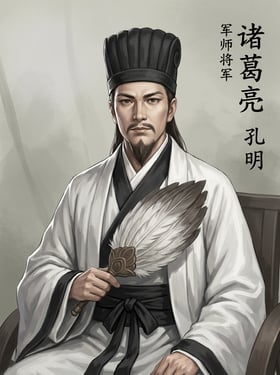
Historical Record
Zhuge Liang, styled Kongming, was a native of Yangdu in Langya, a descendant of Zhuge Feng, who had been Colonel-Director of Retainers under the Han. His father Zhuge Gui once served as Assistant Administrator of Mount Tai Commandery and died early. Zhuge Liang lost his father in childhood and followed his uncle Zhuge Xuan to Yuzhang, after which Xuan attached himself to Liu Biao, Governor of Jing Province. After Xuan died, Zhuge Liang farmed at Longzhong, often comparing himself to Guan Zhong and Yue Yi; most of his contemporaries did not take this seriously, and only friends such as Cui Zhouping of Boling and Xu Shu of Yingchuan believed him c:12009.
In the twelfth year of Jian'an (207 CE), the Former Lord Liu Bei was garrisoned at Xinye, and Xu Shu recommended Zhuge Liang to him, calling him the "Crouching Dragon." Liu Bei made the Three Visits to the thatched cottage before he could meet Zhuge Liang. Zhuge Liang analyzed for Liu Bei the situation of the realm and put forward the "Longzhong Plan" strategic conception of "straddling Jing and Yi, holding fast their natural barriers, making peace with the various Rong to the west, pacifying the Yi and Yue to the south, allying with Sun Quan abroad, and putting governance in order at home," so as to pursue hegemony c:12011. Liu Bei was greatly delighted to hear this, and his friendship with Liang grew daily closer; he explained his high regard for Liang by saying, "My having Kongming is like a fish having water." c:12011
When Cao Cao marched south against Liu Biao, Liu Biao died of illness, and after his son Liu Cong succeeded him, Liu Cong surrendered to Cao. Liu Bei led his followers in retreat to the south, and Cao Cao pursued urgently, routing Liu Bei's army at Changban in Dangyang. Liu Bei, together with Zhuge Liang, Zhang Fei, Zhao Yun, and a few dozen horsemen, managed to escape c:12003. At this critical juncture, Liu Bei sent Zhuge Liang as an envoy to Eastern Wu to ally with Sun Quan. Zhuge Liang successfully persuaded Sun Quan, bringing about the joint Sun-Liu army to resist Cao Cao together c:12013. At the Battle of Red Cliffs, the joint Sun-Liu army routed Cao's army, and Cao Cao led his troops back north. Liu Bei seized the opportunity to take the various commanderies south of the Yangtze, and made Zhuge Liang Military Adviser and General of the Household, supervising the taxes of the three commanderies of Lingling, Guiyang, and Changsha to provision the army c:12013.
In the sixteenth year of Jian'an (211 CE), Liu Bei entered Shu, while Zhuge Liang and Guan Yu held Jing Province. Later Liang led Zhang Fei, Zhao Yun, and others up the river, pacifying commanderies and counties one by one, and joined forces with Liu Bei to besiege Chengdu. After Yi Province was pacified, Liang was appointed Military Adviser General and managed the affairs of the office of the General of the Left, often guarding Chengdu and keeping it well supplied with food and troops c:12014. In the first year of Zhangwu (221 CE), Liu Bei proclaimed himself Emperor and founded Shu Han, making Zhuge Liang Chancellor, managing the affairs of the Imperial Secretariat, with the authority of the staff of office c:12004. In the third year of Zhangwu (223 CE), Liu Bei lay gravely ill at Yongan and summoned Zhuge Liang to entrust him with the affairs that would follow, saying, "Your talent is ten times that of Cao Pi; you will surely bring peace to the state and finally settle the great task. If the heir can be assisted, assist him; if he proves without talent, you may take it yourself." Liang wept and declared that he would exhaust the strength of his limbs and render the integrity of his loyalty c:12018.
After Liu Bei died, Zhuge Liang assisted the Later Lord Liu Shan. In the third year of Jianxing (225 CE), Liang led an army on a southern campaign, pacifying four commanderies, so that military supplies were ample and the state's strength was abundant c:12019. Thereafter, Zhuge Liang ordered the troops and trained for war, planning a northern expedition. In the sixth year of Jianxing (228 CE), Liang led an army north to garrison Hanzhong and advanced from Mount Qi; the three commanderies of Nan'an, Tianshui, and Anding rebelled against Wei in response, shaking the region within the passes. However, because Ma Su disobeyed his commands and Jieting was lost, Liang was forced to withdraw and demoted himself three ranks, acting as Chancellor with the title of General of the Right c:12020. Thereafter, Liang launched several more northern expeditions, once besieging Chencang and defeating Wang Shuang, and pacifying the two commanderies of Wudu and Yinping c:12021. In the ninth year of Jianxing (231 CE), Liang again advanced from Mount Qi, using wooden oxen to transport grain, and in battle with the Wei general Zhang He, he shot Zhang He dead c:12022. In the twelfth year of Jianxing (234 CE), Liang led a great army out through the Xie Valley, using gliding horses to transport grain, occupied the Wuzhang Plains at Wugong, and stood in confrontation with Sima Yi for more than a hundred days. In the eighth month of that year, Zhuge Liang died of illness in camp, aged fifty-four c:12024. In life Liang was incorrupt, his household holding no surplus wealth, just as he himself said: "At Chengdu there are eight hundred mulberry trees and fifteen qing of poor fields; my kinsmen's food and clothing have their own surplus. As for me serving in posts abroad, I make no separate provision; my food and clothing on my person all depend on the government, and I do not pursue separate livelihood to add an inch. On the day I die, I will not let there be surplus silk within nor surplus wealth without, so as to fail Your Majesty." c:12881 In the sixth year of Jingyao (263 CE), the Later Lord decreed that a temple be erected to Liang at Mianyang c:12026.
In the Novel
In the Romance of the Three Kingdoms, Zhuge Liang's image is invested with even more legendary color and divine foresight. The novel describes in detail Xu Shu recommending Zhuge Liang to Liu Bei, and mentions that Master Water Mirror, Sima Hui, once said, "If one can obtain either the Crouching Dragon or the Young Phoenix, the realm may be made secure," likening Zhuge Liang to the "Crouching Dragon" c:12057. The details of Liu Bei's Three Visits are rendered in full, and when Kongming first appears, he is "eight chi tall, his face like fine jade, wearing a silk band on his head and a crane-feather cloak on his body, with the floating air of an immortal." c:12280 The "Longzhong Plan" strategy he put forward in the thatched cottage is portrayed as the peerless wisdom of one who knew the realm would be divided in three before ever leaving his cottage c:12060.
In the novel, Zhuge Liang is not only a strategist but also a military commander. As soon as he emerged from his cottage, he burned Xiahou Dun at Bowang Slope, displaying his outstanding military talent. In this battle, Guan Yu and Zhang Fei doubted Kongming's youth and ability, and Zhang Fei even mocked him, saying, "We all go off to fight, while you sit at home—how comfortable!" c:12311 But Kongming, with the wisdom of "devising strategies within the tent and deciding victory a thousand li away," successfully defeated Cao's army c:12313. Thereafter he again burned Cao's army at Xinye, further consolidating his standing within Liu Bei's faction c:12069.
At the Battle of Red Cliffs, Zhuge Liang shines all the more, with episodes such as borrowing arrows with straw boats and borrowing the east wind (novel-only) c:12072 greatly reinforcing his image of divine foresight. In the novel he foresaw that Cao Cao would pursue Liu Bei and arranged in advance for Liu Qi to receive them at Hanjin, displaying precise judgment of the situation c:12072. When Liu Biao was gravely ill, Liu Bei could not bear to seize Jing Province; though Kongming urged him to, Liu Bei still held to benevolence and righteousness, and through this episode the novel highlights Liu Bei's benevolence while also setting off Kongming's deep foresight c:12067.
The novel also depicts Zhuge Liang's clever response, "reaching neither heaven above nor earth below," when Liu Qi sought his counsel, ultimately pointing out for Liu Qi a strategy to avoid disaster c:12062; these details greatly enrich the image of Zhuge Liang's resourcefulness. Compared with the historical record, the Zhuge Liang of the novel is more legendary in color, his stratagems exaggerated and even tinged with myth, making him the very embodiment of wisdom.
Key Relationships
* Liu Bei's faction (serves): Zhuge Liang was the core strategist and de facto leader of Liu Bei's faction. He devised the "Longzhong Plan" strategy for Liu Bei, assisted Liu Bei from dependence on others to the founding of Shu Han, and ultimately became Chancellor of Shu Han, presiding over both internal and external affairs c:12014. Liu Bei trusted him completely, saying, "My having Kongming is like a fish having water." c:12011
* Liu Bei (witnesses): Zhuge Liang witnessed the whole course of Liu Bei's journey from wandering displacement to founding an imperial enterprise. Before his death, Liu Bei entrusted him with the Later Lord Liu Shan, charging him with the heavy task of assisting the young sovereign c:12018.
* Sun Quan (advises_in): Before the Battle of Red Cliffs, Zhuge Liang, as Liu Bei's envoy, successfully persuaded Sun Quan to resist Cao together, bringing about the Sun-Liu alliance and turning the tide of the realm c:12013.
* Shu Han (serves): Zhuge Liang was a founding minister and de facto ruler of Shu Han. He not only devised the state's strategy but also governed internal affairs, developed the economy, and led several northern expeditions, devoting himself utterly to the survival and development of Shu Han c:12019.
* Guan Yu and Zhang Fei: In the early period, Guan Yu and Zhang Fei were unconvinced by the young and as-yet-unaccomplished Zhuge Liang, but Liu Bei dispelled their dissatisfaction with the "bond of fish and water" c:12011. In the Battle of Bowang Slope, Zhuge Liang's clever military deployment won the wholehearted admiration of both Guan and Zhang c:12063.
* Xu Shu: Xu Shu was Zhuge Liang's close friend and the key figure who recommended Zhuge Liang to Liu Bei. He once told Liu Bei, "Zhuge Kongming is the Crouching Dragon; would the general be willing to see him?" c:12011
* Fa Zheng: Although Zhuge Liang and Fa Zheng differed in their tastes, they esteemed each other for public righteousness, and Liang always marveled at Fa Zheng's wit and resourcefulness. After Fa Zheng died, Liang once lamented, "Had Fa Xiaozhi been alive, he could have restrained the sovereign and kept him from going east; and even had he gone east, he surely would not have come to such peril." c:12030
* Sima Yi: During Zhuge Liang's northern expeditions, he confronted Sima Yi many times. During the standoff at the Wuzhang Plains, Sima Yi appraised Zhuge Liang as "a man of rare talent in the realm!" c:12024
* Liu Qi: Zhuge Liang once cleverly devised a plan for Liu Qi, enabling him to avoid disaster and go to Jiangxia c:12062 (novel-only).
Iconic Scenes
* The Three Visits to the Thatched Cottage: Liu Bei went three times to Longzhong to call on Zhuge Liang, finally winning his agreement to leave his retreat and assist him. This event fully displays Liu Bei's eager thirst for the worthy and Zhuge Liang's extraordinary, transcendent wisdom c:12011.
* The Longzhong Plan: In his thatched cottage, Zhuge Liang analyzed for Liu Bei the great situation of the realm and put forward the strategic conception of "straddling Jing and Yi, holding fast their natural barriers," laying the cornerstone of the Shu Han regime c:12011.
* Debate with the scholars of Jiangdong: In Eastern Wu, facing the doubts of the assembled ministers, Zhuge Liang, with his eloquence, refuted them all and successfully brought about the Sun-Liu alliance c:12013 (novel-only).
* Borrowing arrows with straw boats: Before the Battle of Red Cliffs, Zhuge Liang took advantage of a heavy fog to cleverly borrow Cao Cao's arrows, solving Eastern Wu's shortage of arrows c:12072 (novel-only).
* Borrowing the east wind: At the Battle of Red Cliffs, Zhuge Liang set up an altar and performed rites to borrow a southeast wind, helping Zhou Yu's fire attack on Cao's army and securing the victory at Red Cliffs c:12072 (novel-only).
* Fire attack at Bowang Slope: As soon as Zhuge Liang emerged from his cottage, he directed Liu Bei's army in a fire attack on Cao Cao's general Xiahou Dun, winning a great victory and displaying his outstanding military talent c:12064 (novel-only).
* Burning of Xinye: At Xinye, Zhuge Liang again laid a fire-attack scheme, greatly defeating Cao's army and forcing Cao Cao to withdraw c:12069 (novel-only).
* Provoking Zhou Yu by wit: Through his words Zhuge Liang goaded Zhou Yu into resolving firmly to resist Cao, ultimately bringing about the Battle of Red Cliffs c:12013 (novel-only).
* Seven captures of Meng Huo: During his southern campaign, Zhuge Liang captured and released Meng Huo seven times, ultimately winning his wholehearted submission and stabilizing the southern frontier c:12019 (novel-only).
* Executing Ma Su in tears: During the northern expedition, because Ma Su disobeyed Zhuge Liang's commands and caused the loss of Jieting, Zhuge Liang, though grieving for his talent, still executed him according to the law to uphold military discipline c:12020.
* The Memorial on Setting Out to War: On the eve of his northern expedition, Zhuge Liang submitted the Memorial on Setting Out to War to the Later Lord Liu Shan, expressing his resolve of utter loyalty and devotion to the last c:12019.
* Death at the Wuzhang Plains: In the course of his northern expedition, Zhuge Liang fell ill from overwork and died in camp at the Wuzhang Plains, unable to realize his grand aspiration of restoring the House of Han c:12024.
* A dead Zhuge puts living Zhongda to flight: After Zhuge Liang died, Sima Yi pursued the Shu army but withdrew out of suspicion and fear, giving rise to the popular saying "a dead Zhuge puts living Zhongda to flight" c:12024 (novel-only).
Portrait file
Character profile
- Appearance
- Zhuge Liang stood eight chi tall, his face like polished jade. He wore a silk kerchief and a crane-feather cloak, drifting along with the air of an immortal; in plain shoes and a black sash, his lips as if painted vermilion, his brows clear and his eyes bright.
- Character
- He compared himself to Guan Zhong and Yue Yi; his resolve could not be bent, he was composed and adaptable, skilled at goading generals into action, unrivaled in debate, clear about the larger situation, and able to bend or stand firm as the moment required. His schemes were divinely clever, he foretold events as if by magic, perceived opportunities before they arose, made good use of astronomy, laid plans both open and hidden, and, benevolent and generous of heart, held that winning over men's minds came first.
- Manner of speech
- Zhuge Liang spoke pointedly and decisively, with sweeping literary flair, fond of metaphor. He commonly referred to himself as 'I,' would smile as he laid bare a hidden mystery, often explained himself in terms of 'clever calculation' and 'assailing the heart,' and frequently gave his generals secret instructions with the words 'thus and so.'
- Life
- In his early years Zhuge Liang tilled the fields himself; later he left seclusion to follow Liu Bei, becoming General and Military Advisor, and assisted Liu Bei in founding Shu Han, rising to the office of Chancellor. Entrusted with the orphaned heir by the former sovereign, he campaigned south to pacify four commanderies and mounted repeated northern expeditions, at last dying of illness in camp on the Wuzhang Plains at the age of fifty-four.
- Weapons
- When directing his battle formations, Zhuge Liang often held a feather fan and oversaw the fighting seated in a four-wheeled carriage.
- Anecdotes
- Zhuge Liang wrote a treatise in twenty-four chapters, containing the methods of the Eight Duties, Seven Cautions, Six Fears, and Five Dreads, and he invented a repeating crossbow that could loose ten bolts at a single shot. His posthumous title was Marquis Zhongwu; he was buried at Mount Dingjun without walls, brick, stone, or sacrificial offerings, and a temple was built at Mianyang for sacrifices in the four seasons.
Relationships
227 relationships
Family8
Lord & vassal15
Friends21
Enemies30
Teacher & student13
Other129
Quotes
704 recorded lines · 3 featured
「臣亮五出祁山,未得寸土,負罪非輕!今臣復統全師,再出祁山,誓竭力盡心,剿滅漢賊,恢復中原,鞠躬盡瘁,死而後已!」
The line 'I gave my utmost until my heart stopped beating' is a symbol of Zhuge Liang's loyalty and is widely renowned.
「自董卓造逆以來,天下豪傑並起。曹操勢不及袁紹,而竟能克紹者,非惟天時,抑亦人謀也。今操已擁百萬之眾,挾天子以令諸侯,此誠不可與爭鋒。孫權據有江東,已歷三世,國險而民附,此可用為援,而不可圖也。荊州北據漢、沔,利盡南海,東連吳會,西通巴、蜀,此用武之地,非其主不能守。是殆天所以資將軍,將軍豈可棄乎?益州險塞,沃野千里,天府之國,高祖因之以成帝業。今劉璋闇弱,民殷國富,而不知存恤,智能之士,思得明君。將軍既帝室之冑,信義著於四海,總攬英雄,思賢如渴,若跨有荊、益,保其巖阻,西和諸戎,南撫彝、越,外結孫權,內修政理;待天下有變,則命一上將,將荊州之兵,以向宛、洛;將軍身率益州之眾,以出秦川,百姓有不簞食壼漿以迎將軍者乎?誠如是,則大業可成,漢室可興矣。此亮所以為將軍謀者也。惟將軍圖之。」
The 'Longzhong Plan' laid the foundation of Shu Han and displayed Zhuge Liang's outstanding strategic vision.
「吾以為漢朝大老元臣,必有高論,豈期出此鄙言!吾有一言,諸軍靜聽:昔桓、靈之世,漢統陵替,宦官釀禍;國亂歲凶,四方擾攘。黃巾之後,董卓、傕、汜等接踵而起,遷劫漢帝,殘暴生靈。因廟堂之上,朽木為官;殿陛之間,禽獸食祿。狼心狗行之輩,滾滾當朝;奴顏婢膝之徒,紛紛秉政。以致社稷丘墟,蒼生塗炭。吾素知汝所行!世居東海之濱,初舉孝廉入仕。理合匡君輔國,安漢興劉;何期反助逆賊,同謀篡位!罪惡深重,天地不容!天下之人,願食汝肉!今幸天意不絕炎漢,昭烈皇帝繼統西川。吾今奉嗣君之旨,興師討賊。汝既為諂諛之臣,只可潛身縮首,苟圖衣食;安敢在行伍之前,妄稱天數耶!皓首匹夫!蒼髯老賊!汝即日將歸於九泉之下,何面目見二十四帝乎!老賊速退!可叫反臣與吾共決勝負!」
In Zhuge Liang's Debate with the Scholars of Jiangdong, his rebuttal of Wang Lang showcased his extraordinary eloquence and bold spirit.
Chapters89 回 ▸
- 史ch.3ch.9ch.17ch.26ch.27ch.32ch.33ch.34ch.35ch.36ch.37ch.38ch.39ch.40ch.41ch.42ch.43ch.44ch.45ch.47ch.51ch.53ch.54ch.58
- 演ch.36ch.37ch.38ch.39ch.40ch.41ch.42ch.43ch.44ch.45ch.46ch.48ch.49ch.50ch.51ch.52ch.53ch.54ch.55ch.56ch.57ch.58ch.60ch.61ch.63ch.64ch.65ch.66ch.67ch.70ch.71ch.72ch.73ch.77ch.78ch.79ch.80ch.81ch.84ch.85ch.86ch.87ch.88ch.89ch.90ch.91ch.92ch.93ch.94ch.95ch.96ch.97ch.98ch.99ch.100ch.101ch.102ch.103ch.104ch.105ch.110ch.111ch.113ch.116ch.117
Relationship timeline158 条 ▸
史 ch.32
史 ch.35
- Xu Shu§3
friend_of
友善(俱在荆州,谓为信然)
- Liu Bei§4
mentor_of
三往乃见;与亮情好日密;先主拜亮为军师中郎将、军师将军;章武三年永安托孤"君才十倍曹丕…君可自取"
- Liu Bei§4
advises_in
屏人献策,论曹操孙权及荆益形势(隆中对);劝先主称尊号
- Sun Quan§6
advises_in
奉命求救于柴桑,说权抗曹
commands_in
与张飞、赵云等率众沂江分定郡县共围成都
- Zhao Yun§7
commands_in
与张飞等率众沂江分定郡县共围成都
- Guan Yu§7
commands_in
建安十六年与关羽镇荆州
- Liu Shan§8
mentor_of
受顾命辅幼主;建兴元年封武乡侯开府治事,又领益州牧;上出师表;后主诏赠丞相印绶谥忠武侯
- Meng Huo§10
commands_in
南征至滇池,七擒七纵,孟获遂止不去(按裴注《漢晉春秋》详;主传仅"率眾南征…其秋悉平")
- Ma Su§17
commands_in
使督诸军在前与张郃战于街亭;谡违节度举动失宜大破;亮戮谡以谢众
- Wang Shuang§20
fights_in
散关战之破王双,斩双
- Zhang He§21
fights_in
九年出祁山射杀张郃
- Wei Yan§21
commands_in
出祁山时使魏延、高翔、吴班赴拒,大破之
- Sima Yi§22
rival_of
五丈原对峙百馀日;亮疾病卒于军,宣王案行其营垒处所叹"天下奇才也"
- Sima Yi§22
dies_in
五丈原相持,亮卒于军
- Zhuge Jun§27
sibling_of
兄弟(均为亮弟,官至长水校尉)
- Zhuge Jin§46
sibling_of
兄弟(瑾为亮兄,仕吴)
- Zhuge Zhan§50
parent_of
父子(瞻为亮子,建兴十二年时八岁;后嗣武乡侯爵)
史 ch.37
friend_of
諸葛亮亦言之於先主;与统併为军师中郎将
- Fa Zheng§13
friend_of
雖好尚不同,以公義相取;亮每奇正智术;先主东征败后,亮叹"法孝直若在,則能制主上"
史 ch.38
- Xu Jing§12
friend_of
丞相诸葛亮皆为之拜
史 ch.39
史 ch.40
史 ch.41
- Xiang Lang§17
enemy_of
恨朗知谡逃情不举,免官还成都
- Xiang Chong§21
friend_of
北行表与后主荐之"性行淑均,曉暢軍事"
- Zhang Yi§26
friend_of
遣邓芝言次可从权请裔;为参军、署府事;亮出驻汉中以裔领留府长史
- Yang Hong§31
advises_in
先主争汉中急书发兵,亮以问洪;洪言汉中益州咽喉,亮表洪领蜀郡太守
- Zhang Yi§33
advises_in
致书劝裔与岑述石交之道,论者由是明洪无私
- Meng Da§44
rival_of
欲诱以为外援,致书数相交通;后以达无款诚之心,故不救助
史 ch.42
史 ch.44
史 ch.51
- Zhuge Jin§33
sibling_of
蜀丞相诸葛亮与兄瑾书
演 ch.36
- Zhuge Jun§22
sibling_of
兄;与弟同躬耕南阳
演 ch.37
演 ch.38
- Liu Bei§10
advises_in
隆中对策;许以"愿效犬马之劳"出山相助
演 ch.39
演 ch.40
- Liu Bei§28
advises_in
赞同伊籍之议,又劝弃新野往樊城避之并设火攻水淹之计
演 ch.41
- Liu Bei§5
advises_in
为玄德军师,献弃樊取襄、再取江陵之策
演 ch.42
演 ch.43
演 ch.44
演 ch.45
演 ch.46
- Lu Su§42
friend_of
同舟逼近曹寨擂鼓受箭,事毕谓子敬曰"先生真神人也",肃拜服
演 ch.49
演 ch.51
演 ch.52
- Lu Su§4
rival_of
以「物必歸主」之论辞之,并请出刘琦使肃语塞
rival_of
阵前用扇招之招安;设伏擒之;放回令为内应反计
演 ch.53
commands_in
命翼德立军令状领三千军取武陵
- Wei Yan§20
rival_of
喝令刀斧手推出斬之;指其腦後反骨久後必反;後告以「汝可盡忠報主,勿生异心」
演 ch.54
演 ch.55
演 ch.56
演 ch.57
- Zhou Yu§14
witnesses
亲祭周瑜灵前,伏地大哭,读祭文吊孝
演 ch.58
- Liu Bei§2
advises_in
献"结马超牵制曹操"之策;作书使遣使西凉
演 ch.60
演 ch.61
- Liu Bei§23
serves
引大队船只接来;阿斗已奪回大喜;申文书往葭萌关报玄德
演 ch.63
演 ch.64
- Zhang Ren§14
enemy_of
设金雁桥之计擒之;任不降,命斬之以全其名
演 ch.65
advises_in
段5孔明佯作不闻、以言相激,遂使张飞甘当军令
- Guan Yu§24
advises_in
段24作书抚之,将其与黥布彭越作比较以贬,又以美髯公绝伦超群为褒
演 ch.66
- Liu Bei§2
advises_in
段1—2与玄德演双簧:哭拜求割三郡以全兄之家
演 ch.70
advises_in
解张飞"嗜酒"为诱敌之计,反送美酒接应;末议必由翼德或老将破张郃
演 ch.72
演 ch.77
- Liu Bei§28
advises_in
夜观天象知关公必然被祸;劝慰寛怀;请提兵救荆州
演 ch.78
- Liu Bei§1
advises_in
劝谏刘备保养尊体、按兵不动,分析吴魏移祸之谋
演 ch.79
- Liu Bei§20
advises_in
谏缓图刘封孟达;建议陞二人为郡守分调
演 ch.80
- Liu Bei§25
advises_in
托病设计劝进,激使漢中王允从即位
演 ch.81
演 ch.84
- Liu Bei§9
advises_in
见图叹连营之危,命马良速去改屯;预言若失当投白帝
演 ch.85
演 ch.86
friend_of
设宴款待并以"席间问难,皆戏谈耳"善言为温解围
- Meng Huo§19
enemy_of
因孟获作乱乃急召赵云回军,亲自南征
演 ch.88
- Meng Huo§1
enemy_of
二次释放孟获,欲以攻心服之
演 ch.89
- Meng Huo§6
enemy_of
四擒孟获后又释,以待心服
演 ch.90
演 ch.91
演 ch.92
- Ma Chao§1
witnesses
经马超墓亲自祭之
演 ch.93
rival_of
闻识其玄机者乃姜维,叹"吾今欲取天水,不想有此人"
enemy_of
取夏侯楙至帐下,伪以姜维降书饶其性命,纵之去为反间之资
mentor_of
反间使姜维不容于魏;山林中下车执维手收为传人
- Wang Lang§12
enemy_of
痛骂"皓首匹夫、蒼髯老賊",致王朗气满胸膛撞死马下
演 ch.94
- Yadan§6
witnesses
叱武士去其缚,赐酒压惊,用好言抚慰,尽给还羌兵车马器械放回
演 ch.96
演 ch.98
- Sun Li§5
enemy_of
识其诱粮之计,将计就计夹攻烧车,败之
演 ch.99
- Zhang He§5
rival_of
见张郃万军中救戴陵,叹其勇,谓"若留下此人,必为蜀中之害;吾当除之"
演 ch.100
- Liu Shan§19
betrayed_by
闻宦官流言惊讶,下诏宣孔明回朝
演 ch.101
演 ch.102
- Sun Quan§16
advises_in
修书约东吴同盟北征,"共取中原,同分天下"
演 ch.103
演 ch.104
演 ch.117
- Zhuge Zhan§14
parent_of
父子;母为黄承彦之女
Inner monologues · AI-generated3 段 ▸
- The lamplight wavers in the tent; I cannot speak for much longer. I recall how the late emperor entrusted me with the st
- I stand within the command tent, listening as the bronze drums and gongs outside gradually fall silent. I know that this
- I remember when I worked the fields in Longzhong, often comparing myself to Guan Zhong and Yue Yi, though the people of
Life events76 ▸
- 0207-01-01 · LongzhongThe Three Visits (to the Thatched Cottage)· Advisor
- 0207-01-01 · Bowang SlopeFire Attack at Bowang· Commander
- 0207-01-01 · LongzhongXu Shu Recommends Zhuge Liang· Witness
- 0208-01-01 · ChibiZhuge Liang Summons the Wind at the Seven-Star Altar· Instigator
- 0208-01-01 · ChangshaLiu Bei's Seizure of the Four Southern Jing Commanderies· Commander
- 0208-01-01 · DangyangLiu Bei's Retreat with Refugees across the River· Advisor
- 0208-01-01 · Huarong RoadHuarong Road· Instigator
- 0208-01-01 · XinyeBurning of Xinye· Commander
- 0208-01-01 · ChaisangZhuge Liang's Debate with the Scholars of Jiangdong· Advisor
- 0208-01-01 · Chibi stretch of the YangtzeBorrowing Arrows with Straw Boats· Instigator
- 0208-01-01 · ChaisangZhuge Liang's Mission to Eastern Wu· Advisor
- 0208-01-01 · ChibiBattle of Red Cliffs· Advisor
- 0208-01-01 · Changban, DangyangLu Su Meets Liu Bei at Dangyang· Advisor
- 0209-01-01 · ChangshaGuan Yu Fights Huang Zhong and Takes Changsha· Advisor
- 0209-01-01 · NanxuLiu Bei's Marriage into Eastern Wu· Advisor
- 0209-01-01 · LiulangpuLiu Bei's Escape from Wu· Advisor
- 0209-01-01 · JingkouKongming's Three Sealed-Envelope Stratagems· Instigator
- 0209-01-01 · Jing ProvinceZhang Fei Takes Wuling· Advisor
- 0209-01-01 · Nan CommanderyZhao Yun Seizes Nanjun· Instigator
- 0209-01-01 · GuiyangZhao Yun Takes Guiyang· Witness
- 0209-01-01 · ChangshaWei Yan Kills Han Xuan and Surrenders· Advisor
- 0210-01-01 · JianglingZhou Yu's Stratagem of Borrowed Road to Destroy Guo· Advisor
- 0210-01-01 · BaqiuZhou Yu Dies of Illness at Baqiu· Witness
- 0210-01-01 · Jingzhou (Gong'an)Pang Tong Joins Shu and Receives a Command· Advisor
- 0210-01-01 · Jing ProvinceLu Su's Demand for the Return of Jing Province· Advisor
- 0212-01-01 · YoujiangkouSeizing Liu Shan on the River· Witness
- 0213-01-01 · JiangzhouZhang Fei Captures Yan Yan at Jiangzhou· Commander
- 0213-01-01 · Yi ProvinceLiu Bei's Takeover of Yi Province· Commander
- 0214-01-01 · ChengduLiu Zhang's Surrender· Advisor
- 0214-01-01 · ChengduPromulgation of the Shu Legal Code· Instigator
- 0214-01-01 · LuochengZhang Ren Captured at Golden Goose Bridge· Advisor
- 0218-01-01 · ChengduPeng Yang Affair· Advisor
- 0219-01-01 · MianyangLiu Bei Proclaims Himself King of Hanzhong· Instigator
- 0219-01-01 · MianyangLiu Bei's Elevation to King of Hanzhong· Instigator
- 0220-01-01 · ShangyongMeng Da Defects to Wei and Liu Feng Is Executed· Advisor
- 0221-01-01 · ChengduLiu Bei's Proclamation as Emperor· Advisor
- 0221-01-01 · Wudan HillLiu Bei Proclaims Himself Emperor· Instigator
- 0223-01-01 · ChengduLiu Shan's Accession to the Throne· Instigator
- 0223-01-01 · NanzhongNanzhong Rebellion· Commander
- 0223-01-01 · WuchangWu and Shu Renew Their Alliance· Instigator
- 0223-01-01 · ChengduZhuge Liang Repels the Five Armies· Instigator
- 0223-01-01 · BaidichengLiu Bei's Deathbed Entrustment at Baidi· Witness
- 0223-01-01 · WuchangDeng Zhi's Mission to Wu to Renew the Alliance· Instigator
- 0224-01-01 · ChengduQin Mi's Debate with Zhang Wen· Instigator
- 0225-01-01 · Dian LakeSeven Captures of Meng Huo· Commander
- 0225-01-01 · NanzhongZhuge Liang's Southern Campaign· Commander
- 0227-01-01 · ChengduFormer Memorial on Sending Out the Troops· Instigator
- 0228-01-01 · ChengduLatter Memorial on Sending Out the Troops· Instigator
- 0228-01-01 · JixianTianshui Revolts· Commander
- 0228-01-01 · Mount QiKongming Scolds Wang Lang to Death· Instigator
- 0228-01-01 · HanzhongExecution of Ma Su· Instigator
- 0228-01-01 · XichengEmpty Fort Strategy· Instigator
- 0228-01-01 · Mount QiFirst Northern Expedition· Commander
- 0228-01-01 · ChencangZhuge Liang's Second Northern Expedition· Commander
- 0228-01-01 · JietingBattle of Jieting· Commander
- 0228-01-01 · ChencangSiege of Chencang· Commander
- 0228-01-01 · ChencangBattle for Chencang· Commander
- 0229-01-01 · WuchangThe Wu-Shu Alliance Oath to Divide the Realm in Three· Instigator
- 0229-01-01 · WuchangSun Quan and Shu Han Renew Their Alliance· Instigator
- 0229-01-01 · WuduZhuge Liang's Third Northern Expedition· Commander
- 0229-01-01 · WuchangChen Zhen's Alliance Oath at Wuchang· Instigator
- 0230-01-01 · ChencangCao Zhen's Invasion of Shu· Commander
- 0231-01-01 · Mumen RoadBattle of Mumendao· Commander
- 0231-01-01 · Mumen RoadZhang He Shot Dead at Mumendao· Instigator
- 0231-01-01 · ChengduDismissal of Li Yan· Instigator
- 0231-01-01 · YonganLi Yan Dismissed for Failing to Deliver Supplies on Time· Victim
- 0231-01-01 · Mount QiZhuge Liang's Fourth Northern Expedition· Commander
- 0231-01-01 · Mount QiZhuge Liang's Fifth Northern Expedition· Commander
- 0234-01-01 · Shangfang ValleyFire Attack at Shangfang Valley· Commander
- 0234-01-01 · Wuzhang PlainsBattle of Wuzhang Plains· Commander
- 0234-01-01 · Wuzhang PlainsKongming Sends a Woman's Headdress to Sima Yi· Instigator
- 0234-01-01 · Shangfang ValleyWooden Ox and Flowing Horse· Instigator
- 0234-01-01 · Mount QiGrain Transport by Wooden Ox and Flowing Horse· Commander
- 0234-01-01 · Mount QiZhuge Liang's Six Expeditions to Mount Qi· Commander
- 0234-01-01 · Mount QiZhuge Liang's Northern Expeditions· Commander
- 0253-01-01 · Hefei XinchengZhuge Ke's Siege of Hefei Xincheng· Witness