Background
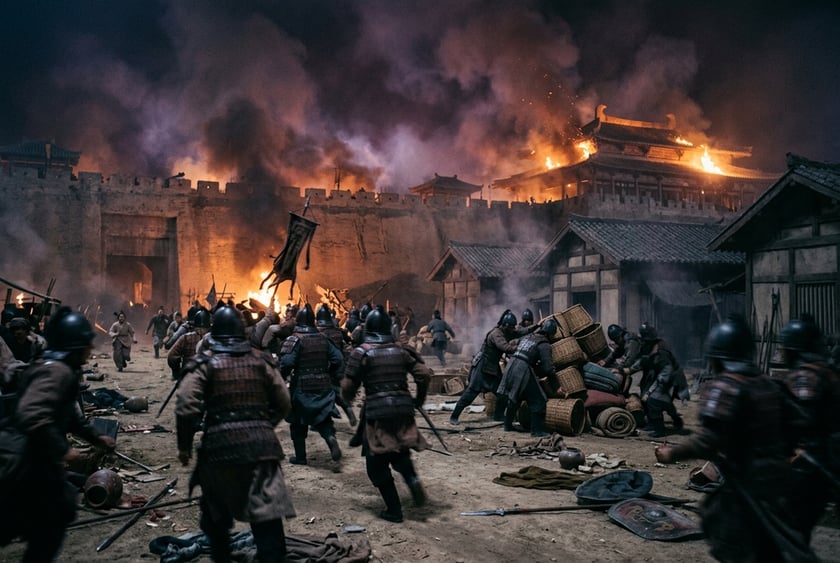
From the standpoint of modern political history, Liubeilingxuzhou — Liu Bei's assumption of governorship over Xuzhou — was the pivotal event in which Liu Bei first entered the stage of warlords as a "provincial governor," and simultaneously the most painful political lesson of his early years. In the first year of Xingping, Cao Cao launched a second punitive campaign against Xuzhou in the name of "avenging his father," massacring entire cities as he went. The Governor of Xuzhou, Tao Qian, had no capacity to resist and sought aid from the Inspector of Qingzhou, Tian Kai, and the Chancellor of Beihai, Kong Rong; Liu Bei at this point was only the Chancellor of Pingyuan with fewer than a few thousand troops, yet was dispatched to Xuzhou to join the fighting [c:16362]. This action had three layers of background: first, from his initial Yellow Turban campaigns through the campaign against Dong Zhuo to his tenure as Chancellor of Pingyuan, Liu Bei had always been in the state of a "dependent military officer" and urgently needed an independent base of operations; second, Xuzhou as a major economic and military center of the late Han (a hub for talent from the Huai-Si and Qing-Xu regions) was a prize every warlord coveted — gaining it would be a qualitative leap; third, Tao Qian himself had no son capable of governing (his sons Tao Shang and Tao Ying were both unsuited to statecraft), so Xuzhou would inevitably pass to another family — the only question was to whom.
Key Figures
The structure of key figures in this event falls into three tiers. The first tier is the "yielding side" — Tao Qian, Mi Zhu, and Chen Deng. Tao Qian's three yieldings of Xuzhou were not simply acts of magnanimous deferral but a form of political wisdom one might call "yielding to preserve the clan": knowing that at his death Xuzhou would be seized by competing warlords, voluntary transfer to the "Imperial Uncle" could protect the Tao clan and Xuzhou's native great families to the greatest possible degree [c:16363]. Mi Zhu and Chen Deng were the actual holders of Tao Qian's political legacy; their support determined the effectiveness of the yielding ceremony. The second tier is the "receiving side" — Liu Bei, Guan Yu, and Zhang Fei. Whether Liu Bei's initial "three refusals" were heartfelt or strategic, historians have long debated; but from his subsequent actions it appears the refusals contained at least genuine political calculation: in an environment of circling warlords and insufficient personal strength, accepting Xuzhou too quickly would have turned him into the target of every rival. The third tier is the "external variables" — Lv Bu, Yuan Shu, and Cao Cao — these three would take the stage in turn during the two years after Liu Bei assumed Xuzhou's governance, ultimately transforming this coveted prize into a burning coal.
Core Issues
On the surface the issue was "whether to accept Xuzhou"; at a deeper level it was "how to hold a province without the matching strength." Xuzhou was situated at the Huai-Si crossroads — economically rich but strategically exposed on all sides: Yuan Tan of Qingzhou to the north, Cao Cao of Yanzhou to the west, Yuan Shu of Shouchun to the south, the coastline with no natural barrier to the east — any of these powers rising would directly threaten Xuzhou. Liu Bei's military strength at this time (fewer than ten thousand men) and his local roots (none) were both insufficient to sustain long-term possession. Chen Deng's proposed solution was "ally with Cao against Yuan" — using Cao Cao to check Yuan Shu — the only viable diplomatic framework at the time, but this path required Liu Bei to assume the political identity of "Cao Cao's ally," which was in long-term tension with his fundamental stance of "an imperial kinsman against the rebels." The deeper issue was the personnel competence gap: when Liu Bei marched on Nanyang to intercept Yuan Shu, he left Xuzhou under Zhang Fei's garrison and instructed Zhang Fei to abstain from alcohol, not to flog soldiers, and to seek Chen Deng's assistance [c:16364][c:16365] — this very admonition foreshadowed the loss of Xuzhou. Zhang Fei's promise "from now on I will not drink or beat soldiers" ultimately went unkept; Cao Bao colluded with Lv Bu to seize Xuzhou, and Liu Bei lost his base of operations for the first time.
Political Consequences
The most immediate consequence was that Xuzhou changed hands twice under Liu Bei's nominal governance — the first time it was lost to Zhang Fei's failure to hold it; the second time Guan Yu's killing of Governor Che Zhou recaptured it by deception [c:16366] — but it was never stabilized. The medium-term consequence is that this experience left Liu Bei with profound "base-of-operations lessons" — his subsequent seven-year garrison at Xinye, his immediate ordering of administration after entering Sichuan, and his immediate advancement to king after Hanzhong: every step was more deliberate than the Xuzhou period. From a power-structure perspective, the Xuzhou period saw the first expansion of the "Peach Garden brotherhood" core circle — Mi Zhu and Mi Fang from this point became the most inner circle of "personal retainers" (Mi Zhu later in Shuhan held the post of General of Pacification, ranked only below Zhuge Liang in status); Chen Deng did not follow Liu Bei into Shu but became an important resource for public opinion. From a strategic perspective, the Xuzhou period also forged a pivotal "blood feud" — the vendetta between Liu Bei and Lv Bu. Lv Bu's seizure of Xuzhou, Liu Bei's submission to Cao Cao, and the strangling of Lv Bu at White Gate Tower — this entire storyline profoundly shaped Liu Bei's judgment about the "reliability of warlord alliances," making him markedly more wary in dealing with Sun Quan later on.
Counterfactual Analysis
Had Liu Bei firmly refused Xuzhou and allowed Tao Qian to transfer it to someone else — Kong Rong or Chen Deng himself, for instance — the most realistic projection is: after Tao Qian's death Xuzhou would have been immediately swallowed by one of Cao Cao, Yuan Shu, or Lv Bu; Liu Bei would have forfeited this opportunity for political advancement but also avoided the cost of "short-term possession followed by long-term failure"; he might have continued as Chancellor of Pingyuan in dependence on Tian Kai, missing his direct confrontation with Cao Cao and Lv Bu, and his entire early-period growth trajectory might have been delayed by five to seven years. Had Liu Bei left Guan Yu rather than Zhang Fei to garrison Xuzhou [c:16364] — Guan Yu being genuinely more stable and less prone to intoxication — Xuzhou might have held at Lv Bu's first attack, and Liu Bei's political trajectory would have been very different: he might have anchored in Xuzhou for ten years, forming a long-term warlord standoff with Cao Cao, and the Battle of Chibi, the Longzhong plan, and the strategy of entering Shu might all have never occurred. Had Chen Deng proposed a more proactive "ally with Cao to consolidate through farming, and prepare for the long term" [c:16363] — rather than merely serving as a staff adviser — the foundations of Xuzhou might have been laid more deeply. Understanding this means understanding that Liu Bei's assumption of Xuzhou's governance, however much it may look like a political victory, was in substance a "school of failure" — every lesson he learned there would be redeemed one by one in the four subsequent base-building episodes of Xinye, the south of Jingzhou, entering Sichuan, and Hanzhong. The failure at Xuzhou was the hidden tuition fee for Shuhan's success.