Background
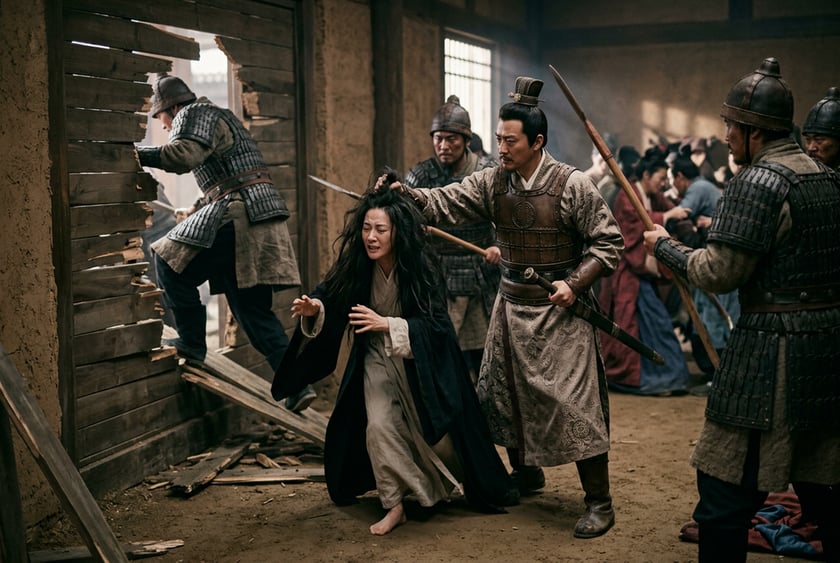
Modern political historians viewing this retreat often find its true political value obscured by its surface appearance of "failure." In the eighth month of the thirteenth year of Jian'an, Liu Biao died; in the ninth month, Cao Cao's army of conquest bore down in overwhelming force. Liu Cong and his mother, swayed by Cai Mao, Kuai Yue, and Fu Xun, surrendered without a fight, handing the whole of Jingxiang to Cao Cao. Liu Bei, a "guest general" who had been garrisoned at Xinye for seven years, was severely behind in intelligence; by the time he learned of Liucongjiangcao — Liu Cong's surrender to Cao Cao — he was already at Fancheng, with Cao Cao to the south, surrendered forces to the east, Zhang Lu to the west, and the only escape route leading south toward Jiangling — more than three hundred li away, passing through the strategic points of Xiangyang, Dangyang, and Huarong. Zhuge Liang's optimal solution at this moment was "immediately abandon Fancheng and retreat south with light forces," but Liu Bei made a decision that seemed to violate military rationality: to take along all the civilians who chose to follow voluntarily [c:16342]. The political meaning of this decision far exceeded its military meaning.
Key Figures
The true protagonist of the entire episode is not any individual general, but the collective of "common people." Zhuge Liang represents the pole of military rationality; Zhang Fei represents the pole of battlefield responsibility (covering the rear); Zhao Yun represents the pole of protecting the last line (safeguarding the family members); while Guan Yu was dispatched far away to Jiangxia to seek reinforcements, forming the relief axis [c:16345]. Liu Bei himself underwent a "role upgrade" during this retreat — for the first time he clearly defined himself not as a battle-worn "guest general" who depended on others, but as "the refuge of the people." "Those who would achieve great things must take the people as their foundation — now the people come to me; how could I abandon them?" [c:16344] — this declaration was not merely a moral pronouncement but an announcement of a new political identity: from this moment Liu Bei would no longer draw his legitimacy from being "the Imperial Uncle" or a "guest general," but from being "that to whom the people return." Jian Yong, Yi Ji, Sun Qian, and other advisers became the coordinating hubs moving between the army and the civilians, transforming what could have been a rout into an organized migration.
Core Issues
On the surface the issue was the tactical choice between "abandoning the civilians or bringing them along"; at a deeper level it was "how a political leader redefines himself in the midst of defeat." When Cao Cao's southern campaign was said to number eight hundred thousand — in reality roughly two hundred thousand — Liu Bei's forces at this point numbered fewer than twenty thousand, plus over one hundred thousand civilians and several thousand carts, advancing barely ten-odd li per day [c:16344] — meaning Cao Cao's Tiger-and-Leopard cavalry could have caught them at any moment; militarily it was a certain defeat. But politically, this retreat accomplished three things that Cao Cao could never achieve: first, it publicly bound together "Cao Cao's unification" and "the people's fear," introducing a crack into the legitimacy narrative of Caowei; second, it rewrote Liu Bei from "political refugee" to "savior of the people," laying up moral capital for his later entry into Sichuan and the founding of a state; third, it turned Zhuge Liang's principle of "taking the people as the foundation" from political theory into a concrete act that could be celebrated and transmitted — a narrative later precisely recalled by the Shixiao Memorial's passage "The Late Emperor's undertaking was half complete when..." It is worth noting that Liu Bei's weeping at Liu Biao's tomb [c:16343] was also a ritual gesture through which he actively severed ties with the "dependency on Liu Biao" era and announced the beginning of the "independent responsibility" era.
Political Consequences
The most immediate consequence was the catastrophic defeat at Dangyangchangban — the civilians were scattered, Gan Furen and young Adou (Liu Chan) nearly lost, all baggage and equipment destroyed, and Liu Bei himself "abandoned the civilians" and fled into Hanjin to join Guan Yu and Liu Qi [c:16346][c:16347]. On the military ledger it was a crushing defeat: the majority of the hundred-thousand-plus civilians were scattered or seized by Cao Cao's forces, and Liu Bei's fighting strength shrank from twenty thousand to barely a thousand. But on the political ledger it was the most critical turnaround of Liu Bei's life: he acquired the core narrative of "the benevolent lord"; Liu Qi's Jiangxia forces became his temporary base of operations; and, most importantly, when Sun Quan sent Lu Su to visit Liu Bei on the eve of the Battle of Chibi, what Lu Su saw was not a routed warlord but a political symbol "to whom the people return" — and this became the essential psychological foundation on which the Sun-Liu alliance was built. The medium-term consequence was that "taking the people as the foundation" became the core political brand of the Shuhan regime — clearly distinct from Caowei's "governing the army by law" and Sunwu's "co-governance with the great families." The long-term consequence was that this narrative entered the Chinese political tradition: "those who would achieve great things must take the people as their foundation" became one of the core standards by which rulers were evaluated over more than a thousand years that followed.
Counterfactual Analysis
Had Liu Bei heeded the generals' counsel to "leave the civilians behind and march ahead" [c:16344], the most realistic projection is: he would have preserved more troops (possibly several thousand rather than barely one), reached Jiangling faster, but would have permanently forfeited the moral identity of "savior of the people" — Sun Quan might not have granted him an audience, Lu Su might not have pressed for the alliance, and the diplomatic consultations before Chibi would have proceeded very differently, with Liu Bei's position in the alliance possibly downgraded from "equal partner" to "remnant warlord." Had Cao Cao in his southern campaign chosen steady consolidation rather than "light cavalry pursuit" [c:16344], Liu Bei might have been cut off and surrounded before reaching Hanjin, but equally the portion of civilians Liu Bei "abandoned" would also have been reduced. The most interesting counterfactual is: had Zhuge Liang at this juncture insisted on his military advice and openly broken with Liu Bei, the entire ruler-minister relationship in Shuhan could never have formed that "fish-and-water" intimacy — Zhuge Liang's choice to respect Liu Bei's political instinct was itself a form of political wisdom. Understanding this means understanding that carrying the people across the river — however much it may look like Liu Bei's "act of benevolence" — was in substance a complete rewriting of his political identity, and by paying that price he redeemed the most critical single diplomatic opportunity of the pre-Chibi period.