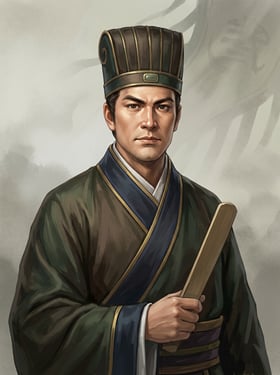
Historical Record
Li Yan, styled Zhengfang, was a native of Nanyang. In his early years he served in his home commandery and was known for his outstanding ability. The Governor of Jing Province, Liu Biao, once sent him to serve in various commanderies and counties. When Cao Cao entered Jing Province, Li Yan was serving as Magistrate of Zigui; he then went west into Shu, where Liu Zhang appointed him Magistrate of Chengdu, again displaying his outstanding ability. c:5676 In the eighteenth year of Jian'an (213 CE), Liu Zhang appointed Li Yan Protector of the Army, leading troops to resist Liu Bei at Mianzhu. However, Li Yan led his forces in surrendering to Liu Bei, who at once appointed him Auxiliary General. After Chengdu was pacified, Li Yan was appointed Grand Administrator of Jianwei and General Who Founds Enterprise.
In the twenty-third year of Jian'an (218 CE), the bandits Ma Qin, Gao Sheng, and others rose at Qi County, mustering tens of thousands to attack Zizhong County. At the time Liu Bei was in Hanzhong, and Li Yan did not call up additional troops but led only five thousand of the commandery's soldiers to suppress them, slaying Ma Qin, Gao Sheng, and the rest. Their partisans then scattered and all reverted to civilian status. Thereafter the Yi commander of Yuesui, Gao Ding, sent troops to besiege Xindao County, and Li Yan swiftly went to the rescue and routed the enemy. For this merit he was further given the title General Who Upholds the Han, while continuing to hold the post of Grand Administrator of Jianwei. c:5676
In the second year of Zhangwu (222 CE), Liu Bei summoned Li Yan to the Palace of Yongan and appointed him Prefect of the Imperial Secretariat. In the third year of Zhangwu (223 CE), Liu Bei, gravely ill, together with Zhuge Liang received the testamentary edict to assist the young lord Liu Shan. Li Yan was appointed Central Protector-General, commanding the inner and outer military forces, and remained to guard Yongan. In the first year of Jianxing (223 CE), he was enfeoffed as Marquis of Duxiang, granted a staff of authority, and made Superintendent of the Imperial Household. In the fourth year of Jianxing (226 CE), Li Yan was transferred to General of the Vanguard. Because Zhuge Liang planned to send troops to Hanzhong, Li Yan was charged with handling rear affairs, moved his station to Jiangzhou, and left the Protector of the Army Chen Dao to guard Yongan, all troops being placed under Li Yan's command. Li Yan once wrote to Meng Da, saying: "Kongming and I both received the entrustment; deep are our cares and heavy our charge, and I long for a good companion." Zhuge Liang too wrote to Meng Da, praising Li Yan: "He divides matters as smoothly as a flowing stream, advancing and yielding without hindrance—such is Zhengfang's nature," showing how highly he was then esteemed. c:2414
In the eighth year of Jianxing (230 CE), Li Yan was promoted to General of Agile Cavalry. When Cao Zhen planned to attack Hanzhong by three routes, Zhuge Liang ordered Li Yan to lead twenty thousand men to Hanzhong. Zhuge Liang memorialized to appoint Li Yan's son Li Feng Commander of Jiangzhou, in charge of Li Yan's rear affairs. Zhuge Liang planned to send troops the following year, and ordered Li Yan, in his capacity as Central Protector-General, to take charge of the headquarters affairs. At this time Li Yan changed his name to Li Ping. c:2414
In the spring of the ninth year of Jianxing (231 CE), Zhuge Liang led his army out to Mount Qi, and Li Ping was charged with urging on the transport of grain and fodder. However, between summer and autumn it rained for days on end, and the grain transport could not be supplied in time. Li Ping sent the Army Adviser Hu Zhong and the Army Supervisor Cheng Fan to convey an order recalling Zhuge Liang, and Zhuge Liang therefore withdrew his army. When Li Ping learned that the army had withdrawn, he feigned surprise, declaring "the army's grain was ample—why then return?" attempting to shift onto others the blame for his own failure to supply grain in time, and to make Zhuge Liang appear at fault for not advancing further. He also submitted a memorial to the Latter Lord, falsely claiming "the army has feigned retreat, intending to lure the enemy into battle." Zhuge Liang thereupon published the full contents of Li Ping's correspondence from start to finish, and Li Ping's fault became plain. Li Ping was finally at a loss for words and admitted his crime. Zhuge Liang submitted a memorial impeaching Li Ping, pointing out that "since the former emperor's death, wherever Li Ping has managed affairs he has done petty kindnesses, seeking safety and reputation for himself, with no concern for the state," and criticizing him as "narrow in feeling and reckless in ambition, as though heaven and earth did not exist." In the end, Li Ping was reduced to commoner status and exiled to Zitong Commandery. c:12200
In the Novel
In the Romance of the Three Kingdoms, Li Yan's image differs from the historical fact in certain respects and is endowed with more dramatic color.
Li Yan first appears when Liu Bei was taking Yi Province. When Liu Bei advanced on Mianzhu, Liu Zhang sent his brother-in-law Fei Guan together with Li Yan to lead thirty thousand troops to defend Mianzhu. c:5679 In the fight with Huang Zhong, Huang Zhong feigned defeat and lured Li Yan into a valley, whereupon Wei Yan led troops to cut off his retreat. Zhuge Liang appeared on the hilltop and urged Li Yan to surrender, provoking him with the death of Pang Tong. Li Yan then dismounted and surrendered, with not a single one of his men harmed. Liu Bei treated Li Yan with great generosity. Li Yan said that although Fei Guan was Liu Zhang's kinsman, he was on close terms with himself, and was willing to go and persuade Fei Guan to surrender. Xuande thereupon ordered Li Yan to return to the city to win over Fei Guan. c:2415 In the historical sources this passage records only that Li Yan "led his forces in surrendering to the former lord," without detailing his surrender, and without any such details as Huang Zhong's feigned defeat, Wei Yan's cutting off the retreat, or Zhuge Liang's persuasion—these are all the novel's literary creation.
In the scene of Liu Bei entrusting his orphan, the novel and the historical fact are largely consistent, both mentioning that when Liu Bei was gravely ill, he entrusted Liu Shan to Zhuge Liang and Li Yan, and appointed Li Yan Central Protector-General to remain and guard Yongan. c:5674
When Zhuge Liang campaigned south against Meng Huo, the Latter Lord Liu Shan once worried that Eastern Wu and Cao Wei might take the chance to invade. Zhuge Liang confidently replied that Eastern Wu had already made peace with Shu Han, and that with Li Yan guarding Baidicheng it was quite enough to hold off Lu Xun. c:5680 This reflects the novel's affirmation of Li Yan's military ability, regarding him as an important general a match for Lu Xun.
During Zhuge Liang's Northern Expeditions, Li Yan's image begins to take a negative turn. When Zhuge Liang won a great victory at Mount Qi, Li Yan's son Li Feng came to report that Meng Da wished to respond to Zhuge Liang and raise troops from Xincheng and other places to attack Luoyang. c:5681 However, on the matter of grain supply for the Northern Expedition, Li Yan played a negative role. When Zhuge Liang was discussing sending out the army at Hanzhong, Yang Yi proposed a strategy of dividing the troops to campaign in rotation, so as to keep the military strength from being exhausted, and Kongming adopted this suggestion. However, when Zhuge Liang withdrew because grain was short, Li Yan falsely reported the military situation to the Latter Lord, claiming he had prepared ample army grain and did not know why the Chancellor had suddenly turned the army back. c:2417 The Latter Lord sent Fei Yi to inquire, and Fei Yi discovered that Li Yan, because the army grain was short and he feared Zhuge Liang would hold him to account, had sent a letter recalling Zhuge Liang, and also falsely reported the military situation to the Latter Lord to cover his fault. When Zhuge Liang learned the truth he was enraged and wished to execute Li Yan, but on the persuasion of Fei Yi and Jiang Wan, he finally demoted him to commoner status and exiled him to Zitong. c:2417 The novel further depicts Li Yan, on learning of Zhuge Liang's death, weeping bitterly and dying of illness because "he had always hoped Kongming would recall him again so he might atone for his past faults, but reckoned that after Kongming's death no one would employ him." c:2418 This has no record in the historical sources and is an artistic embellishment by the novel to highlight Zhuge Liang's influence over Li Yan and Li Yan's remorse.
Key Relationships
* Liu Zhang's faction (serves): Li Yan at first served under Liu Zhang as Magistrate of Chengdu, and was once appointed Protector of the Army to lead troops to resist Liu Bei. c:5676
* Liu Bei's faction (defected_to): At the Battle of Mianzhu, Li Yan led his forces in surrendering to Liu Bei, and was generously treated and appointed Auxiliary General, later holding posts such as Grand Administrator of Jianwei. c:5676
* Liu Bei (witnesses): Li Yan was an important witness and executor of Liu Bei's entrustment of his orphan, charged together with Zhuge Liang to assist the young lord Liu Shan. c:5674
* Shu Han (serves): As an important official of Shu Han, Li Yan held key posts under both Liu Bei and Liu Shan, in charge of military and government affairs, such as Central Protector-General, General of the Vanguard, and General of Agile Cavalry. c:2414
* Zhuge Liang (co-regent, rival): Li Yan, like Zhuge Liang, was a minister entrusted with Liu Bei's orphan, jointly assisting Liu Shan. However, on the matter of Northern Expedition grain, Li Yan's dereliction and false report of the military situation led to conflict with Zhuge Liang, and he was finally deposed. c:12200
* Meng Da (correspondent): Li Yan once corresponded with Meng Da, expressing the wish to assist Shu Han together. c:2414 In the novel, Li Yan's son Li Feng conveyed to Zhuge Liang Meng Da's intent to respond to the Northern Expedition. c:5681 (unique to the novel)
* Fei Guan (ally): In the novel, Fei Guan guarded Mianzhu together with Li Yan, and after Li Yan surrendered he persuaded Fei Guan to surrender. c:2415 (unique to the novel)
* Liu Shan (sovereign): As an entrusted minister, Li Yan was directly answerable to Liu Shan, but was finally deposed for deceiving both Liu Shan and Zhuge Liang. c:2417
Signature Scenes
* Surrendering to Liu Bei at Mianzhu: While resisting Liu Bei at Mianzhu, Li Yan finally led his forces in surrender, becoming an important general under Liu Bei. In the novel, this scene is depicted as a dramatic process of Huang Zhong's feigned defeat, Wei Yan's cutting off the retreat, and Zhuge Liang's persuasion. c:2415 (unique to the novel)
* Putting down the revolt of Ma Qin and Gao Sheng: Li Yan put down a revolt of tens of thousands with only five thousand men, displaying his outstanding military talent and daring. c:5676
* Liu Bei's entrustment of his orphan at Yongan: When Liu Bei was gravely ill, he entrusted Liu Shan to Zhuge Liang and Li Yan at the Palace of Yongan, appointing Li Yan Central Protector-General commanding the inner and outer military forces. c:5674 This was the peak of Li Yan's political career and an important mark of his standing as a core figure of Shu Han.
* Guarding Baidicheng against Eastern Wu: In the novel, during Zhuge Liang's southern campaign, it is mentioned that Li Yan guarded Baidicheng, quite enough to hold off the attack of Eastern Wu's Lu Xun, showing his important standing in military defense. c:5680 (unique to the novel)
* Being deposed over the Northern Expedition grain affair: During Zhuge Liang's Northern Expeditions, Li Yan, having failed to supply grain, instead falsely reported the military situation and deceived both Zhuge Liang and the Latter Lord Liu Shan; in the end Zhuge Liang exposed the truth, and he was reduced to commoner status and exiled to Zitong. c:12200 This was the turning point of Li Yan's political career and the beginning of his tragic end.
* Dying of illness on hearing of Zhuge Liang's death: In the novel, on learning of Zhuge Liang's death, Li Yan wept bitterly and died of illness because "he reckoned that after Kongming's death no one would employ him." c:2418 (unique to the novel) This scene highlights Li Yan's complex feelings toward Zhuge Liang and the close tie between his personal fortunes and Zhuge Liang's fate.
Portrait file
Character profile
- Character
- Li Yan thought highly of himself, narrow-minded and wildly ambitious, and greedy for glory and gain. When the grain transport failed, he forged a letter to recall the Prime Minister, and lied to the Son of Heaven to cover up his fault.
- Life
- Li Yan, styled Zhengfang, was a native of Nanyang. At first a subordinate of Liu Zhang, he led his troops in surrender to Liu Bei. When Liu Bei entrusted his heir to his ministers, Li Yan together with Zhuge Liang assisted the young ruler. He held such offices as Administrator of Qianwei, General Who Founds the Enterprise, General Who Upholds the Han, Master of Writing, Central Protector, General of the Front, and General of Agile Cavalry. Later, over the grain-transport affair, he was reduced to commoner and banished to Zitong commandery, and finally died of illness upon learning of Zhuge Liang's death.
- Anecdotes
- Li Yan was a senior minister of Shu Han who took part in drafting the Legal Code of Shu. He garrisoned Yong'an, in charge of commanding the armies within and without, and oversaw the transport of grain and fodder.
Relationships
16 relationships
Quotes
4 recorded lines · 3 featured
「吾與孔明俱受寄託,憂深責重,思得良伴。」
This line shows Li Yan's standing as a senior minister who, together with Zhuge Liang, received the charge to support the heir, of historical significance.
「軍糧饒足,何以便歸」
This line reflects Li Yan's stance on the matter of provisions during the Northern Expedition, an important reason for his dismissal.
「軍偽退,欲以誘賊與戰」
This line reflects Li Yan's judgment of the battle situation; though controversial, it shaped his military image.
Chapters13 回 ▸
- 史ch.32ch.33ch.40ch.41ch.45
- 演ch.64ch.65ch.85ch.87ch.94ch.100ch.101ch.104
Relationship timeline5 条 ▸
史 ch.32
- Liu Bei§19
witnesses
率众降之
史 ch.40
- Liu Bei§38
advises_in
三年先主疾病,严与诸葛亮并受遗诏辅少主
演 ch.65
演 ch.104
- Zhuge Liang§19
kin_of
嘗望孔明复收己以补前过;闻孔明亡大哭病死
Inner monologues · AI-generated3 段 ▸
- I, Li Yan, courtesy name Zhengfang, have no way left to explain myself to anyone. I remember how the late emperor summon
- I am Li Yan, courtesy name Zhengfang, a native of Nanyang. In my youth, I served as a clerk in the commandery, relying o
- My name is Li Yan, and my courtesy name is Zhengfang. I recall that when I first entered service in Yi Province, what I
Life events9 ▸
- 0214-01-01 · ChengduLiu Zhang's Surrender· Witness
- 0214-01-01 · ChengduPromulgation of the Shu Legal Code· Advisor
- 0223-01-01 · ChengduLiu Shan's Accession to the Throne· Advisor
- 0223-01-01 · ChengduZhuge Liang Repels the Five Armies· Advisor
- 0223-01-01 · BaidichengLiu Bei's Deathbed Entrustment at Baidi· Witness
- 0231-01-01 · ChengduDismissal of Li Yan· Victim
- 0231-01-01 · YonganLi Yan Dismissed for Failing to Deliver Supplies on Time· Instigator
- 0231-01-01 · Mount QiZhuge Liang's Fourth Northern Expedition· Instigator
- 0231-01-01 · Mount QiZhuge Liang's Fifth Northern Expedition· Advisor