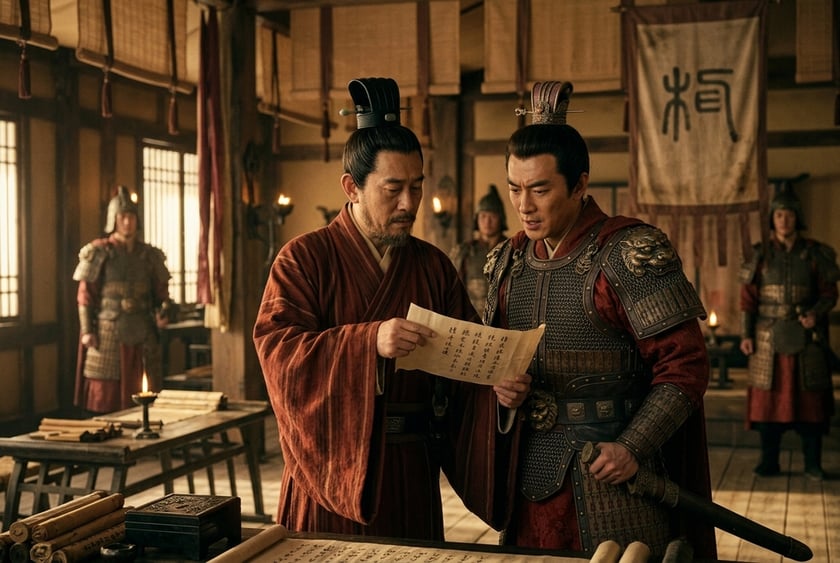
Strategic Background
From a modern military-history perspective, Liu Bei's eastern campaign (Liubeidongzheng) was a classic example of an "emotion-driven strategic choice." Shuhan's true strategic adversary was always Caowei, holding the nine circuits of the Central Plains. The Longzhong Plan envisioned a two-pronged attack — one column from Jingzhou toward Wan and Luo, one from Yizhou out through the Qin River valley — as the only scenario in which Shuhan had any prospect of shaking Caowei. Sunwu, strategically, was a necessary ally to keep; without it, Shuhan would have had to absorb the full pressure of Caowei alone. Yet the fall of Jingzhou and the death of Guan Yu following Guanyubeifa in the twenty-fourth year of Jian'an pushed Liu Bei to a crossroads where personal emotion and national interest clashed sharply. In the novel, Zhao Yun's remonstrance cuts straight to the heart of this contradiction: "The enmity against the Han rebels is a public matter; the enmity against those who killed your brothers is a private one" — urging that "the realm be placed above all". But Liu Bei regarded the Taoyuan oath as weightier than national strategy, and ultimately chose the path in which private righteousness overwhelmed public duty.
Disposition of Forces
Shuhan mobilized nearly all the field armies it could move, claimed to number more than 700,000 (a novelistic exaggeration; actual estimates fall between 40,000 and 50,000), and advanced with the main force downstream along the Yangtze through the Three Gorges into the Yiling-Xiaoting corridor, with Zhang Bao and Guan Xing in the vanguard, Feng Xi and Zhang Nan as left and right supervisors, and Ma Liang accompanying the army as adviser to the Wuling tribesmen of the south. Zhuge Liang was kept in Chengdu to anchor the rear; Zhao Yun was sent to oversee Jiangzhou as a strategic reserve — an arrangement that already betrayed the problem: the two people with the broadest strategic vision were absent from the front. Sunwu initially withdrew voluntarily; Sun Quan appointed Lu Xun as Grand Commander, with Zhu Ran, Pan Zhang, Song Qian, Xu Sheng, Ding Feng, and other generals under him. Relying on the geographic advantages of the lower Yangtze and the rough mountain terrain, Lu Xun dug in along the Yiling line, voluntarily abandoning hundreds of li of territory including Badong and Zigui, drawing the battle line back to the position most favorable to himself.
Key Decision Points
The first key decision point was the pre-campaign strategic choice. Liu Bei rejected the advice to "deal with the north first, then turn east," inverting the strategic sequence and exposing Shuhan to the potential risk of fighting on two fronts simultaneously. The second decision point was the choice of "extended-camp deployment" when the battlefield situation deteriorated. After Shu forces pushed into Yiling, Liu Bei, finding the summer heat unbearable, ordered all camps moved into the mountain forests and set up along streams and ravines in a seven-hundred-li chain of encampments — a posture that became a vulnerability on three counts: naval support, tactical mobility, and fire defense, all of which Lu Xun identified precisely. The third decision point was the command structure gap created by Zhang Fei's death. The novel records that Zhang Fei was killed by his own officers Fan Jiang and Zhang Da before the campaign set out, depriving Liu Bei of the subordinate most capable of inspiring combat cohesion; with the Taoyuan brotherhood that had outlasted Zhang Fei now completely shattered, Liu Bei's emotional drive for the campaign burned with doubled intensity, further suppressing rational judgment.
Results and Reverberations
When all elements of weather, terrain, and human factors came together, Lu Xun launched his fire attack; the seven-hundred-li chain of Shu army camps burned, Feng Xi, Zhang Nan, Fu Tong, Ma Liang, and a large number of officers and subordinates died in battle, and Liu Bei retreated to Baidicheng, with Shuhan's elite forces nearly annihilated in a single engagement. The reverberations of this campaign extended far beyond the tactical level. First, from that point on Shuhan had no further capacity for active offensive operations; the Longzhong two-pronged strategy was declared bankrupt; Zhuge Liang's subsequent six sorties from Qishan were nothing more than the politically necessary gesture of "persisting despite knowing it cannot be done." Second, the successive deaths of Guan Yu, Zhang Fei, and Liu Bei marked the complete exit of the first-generation Taoyuan brotherhood, and Shuhan entered the era of Liu Chan; the center of power shifted from the politics of personal bonds to the bureaucratic politics of the Zhuge Liang mode. Third, the Sun-Liu alliance, after its surface rupture, was rebuilt by necessity, but the fissures remained forever. The San Guo configuration crystallized definitively into "one strong Wei versus two weak Sun and Shu holding together," a structure that saw no major transformation for the next forty years.
Counterfactual Analysis
If Liu Bei had heeded Zhao Yun's advice and first sent troops from Hanzhong to attack the Guan-Long region — what would have been different? The most optimistic projection: Shuhan might have struck at Changan by surprise, taking advantage of Cao Pi's newly proclaimed dynasty when the Guanzhong defenses had not yet solidified and Zhang Lu's old territory had not yet been fully absorbed; even without actually taking it, Shuhan could have gained strategic depth in the Guanzhong area. Simultaneously, maintaining the Sun-Liu alliance and having Sun Quan pin down Caowei in Jingzhou might have allowed Shuhan to preserve 30,000 to 50,000 more field troops — giving Zhuge Liang's northern campaigns a considerably higher starting point. The more conservative projection: even if the northern campaign failed, the losses would not have been as concentrated and catastrophic as Yiling — campaigns in Hanzhong could have been conducted in smaller batches with easier withdrawal, whereas the decisive defeat at Yiling meant the collapse of an entire army. The most realistic projection: Liu Bei's character meant he would not make such a trade-off — this eastern campaign was almost fated. Understanding this also explains why Zhuge Liang in the Zhugeliangbeifa Memorial does not utter a single word about Liu Bei's strategic error, attributing Shuhan's predicament entirely to "the late emperor's enterprise was cut short at midway by his untimely death" — he had to preserve the last shred of dignity for his old lord.