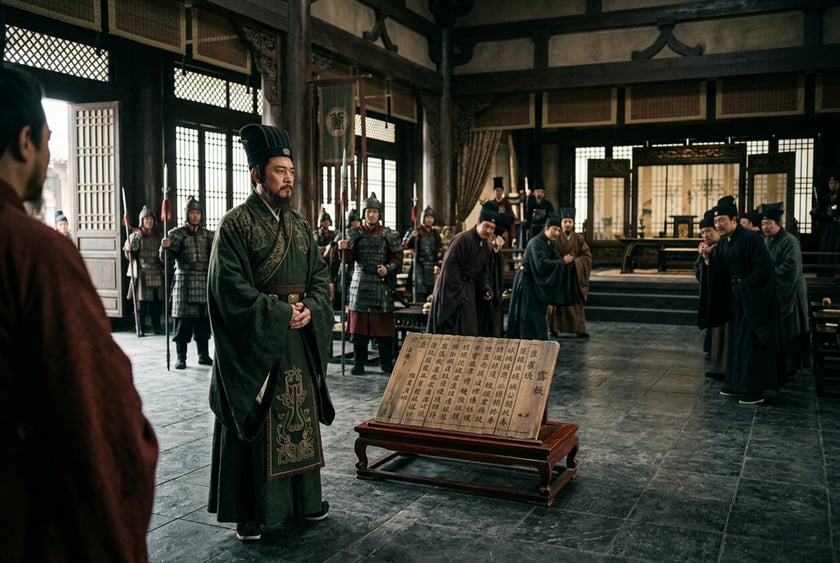
The Final Scene
Zhang Fei in the first year of Zhangwu was in a state of extreme emotional imbalance. When news of Guan Yu's death at the hands of Eastern Wu reached Langzhong, he fell, just as Liu Bei had, into an obsession with vengeance. The romance externalizes this obsession as a military order that was practically impossible to fulfill: complete white banners and white armor for the entire army within three days, to mourn and march against Wu. The core problem with this order was not excess of grief but administrative impossibility — white banners and white armor are ceremonial mourning articles, and no one could procure army-wide mourning dress on such a timetable. Fan Jiang and Zhang Da's appeal for an extension was thoroughly reasonable within the conventions of military administration; but Zhang Fei at this point could accept no hint of "delay," since delay would mean betraying his promise to Guan Yu. The punishment of fifty lashes of the back was itself already excessive; combined with the added death threat — "fail to deliver on time and I will execute you both as an example" — it pushed the two subordinates to a binary choice between "dying passively" and "fighting for their lives." This was the old vice of Zhang Fei's character — "delighting in flogging his troops" — carried to an extreme under emotional breakdown.
Last Words or Last Orders
The romance gives Zhang Fei no solemn battlefield dying speech at his death. He dies not on the field of battle but on the sleeping platform where he lay drunk. When the two beaten subordinates conferred, they spoke with cold matter-of-factness: rather than wait to die, better to strike first; if he is not destined to die, he will be awake in bed; if he is destined to die, he will be drunk. This is a classic "gambling on fate" mentality, but also the only way out for men driven to a wall. Zhang Fei's "last order," in this context, can only be recovered from the final military command he issued before death — the order for white-mourning-dress troops to march against Wu was itself his last political statement to Shuhan. That statement bound him to Liu Bei's campaign against Wu, making his death the emotional detonator for the entire Battle of Yiling.
Aftermath
Fan Jiang and Zhang Da cut off the head and fled by night to Eastern Wu; Zhang Fei's eldest son Zhang Bao arrived before Liu Bei in white mourning robes and silver armor, bearing his father's coffin. Liu Bei, on the very night Zhang Fei's death reached him, had already felt a sense of ill omen from unusual celestial phenomena; on receiving the news he wept aloud and fainted to the ground, nearly bringing his campaign preparations to a halt. On his return journey to Chengdu, Zhuge Liang issued his pregnant observation — "If Fa Zheng were still alive, he would certainly have been able to hold back the emperor from marching east" — an indirect repudiation, from the standpoint of political reason, of Liu Bei's decision to campaign against Wu. In terms of strategic consequences, Zhang Fei's death had at least three dimensions: first, Shuhan lost one of its generals most capable of independent command in a theater, and the anti-Wu expeditionary force was deprived of both Guan Yu and Zhang Fei; second, the compounding of the deaths of Guan Yu and Zhang Fei pushed the double grief to its peak, stripping Liu Bei entirely of the capacity to heed rational opposition; third, Fan Jiang and Zhang Da's defection to Wu became an embarrassment under Sun Quan's posture of "avoiding battle and seeking peace" — Wu could neither fully accept them nor conveniently return them.
Historical Assessment
From the standpoint of commander management, the manner of Zhang Fei's death was nearly the inevitable blowback of his years of harsh treatment of his subordinates. Chen Shou's assessment of him in San Guozhi already noted "violent and without benevolence — defeated by his own shortcomings"; the romance's handling at this juncture can be read as a dramatic concretization of the official-history verdict. But from the standpoint of strategic narrative, the true tragedy of Zhang Fei's death lies not in his personal failure but in the loss of the one general who might still have spoken frankly to Liu Bei before the Yiling disaster — with Guan Yu already dead and Fa Zheng already gone, those capable of tempering Liu Bei's emotions were already few; had Zhang Fei lived, at minimum he could have steadied one flank at the command level. Zhuge Liang's lament about "Fa Zheng" in fact contains the same unspoken pain — Shuhan was entering a dangerous window in which rational voices had snapped, and decision-making was driven entirely by emotion. Zhang Fei's death and the Yiling catastrophe together constitute the opening and the climax of that window; the two are in essence two nodes on the same chain of emotion. Viewed over the longer arc of time, Zhang Fei's death was also the starting point for the emergence of Shuhan's second-generation commanders (Zhang Bao, Guan Xing), marking the complete withering of the first-generation core fighting group.