Background
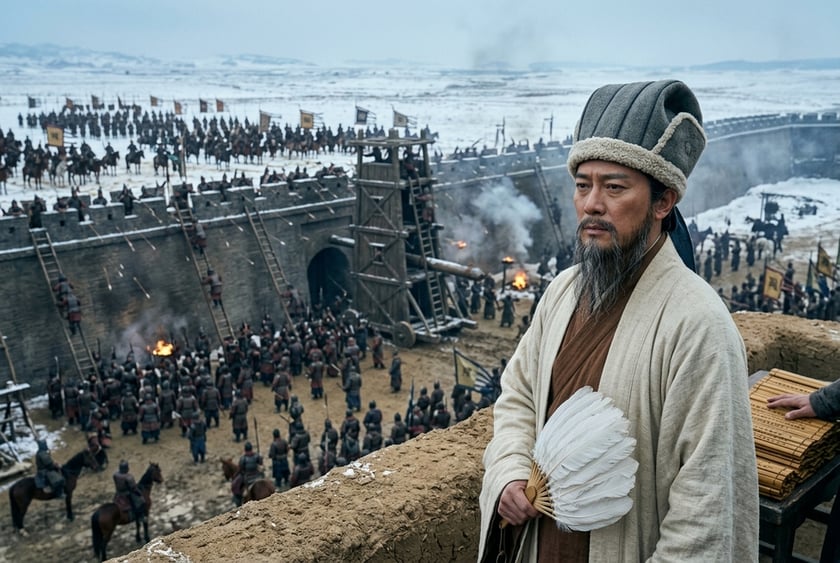
The Xuzhou power-transfer drama of Xingping 1 (194) is one of the most theatrically charged episodes in the early fragmentation of the late Han. Under the governorship of Tao Qian, Xuzhou had been a prosperous and stable region: it lay astride the major north-south arteries and counted a population of a million. The crisis began when Tao Qian's subordinate Zhang Kai murdered Cao Cao's father Cao Song and his household while escorting them through the region, prompting Cao Cao to march on Xuzhou in a campaign of punitive slaughter. Unable to resist, Tao Qian appealed for help to Tian Kai of Qingzhou and Kong Rong of Beihai; Kong Rong in turn invited Liu Bei to join the relief force. Liu Bei was then chancellor of Pingyuan, commanding only a few thousand men, yet he answered the call at Xuzhou's darkest hour — an act that became the founding event of his reputation among the scholar-official class of the late Han. When Tao Qian saw Liu Bei atop the city walls — "dignified in bearing and frank in speech" — he immediately conceived the idea of entrusting Xuzhou to him [c:17993].
Key Figures
Four people stand at the center of this episode. The one offering the title is Tao Qian, sixty-three years old and already gravely ill; his two sons Tao Shang and Tao Ying were both judged "men of no ability," incapable of inheriting power. The one being offered the title is Liu Bei, then in his early thirties, in urgent need of a stable base. The advocates — Kong Rong, Mi Zhu, and Chen Deng — represent the local Xuzhou gentry's active endorsement of Liu Bei. The silent witnesses — Guan Yu, Zhang Fei, and Zhao Yun — play no role in the decision, yet their support is the hidden variable that determines whether Liu Bei could ever truly command Xuzhou. In this episode Cao Cao is "the enemy who has withdrawn for now," but his continued existence exerts constant strategic pressure on the Xuzhou gambit: whoever takes the city must immediately reckon with the possibility of Cao Cao returning.
The Core Issue
The political essence of Tao Qian's three offers of Xuzhou is a collective decision by the local power elite to choose an "outsider with legitimate pedigree" as a bulwark against a "neighboring strongman." Tao Qian's own calculation had three parts. First, his sons lacked the ability to hold Xuzhou; leaving it to them would mean it would be absorbed by whichever of Cao Cao, Yuan Shu, or Lv Bu moved first. Second, Liu Bei's status as a member of the Han imperial clan could give Xuzhou the political language of a "legitimate Han regional government." Third, Liu Bei had already demonstrated his fidelity by coming to fight — he was more trustworthy than any other option. Liu Bei's own calculation was more complex: he needed Xuzhou as a power base, yet feared that accepting it would brand him in the eyes of the empire as someone who "took advantage of another's distress" and "acted without righteous purpose" — among the gravest taboos in late-Han scholarly society. He therefore declined three times: "Kong Wenju [Kong Rong] called Bei to rescue Xuzhou, and that was righteousness; to occupy it now without cause would make Bei a man without righteousness in the eyes of the world" [c:17994]. This rhetoric of "righteousness" was not empty posturing; it was the precise accumulation of political capital — each refusal was proof to the world that he sought Xuzhou not out of greed but under the compulsion of public duty. The repeated persuasion by Mi Zhu, Chen Deng, and Kong Rong represents the local gentry's active endorsement of Liu Bei [c:17994], an endorsement that would be critical to his ability to govern Xuzhou in practice.
Political Consequences
In the short term, Tao Qian's compromise of offering Liu Bei "temporary administration of Xiaopei" [c:17995] allowed Liu Bei to enter the Xuzhou power structure as a proxy without incurring the political costs of an immediate full acceptance. The following year (195), when Tao Qian's illness worsened, he asked Mi Zhu and Chen Deng to deliberate on the formal transfer; both ministers urged him to deliver the seal in person while he still could [c:17996]. Liu Bei finally accepted Xuzhou's seal under the best possible conditions for his political narrative: Tao Qian weeping as he entrusted it to him, and the full assembly of local gentry presenting it unanimously. This process forged Liu Bei's core political label — "one who received power through virtue" — in sharp contrast to Cao Cao's "using the Son of Heaven to command the lords" and the Sun clan's "realm won through father-and-son bloodshed." In the medium term, although Liu Bei gained Xuzhou, his capacity to hold it was far short of his capacity to receive it: the very next year Lv Bu seized Xiapi while Liu Bei was away, and Xuzhou was lost as quickly as it had been gained. Yet the networks Liu Bei built during his brief administration — Mi Zhu, who became a powerful relative by marriage in the Shuhan court; Chen Deng, who in the novel ultimately posed no lasting threat due to early death from illness; and the fraternal bond forged among Guan Yu, Zhang Fei, and Zhao Yun — continued to nourish his career for decades. In the long term, Tao Qian's three offers of Xuzhou is one of the most important narrative foundations of the novel's portrait of Liu Bei, elevating him in an instant from "a Han clansman holding the minor post of Pingyuan chancellor" to "the nominally recognized governor of Xuzhou in the eyes of the realm" — a title that remained his core credential for the two decades of wandering that followed, consistently earning him courteous treatment from the warlords he encountered.
Counterfactual Analysis
If Liu Bei had accepted Xuzhou on the first offer, he would have been condemned by public opinion as someone who seized power in another's moment of crisis, and would never have been able to use the label of "righteousness" to integrate the local power structures of Yizhou, Hanzhong, and Jingzhou; the moral foundation of the Shuhan state would have been severely undermined. If Liu Bei had refused all three times and ultimately declined, Xuzhou would have fallen to Lv Bu or Yuan Shu; under either outcome Liu Bei would have lost this critical foothold and found it nearly impossible to establish himself in the Central Plains. If Tao Qian had died from his first illness before recovering enough for a second offer, Liu Bei would have lacked sufficient time for political preparation, and local gentry acceptance of him might have been too shallow to sustain a stable succession. The three-stage rhythm of offers gave all parties adequate time to build psychological readiness, allowing the final transfer of power to achieve legitimacy on all three fronts: moral rectitude, local gentry endorsement, and military credibility. This episode is a classic specimen of the "promote acceptance through repeated yielding" paradigm in the politics of ancient Chinese power succession, and is also the single most important narrative device by which the novel constructs Liu Bei's identity as a ruler of benevolence and virtue.