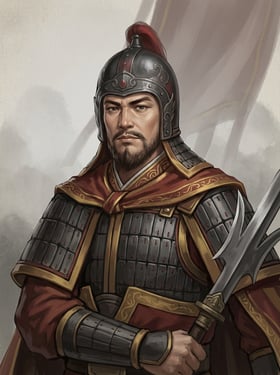
Historical Record
Historical records concerning Ji Ling are extremely scarce; the official history, the Records of the Three Kingdoms, scarcely mentions any independent deeds or details of his life directly. This suggests that Ji Ling's standing in real history may be far less prominent than in literary works. In the histories he appears more as one general among those under Yuan Shu, occasionally mentioned in the military actions of Yuan Shu's faction, but lacking any specific personal biography or detailed account of his exploits. We therefore cannot sketch a complete image of Ji Ling from the historical source material, nor can we know his place of origin, his background, his early experiences, or his ultimate fate. [c:无史传材料] This dearth of sources has made Ji Ling, to a great extent, a blank space for the artistic creation and imagination of literary works such as Romance of the Three Kingdoms. In the context of the official history, Ji Ling is merely a vague symbol representing a portion of Yuan Shu's faction's military strength, without any independent personal color.
In the Novel
In Luo Guanzhong's Romance of the Three Kingdoms, Ji Ling is shaped into a leading general under Yuan Shu, a vivid figure of a certain martial power. His first appearance is full of menace: on Yuan Shu's orders he led an army of a hundred thousand to attack Xu Province, held by Liu Bei. c:3002 Ji Ling is described as "a man of Shandong, wielding a three-pronged sword weighing fifty catties," showing his great physical strength. In his first clash with Guan Yu, the two fought thirty bouts without a decision, displaying Ji Ling's not inconsiderable martial skill. However, when Guan Yu proposed a decisive duel, Ji Ling sent his deputy general Xun Zheng out to fight instead; the result was that Xun Zheng was cut down from his horse by Guan Yu in a single bout, making Ji Ling's image appear somewhat the lesser. c:13089 Thereafter, in his standoff with Liu Bei, Ji Ling adopted the tactic of raiding the camp by stealth, but was defeated each time by the Xu Province troops. c:13089
Ji Ling's best-known event in the novel is the relief brought about by Lü Bu's "shooting the halberd at the camp gate." At that time Yuan Shu sent Ji Ling to lead an army against Liu Bei at Xiaopei, and Lü Bu, to protect his own interests, came forward to mediate. In Lü Bu's tent, faced with Lü Bu's mediation, Ji Ling was at first unwilling, claiming he was under his lord's orders to capture Liu Bei and could not withdraw his troops. c:13096 Enraged, Lü Bu used the method of shooting the halberd at the camp gate to force a truce between the two sides. Ji Ling, privately reckoning it impossible for Lü Bu to hit the small branch of the halberd a hundred paces away, readily agreed. c:13097 When Lü Bu hit it with a single arrow, Ji Ling had no choice but to comply, and took his leave of Lü Bu to return to camp. c:13098 Back in Huainan, Ji Ling reported to Yuan Shu the matter of Lü Bu shooting the halberd to make peace, and presented Lü Bu's letter. Yuan Shu was furious at the news, but Ji Ling offered a plan, advising Yuan Shu to seek a marriage match with Lü Bu's daughter so as to drive a wedge between Lü Bu and Liu Bei. c:13099 This episode shows that Ji Ling possessed not only martial strength but also a measure of strategy.
Later, after Yuan Shu proclaimed himself emperor, he again sent troops to attack Xu Province, and Ji Ling was appointed Commissioner of Relief for the Seven Routes, responsible for coordinating the provisions and support of the seven armies. c:6065 This shows that Ji Ling still held an important position in Yuan Shu's faction and was a general on whom Yuan Shu relied. However, with Yuan Shu's decline, Ji Ling's end was also not a good one. After Yuan Shu's defeat and death, Ji Ling, in battle with Liu Bei, was finally slain by Zhang Fei, ending his life as a leading general under Yuan Shu. [c:演义独有] On the whole, Ji Ling in the novel is a tragic figure of both valor and cunning who in the end could not save Yuan Shu's doomed cause.
Key Relationships
* Yuan Shu (serves): Ji Ling was one of the most important generals under Yuan Shu. He served Yuan Shu loyally, repeatedly leading armies on his orders, and was a vital pillar of Yuan Shu's military strength. Yuan Shu also trusted Ji Ling greatly, entrusting him with major tasks at critical moments, such as attacking Xu Province and coordinating the seven armies. c:3002 Ji Ling was not only Yuan Shu's military general but also offered him strategies, devising the plan to drive a wedge between Lü Bu and Liu Bei, reflecting that their relationship was not merely one of superior and subordinate but one of mutual reliance. c:13099
* Yuan Shu's Faction (serves): As the core military force of Yuan Shu's faction, Ji Ling represented the faction's outward military image. His military actions and strategic deployments bore directly on the rise and fall of Yuan Shu's faction. He, together with colleagues such as Lei Bao and Chen Lan, formed the military backbone of Yuan Shu's faction. c:6064 Ji Ling's presence gave Yuan Shu's faction a degree of military strength in the novel, able to contend with powers such as Liu Bei and Lü Bu.
* Liu Bei (adversary): Ji Ling stood in a long-standing hostile relationship with Liu Bei. He repeatedly attacked Liu Bei on Yuan Shu's orders, and was an important military threat Liu Bei faced in his early development. c:3002 Although there was a brief peace under Lü Bu's mediation, this enmity ran through most of Ji Ling's appearances in the novel.
* Lü Bu (intervener): Lü Bu played the important role of mediator in the conflict between Ji Ling and Liu Bei. Lü Bu's "shooting the halberd at the camp gate" directly halted Ji Ling's attack on Liu Bei, forcing Ji Ling to withdraw his troops for the time being. c:13097 Lü Bu's intervention shows Ji Ling's helplessness before a stronger power and indirectly affected the strategic deployments of Yuan Shu's faction.
* Guan Yu (rival): Ji Ling once had a fierce single combat with Guan Yu, fighting thirty bouts without a decision, displaying their evenly matched martial strength. c:13089 This battle is an important demonstration of Ji Ling's martial worth and also serves as a foil to Guan Yu's valor.
Iconic Scenes
* Leading a Hundred Thousand Troops Against Xu Province (novel only): Ji Ling's first appearance was on a grand scale: on Yuan Shu's orders he led an army of a hundred thousand charging toward Xu Province, seeking to swallow up Liu Bei's territory. This scene established Ji Ling's standing as a leading general under Yuan Shu and displayed the formidable military strength of Yuan Shu's faction. c:3002
* Fighting Thirty Bouts with Guan Yu (novel only): In the attack on Xu Province, Ji Ling dueled Guan Yu before the lines, fighting thirty bouts without a decision. This scene is an important demonstration of Ji Ling's martial worth and left a deep impression on readers. c:13089
* The Relief by Shooting the Halberd at the Camp Gate (novel only): Ji Ling attacked Liu Bei on Yuan Shu's orders, and Lü Bu set a banquet to mediate, forcing a truce between Ji Ling and Liu Bei by shooting the halberd at the camp gate. Under Lü Bu's intimidation, Ji Ling had no choice but to accept the mediation; this event became one of the classic scenes of Romance of the Three Kingdoms, highlighting Lü Bu's heroic spirit and Ji Ling's helplessness. c:13097 Ji Ling's conduct in this scene combines his duty as Yuan Shu's general with his ability to read the situation when facing Lü Bu.
* Devising the Plan to Estrange Lü Bu and Liu Bei (novel only): After the halberd shooting, Ji Ling returned to Huainan and offered Yuan Shu a plan, advising him to seek a marriage match with Lü Bu's daughter so as to drive a wedge between Lü Bu and Liu Bei. This scene shows that Ji Ling possessed not only martial strength but also strategy, seeking to achieve military aims through political marriage. c:13099
* Appointed Commissioner of Relief for the Seven Routes (novel only): After Yuan Shu proclaimed himself emperor and again sent troops against Xu Province, Ji Ling was appointed Commissioner of Relief for the Seven Routes, responsible for coordinating the provisions and support of the seven armies. This appointment shows that Ji Ling still held an important position in Yuan Shu's faction and was a general on whom Yuan Shu relied, reflecting Yuan Shu's trust in him. c:6065
Portrait file
Character profile
- Character
- Ji Ling was a great general of Yuan Shu, who once led thirty thousand foot and horse to attack Liu Bei, commanded a hundred thousand troops in an incursion into Xu Province, and fought Lord Guan to a draw over thirty bouts. As Yuan Shu's subordinate general, he was in the end run through by Zhang Fei and unhorsed.
- Weapons
- Ji Ling's weapon was a three-pointed blade weighing fifty jin.
- Anecdotes
- Ji Ling was a man of Shandong, who once served as Yuan Shu's rescue commander over the seven columns, taking in the defeated army behind the hills.
Relationships
4 relationships
Quotes
11 recorded lines · 3 featured
「劉備村夫,安敢侵吾境界!」
This line shows Ji Ling's contempt for Liu Bei, a classic portrayal of his character.
「吾奉主公之命,提十萬之兵,專捉劉備,如何罷得?」
This line emphasizes Ji Ling's determination to capture Liu Bei on orders, embodying his sense of duty.
「主公不可造次。呂布勇力過人,兼有徐州之地;若布與備首尾相連,不易圖也。靈聞布妻嚴氏有一女,年已及笄。主公有一子,可令人求親於布。布若嫁女於主公,必殺劉備。此乃『疏不間親之計』也。」
This stratagem embodies Ji Ling's cunning and is his important showing in Lü Bu's episode of Lu Bu Shoots the Halberd at the Camp Gate.
Chapters6 回 ▸
- 史ch.7
- 演ch.14ch.15ch.16ch.17ch.21
Relationship timeline1 条 ▸
演 ch.14
- Yuan Shu§35
serves
袁术上将;统兵十万犯徐州
Inner monologues · AI-generated3 段 ▸
- I am Ji Ling; my courtesy name is unknown. I recall the day Xiaopei and Huainan were at odds. Zhang Fei was eager to fig
- I was acting on my lord’s orders, leading tens of thousands of troops to close in on Xiaopei. When we first set out, I t
- I am Ji Ling; my courtesy name is unknown. I recall serving under Yuan Shu. When he heard that Liu Bei had submitted a m
Life events4 ▸
- 0196-01-01 · XiaopeiLu Bu Shoots the Halberd at the Camp Gate· Commander
- 0199-01-01 · ShouchunCao Cao's Campaign Against Yuan Shu· Warrior
- 0199-01-01 · Xu ProvinceLiu Bei's Defeat of Yuan Shu at Xuzhou· Killed in action
- 0199-01-01 · JiangtingDefeat and Death of Yuan Shu· Warrior