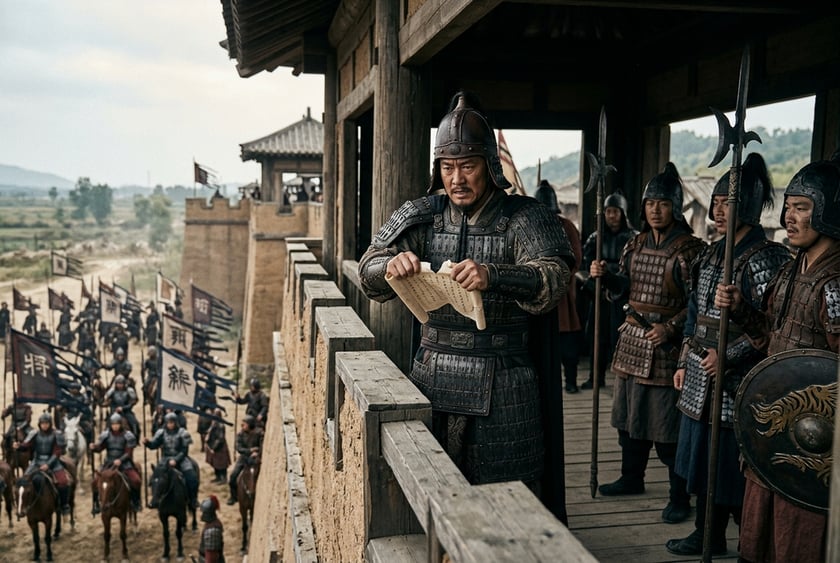
Background
From the perspective of modern political history, the Fuchenghuimian is a classic case study in "using an alliance meeting to achieve strategic penetration." In Jianan year 16 (211), Cao Cao was preparing a personal campaign against Zhang Lu; fearing that Zhang Lu could not withstand it alone — and that if Hanzhong fell, the northern gateway of Chengdu would lie exposed — Yizhou Pastoral Liu Zhang decided, under the planning of Zhang Song and Fa Zheng, to proactively invite a third-party force: Liu Bei. The plan Zhang Song and Fa Zheng presented was this: in the name of "assistance between clansmen and shared resistance to Cao Cao," invite Liu Bei to bring troops from Jingzhou into Shu and first station them around Fucheng and Jiamengguan in Yizhou's northern reaches — nominally shielding Yizhou against the enemy, in actuality pre-positioning a bridgehead for the future annexation of Yizhou [c:17237]. This plan was extremely hazardous for Liu Zhang, but driven by strategic terror he chose to trust in clansmen's sentiment and the judgment of his close advisors Zhang Song and others. The Fuchenghuimian was the opening ceremony of this strategic gamble — both sides needed to confirm each other's identity in a public setting and establish the legitimacy of the subsequent military actions.
Principal Figures
The central parties were Liu Bei, Liu Zhang, Pang Tong, Fa Zheng, Huang Quan, and Wang Lei. Pang Tong, as Liu Bei's accompanying chief of staff, was the principal advocate of the aggressive scheme to "use the meeting as a pretext and seize Yizhou directly" [c:17239]. Fa Zheng was nominally Liu Zhang's envoy but was in practice a strategic agent of Liu Bei's camp. Huang Quan and Wang Lei represented the nativist anti-invasion faction within Yizhou; the intensity of their remonstrance — Huang Quan clenching Liu Zhang's robe in his teeth, unwilling to release it, breaking off his front teeth in the struggle; Wang Lei hanging himself upside-down from the city gate as a mortal protest [c:17237] — reflected both the lucid predictive judgment of Yizhou's native scholars regarding the situation and the dangerous state in which Liu Zhang's decision-making circle had utterly lost its capacity for self-correction. Zhang Ren, as a representative of the Yizhou military, drew his sword and performed a sword dance at the banquet [c:17239] — a signal that has been underestimated yet was critical: it meant that the Yizhou military was not ignorant of Liu Bei's true intentions upon entering Shu, only that it had been suppressed by Liu Zhang's political decision.
The Central Issue
The surface-level issue was "a meeting between kinsmen, jointly resisting the common threat"; the deeper level was an acutely asymmetric alliance-meeting game. Liu Bei's true purpose for the visit was to acquire legitimate grounds for stationing troops within Yizhou territory as a basis for future military operations; Liu Zhang's true purpose was to "lock" Liu Bei into Yizhou's outer perimeter as a screen against Zhang Lu. The two strategic objectives briefly overlapped at Fucheng, constructing the illusion of "alliance between kinsmen." The assassination plan Pang Tong plotted at the banquet was a radical route that would have prematurely exposed Liu Bei's true intentions — if successful, it could have eliminated Liu Zhang in one stroke and seized Chengdu directly; but if it failed, the price was a complete tearing away of the clan-alliance disguise, bringing a full-force counterattack from the Yizhou military and local magnate families. Liu Bei's drawing of his sword to drive away his generals [c:17239] looked on the surface like a display of benevolence, but was in substance a cool cost-benefit calculation: he was well aware that his troops at the time were insufficient to handle three-front mobilization at Chengdu, Fucheng, and Langzhong simultaneously, and that he had to complete his strategic positioning while "playing the good man," waiting for the next opportunity to act. This is the standard operating procedure of "packaging strategic opportunism in the rhetoric of benevolence."
Political Consequences
The most immediate consequence was the completion on both sides of a superficially successful alliance meeting; Liu Bei gained political space to legitimately station troops in the area between Fucheng and Jiamengguan for one year [c:17240]. During that year, under the pretext of "supporting the campaign against Zhang Lu," he in practice familiarized himself with the geography of northern Yizhou and the capabilities of its garrison commanders, cultivated ties with some Yizhou military leaders other than Zhang Ren, and normalized the intelligence channel with Fa Zheng and Zhang Song. From a military geography standpoint, the Fucheng-Jiamengguan corridor commanded the northern throat of Chengdu; Liu Bei's occupation of this line meant he could at any time reverse direction and march south on Chengdu, drastically compressing Yizhou's entire defensive depth — and this is the fundamental reason why the Fushuiguanzhanyanggao episode was able to determine the fate of Chengdu's gateway within a matter of days. From a political science standpoint, the post-meeting configuration also accelerated internal fragmentation in Yizhou: clear-eyed figures such as Huang Quan and Wang Lei were marginalized; the Zhang Song and Fa Zheng faction grew further dominant; and Yizhou's local magnate families began watching "which side to bet on," establishing a hotbed that would allow rapid defection when the break came the following year.
Counterfactual Analysis
What if Liu Zhang had accepted Huang Quan and Wang Lei's remonstrance, refused to go personally to Fucheng, or even canceled the invitation for Liu Bei to enter Shu? One possibility is that Yizhou independently endures the dual pressure of Zhang Lu and Cao Cao; Liu Zhang's personal prestige actually rises, and the cohesion of Yizhou's native magnate families strengthens. But the cost is that if Cao Cao truly advances on Hanzhong's south, Yizhou could fall independently within a year or two. A second scenario: if Liu Bei had accepted Pang Tong's proposal and struck at the banquet — had it succeeded, Liu Bei might have held Yizhou by 212, but at the cost of "blood meeting" attaching to his name permanently, greatly diminishing his moral capital when dealing with northern scholar-official families in the future; had it failed, his entire force would have been annihilated at Fucheng. The most worth pondering is: when Liu Zhang "took Xuande's hand and wept" at the banquet [c:17239], did he truly believe in the clansmen's bond? Or had he already accepted the pessimistic calculation of "even if I am displaced, it is better than dying at Cao Cao's hands"? Understanding this unstated psychological equation is the way to understand the unique weight of this meeting in San Guo political history.