Background
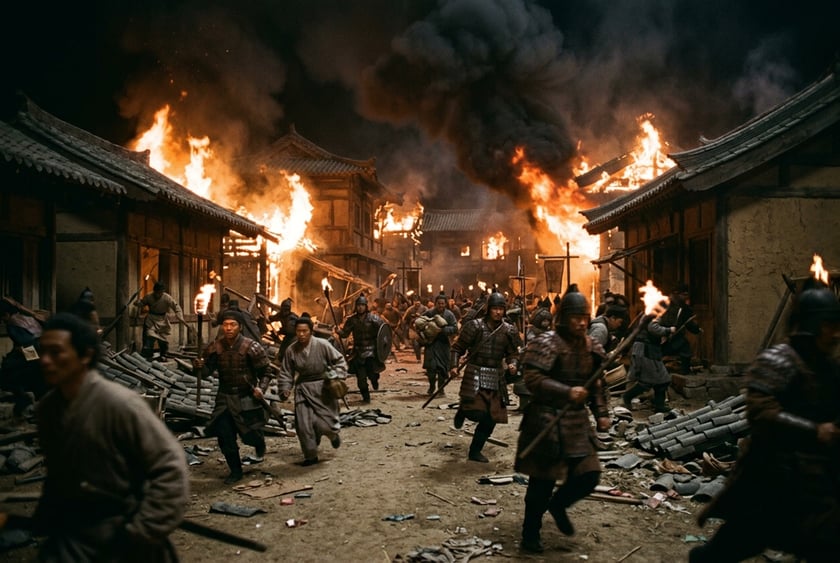
Baidituogu in the spring of the third year of Zhangwu (223) was the pivotal event that switched Shuhan's governance from "founding sovereign in command" to "prime minister in command, young sovereign as figurehead." The background reaches back to the first major act after Liu Bei proclaimed himself emperor in the first year of Zhangwu (221) — the eastern campaign against Sunwu to avenge Guan Yu — which ended in catastrophic defeat at Yiling when Lu Xun used fire attacks to destroy nearly the entire expeditionary force, forcing Liu Bei to retreat to Baidicheng (Yongan Palace). This defeat was both military and political: Liu Bei had spent the cream of his lifetime-accumulated elite forces and gotten nothing back in return for Jingzhou, leaving Shuhan's external strategy locked in a two-way deadlock — unable to punish Sunwu and avenge Guan Yu, yet also unable to immediately launch a northern campaign against Caowei. Meanwhile his own health deteriorated rapidly; that he summoned Prime Minister Zhuge Liang from Chengdu to Yongan in the second month of the third year of Zhangwu tells us he already sensed his end was near [c:17387] [c:17392].
Key Figures
The chain of actors in Baidituogu is clear: Liu Bei as the one conferring the charge, Zhuge Liang as the future helmsman of the regime, Li Yan as military deputy and a counterbalancing force, Liu Chan as the nominal new sovereign, and Zhao Yun as both imperial guard and a symbol of entrustment over the sons [c:17387] [c:17391] [c:17395]. Li Yan's dual identity deserves particular attention: on one hand he was empowered as Shangshu Ling, Zhongduhu, and commander of all internal and external military affairs, charged with sharing governance with Zhuge Liang; on the other hand he was kept at Yongan to command only the secondary-capital troops defending against Sunwu, and in practice could not truly rival Zhuge Liang's Chengdu center [c:17391]. This arrangement of "nominal equality, actual division of labor" gave Li Yan face (he was the representative of Yizhou-based factions and those connected to the imperial consort clan) while ensuring Zhuge Liang's complete grip on the central apparatus. Ma Su did not participate directly in the deathbed charge, yet he was the "negative annotation" Liu Bei specifically singled out — the warning "he is full of words beyond his ability and must not be given major responsibilities; you should watch him carefully" was Liu Bei's last act of guidance on Zhuge Liang's personnel judgment at life's end [c:17390]; when Zhuge Liang later appointed Ma Su to defend Jieting and was defeated as a result, it confirmed the precision of that admonition.
Core Issue
The core issue of the deathbed charge was not "succession" — Liu Chan's status as crown prince had been established as early as the twenty-fourth year of Jian'an (219) [c:17388] — but rather "how to keep Shuhan's regime functioning in the absence of Liu Bei." Liu Bei's answer took the form of a sentence that has been quoted countless times: "Your talent is tenfold that of Cao Pi; you will surely be able to secure the state and in the end settle the great enterprise. If the heir is capable of support, support him; if he is not capable, you may take it yourself" [c:17389] [c:17394]. This sentence has been interpreted along two main lines throughout history: one reads it as a sincere political transfer of authority — Liu Bei acknowledging that Zhuge Liang's talent surpassed his son's and granting him the power to act at his own discretion; the other reads it as a political test — invoking "take it yourself" precisely in order to force Zhuge Liang to declare his absolute loyalty on the spot and foreclose any thought of usurpation. Zhuge Liang's response was to prostrate himself, weep until he bled, and vow to "exhaust the strength of my limbs, to uphold the virtue of loyal integrity, to continue until death" [c:17389] [c:17394] — which neatly sealed off both interpretations: whatever Liu Bei's true intent, Zhuge Liang used the highest-grade political oath to lock himself into the role of one who "bends his back in service to the end of his days." Chen Shou later wrote: "When he commended the entire kingdom to Zhuge Liang at his deathbed, and his heart was without the slightest wavering — this was truly the highest public good between ruler and minister, the supreme model for all time" — the most classic summation of this moment of political understanding.
Liu Bei also made three additional explicit supplementary arrangements: (1) In the imperial edict to Liu Chan, he wrote "serve the Prime Minister as you would a father" [c:17389], framing the future emperor–prime minister relationship in the ethical terms of father and son rather than the ceremonial terms of ruler and subject; (2) separately instructing Zhao Yun to "watch over my sons at all times" [c:17395], binding the most senior general in the palace guard to Liu Chan's physical protection; and (3) the reverse admonition about Ma Su [c:17390], leaving a standing warning about personnel decisions for the campaigns ahead. Taken together these three items formed a complete political defense system: prime ministerial authority, father-son ethical framing, personal guard protection, and talent early-warning — all combining to fix the operational rules of the Shuhan court under the later sovereign.
Political Consequences
The political consequences of Baidituogu can be viewed in three layers. The first layer is the direct result: after Zhuge Liang returned to Chengdu, Shuhan entered a political mode in which "governance comes from the Ge family; sacrifice rests with this orphan" [c:17388, Pei annotation], with the prime minister functionally exercising imperial prerogatives while Liu Chan served as the ritual emperor, receiving court obeisance and presiding over sacrifices. The second layer is the medium-to-long-term impact: although Li Yan was given the status of deputy, being kept at Yongan with limited real power, his relationship with Zhuge Liang ran through several years of ups and downs until he was dismissed in the ninth year of Jianxing (231) — a development that signified the entire Shuhan regime resting completely in Zhuge Liang's hands alone. The third layer is the institutional legacy: Baidituogu has been regarded by later generations as the paradigm of "the supreme public good between ruler and minister," influencing subsequent regency arrangements under young sovereigns across later dynasties — from Yang Jun in the Western Jin to Zhang Yue in the Tang to Zhang Juzheng in the Ming, virtually every great regent had to reckon with the political echo of those four characters "you may take it yourself."
Counterfactual Analysis
If Liu Bei had not uttered the words "you may take it yourself" to Zhuge Liang at his deathbed, but had merely issued a decree making Zhuge Liang regent, Zhuge Liang's political legitimacy would have remained within the traditional framework of "prime minister supporting a young sovereign," and Li Yan and other regional leaders might have used that space to contest more real power; Shuhan might have entered severe factional infighting in the early Jianxing years. Conversely, if Zhuge Liang had accepted the "take it yourself" offer and supplanted Liu Chan some years later, the already thin ruling legitimacy of Shuhan would have collapsed further — without the political narrative of "restoring the Han house," Shuhan would have been reduced to a purely regional Yizhou power, and Caowei need not have waited until 263 to complete its absorption. Viewed in this light, the true function of those four words "you may take it yourself" was not political authorization but political containment: they forced Zhuge Liang to publicly swear loyalty, thereby preemptively foreclosing all future suspicions about "whether Zhuge Liang might usurp the throne." This was Liu Bei's last political calculation — and also his most far-reaching investment in whether Shuhan's regime could endure.
The Romance follows the main narrative of San Guozhi in chapter 85, but adds a prologue in which the ghosts of Guan Yu and Zhang Fei appear to Liu Bei in dreams [c:17392] [c:17393], wrapping the political deathbed charge in a sequence of supernatural omens. This approach is characteristic of the Romance's method of "pairing ritual solemnity with portentous signs" — Liu Bei's legitimacy as a scion of the Han imperial house required reaffirmation through supernatural augury, and the political tension of the deathbed charge is emotionally pre-processed through the grief of the Guan-Zhang dream apparitions. For readers of history, distinguishing between these two layers — Chen Shou's political narrative in San Guozhi and Luo Guanzhong's supernatural narrative — is the key reading exercise for understanding Baidituogu.