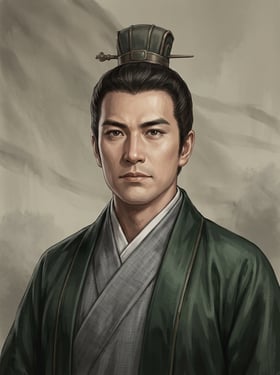
Historical Record
Huang Quan, courtesy name Gongheng, was a native of Langzhong in Baxi. In his early years he was a commandery clerk, and was later recruited by Liu Zhang, Governor of Yi Province, as Registrar. When Zhang Song advised Liu Zhang to welcome and invite Liu Bei into Shu, Huang Quan remonstrated, pointing out that Liu Bei was valiant and that to treat him as a subordinate officer would leave him dissatisfied, while to treat him as a guest would mean one state could not hold two rulers—a contradiction posing the danger of the stability of Mount Tai versus the precariousness of stacked eggs—and he advised closing the borders and holding fast. However, Liu Zhang did not adopt his remonstrance and instead sent Huang Quan out to serve as Prefect of Guanghan.
When Liu Bei attacked and took Yi Province, the various commanderies and counties submitted one after another; only Huang Quan closed his city and held firm, not submitting to Liu Bei until after Liu Zhang had surrendered. Moved by his loyalty, Liu Bei appointed him General of the Vanguard. After Cao Cao broke Hanzhong, Huang Quan again offered counsel, stressing Hanzhong's importance to Yi Province and pointing out that "if Hanzhong is lost, then the Three Ba will not be secure—this would be like cutting off Shu's arm." Liu Bei adopted his advice and appointed Huang Quan as Protector of the Army, leading the generals to advance against Zhang Lu. Although Zhang Lu had already surrendered to Cao Cao, Huang Quan in subsequent campaigns successfully defeated Du Huo and Pu Hu, and ultimately, at the Battle of Hanzhong, slew Xiahou Yuan, rendering great service in Liu Bei's seizure of Hanzhong.
After Liu Bei declared himself King of Hanzhong, Huang Quan was appointed Attendant Officer of the Headquarters. After Liu Bei proclaimed himself emperor and decided to campaign east against Eastern Wu, Huang Quan again remonstrated, holding that the men of Wu were skilled in battle and that their navy moving downstream made advance easy and retreat hard, and proposing that he himself serve as vanguard while Liu Bei remained behind to guard the rear. Liu Bei did not heed him, and instead appointed Huang Quan as General Who Guards the North, commanding the various armies north of the river to guard against Cao Wei, while Liu Bei personally led the main force in battle south of the river.
In the Battle of Xiaoting, the Wu general Lu Xun seized the moment to cut off the Shu army's retreat, and Liu Bei's main force suffered a great defeat. Because the roads were blocked, Huang Quan's forces could not withdraw back to Shu, and he ultimately led his troops in surrendering to Cao Wei. The Shu Han officials asked that the responsibility of Huang Quan's family be pursued, but Liu Bei said, "I have failed Huang Quan; Huang Quan has not failed me," and treated his family kindly.
After Huang Quan surrendered to Wei, Emperor Wen of Wei, Cao Pi, asked him whether he wished to emulate Chen Ping and Han Xin. Huang Quan replied that it was because he had received Liu Bei's deep favor and was unwilling to surrender to Wu, and yet had no way to return to Shu, that he submitted to Cao Wei—seeking only to avoid death, and not daring to compare himself with men of old. Cao Pi admired his candor, appointed him General Who Guards the South, enfeoffed him as Marquis of Yuyang, added the office of Palace Attendant, and had him ride in his carriage. In Wei, Huang Quan rose to General of Chariots and Cavalry, Equal in Ceremonial Honors to the Three Excellencies. Emperor Ming of Wei once asked Huang Quan which of the tripartite realm was the legitimate one, and Huang Quan answered in terms of celestial omens. After Huang Quan died, his posthumous title was Marquis Jing. His son Huang Yong inherited his position, but having no son, the line was extinguished. Huang Chong, the son Huang Quan had left behind in Shu, when Shu Han fell, followed Zhuge Zhan in resisting Deng Ai and repeatedly urged Zhuge Zhan to hold the strategic ground in defense, but his advice was not adopted, and he ultimately died in battle at Mianzhu.
In the Novel
In Romance of the Three Kingdoms, the image of Huang Quan as a loyal remonstrant is further reinforced and dramatized. When Liu Zhang, heeding Zhang Song's words, wished to welcome Liu Bei into Shu, Huang Quan stepped forward and bluntly declared that Liu Bei was "magnanimous in treating others, able to overcome the hard with the soft, a hero without rival," and predicted that welcoming Liu Bei into Shu would create a situation in which "one state cannot hold two rulers," urging Liu Zhang to first behead Zhang Song and then cut off Liu Bei, or else to close the borders and seal the passes to await clearer times. When Liu Zhang insisted on going in person to Fucheng to welcome Liu Bei, Huang Quan "kowtowed until he bled, came forward and gripped Liu Zhang's robe in his mouth to remonstrate," and even when Liu Zhang tore out his front teeth, he did not alter his loyal remonstrance. These episodes are not recorded in detail in the histories and are artistic elaborations by the novel to shape his image of unwavering loyalty.
When Liu Bei besieged Chengdu, in the novel Huang Quan was once ordered by Liu Zhang to go to Hanzhong to seek aid from Zhang Lu, and promised Yang Song twenty prefectures' worth of territory, prompting Zhang Lu to send troops. However, Zhang Lu ultimately failed to break the siege. As Liu Zhang was about to surrender, the novel also depicts Huang Quan, together with Liu Ba, angrily rebuking Qiao Zhou, because Qiao Zhou had used celestial omens to urge Liu Zhang to comply with the Mandate of Heaven and surrender to Liu Bei. These details are not clearly recorded in the histories but accord with Huang Quan's consistent image of loyalty to his lord.
After Liu Bei took charge of Yi Province, in the novel Huang Quan was appointed General of the Right. When Liu Bei campaigned east against Wu, Huang Quan again remonstrated, pointing out that "the navy goes downstream along the river—advance is easy, retreat is hard. I am willing to be the vanguard. Your Majesty should remain in the rear formation, so that there is no risk of any mishap." Liu Bei did not heed him and instead ordered Huang Quan to command the troops north of the river to guard against the Wei foe. In the end, because Lu Xun burned the connected camps, the Shu army suffered a great defeat, and Huang Quan's forces, with their road cut off, surrendered to Cao Wei; his words after surrendering are basically consistent with the historical record, stressing that he had "no road to return to Shu and could not surrender to Wu". In the novel, Cao Pi once believed a rumor that Liu Bei would execute Huang Quan's family, but Huang Quan was firmly convinced that Liu Bei would not do so, reflecting his understanding of and trust in Liu Bei.
Key Relationships
* Liu Zhang's faction (serves): Huang Quan initially served Liu Zhang as his Registrar, and was later sent out as Prefect of Guanghan. He repeatedly remonstrated with Liu Zhang, opposing the welcoming of Liu Bei into Shu and advising closing the borders to hold fast, showing his loyalty to Liu Zhang,.
* Liu Bei's faction (defected_to): After Liu Bei attacked and took Yi Province, Huang Quan submitted to Liu Bei and was given heavy responsibility. He offered strategies for Liu Bei's seizure of Hanzhong and served as General Who Guards the North during Liu Bei's eastern campaign against Wu. Even though Huang Quan ultimately surrendered to Cao Wei, Liu Bei did not pursue his family's responsibility and said, "I have failed Huang Quan; Huang Quan has not failed me," showing Liu Bei's high regard and understanding of Huang Quan.
* Cao Wei (defected_to): After the Battle of Xiaoting, Huang Quan surrendered to Cao Wei because the roads were blocked. In Cao Wei, he won the appreciation of Cao Pi, rising to General of Chariots and Cavalry, Equal in Ceremonial Honors to the Three Excellencies, and was enfeoffed as Marquis of Yuyang,. He also had exchanges with Sima Yi, who once praised him as "a fine gentleman".
* Zhang Song (opposes): While in Liu Zhang's faction, Huang Quan strenuously opposed Zhang Song's proposal to welcome Liu Bei into Shu, even advising Liu Zhang to first behead Zhang Song (novel only).
* Zhuge Liang (colleague/praised by): Huang Quan served Shu Han alongside Zhuge Liang; Sima Yi once mentioned to Zhuge Liang the praise Huang Quan had for him.
* Lu Xun (opponent): In the Battle of Xiaoting, Huang Quan's forces faced off against the Wu army led by Lu Xun, and Huang Quan ultimately surrendered because Lu Xun cut off the Shu army's retreat.
* Huang Chong (father and son): The son Huang Quan left behind in Shu, who gave his life for his country when Shu Han fell.
Iconic Scenes
* Remonstrating against Liu Zhang welcoming Liu Bei into Shu: When Zhang Song advised Liu Zhang to welcome Liu Bei into Shu, Huang Quan overruled the consensus, pointing out the threat Liu Bei posed and advising Liu Zhang to close the borders and hold fast. In the novel, he even "kowtowed until he bled, came forward and gripped Liu Zhang's robe in his mouth to remonstrate," and had his front teeth torn out by Liu Zhang yet did not alter his loyal remonstrance—a scene that greatly reinforces his image of loyalty (novel only).
* Offering the strategy to seize Hanzhong: After Cao Cao broke Hanzhong, Huang Quan counseled Liu Bei, stressing Hanzhong's importance to Yi Province and pointing out that "if Hanzhong is lost, then the Three Ba will not be secure—this would be like cutting off Shu's arm," prompting Liu Bei to resolve to seize Hanzhong and ultimately achieve victory in the Hanzhong Campaign.
* Remonstrating against Liu Bei's eastern campaign against Wu: After Liu Bei proclaimed himself emperor and decided to campaign east against Eastern Wu, Huang Quan again remonstrated, pointing out that the men of Wu were skilled in battle and that their navy moving downstream made advance easy and retreat hard, and proposing that he himself serve as vanguard while Liu Bei remained behind to guard the rear. Although Liu Bei did not adopt it, Huang Quan's foresight and loyalty were again displayed.
* Surrendering to Cao Wei after the Battle of Xiaoting: In the Battle of Xiaoting, Liu Bei's main force suffered a great defeat, and Huang Quan's forces, unable to withdraw back to Shu because the roads were blocked, ultimately led their troops in surrendering to Cao Wei. This was not a betrayal but an act of necessity; Liu Bei understood this and treated his family kindly.
* Candid exchange before Emperor Wen of Wei: After Huang Quan surrendered to Wei, Emperor Wen of Wei, Cao Pi, asked him whether he wished to emulate Chen Ping and Han Xin. Huang Quan candidly replied that it was because he had received Liu Bei's deep favor, was unwilling to surrender to Wu, and had no way to return to Shu that he submitted to Cao Wei—seeking only to avoid death, and not comparing himself with men of old. This exchange displayed Huang Quan's steadfast, magnanimous character and his calm bearing and composure.
* Firmly convinced Liu Bei would not execute his family: In Cao Wei, when there was a rumor that Liu Bei had executed Huang Quan's family, Huang Quan was firmly convinced that Liu Bei would not do so, and said, "I and Liu and Ge dealt with one another in all sincerity; they understand my true intent," reflecting his trust in and understanding of Liu Bei.
Portrait file
Character profile
- Character
- Huang Quan was calm, resolute, and self-possessed, keeping his bearing and expression composed [c:4]. Loyal and forthright, he dared to remonstrate, and once forcefully urged Liu Zhang not to summon Liu Bei into Shu [c:5].
- Life
- In his early years Huang Quan was a native of Langzhong in Baxi; young, he served as a commandery clerk, and was later summoned by the provincial governor Liu Zhang to be his Registrar [c:7]. He remonstrated against Liu Zhang's welcoming of Liu Bei, and when the Former Sovereign entered Yi Province, he shut his city and held firm, submitting only after Liu Zhang surrendered [c:7]. After the Battle of Xiaoting, Huang Quan commanded the army north of the Yangzi to guard against Wei; when his route of return was cut off, he led his troops in surrender to Wei, and afterward served in Wei in such posts as General Who Guards the South and General of Chariots and Cavalry [c:7].
- Anecdotes
- Huang Quan's son Huang Chong followed Zhuge Zhan in resisting Deng Ai and was killed in battle [c:1]. He twice went to Hanzhong at Liu Zhang's command to seek aid, and persuaded Yang Song with the promise of "repayment with twenty prefectures" [c:2].
Relationships
8 relationships
Family1
Lord & vassal1
Enemies1
Other5
Quotes
14 recorded lines · 3 featured
「某素知劉備寬以待人,柔能克剛,英雄莫敵。遠得人心,近得民望。兼有諸葛亮、龐統之智謀,關、張、趙雲、黃忠、魏延為羽翼。若召到蜀中,以部曲待之,劉備豈肯伏低做小?若以客禮待之,又一國不容二主。今聽臣言,則西蜀有泰山之安;不聽臣言,則主公有累卵之危矣。張松昨從荊州過,必與劉備同謀。可先斬張松,後絕劉備,則西川萬幸也。」
These words foresee the latent threat of Liu Bei's entry into Shu, displaying Huang Quan's outstanding strategic vision.
「左將軍有驍名,今請到,欲以部曲遇之,則不滿其心,欲以賓客禮待,則一國不容二君。若容有泰山之安,則主有累卵之危。可但閉境,以待河清。」
Recorded in the official histories, this line incisively sums up the predicament of Liu Bei's entry into Shu, carrying historical significance.
臣與蜀主,推誠相信,知臣本心,必不肯殺臣之家小也。
These words reflect Huang Quan's loyalty and trust toward Liu Bei, shaping his upright and noble character.
Chapters12 回 ▸
- 史ch.2ch.4ch.31ch.32ch.43
- 演ch.60ch.62ch.64ch.65ch.82ch.84ch.85
Relationship timeline8 条 ▸
Inner monologues · AI-generated3 段 ▸
- The Yangtze separates the north and south; the river cuts off communication, and the sounds of the armies grow ever more
- I am Huang Quan, courtesy name Gongheng. In the past, I served as a registrar under Liu Jiyu. I have always believed tha
- I am Huang Quan, courtesy name Gongheng, from Langzhong in Ba Xi. I recall that in the past, when I served in Liu Zhang’
Life events5 ▸
- 0212-01-01 · FuchengMeeting at Fucheng· Advisor
- 0213-01-01 · Yi ProvinceLiu Bei's Takeover of Yi Province· Advisor
- 0214-01-01 · ChengduLiu Zhang's Surrender· Witness
- 0214-01-01 · ChengduLiu Zhang's Surrender of Chengdu· Advisor
- 0221-01-01 · Wudan HillLiu Bei Proclaims Himself Emperor· Witness