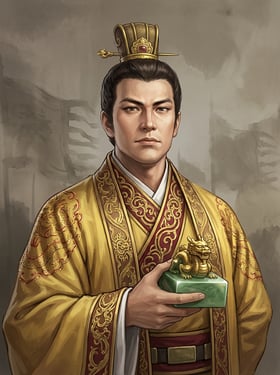
史载(Historical Record)
Yuan Shu, styled Gonglu, came from the Yuan clan of Runan. He was the son of the Minister of Works Yuan Feng and the younger cousin of Yuan Shao. Known for his chivalrous spirit, he was once recommended as a Filial and Incorrupt candidate and held the posts of Gentleman of the Interior, Colonel Who Routs the Enemy, and General of the Household Rapid as Tigers. When Dong Zhuo sought to depose the young emperor, he appointed Yuan Shu General of the Rear. Fearing the calamity Dong Zhuo posed, Yuan Shu fled to Nanyang. At that time the Grand Administrator of Changsha, Sun Jian, killed the Grand Administrator of Nanyang, Zhang Zi, allowing Yuan Shu to take possession of Nanyang.
After occupying Nanyang, Yuan Shu lived extravagantly and taxed the people ruthlessly, reducing the region to misery, with conditions so dire that people even ate one another. He had a long-standing rift with Yuan Shao and was also at odds with Liu Biao, so he turned to ally with Gongsun Zan in the north. Yuan Shao, in turn, was on bad terms with Gongsun Zan and allied with Liu Biao in the south. Thus the brothers spurned those near and courted those far, harboring mutual suspicion.
In the winter of the second year of Xingping (195 CE), Emperor Xian of Han suffered a setback at Caoyang. Yuan Shu gathered his subordinates and declared that the house of Han had declined, that the Yuan clan had produced three dukes over four generations and won the people's hearts, and that he meant to follow the mandate of Heaven and proclaim himself emperor. His Registrar, Yan Xiang, remonstrated, pointing out that although King Wen of Zhou possessed two-thirds of the realm he still served the Yin-Shang, while the Yuan clan fell far short of Zhou's flourishing, and the house of Han was not as cruel as the tyrant Zhou of Yin. Yuan Shu was displeased to hear this, but he still adopted the prophetic omens put forward by Zhang Jiong of Henei, and at Shouchun he usurped the title and proclaimed himself emperor, styling his dynasty "Zhong," establishing the high ministries, and offering sacrifices to Heaven and Earth.
After proclaiming himself emperor, Yuan Shu grew even more dissolute and unrestrained. The several hundred women of his harem all wore fine silks and ate rich fare, while his soldiers suffered cold and hunger, and the Jianghuai region fell into utter desolation. He once sent word to Lü Bu of his imperial intentions, hoping to win him as an ally, but Lü Bu detained the envoy and submitted the letter to the court. Enraged, Yuan Shu attacked Lü Bu but was instead defeated by him. Later, Yuan Shu encroached upon the territory of Chen, and Cao Cao personally led an eastern campaign. On hearing the news, Yuan Shu abandoned his army and fled, leaving behind generals such as Qiao Rui, Li Feng, Liang Gang, and Yue Jiu. When Cao Cao arrived, he routed and beheaded Qiao Rui and the others, while Yuan Shu crossed the Huai River and escaped.
After his defeat, Yuan Shu sought refuge with his own commanders Lei Bao and Chen Lan at Mount Qian, but they refused him. Anxious and at a loss, he planned to return the imperial title to Yuan Shao and to go to Qing Province to seek refuge with Yuan Tan, but he fell ill and died on the way. His wife and children later attached themselves to Yuan Shu's former officer Liu Xun, the Grand Administrator of Lujiang. After Liu Xun was defeated by Sun Ce, Yuan Shu's daughter was taken into Sun Quan's harem, his son Yuan Yao was appointed Gentleman of the Interior, and Yuan Yao's daughter was married to Sun Quan's son Sun Fen.
演中(In the Novel)
In Romance of the Three Kingdoms, Yuan Shu's image, built upon the historical record, takes on added literary coloring of arrogance and conceit. When Dong Zhuo threw the government into chaos and the eighteen lords allied to campaign against him, Yuan Shu was appointed overseer of provisions. When Hua Xiong slew several great generals of the alliance in succession, Yuan Shu rebuked Guan Yu for his lowly origins and forbade him to do battle, fully displaying his haughtiness and his contempt for talent. Later, when Sun Jian rendered great service by slaying Hua Xiong, Yuan Shu listened to slander and withheld provisions, causing Sun Jian's defeat and nearly costing him his life.
The discord between the brothers Yuan Shu and Yuan Shao is also reflected in the novel. After Yuan Shao obtained Ji Province, Yuan Shu asked him for horses, and when Yuan Shao refused, the two brothers became estranged. Yuan Shu also secretly sent envoys to incite Sun Jian to attack Liu Biao, hoping to profit as the fisherman does.
On the matter of proclaiming himself emperor, the novel paints a far fuller picture. Holding vast lands and ample provisions in Huainan, and possessing the Imperial Seal that Sun Ce had pledged to him, Yuan Shu conceived ambitions of usurpation. He gathered his subordinates to deliberate, and his Registrar Yan Xiang remonstrated once more; but Yuan Shu insisted on proclaiming himself emperor, citing such reasons as "the Yuan surname descends from Chen, and Chen is the descendant of the great Shun; earth succeeding fire is exactly suited to his fortune," and "my style is Gonglu, which precisely matches the prophecy," and he threatened to behead any who spoke against it. He thereupon established the dynastic title "Zhong," set up the offices of the Terrace and Department, rode in a dragon-and-phoenix carriage, sacrificed to Heaven and Earth, made Feng Fang's daughter his empress, and established his son as crown prince.
After proclaiming himself emperor, Yuan Shu sent his general Ji Ling to attack Liu Bei and tried to win over Lü Bu. He promised Lü Bu provisions, gold, and silver to join in a pincer attack on Liu Bei. Lü Bu, however, went back on his word, and at the camp gate he shot his halberd to defuse the conflict between Liu Bei and Ji Ling (unique to the novel). Enraged, Yuan Shu dispatched Zhang Xun and others with seven armies totaling over two hundred thousand men to attack Lü Bu in Xu Province, and personally led thirty thousand more in support. However, owing to the rebellion of the surrendered generals Han Xian and Yang Feng, Yuan Shu was utterly routed.
At the end of his road, the novel portrays Yuan Shu's wretched fate. After his defeat, he wished to return the imperial title to Yuan Shao and seek refuge with Yuan Tan. On the way to Qing Province, he was pursued by the combined forces of Cao Cao and Liu Bei, and was robbed of his money and grain by Lei Bao and Chen Lan. In the end he withdrew to Jiangting, with only a thousand or so aged and infirm soldiers remaining. In the height of summer, his grain ran out, leaving only thirty bushels of wheat chaff. Craving honey water that he could not obtain, he sat on his couch and sighed for a long while, crying out, "Has Yuan Shu come to this!" Whereupon he vomited up more than a peck of blood and died.
关键关系
* Yuan Shao (rival_of): In history, Yuan Shu and Yuan Shao were cousins, but they were on poor terms, mutually suspicious, to the point that "the brothers harbored division, spurning those near and courting those far". In the novel this conflict is more pronounced: Yuan Shu was enraged when Yuan Shao refused him horses, and the brothers were estranged thereafter. After Yuan Shu proclaimed himself emperor, he wished to return the imperial title to Yuan Shao, but Yuan Shao's aim was to seize the Seal, not to truly accept it.
* Cao Cao (enemy_of): Yuan Shu and Cao Cao were direct military rivals. In history, Cao Cao once joined Yuan Shao in attacking Yuan Shu's army and routed it. Later, Cao Cao campaigned eastward against Yuan Shu when the latter encroached on Chen, and Yuan Shu fled on hearing of it. In the novel, Cao Cao was one of the principal forces in the campaign against Yuan Shu; Liu Bei campaigned against Yuan Shu on Cao Cao's orders and at last defeated him.
* Lü Bu (rival_of): In history, Yuan Shu tried to win over Lü Bu by informing him of his imperial intentions, but Lü Bu detained the envoy and reported it to the court. Yuan Shu therefore attacked Lü Bu but was defeated. In the novel the relationship is more complex: Yuan Shu promised Lü Bu provisions, gold, and silver to join in a pincer attack on Liu Bei. But Lü Bu shot his halberd at the camp gate, defusing the conflict between Liu Bei and Ji Ling, which enraged Yuan Shu and prompted him to send a great army against Lü Bu,.
* Gongsun Zan (friend_of): In history, Yuan Shu, having a rift with Yuan Shao, sought aid from Gongsun Zan, who sent troops to help in order to pressure Yuan Shao. This embodied Yuan Shu's strategy of "spurning the near and courting the far".
* Sun Jian / Sun Ce: In history, Sun Jian attacked the Grand Administrator of Nanyang, Zhang Zi, on Yuan Shu's behalf, allowing Yuan Shu to take Nanyang. Sun Ce once attached himself to Yuan Shu and rendered him meritorious service. But later Sun Ce demanded the Imperial Seal from Yuan Shu, who refused to return it, and Sun Ce thereupon broke with Yuan Shu (unique to the novel).
* Liu Bei: In the novel, Yuan Shu regarded Liu Bei as "a weaver of mats and seller of sandals" and was deeply resentful of his holding a great commandery, sending troops to attack him several times,. Liu Bei, on Cao Cao's orders, campaigned against Yuan Shu and at last defeated him.
标志性场景
* Proclaiming himself emperor at Nanyang: Holding a million households in Nanyang yet living in boundless extravagance and license, Yuan Shu at last usurped the title at Shouchun, styling his dynasty "Zhong" and becoming the first lord of the late Han to openly proclaim himself emperor. This act laid his ambition fully bare and hastened his downfall.
* Slighting Guan Yu during the campaign of the eighteen lords against Dong Zhuo: In the novel, when Hua Xiong slew several great generals of the alliance in succession and Guan Yu volunteered for battle, Yuan Shu loudly rebuked him for his rank as a mere "mounted archer" and sought to drive him from the tent, fully revealing his arrogance and his habit of judging men by appearance. This scene stands in sharp contrast to Guan Yu's valor in "slaying Hua Xiong before the wine grew cold," and it sets off Yuan Shu's shortsightedness.
* Withholding provisions and causing Sun Jian's defeat: During the campaign against Dong Zhuo, Sun Jian, serving as vanguard, repeatedly won merit, yet Yuan Shu listened to slander and withheld provisions, causing Sun Jian's defeat. This reveals not only Yuan Shu's jealousy of merit and unfairness, but also his narrow heart and suspicion toward his allies.
* The feud with Lü Bu: Yuan Shu sought to win over Lü Bu to deal with Liu Bei together, promising him rich rewards of gold and provisions, but Lü Bu shot his halberd at the camp gate, defusing Liu Bei's crisis and enraging Yuan Shu (unique to the novel). Yuan Shu then sent a great army against Lü Bu but was defeated, further weakening his strength.
* Death from vomiting blood at the end of the road: After his defeat, Yuan Shu wandered homeless, and at last at Jiangting, facing the plight of having no grain and no honey, he cried out "Has Yuan Shu come to this!" and then vomited up more than a peck of blood and died. This scene is the tragic portrait of a life of extravagance and dissipation that ended in destitution, the final embodiment of how his flaws of character led to his ruin.
Portrait file
Character profile
- Character
- Yuan Shu was proud and arrogant, envious of others' achievements and unfair, deceitful and sulky, and often sowed discord among his allies; he was conceited and self-important, obstinate and given to killing.
- Manner of speech
- He once said, 'Fengxian is fickle and untrustworthy; first send over the daughter, and only then dispatch the troops.'
- Life
- Yuan Shu, styled Gonglu, was the son of the Minister of Works Yuan Feng and a younger cousin of Yuan Shao. He once served as overseer of grain and forage, but later, heeding slander, withheld the supplies and brought about Sun Jian's defeat. He was driven by Xun Yu's stratagem of 'driving the tiger to devour the wolf,' and afterward boasted of his family's four generations in the Three Ducal Offices, usurping the dynastic title 'House of Zhong.' When his bid for the throne failed, he retreated to Huainan, and at last, a fugitive at Jiangting, thirsting and unable to obtain even honey water, he vomited blood and died.
- Anecdotes
- After He Jin was killed, Yuan Shu led troops bursting into the palace and slaughtered every eunuch. He once sent an envoy to inform Lü Bu that he had ascended the imperial throne, and later drew on prophetic apocrypha to justify himself, saying, 'My surname Yuan springs from Chen, and Chen is descended from the Great Shun. With Earth succeeding Fire, this precisely accords with the cycle of fate.'
Relationships
36 relationships
Family2
Lord & vassal6
Friends3
Enemies12
Teacher & student1
Other10
Quotes
21 recorded lines · 3 featured
「吾袁姓出於陳。陳乃大舜之後。以土承火,正應其運。又讖云:『代漢者,當塗高也。』吾字公路,正應其讖。又有傳國玉璽,若不為君,背天道也。吾意已決,多言者斬!」
The core rationale for Yuan Shu Proclaims Himself Emperor, embodying his arrogant conceit and absurdity.
「汝乃織蓆編屨之夫,今輒占據大郡,與諸侯同列;吾正欲伐汝,汝卻反欲圖我!深為可恨!」
Yuan Shu's classic line disdaining Liu Bei, displaying his obsession with aristocratic pedigree.
「今劉氏微弱,海內鼎沸。吾家四世公輔,百姓所歸,欲應天順民,於諸君意如何?」
Recorded in the official history, Yuan Shu's self-avowal before proclaiming himself emperor, reflecting his ambition.
Chapters24 回 ▸
- 史ch.1ch.6ch.7ch.11ch.13ch.22ch.32ch.46ch.56ch.57ch.58
- 演ch.3ch.5ch.6ch.7ch.8ch.11ch.14ch.15ch.16ch.17ch.19ch.21ch.44
Relationship timeline18 条 ▸
史 ch.1
- Gongsun Zan§19
friend_of
术求援;瓒使刘备、单经、陶谦以逼绍
- Lü Bu§36
rival_of
欲称帝告布;布收使上书;术怒攻布为布所破
史 ch.6
- Yuan Shao§47
rival_of
既与绍有隙,又与刘表不平
- Gongsun Zan§47
friend_of
北连公孙瓒(对袁绍)
- Cao Cao§47
enemy_of
太祖与绍合击,大破术军
史 ch.58
- Lu Kang§3
enemy_of
有隙,将攻之
演 ch.5
- Yuan Shao§32
sibling_of
弟(紹自称"吾弟袁術")
演 ch.6
- Sun Jian§1
friend_of
惶恐无言,命斩进谗者以谢孙坚
演 ch.7
演 ch.11
- Lü Bu§13
betrayed_by
吕布投袁术,术怪其反覆不定,拒而不纳
演 ch.15
演 ch.16
- Lü Bu§1
friend_of
致密书并送粟二十万斛以结其心,使按兵不动
演 ch.17
- Sun Ce§10
enemy_of
遣使往江东借兵报雠;遭孙策书绝
演 ch.19
- Lü Bu§24
rival_of
「奉先反覆無信,可先送女,然後發兵」
演 ch.21
- Yuan Shao§16
遣人归帝号(政治归附)
Inner monologues · AI-generated3 段 ▸
- I am Yuan Shu, courtesy name Gonglu. By this point, my troops had scattered and my provisions were gone; the influence I
- I am Yuan Shu, courtesy name Gonglu, born into a family that had produced high ministers for four generations. In my you
- I am Yuan Shu, courtesy name Gonglu, born into the Yuan clan. The weight of my family standing in my youth made me confi
Life events12 ▸
- 0189-01-01 · LuoyangAssassination of He Jin· Warrior
- 0190-01-01 · SuanzaoCampaign against Dong Zhuo· Commander
- 0190-01-01 · LuoyangSun Jian Obtains the Heirloom Seal of the Realm
- 0190-01-01 · Sishui PassBattle of Sishuiguan· Commander
- 0196-01-01 · XuchangStratagem of Two Tigers Fighting over Food
- 0196-01-01 · XiaopeiLu Bu Shoots the Halberd at the Camp Gate· Commander
- 0197-01-01 · ShouchunYuan Shu Proclaims Himself Emperor· Instigator
- 0199-01-01 · LujiangSun Ce's Seizure of Lujiang· Witness
- 0199-01-01 · ShouchunCao Cao's Campaign Against Yuan Shu· Commander
- 0199-01-01 · Xu ProvinceLiu Bei's Defeat of Yuan Shu at Xuzhou· Victim
- 0199-01-01 · JiangtingDefeat and Death of Yuan Shu· Killed in action
- 0200-01-01 · LiyangSun Ce's Pacification of Jiangdong· Witness