Background
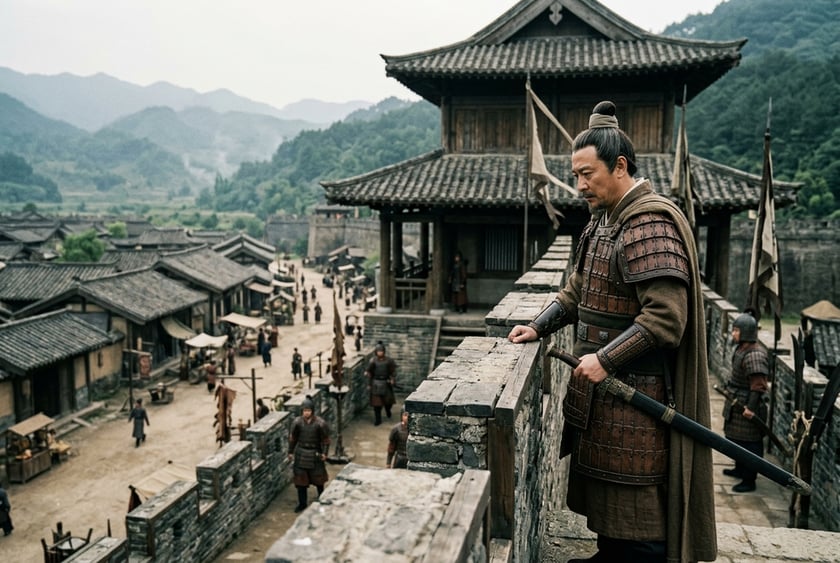
From the perspective of modern political history, the Fushuiguanzhanyanggao — the execution of Yang Huai and Gao Pei at Fushuiguan — was the threshold event that transformed the Yizhou campaign from "diplomatic standoff" into full-scale armed rupture. At the end of Jianan year 17, Zhang Song's conspiracy was exposed and Liu Zhang had him executed, then immediately ordered the passes along the route to rescind their supply arrangements with Liu Bei and guard all positions strictly [c:17241]. This meant the "clansmen's alliance" surface constructed at the Fuchenghuimian the previous year had officially shattered and both sides had entered a state of actual war. But Liu Bei now faced a sharp tactical problem: the troops he had between Fucheng and Jiamengguan numbered barely more than thirty thousand; if he proceeded by the conventional military program of reducing fortifications one by one, there were four to five more passes between Fuguang and Chengdu, each of which would give Yizhou's native forces time to consolidate and allow Liu Zhang ample time to summon reinforcements from Hanzhong or Nanzhong. Pang Tong's solution was "bypass the fortifications, strike the critical nodes directly" — using a combination of feigned surrender, lure-and-kill, and gate-fraud to seize the entire northern corridor before the enemy's response window could close.
Principal Figures
The central figures were Liu Bei, Pang Tong, Yang Huai, Gao Pei, and the executors Liu Feng, Guan Ping, Huang Zhong, and Wei Yan. Pang Tong was the true overall architect of this event — he both devised the "banquet to lure and kill" plan and on the spot decisively "ordered the axe-bearing guards to execute them" [c:17241], pulling Liu Bei out of his "hesitant indecision." This reflects the internal role division of Liubeijituan: Liu Bei bore the outward-facing facade of "the image of benevolence," while Pang Tong and Fa Zheng shouldered the "strategic execution" — the dirty, hard work. Yang Huai and Gao Pei, as Fushuiguan's garrison commanders, "each having concealed a sharp knife" [c:17241] showed they too were not without preparation — both parties understood the true purpose of the banquet was a "strike-first-to-win" contest. But they made one fatal tactical error: bringing only two hundred attendants into the camp, with no deputy-commander structure left at the pass to handle emergencies. This was less a personal failure than a chain reaction of intelligence confusion and command-chain fracture in the Yizhou military following the Zhang Song incident.
The Central Issue
The surface-level issue was "capturing and executing two commanders to seize the pass"; the deeper level was an acute choice between "legitimacy vs. efficiency." Before executing Yang Huai and Gao Pei, Liu Bei charged them with the crimes of "conspiring to drive a wedge between kinsmen" and "concealing sharp knives in an assassination attempt" [c:17241] — a rhetorical maneuver in which "the first one to act becomes the defendant," aimed at providing a post-hoc legitimacy narrative for this lure-and-kill operation. Yet on the day of the following banquet, Pang Tong directly remonstrated with "to attack another's state and treat it as cause for joy is not the warfare of a benevolent man" [c:17242], in effect placing the issue openly on the table: the joy you celebrated over taking the pass a moment ago is in conflict with your self-positioning as a Han royal clansman and a man of benevolence. Liu Bei, momentarily drunk, rebuked and dismissed Pang Tong; once sober, he came to apologize, and in the end the two men concluded the episode with "both lord and minister at fault" [c:17242]. The fact that this exchange was preserved in the novel itself carries political-historical significance — it reveals that as the Shuhan clique transitioned from Jingzhou to Yizhou, it was compelled to reconcile the rhetorical gap between "claiming to stand on benevolence" and "seizing land through deceit." This gap was never truly bridged in Shuhan's internal and external propaganda throughout the life of that entire regime.
Political Consequences
The most immediate consequence was the fall of Fuguang Pass and the elimination in a single stroke of the screen protecting Chengdu's northern face [c:17242]. Militarily, Fuguang's loss meant Liu Bei could move his main force south along the Fu River, bypassing the multiple field works on the outer perimeter of Luocheng and striking directly at Chengdu's northern outskirts. This chain of pressure ultimately transmitted through a succession of events — Pang Tong being struck by a stray arrow and dying before Luocheng, Liu Bei summoning Zhuge Liang, Zhang Fei, and Zhao Yun as reinforcements, and Machaojiangliubei — all converging on Chengdu's walls, and Liuzhangchujiang. From a political science standpoint, Fushuiguanzhanyanggao also defined the Liubeijituan's dual-edged approach to defectors and the captured: on one hand "pouring wine for each of the two hundred attendants to settle their nerves" and "no need to be alarmed" [c:17241] — rapidly incorporating the rank-and-file as a vanguard; on the other hand leaving no surviving senior or middle-ranking commanders to prevent future betrayals. This was a "bottom-tier absorption, top-tier elimination" entry strategy, consistently applied in the subsequent overall handling of Liuzhangjituan.
Counterfactual Analysis
What if Pang Tong had not proposed the lure-and-kill plan and had instead pushed forward by the conventional siege program, reducing each pass in turn? One possibility: the Yizhou campaign drags on for one to two years; Liu Zhang has time to mobilize Yi troops from Nanzhong, organize a combined water-land advance from Nanjun, and the war could evolve into a prolonged attritional conflict with sharply increased probability of Cao Cao or Sun Quan intervening while Liu Bei is bogged down. Another divergent path: if Liu Bei had rejected Pang Tong's plan and insisted on "courtesy before force" — negotiating with Yang Huai and Gao Pei — the outcome might have evolved into a brief political impasse, but Yang Huai and Gao Pei represented the collective will to resist of Liu Zhang's entire clique, and any negotiation would ultimately have ended with some form of violence. The deepest question is the argument between Pang Tong and Liu Bei after the drinking [c:17242]: can a political clique that defines itself by "benevolence" complete military expansion without paying a cost in its brand of benevolence? The Fushuiguanzhanyanggao supplies the answer: no — from this point, Shuhan bore a moral debt that never disappeared. Understanding the existence of this debt is the key to understanding how "discursive legitimacy" and "military realism" tore at each other in the San Guo period.