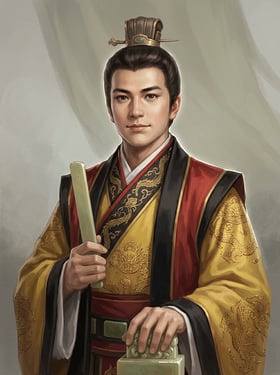
Historical Record
Liu Shan, courtesy name Gongsi, was the son of Emperor Zhaolie, Liu Bei. In the first year of the Jianxing era (223 CE), Liu Bei passed away, Liu Shan succeeded to the throne, and the era name was changed to Jianxing. At the outset of his reign, the Shu Han regime faced troubles within and without: the commanderies of Nanzhong rose in rebellion, and Hua Xin, Minister over the Masses of Wei, among others, urged him to declare himself a vassal. Yet Liu Shan did not decide these matters directly, but entrusted all affairs of state entirely to the Chancellor, Zhuge Liang. Zhuge Liang was enfeoffed as Marquis of Wuxiang, opened his own office to manage affairs, and held the post of Governor of Yi Province; from then on "in affairs of state, great and small, all were decided by Liang". During his reign, although Liu Shan never led a campaign in person, he repeatedly affirmed Zhuge Liang's achievements in the Northern Expeditions through edicts. For example, after Zhuge Liang defeated the Wei general Wang Shuang in his Fourth Northern Expedition and pacified Wudu and Yinping, Liu Shan issued an edict restoring his post as Chancellor, to commend his quelling of the violent and his conspicuous merit. Although the histories record extremely few of Liu Shan's own words—only seven lines of dialogue survive—his political posture as ruler was one of profound trust in and delegation of power to his "father-chancellor," and this ruler-subject relationship constituted the core feature of late Shu Han politics.
In the Novel
In the literary shaping of the Romance of the Three Kingdoms, Liu Shan's image is given more emotional color and interactive detail, presenting a ruler who depends on his father-chancellor and appears somewhat callow. The novel describes in detail how, after Liu Bei's death, Liu Shan went out of the city to meet the coffin and ascended the throne on Zhuge Liang's advice. Unlike the cold political transition in the histories, the novel emphasizes Liu Shan's awe of and reliance on Zhuge Liang. For example, when armies pressed in along five routes, Liu Shan came in person to the Chancellor's residence to ask for a plan; seeing Zhuge Liang leisurely watching fish, he was at first alarmed, but on hearing that Zhuge Liang had already secretly turned back four of the routes, he could not help marveling, "Truly my father-chancellor has plans unfathomable as those of gods and ghosts". This episode greatly heightens Zhuge Liang's marvelous calculation while also setting off Liu Shan's ignorance of military affairs and his absolute trust in the Chancellor. In addition, the novel invents an episode in which Zhuge Liang takes the initiative to select Zhang Fei's daughter as empress for Liu Shan, further underscoring Zhuge Liang's comprehensive control over both the latter ruler's life and court affairs. This literary treatment makes Liu Shan's image more rounded, but also deepens the stereotype of him as a "mediocre ruler" or "puppet."
Key Relationships
* Zhuge Liang: This is the most central relationship of Liu Shan's life. In history, Liu Shan enfeoffed Zhuge Liang as Marquis of Wuxiang, let him open his own office to manage affairs, and left all matters of state, great and small, to be decided by Liang. In the novel, this relationship is depicted as intimate and dependent, like that of "father-chancellor" and "son." Liu Shan regarded Zhuge Liang as his spiritual pillar, relying on his guidance in moments of crisis as if awakening from a dream. Zhuge Liang, for his part, was utterly faithful to Liu Bei's deathbed charge, both controlling court affairs and attending to Liu Shan's private life (such as choosing an empress), forming a unique symbiotic ruler-subject structure.
* Liu Bei: As father and late emperor, Liu Bei's deathbed entrustment was the source of the legitimacy of Liu Shan's power. The novel specially describes the detail of Liu Shan going out of the city to meet the coffin, reflecting filial piety and the solemnity of succession. Liu Bei's testamentary edict became the legal basis for Liu Shan's accession and Zhuge Liang's regency.
* Lady Wu (Empress Dowager): Liu Shan honored his mother, Lady Wu, as Empress Dowager, and in the novel arranged for her wish to see Zhuge Liang, showing the ethical order within the palace.
Iconic Scenes
* The ruler-subject dialogue after the five-route retreat (unique to the novel): Liu Shan came in person to the Chancellor's residence, saw Zhuge Liang watching fish, and asked about the five routes of troops. Zhuge Liang responded with composure, analyzing one by one how he had turned back the troops of the Qiang king, the Man king, Meng Da, and Cao Zhen, finally pointing out that an envoy must be sent to Eastern Wu. On hearing this, Liu Shan marveled at his plans unfathomable as those of gods and ghosts; this scene vividly displays Zhuge Liang's marvelous calculation and Liu Shan's dependent psychology, and is a highly representative episode in the novel.
* Opening his own office and entrusting government to the Chancellor (historical): In the first year of Jianxing, Zhuge Liang was enfeoffed Marquis of Wuxiang, opened his own office to manage affairs, and held the post of Governor of Yi Province; the affairs of Shu Han, great and small, were all decided by Zhuge Liang. This historical fact laid the foundation for the political structure of the late Shu Han and explains why Liu Shan has so little presence in the histories—because real power was entirely in Zhuge Liang's hands.
Portrait file
Character profile
- Character
- Liu Shan was by nature benevolent and quick-witted, humane and filial. In his early years he relied on the Chancellor Zhuge Liang for decisions and accepted the counsel of the northern campaigns. In his later years he indulged in wine and women, trusted the eunuch Huang Hao, and grew irresolute, in the end displaying a character content merely to muddle through and survive, mediocre and forgetful of his fallen homeland.
- Life
- Liu Shan, styled Gongsi, was the son of Liu Bei, and was established as crown prince in the first year of Zhangwu. In the fifth month of the third year of Zhangwu he succeeded to the throne at Chengdu at the age of seventeen, honored the empress as empress dowager, and proclaimed a general amnesty and a change of reign title. In the first year of Yanxing, on Qiao Zhou's counsel, he surrendered to Deng Ai, and afterward his whole household was moved east to Luoyang, where he was enfeoffed as Duke of Anle County; in the seventh year of Taishi he died at Luoyang.
- Anecdotes
- Liu Shan was the second emperor of Shu Han and its last. He had once been rescued by Zhao Yun, and his childhood name was Adou.
Relationships
47 relationships
Family13
Lord & vassal7
Teacher & student3
Other24
Quotes
36 recorded lines · 3 featured
「此間樂,不思蜀也。」
This phrase, 'so happy he does not miss Shu,' has become an idiom, profoundly shaping Liu Shan's image of muddled incompetence.
「朕年幼無知,惟相父斟酌行之。」
It reflects Liu Shan's extreme dependence on Zhuge Liang, a portrayal of his image as 'the hopeless Adou who cannot be propped up.'
「今大臣皆議當降,汝獨仗血氣之勇,欲令滿城流血耶?」
It reflects Liu Shan's cowardly mindset in choosing surrender over resistance at the moment of national peril.
Chapters34 回 ▸
- 史ch.4ch.28ch.32ch.33ch.34ch.35ch.36ch.39ch.42ch.44
- 演ch.34ch.41ch.61ch.73ch.80ch.83ch.85ch.87ch.91ch.96ch.99ch.100ch.104ch.105ch.107ch.110ch.112ch.113ch.114ch.115ch.116ch.117ch.118ch.119
Relationship timeline18 条 ▸
史 ch.4
- Deng Ai§84
betrayed_by
诣艾降,巴蜀皆平
史 ch.28
- Deng Ai§53
betrayed_by
面缚舆櫬诣军门请降
史 ch.33
史 ch.35
student_of
建兴元年封亮武乡侯,开府治事;又领益州牧;事之如父
演 ch.80
- Liu Bei§30
kin_of
长子,立为太子
演 ch.85
- Liu Bei§18
出城迎灵柩
- Zhuge Liang§21
加封
- Lady Wu§21
尊为皇太后
- Lady Gan§21
追谥昭烈皇后
- Lady Mi§21
追谥皇后
- Zhang Fei§24
纳为皇后
- Zhuge Liang§26
亲赴相府问计
演 ch.110
- Jiang Wei§18
commands_in
因洮西之功降诏封维为大将军
演 ch.116
betrayed_by
进师婆之言惑后主;隐匿姜维告急表文
演 ch.117
- Huang Hao§14
betrayed_by
奏'"此詐傳耳。神人必不肯誤陛下也"'蒙蔽
Inner monologues · AI-generated3 段 ▸
- Now I am in Luoyang, enfeoffed as the Duke of Anle, with my lodging, food, and clothing all provided by the Wei court. I
- I inherited the work of the late emperor. The realm over which I presided was not merely a palace or a city; it also enc
- I was born in Jing Province. While I was still young, my father was already struggling through the turmoil and upheaval.
Life events20 ▸
- 0208-01-01 · ChangbanZhao Yun Rescues His Lord on a Single Horse· Victim
- 0212-01-01 · YoujiangkouSeizing Liu Shan on the River· Victim
- 0219-01-01 · MianyangLiu Bei's Elevation to King of Hanzhong· Witness
- 0221-01-01 · Wudan HillLiu Bei Proclaims Himself Emperor· Witness
- 0223-01-01 · ChengduLiu Shan's Accession to the Throne· Commander
- 0223-01-01 · ChengduZhuge Liang Repels the Five Armies· Witness
- 0223-01-01 · BaidichengLiu Bei's Deathbed Entrustment at Baidi
- 0223-01-01 · LinqiongRebellion of Huang Yuan· Witness
- 0227-01-01 · ChengduFormer Memorial on Sending Out the Troops· Witness
- 0228-01-01 · ChengduLatter Memorial on Sending Out the Troops· Witness
- 0228-01-01 · HanzhongExecution of Ma Su· Witness
- 0229-01-01 · WuchangSun Quan and Shu Han Renew Their Alliance· Witness
- 0229-01-01 · ChengduDeath of Zhao Yun· Witness
- 0231-01-01 · YonganLi Yan Dismissed for Failing to Deliver Supplies on Time
- 0234-01-01 · Mount QiZhuge Liang's Northern Expeditions· Witness
- 0262-01-01 · DazhongJiang Wei's Agricultural Garrison at Tazhong to Avoid Trouble· Witness
- 0263-01-01 · ChengduConquest of Shu by Wei· Victim
- 0263-01-01 · YinpingDeng Ai's Surprise Attack Through Yinping· Victim
- 0263-01-01 · ChengduHuang Hao's Usurpation of Power· Witness
- 0264-01-01 · ChengduZhong Hui's Rebellion· Witness