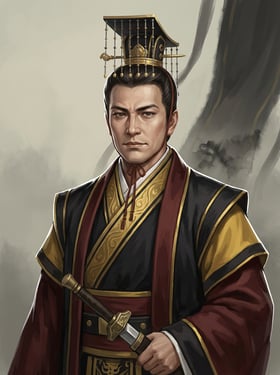
Historical Record
Sima Zhao, styled Zishang, was an important statesman and military commander of late Cao Wei in the Three Kingdoms period, playing a pivotal role in the Wei court throughout his life. Born of the Sima clan, he was the second son of Sima Yi and the younger brother of Sima Shi. Sima Zhao's political career began after his father Sima Yi launched the Incident at the Gaoping Tombs, and he gradually came to hold real power in Wei. In the first month of the second year of Zhengyuan (255 CE), the General Who Guards the East Guanqiu Jian and the Inspector of Yangzhou Wen Qin rebelled, and the General-in-Chief, King Jing of Sima (Sima Shi), led an army to suppress them. In this campaign Sima Shi fell ill and died at Xu Chang. c:4850 Sima Zhao was then appointed General-in-Chief and Director of the Masters of Writing, succeeding to his brother's authority and further consolidating the Sima clan's rule over Wei. c:4850
In the second year of Ganlu (257 CE), the Grand General Who Guards the East, Zhuge Dan, raised troops in revolt at Shouchun, and Sima Zhao personally led a great army to suppress him. In the course of the campaign Sima Zhao displayed outstanding military skill and strategic vision. He adopted Wang Ji's advice, taking a strategy of encirclement rather than a hasty assault, and finally drove Zhuge Dan into a corner. c:8849 Although some argued for a swift attack, Sima Zhao held that "the city is strong and the troops many; to assault it would surely exhaust our strength, and should there be an outside foe, we would be caught between enemies within and without—this is the road to peril." c:8852 In the end, after months of siege, the city's provisions ran out; Zhuge Dan's subordinate commanders Jiang Ban, Jiao Yi, and Wen Qin and his sons surrendered or were killed one after another, and Zhuge Dan himself was slain while trying to break out. c:8851 The victory at Shouchun thoroughly removed the threat to Wei's east and further raised Sima Zhao's prestige. After the battle, Sima Zhao adopted a lenient policy toward the surrendered Wu soldiers, killing none and settling them in the nearby commanderies of the Three Rivers, showing a side of benevolent rule. c:8852
In the fourth year of Jingyuan (263 CE), Sima Zhao dispatched Zhong Hui, Deng Ai, and others on a large-scale invasion of Shu, finally destroying Shu Han. In the course of the conquest, however, friction arose between Zhong Hui and Deng Ai. Zhong Hui secretly accused Deng Ai of plotting rebellion, and Sima Zhao thereupon issued an edict to bring Deng Ai in by prison cart. c:8853 Sima Zhao well knew that Zhong Hui might also harbor disloyalty; he once said to Jia Chong, "Once I reach Chang'an, the matter will settle itself." c:8855 Sure enough, Zhong Hui launched a rebellion in Chengdu, but it was soon put down, and both Zhong Hui and Deng Ai perished in the affair. c:4852 In the first year of Xianxi (264 CE), Sima Zhao was advanced to Prince of Jin, enfeoffed with ten commanderies and granted the Nine Bestowals. He posthumously named his father Sima Yi King Xuan of Jin and his brother Sima Shi King Jing of Jin. c:4852 These acts laid the foundation for his eventual supplanting of Wei and founding of the Jin. During his tenure, although Sima Zhao did not proclaim himself emperor, he already held the supreme power of Wei in fact, paving the way for the establishment of the Western Jin.
In the Novel
In Romance of the Three Kingdoms, Sima Zhao is drawn more vividly and dramatically, with particular emphasis on his ambition—"Sima Zhao's heart is known to every passerby." He first appears in Chapter 94, alongside his elder brother Sima Shi at the side of their father Sima Yi, showing a keen grasp of the situation and lofty ambitions. c:806 At the Battle of Jieting, Sima Zhao campaigned with his father and offered his own view on Jieting's defenses, judging that Ma Su, camping his troops atop the hill, would be easy to break—a contrast with Sima Yi's caution that also reflects his boldness in his youth. c:807
The novel repeatedly depicts Sima Zhao campaigning with his father Sima Yi, as during Zhuge Liang's Northern Expeditions, when he and Sima Shi led troops to relieve the forward camp. c:808 In the classic episode of "the dead Zhuge frightened off the living Zhongda," Sima Zhao did not understand Sima Yi's decision to withdraw, thinking Zhuge Liang might have no troops—an aside that also sets off Zhuge Liang's cunning. c:8844 In the campaign to pacify Gongsun Yuan, Sima Zhao and Sima Shi together aided Sima Yi, finally capturing and killing Gongsun Yuan and his son and further consolidating the Sima clan's military power. c:810
After Sima Shi fell ill and died, Sima Zhao succeeded to his brother's authority, becoming General-in-Chief and Director of the Masters of Writing, and from then on held the great power of Wei. c:4853 c:4855 The novel dwells on the gradual unmasking of Sima Zhao's usurping heart. He often went escorted by three thousand armored elite officers, settling matters directly without reporting to the court. c:4856 His confidant Jia Chong repeatedly schemed for him, sounded out men's hearts, and even directly provoked Zhuge Dan into rebellion. c:4856 In suppressing Zhuge Dan's rebellion, Sima Zhao followed Jia Chong's advice and took the Empress Dowager and the Son of Heaven along on campaign to forestall any upheaval at court. c:8803 After Shouchun fell, he adopted Zhong Hui's advice and released the Wu soldiers as a show of leniency—which accords with the historical record. c:8811
The most controversial event in the novel is the death of Cao Mao. In open court Sima Zhao pressed Cao Mao to enfeoff him as Duke of Jin and grant the Nine Bestowals, and using Cao Mao's "Hidden Dragon Poem" as a pretext, he threatened him. c:813 In the end Cao Mao, unwilling to endure the humiliation, led his followers to attack Sima Zhao but was killed by Cheng Ji. Though Sima Zhao feigned grief, his usurping heart was already laid bare. c:8816 Although Jia Chong and others urged him to accept abdication and proclaim himself emperor at once, Sima Zhao likened himself to "King Wen, who held two-thirds of the realm yet served the Yin," declaring that he was in no hurry to take the throne but would leave that great task to his son Sima Yan—fully displaying his far-sighted calculation and political skill. c:814
Key Relationships
* Cao Wei (serves): Sima Zhao held office under the Cao Wei regime all his life, but his ultimate aim was to supplant Cao Wei. Through a series of political and military actions he progressively hollowed out the Cao Wei emperor and grasped the real power of the state, laying the foundation for the establishment of the Jin dynasty. c:4850
* Zhuge Dan (enemy_of): Zhuge Dan was Sima Zhao's chief opponent in pacifying the Huainan rebellion. Resentful of Sima Zhao's monopoly of power, Zhuge Dan rose in revolt but was finally defeated and slain by Sima Zhao's army, a battle that further consolidated Sima Zhao's position. c:804 c:8803
* Sima Yi (kin_of): Sima Zhao was the second son of Sima Yi, inheriting his father's political legacy and stratagem. On his deathbed Sima Yi charged the two brothers Sima Shi and Sima Zhao to govern the state well c:4853 (novel only).
* Sima Shi (kin_of): Sima Zhao was the younger brother of Sima Shi. After Sima Shi died, Sima Zhao succeeded to his brother's authority as General-in-Chief and continued the Sima clan's policy of monopolizing power. c:4850 c:4855
* Cao Mao (lord_of): Cao Mao was the emperor of Wei but was in fact controlled by Sima Zhao. In the end, unwilling to endure Sima Zhao's monopoly of power, Cao Mao tried to resist but was killed by Sima Zhao's confidant Cheng Ji c:813 c:8816 (novel only).
* Jia Chong (ally_of): Jia Chong was Sima Zhao's confidant counselor, repeatedly scheming for him and playing an important part especially in the killing of Cao Mao c:813 c:8813 (novel only).
* Zhong Hui (ally_of): Zhong Hui was an important general of Sima Zhao who rendered great service in the conquest of Shu. Yet Zhong Hui later launched a rebellion in Chengdu and was finally put down. c:4852 c:8853
* Deng Ai (ally_of): Deng Ai was likewise an important general under Sima Zhao who performed outstandingly in the conquest of Shu, but was later falsely accused of rebellion by Zhong Hui and ultimately killed. c:4852 c:8853
Iconic Scenes
* Succeeding to his brother's authority as General-in-Chief: After Sima Shi fell ill and died, Sima Zhao was appointed General-in-Chief and Director of the Masters of Writing, formally taking over the Sima clan's supreme power in Wei—an important turning point in his political career. c:4850
* Pacifying Zhuge Dan's rebellion: Sima Zhao personally led a great army to put down Zhuge Dan's revolt at Shouchun, displaying outstanding military skill and strategic vision. The victory further consolidated the Sima clan's rule. c:804 c:8849
* "Sima Zhao's heart is known to every passerby": This saying comes from Cao Mao's appraisal of Sima Zhao's usurping ambition. In the novel, Cao Mao gathered his ministers, tearfully decried Sima Zhao's usurping heart, and tried to march against him c:813 (novel only).
* The killing of Cao Mao: Unwilling to endure Sima Zhao's monopoly of power, Cao Mao tried to resist but was finally killed by Sima Zhao's confidant Cheng Ji. This event fully exposed Sima Zhao's cold ruthlessness and usurping ambition. c:813 c:8816 (novel only).
* Conquering Shu and destroying Han: Sima Zhao dispatched Zhong Hui, Deng Ai, and other generals on a large-scale invasion of Shu, finally destroying Shu Han. This was a major military achievement of Sima Zhao's and laid the foundation for the establishment of the Jin dynasty. c:4859
* Advancement to Prince of Jin: In the first year of Xianxi, Sima Zhao was advanced to Prince of Jin and posthumously enfeoffed his father and brother, marking the Sima clan's coming within a single step of supplanting Wei and founding the Jin. c:4852
* Escaping the trap at Iron Cage Mountain: In a clash with Jiang Wei, Sima Zhao was once trapped by Jiang Wei at Iron Cage Mountain, the water source dried up and he faced a desperate plight. But in the novel, through prayer, he miraculously obtained water and finally escaped the trap. c:8799 c:8800 (novel only).
Portrait file
Character profile
- Character
- 'Sima Zhao's intent is known even to the passerby.' He went out and in always attended by three thousand mailed and valiant officers, and matters were settled at his chancellery without being reported to the court—signs of his overweening power. He was suspicious yet a good judge of men, skilled in stratagem: he made use of Zhong Hui's schemes and could anticipate the minds of others.
- Manner of speech
- He compared himself to King Wen and to Cao Cao to mask his intent to usurp, and descended from the hall with a cold laugh. He argued by quoting the old adage, 'A defeated general cannot speak of valor; a minister of a fallen state cannot plan for survival.'
- Life
- After Sima Shi's death, Sima Zhao became Grand General and Overseer of the Masters of Writing in the second year of the Zhengyuan era. In the third year of the Ganlu era he took Shouchun and beheaded Zhuge Dan; in the fifth year of Ganlu, after the Duke of Gaogui District was assassinated, he set up the Prince of Chenliu. In the first year of the Xianxi era he was advanced in rank to King of Jin, and he died in the second year of the Xianxi era.
- Anecdotes
- He was the second son of Sima Yi and the younger brother of Sima Shi. Succeeding his brother in control of the government, he held such offices as General of the Guards, Grand General, Grand Commander-in-chief, Chancellor, Duke of Jin, and King of Jin. He once tearfully entreated his brother Sima Shi, but was refused.
Relationships
43 relationships
Family6
Lord & vassal10
Friends1
Enemies5
Other19
Quotes
60 recorded lines · 3 featured
「頗思蜀否?」
This line is the origin of the allusion 'so happy as to forget Shu' (le bu si Shu), and is highly recognizable culturally.
「昔文王三分天下有其二,以服事殷,故聖人稱為至德。魏武帝不肯受禪於漢,猶吾之不肯受禪於魏也。」
This remark uses the past to comment on the present, hinting at his ambition to usurp Wei—a footnote to the saying 'Sima Zhao's intent is known to every passerby.'
「朝臣皆言蜀未可伐,是其心怯:若使強戰,必敗之道也。今鍾會獨建伐蜀之策,是其心不怯:心不怯,則破蜀必矣;蜀既破,則蜀人心膽已裂。『敗軍之將,不可以言勇;亡國之大夫,不可以圖存。』會即有異志,蜀人安能助之乎?至若魏人得勝思歸,必不從會而反,更不足慮耳。此言乃吾與汝知之,切不可泄漏。」
This remark displays Sima Zhao's far-sighted scheming and his insight into human nature, an expression of his political skill.
Chapters25 回 ▸
- 史ch.4ch.13ch.21ch.22ch.27ch.28
- 演ch.94ch.95ch.102ch.103ch.104ch.106ch.107ch.108ch.109ch.110ch.111ch.112ch.113ch.114ch.115ch.116ch.117ch.118ch.119
Relationship timeline15 条 ▸
史 ch.4
- Zhuge Dan§57
enemy_of
陷壽春城,斩诞
史 ch.28
- Zhuge Dan§29
enemy_of
督中外二十六万众临淮讨之,破之、斩之
演 ch.94
- Sima Yi§14
kin_of
司马懿次子,字子尚;通晓兵书
演 ch.95
- Sima Yi§6
kin_of
父子;亲哨街亭,识破马谡屯山
演 ch.102
- Sima Yi§11
kin_of
次子;与兄共引兵救应前营
演 ch.104
- Sima Yi§29
kin_of
次子,催军追蜀
演 ch.106
- Sima Yi§9
kin_of
次子,与父合围公孙渊
演 ch.107
- Sima Yi§1
kin_of
护父出城屯洛河浮桥
演 ch.112
advises_in
用其计策,抚背称"君真吾之子房也"
演 ch.114
演 ch.118
- Deng Ai§26
enemy_of
疑其有自专反意,遣卫瓘伺察、令钟会收之
演 ch.119
Inner monologues · AI-generated3 段 ▸
- After Shouchun fell, what I relied on was not a momentary assault, but caution and waiting for events to change. At firs
- I am Sima Zhao, courtesy name Zishang. Shouchun had fallen, but the banners had not yet been furled, and the sounds of w
- My name was Zi Shang. I remember when I was young, my father heard in Wancheng that Wei’s forces had suffered repeated d
Life events7 ▸
- 0234-01-01 · Shangfang ValleyFire Attack at Shangfang Valley· Warrior
- 0258-01-01 · ShouchunThree Rebellions in Shouchun· Commander
- 0258-01-01 · LuoyangZhuge Dan's Rebellion· Commander
- 0258-01-01 · ShouchunZhuge Dan Holds Shouchun and Rebels against Wei· Commander
- 0260-01-01 · LuoyangGanlu Incident· Instigator
- 0264-01-01 · ChengduRebellion of Zhong Hui and Jiang Wei· Instigator
- 0266-01-01 · LuoyangThe Sima Clan's Seizure of Power· Instigator